1 and future tense and words that show which tense is Vary support - - PowerPoint PPT Presentation

1
SMART_READER_LITE
LIVE PREVIEW

1 and future tense and words that show which tense is Vary support - - PowerPoint PPT Presentation

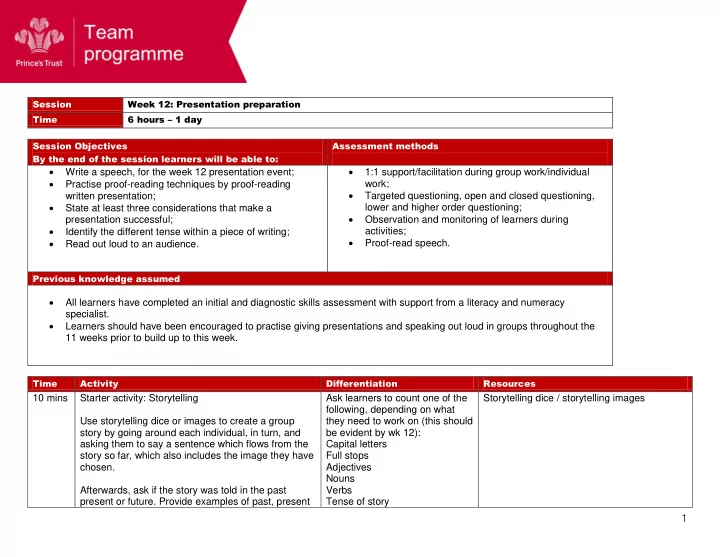
Session Week 12: Presentation preparation Time 6 hours 1 day Session Objectives Assessment methods By the end of the session learners will be able to: Write a speech, for the week 12 presentation event; 1:1 support/facilitation


slide-1
SLIDE 1

1

Session Week 12: Presentation preparation Time 6 hours – 1 day Session Objectives By the end of the session learners will be able to: Assessment methods

 Write a speech, for the week 12 presentation event;  Practise proof-reading techniques by proof-reading written presentation;  State at least three considerations that make a presentation successful;  Identify the different tense within a piece of writing;  Read out loud to an audience.  1:1 support/facilitation during group work/individual work;  Targeted questioning, open and closed questioning, lower and higher order questioning;  Observation and monitoring of learners during activities;  Proof-read speech.

Previous knowledge assumed

 All learners have completed an initial and diagnostic skills assessment with support from a literacy and numeracy specialist.  Learners should have been encouraged to practise giving presentations and speaking out loud in groups throughout the 11 weeks prior to build up to this week.

Time Activity Differentiation Resources

10 mins Starter activity: Storytelling Use storytelling dice or images to create a group story by going around each individual, in turn, and asking them to say a sentence which flows from the story so far, which also includes the image they have chosen. Afterwards, ask if the story was told in the past present or future. Provide examples of past, present Ask learners to count one of the following, depending on what they need to work on (this should be evident by wk 12): Capital letters Full stops Adjectives Nouns Verbs Tense of story Storytelling dice / storytelling images

slide-2
SLIDE 2

2

and future tense and words that show which tense is being used e.g. looked, is looking, will look. Explain what you want from a presentation and ask which tense learners’ presentations will be in. Provide examples: I did, I do I will.. Vary support according to learner/group needs 5 mins State session objectives 45 mins Activity 1: Journey stimulator Offer stimulus to remind people of their journey e.g. ILRs, photos, video clips, etc. You could do a whole-team review, looking at the 12 week journey, this could be done in any format suited to the team. Use a review that will be encouraging for the team Optional: Art materials Flipchart paper Photos ILRs Projector 30 mins Activity 2: Mind map planning Ask learners to create a mind map of things they would like to include in their speech. Ask learners to sequence their ideas and add substance to each point. Vary support according to learner/group needs Pairs Buddying Provide an example Provide a template Pen and paper Computer option 90 mins Activity 3: Write up 1st draft of presentation Ask learner to write up their presentation. Break down this activity and inject other activities and energisers if appropriate. Use any of the following worksheets that you feel are appropriate for either the group or individuals:

  • Better spelling
  • Spelling and letters
  • I and e
  • Able and ible
  • Words most commonly misspelt
  • Words that end in ly

Include additional activities to accommodate for different learners’ pace. Vary support according to learner/group needs Seek additional support for this activity/session Carry out activity over an extended period of time Give learners the option to take home Computer option Pen and paper Computer and internet access http://www.bbc.co.uk/skillswise/english/games Worksheets

  • Better spelling
  • Spelling and letters
  • I and e
  • Able and ible
  • Words most commonly misspelt
  • Words that end in ly
  • Capital letters
slide-3
SLIDE 3

3

  • Capital letters
  • Question marks
  • Question marks

40 mins Activity 4: Proof-reading Ask learner to proof read the following:  Sense; does it flow, make sense? Sound interesting  Is the presentation balanced in relation to how much of it is about the past, present and future? This can be done by highlighting the speech in different colours to easily see the tense balance.  Spelling; check by reading slowly, reading out loud, reading backwards to just focus on spelling rather than sentence coherency, someone else read it.  Sentence coherency; Read out loud, read to someone else, someone else read it, read at a later date with a fresh pair of eyes. Pairs Individuals Vary support according to learner/group needs Use worksheets to cement learning Pens and paper Different coloured pens Worksheets:

  • Checking writing work for mistakes
  • Proof reading a letter

20 mins Activity 5: Consequences Carry out consequences energiser activity. Set up an environment in which young people feel comfortable reading out loud without being judged. Can use this activity to encourage learners to read aloud as if they would on presentation day. Another activity which encourages speaking out loud in a group setting Vary support according to learner/group needs Modify story to be appropriate to group and individuals Give people the option to draw some of the responses Pen and paper 30 mins Activity 6: Presentation tips Watch a clip of a good presentation speech e.g. Tim Minchin Graduation Speech this can be used to form discussion around good and bad practice when delivering a presentation/speech. Role-play from TL or TM Clips from past Team presentations Presentation skills tips

slide-4
SLIDE 4

4

60 mins Activity 7: Practise reading Use this time for learners to practise reading their speech, to themselves in a quiet space and in pairs

  • r small groups.

If reading in pairs, listener can use ‘presentation tips’, from previous activity, as a basis for constructive

  • feedback. Stimulate a discussion around constructive
  • feedback. Explore the benefits and how to give it
  • well. Encourage people to give balanced feedback

and offer examples of constructive feedback. Build up to reading out loud in larger groups, if you feel this is appropriate for the learners. Individually Pairs Small groups whole group Presentation scripts Internet access to show video clip http://www.bbc.co.uk/skillswise/topic/giving-a- presentation 30 mins Activity 8: Review

  • 1. Ask learner to read out loud and fill in the

spaces on the following statement: ‘Before the session started I felt …………………… …………. about writing and presenting a

  • speech. Now I feel……………………………

………………….

  • 2. Ask what specific LLN have they used during

this session, e.g. spelling, punctuation, grammar, formal writing, proof-reading, etc.

  • 3. Ask what skills they have used today will they

use in life after the Team? Whole group activity Small group activity Paper Flipchart

Development work

Further reading and resources:  http://www.princes-trust.org.uk/delivery_partners_for_team/delivery_and_resources.aspx  Teaching Adult Literacy – Principles and Practice, Nora Hughes and Irene Schwab  www.bbc.co.uk/skillswise/  www.businessballs.com  Reference: Ofqual (September 2011) Functional Skills Criteria for English and Maths: Entry 1, Entry 2, Entry 3, Level 1 and Level 2. http://ofqual.gov.uk/how-we-regulate/regulatory-requirements/functional-skills/.

slide-5
SLIDE 5

5

English skills Maths skills ICT skills By: Speaking, listening and communication  present information and ideas clearly and persuasively  contribute own ideas and suggestions to informal discussions  listen to presentations and provide constructive feedback  identify main points of presentation  listen to instructions and feedback from

  • thers

 participate in role plays  use topic and specialist vocabulary  present to group Reading  using strategies for skimming and scanning  read in detail and summarise  proof reading  reading to self  reading in pairs/groups out loud Writing  plan, draft and organise writing  present information in a logical sequence  write clearly including the appropriate level of detail  use appropriate language suitable for a presentation and the audience  make sure the meaning is clear  take notes from presentations By: By:  type up presentation  create a PowerPoint presentation (if required)  use computer to project images and video clips 

  • pen and save files