Challenges in Crime Scene Investigation Technical challenges in - - PDF document

challenges in crime scene investigation
SMART_READER_LITE
LIVE PREVIEW

Challenges in Crime Scene Investigation Technical challenges in - - PDF document

Epigenetics a New Perspective for Improving Forensic Science p g Hwan Young Lee, Ph.D. Department of Forensic Medicine Yonsei University College of Medicine Current Forensic DNA Typing Forensic cases -- matching suspect with evidence


slide-1
SLIDE 1

1

Epigenetics – a New Perspective for

Improving Forensic Science p g

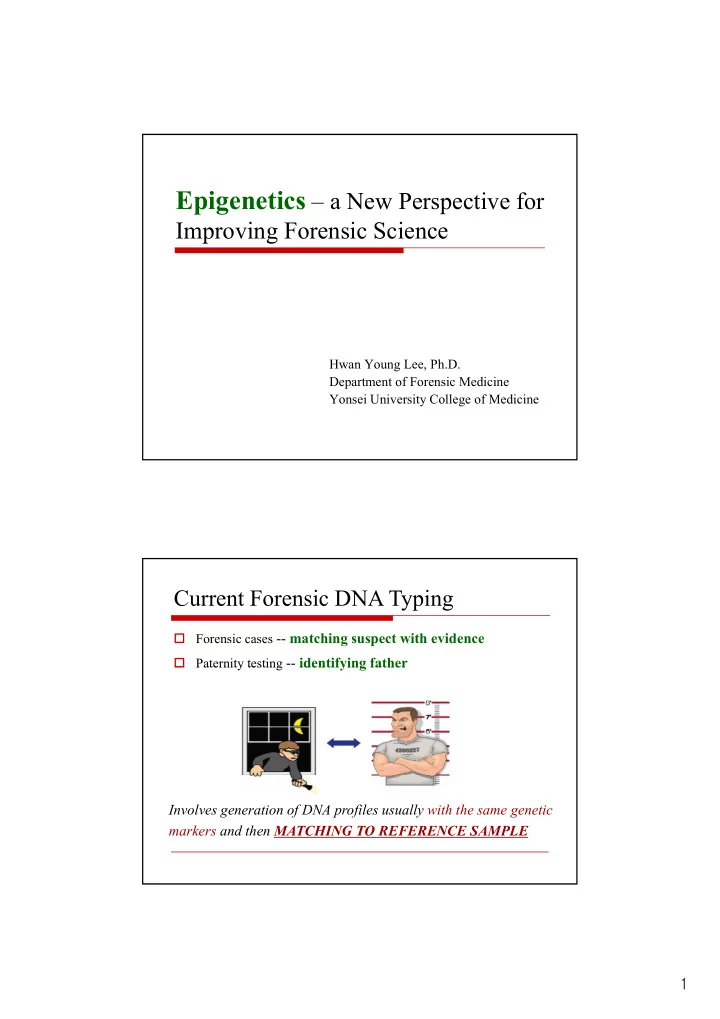
Hwan Young Lee, Ph.D. Department of Forensic Medicine Yonsei University College of Medicine  Forensic cases -- matching suspect with evidence  Paternity testing -- identifying father

Current Forensic DNA Typing

 Paternity testing

identifying father Involves generation of DNA profiles usually with the same genetic markers and then MATCHING TO REFERENCE SAMPLE

slide-2
SLIDE 2

2

Challenges in Crime Scene Investigation

 Technical challenges in forensic STR profiling  Degraded DNA  Degraded DNA  Low amount of DNA  Increasing discrimination power  Familiar searching….  Important challenges remain for the use of genetic and  Important challenges remain for the use of genetic and epigenetic approaches in forensic investigations

Kayser M and de Kniff P, Nat Rev Genet (2011)

Future of Crime Scene Investigation

 The ability to infer biogeographic ancestry and external visible characteristics from DNA

 Eye (IrisPlex), hair and skin color  Freckles  Stature  Hair morphology  Male baldness, etc.

http://meglikestodraw.tumblr.com/ Kayser M and de Kniff P, Nat Rev Genet (2011)

slide-3
SLIDE 3

3

 Body fluid identification can provide information linking sample donors with actual criminal acts

Future of Crime Scene Investigation

 Detailed reconstruction of crime events by determining the time of sample donation and sample age

Kayser M and de Kniff P, Nat Rev Genet (2011) Body fluids founds on the bed Sex offender’s trial

Genetics and Epigenetics

 Epi (on top of or in addition to) + Genetics  Epigenetics is the study of heritable changes in gene expression or cellular phenotype caused by mechanisms

  • ther than changes in the underlying DNA sequence

 Genome – Epigenome, Genetic code – Epigenetic code

slide-4
SLIDE 4

4

What is a Epigenome?

 DNA methylation  Histone modification  Histone modification  MicroRNA

http://learn.genetics.utah.edu/content/epigenetics/

Methyl tag Acetyl tag

DNA Packaging

Felsenfeld G and Groudine M, Nature (2003)

slide-5
SLIDE 5

5

Gene Control by the Epigenome

http://learn.genetics.utah.edu/content/epigenetics/

Gene Control by the Epigenome

 Epigenome is flexible and epigenetic tags react signals, e.g., diet, stress, etc

http://learn.genetics.utah.edu/content/epigenetics/

Methyl tag Acetyl tag

slide-6
SLIDE 6

6

Epigenetic Tags and Cellular Memory

 A cell’s epigenetic profile – a collection of tags that tell genes whether to be on or off – is the sum of the signals it g g has received during its lifetime  Epigenetic profiles are specific to tissue, age and environmental factors

http://learn.genetics.utah.edu/content/epigenetics/

DNA Methylation

 DNA methylation is the addition of a methyl group to the DNA base cytosine followed by a guanine (5' CG 3') DNA base cytosine followed by a guanine (5 CG 3 )

Cytosine 5-Methyl Cytosine

slide-7
SLIDE 7

7

tDMRs and Body Fluid Identification

 Chromosome pieces called tDMRs (tissue-specific differentially methylated regions) show different DNA differentially methylated regions) show different DNA methylation profiles according to the type of cell or tissue.

Tissue UCSC location (Mar. 2006) CGI Gene Function References Testis chr14:58182690–58182995 cpgi50 DACT1 Dapper 1 isoform 2

  • Genomics. 89:326

Testis chr6:41881884–41882111 cpgi46 USP49 Ubiquitin carboxyl-terminal hydrolase 49

  • Genomics. 89:326
  • Table. Genomic information for candidate tDMRs for body fluid identification

Blood chr7:27135995–27136879 cpgi87 HOX44 Homeobox protein Hox-A4 PLoS Biol. 6:e22 Blood chr5:176758438–176760564 cpgi82 PFN3 Profilin-3 PLoS Biol. 6:e22 Blood chr21:46905647–46905874 cpgi55 PRMT2 Protein arginine N-methyltransferase 2 PLoS Biol. 6:e22

Lee HY et al. Int J Legal Med (2012)

Analysis of DNA Methylation

Met Met

 Sodium bisulfite conversion

CpG CpG CpG UpG CpG TpG

Sodium bisulfite PCR Sequencing SBE MSP

 MSRE-PCR

Methylation-sensitive restriction enzyme PCR product No PCR product PCR

CpG CpG CpG CpG

Met Met
slide-8
SLIDE 8

8

 DNA methylation profiles for the DACT1, USP49, HOXA4, PRMT2 and PFN3 tDMRs in pooled DNA l f bl d li l bl d d

Differential DNA Methylation

: DACT1 : USP49

samples from blood, saliva, semen, menstrual blood and vaginal fluid

Lee HY et al. Int J Legal Med (2012)

 DNA methylation profiles for the DACT1, USP49, HOXA4, PRMT2 and PFN3 tDMRs in pooled DNA l f bl d li l bl d d

Differential DNA Methylation

: DACT1 : USP49 : HOXA4 : PRMT2

samples from blood, saliva, semen, menstrual blood and vaginal fluid

Lee HY et al. Int J Legal Med (2012)

slide-9
SLIDE 9

9

 DNA methylation profiles for the DACT1, USP49, HOXA4, PRMT2 and PFN3 tDMRs in pooled DNA l f bl d li l bl d d

Differential DNA Methylation

: DACT1 : USP49 : HOXA4 : PRMT2 : PFN3

samples from blood, saliva, semen, menstrual blood and vaginal fluid

Lee HY et al. Int J Legal Med (2012)

DNA Methylation and Aging

 The DACT1, USP49 and PRMT2 tDMRs in pooled DNA samples from blood, saliva and semen obtained from 20 ( 30 ) d 15 ld ( 50 ) young (< 30 y) and 15 old (> 50 y) men

: DACT1 : USP49 : PRMT2 An JH et al. Int J Legal Med in press : PRMT2

slide-10
SLIDE 10

10

Methylation-Specific Multiplex Assays

MSRE-PCR Methylation-SNaPshot

Blood Saliva Menstrual blood

An JH et al. Int J Legal Med in press

Vaginal fluid Semen

DNA Methylation and Age Estimation

 The methylation of three sites—in the promoters of the EDARADD NPTX2 and TOM1L1 genes—is linear with EDARADD, NPTX2 and TOM1L1 genes is linear with age over a range of five decades in saliva.

Percentage methylation versus age for three markers, (a) EDARADD, (b) NPTX2 and (c) TOM1L1

Bocklandt et al. PLoS One (2011)

slide-11
SLIDE 11

11

Age Estimation Using Body Fluids

TOM1L1 SPAG7 ALDH1A1 WISP2 EDARADD

20s

TOM1L1 SPAG7 ALDH1A1 WISP2 EDARADD

20s

DNA Methylation in Saliva DNA Methylation in Semen

20s 30s 50s 50s 20s 50s 50s

DNA Methylation in Skin Epidermis

TOM1L1 SPAG7 ALDH1A1 WISP2 EDARADD

20s 30s 60s

Discrimination Between Identical Twins

 Identical twins exhibit differences in DNA methylation profile

Fraga MF et al. Proc Natl Acad Sci U S A (2005), Zhao SM et al. Fa Yi Xue Za Zhi (2011)

slide-12
SLIDE 12

12

Detection of Fabricated DNA Evidence

 Natural and artificial DNA are distinguishable based on methylation analysis of a set of genomic loci: in artificial y y g DNA, all loci are unmethylated

Bisulfite sequencing

Natural

Frumkin D et al. Forensic Sci Int Genet (2010), New York Times- Aug 17, 2009

Artificial

Current View of Human Epigenome

 DNA methylation  Histone modification  Histone modification  Small RNAs  Microarray  Next Generation Sequencing…

Schones DE and Zhao K, Nat Rev Genet (2008)

slide-13
SLIDE 13

13

The Future of Forensic DNA Typing

Genetics, Genomics, Epigenetics, Epigenomics, Epitranscriptomics…

Thank you for your attention!

http://infovalleyart.blogspot.com