1 Space-Partition Constraints Solving the Space-Partition - - PowerPoint PPT Presentation

1
SMART_READER_LITE
LIVE PREVIEW

1 Space-Partition Constraints Solving the Space-Partition - - PowerPoint PPT Presentation

Cetus Compiler Synchronization-Free Parallelism Status Today Written in Java SPMD and OpenMP programming models Parses C Synchronization-free affine partitioning algorithm Announced new release late last night


slide-1
SLIDE 1

1

CS553 Lecture Synchronization-Free Parallelism 1

Cetus Compiler

Status

– Written in Java – Parses C – Announced new release late last night – J

CS553 Lecture Synchronization-Free Parallelism 2

Synchronization-Free Parallelism

Today

– SPMD and OpenMP programming models – Synchronization-free affine partitioning algorithm – Deriving primitive affine transformations

CS553 Lecture Synchronization-Free Parallelism 3

Two Parallel Programming Models

SPMD

– single program multiple data – program should check what processor it is running on and execute some subset of the iterations based on that MPI_Init(&Argc,&Argv); // p is the processor id MPI_Comm_rank(MPI_COMM_WORLD,&p);

OpenMP

– shared memory, thread-based parallelism – pragmas indicate that a loop is fully parallel #pragma omp for for (i=0; i<N; i++) { }

CS553 Lecture Synchronization-Free Parallelism 4

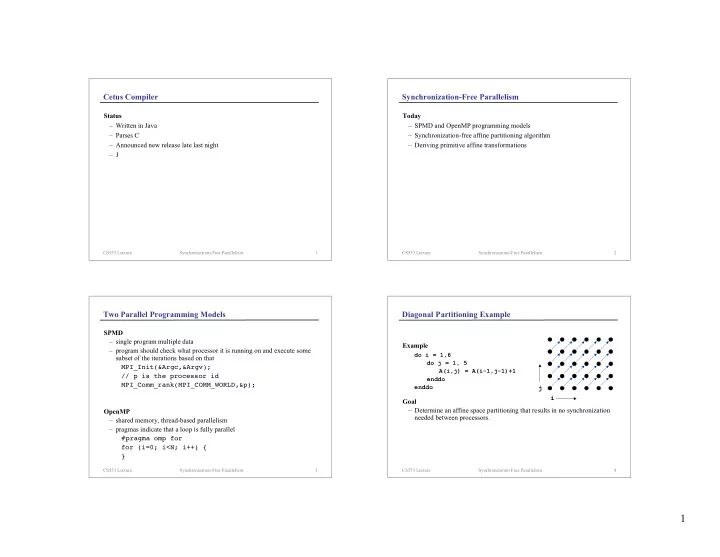
Diagonal Partitioning Example

Example

do i = 1,6 do j = 1, 5 A(i,j) = A(i-1,j-1)+1 enddo enddo

Goal

– Determine an affine space partitioning that results in no synchronization needed between processors. i j

slide-2
SLIDE 2

2

CS553 Lecture Synchronization-Free Parallelism 5

Space-Partition Constraints

Accesses sharing a dependence should be mapped to the same processor

– loop bounds – equality constraints on dependence – equality constraints on space partition

CS553 Lecture Synchronization-Free Parallelism 6

Solving the Space-Partition Constraints

Ad-hoc approach

– Reduce the number of unknowns – Simplify – Determine independent solutions for space partition matrix – Find constant terms (would like min of mapping to be non-negative)

CS553 Lecture Synchronization-Free Parallelism 7

Generate Simple Code

Algorithm 11.45 Generate code that executes partitions of a program

sequentially – for each statement, project out all loop index variables from the system with original loop bounds and space partition constraints – use FM-based code gen algorithm to determine bounds over partitions – not needed for example – union the partition bounds over all statements – not needed for example – insert space partition predicate before each statement

do p = 0, 9 do i = 1,6 do j = 1, 5

if (i-j+4 = p) A(i,j) = A(i-1,j-1)+1

CS553 Lecture Synchronization-Free Parallelism 8

Eliminate Empty Iterations

Apply FM-based code generation algorithm to resulting iteration space

– for each statement – use unioned p bounds, the statement iteration space and the space partition constraints – determine new bounds for the statement iteration space – union the iteration space for all statements in the same loop – For example, did this when determining bounds on p

do p = 0, 9 do i = max(1,-3+p), min(6,p+1) do j = max(1,i+4-p), min(5,i+4-p) if (i-j+4 = p) A(i,j) = A(i-1,j-1)+1
slide-3
SLIDE 3

3

CS553 Lecture Synchronization-Free Parallelism 9

Eliminate Tests from Innermost Loops

General approach: apply the following repeatedly

– select an inner loop with statements with different bounds – split the loop using a condition that causes a statement to be in only one of the splits – generate code for the split iteration spaces

do p = 0, 9 do i = max(1,-3+p), min(6,p+1) do j = max(1,i+4-p), min(5,i+4-p) A(i,j) = A(i-1,j-1)+1

CS553 Lecture Synchronization-Free Parallelism 10

Using the Two Programming Models

SPMD and MPI OpenMP

MPI_Comm_rank(MPI_COMM_WORLD,&p);

for (i = max(1,-3+p); i<= min(6,p+1); i++)

for (j = max(1,i+4-p); j<=min(5,i+4-p); j++) A[i][j] = A[i-1][j-1]+1 #pragma omp for for (p = 0; p<=9; p++) for (i = max(1,-3+p); i<=min(6,p+1); i++) for (j = max(1,i+4-p); j<= min(5,i+4-p); j++) A[i][j] = A[i-1][j-1]+1

CS553 Lecture Synchronization-Free Parallelism 11

Derive Re-indexing by using Space Partition Constraints

Source Code Transformed Code for (i=1; i<=N; i++ { Y[i] = Z[i]; /* s1 */ X[i] = Y[i-1]; /* s2 */ } if (N>=1) X[1]=Y[0]; for (p=1; p<=N-1; p++) { Y[p] = Z[p]; X[p+1]=Y[p]; } if (N>=1) Y[N] = Z[N];

CS553 Lecture Synchronization-Free Parallelism 12

Concepts

Two Parallel Programming Models

– SPMD – OpenMP

Deriving a Synchronization-Free Affine Partitioning

– setting up the space partition constraints (keep iterations involved in a dependence on the same processor) – solve the sparse partition constraints (linear algebra) – eliminate empty iterations (Fourier-Motzkin) – eliminate tests from inner loop (more Fourier-Motzkin) – using the above to derive primitive affine transformations

slide-4
SLIDE 4

4

CS553 Lecture Synchronization-Free Parallelism 13

Lecture

– Tiling!

Suggested Exercises

– Be able to derive the synchronization-free affine partitioning for Example 11.41 in the book. – Show how the other primitive affine transformations are derived.

Next Time