1 Benefits of exception handling Handling exceptions Generally, - - PowerPoint PPT Presentation

1
SMART_READER_LITE
LIVE PREVIEW

1 Benefits of exception handling Handling exceptions Generally, - - PowerPoint PPT Presentation

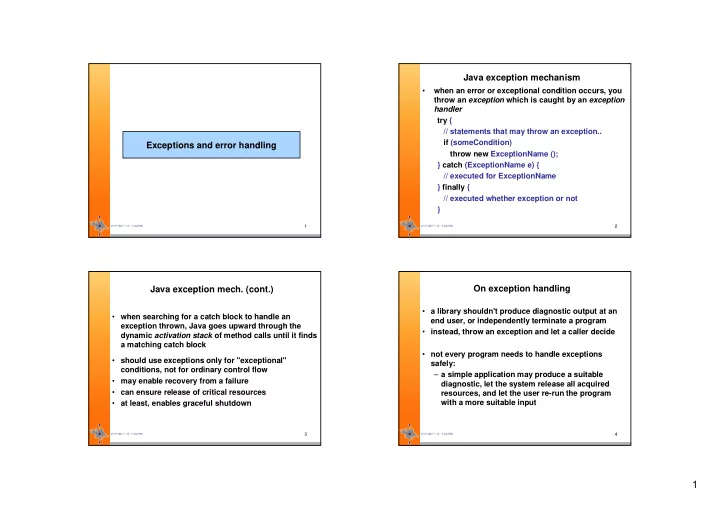
Java exception mechanism when an error or exceptional condition occurs, you throw an exception which is caught by an exception handler try { // statements that may throw an exception.. if (someCondition) Exceptions and error handling


slide-1
SLIDE 1

1

1

Exceptions and error handling

2

Java exception mechanism

  • when an error or exceptional condition occurs, you

throw an exception which is caught by an exception handler try { // statements that may throw an exception.. if (someCondition) throw new ExceptionName (); } catch (ExceptionName e) { // executed for ExceptionName } finally { // executed whether exception or not }

3

Java exception mech. (cont.)

  • when searching for a catch block to handle an

exception thrown, Java goes upward through the dynamic activation stack of method calls until it finds a matching catch block

  • should use exceptions only for "exceptional"

conditions, not for ordinary control flow

  • may enable recovery from a failure
  • can ensure release of critical resources
  • at least, enables graceful shutdown

4

On exception handling

  • a library shouldn't produce diagnostic output at an

end user, or independently terminate a program

  • instead, throw an exception and let a caller decide
  • not every program needs to handle exceptions

safely: – a simple application may produce a suitable diagnostic, let the system release all acquired resources, and let the user re-run the program with a more suitable input

slide-2
SLIDE 2

2

5

Benefits of exception handling

  • separates of error handling from normal processing
  • provides a systematic way to report and handle

exceptional situations (failures or errors)

  • exceptions are necessary for making reusable

libraries and components work: – the library component may detect an error, e.g., violation of a precondition, but cannot know how to handle it

6

Handling exceptions

Generally, there are many ways to handle an exception:

  • 1. let Java handle it (but don't supress it)
  • 2. fix the problem that let to the exception and resume

the program; but often, erroneous conditions are difficult or impossible to fix

  • 3. log the problem and resume the program
  • 4. log the problem and rethrow the exception
  • 5. chain a low-level exception within a new higher-level

exception (wrap inside as a parameter) and throw that

  • 6. print/display/log out an error message and let the

program terminate

7

Handling exceptions (cont.)

  • no one-for-all solution, depends strongly on the

specific requirements of the application

  • it may well be OK to simply let the program

terminate itself, and let the user try with better input

8

Java exception class hierarchy

slide-3
SLIDE 3

3

9

Checked vs. unchecked exceptions

  • checked exceptions are either caught by the method

in which they occur, or you must declare that the method throws the exception

  • checked exceptions force the programmer to deal

with exceptional conditions; error situations become explicit and in principle the program becomes more reliable

  • unchecked exceptions extend RuntimeException

and, if uncaught, are handled by Java

  • use checked exceptions for recoverable conditions

and RuntimeExceptions for programming errors

  • other object-oriented languages (C++, C#) don't have

checked exceptions (but Clu did)

10

Guidelines

  • avoid unnecessary use of exceptions
  • exception handling is not meant to replace a simple

test; for example: – reaching the end of a list should not throw a exception – the API offers a query method (hasNext) for that – but then going past the end should throw

  • NoSuchElementException is a run-time

exception that indicates a programming error

  • don't wrap every statement in a separate try block

– "throw early, catch late" at a higher-level system

11

Guidelines (cont.)

  • don't suppress or ignore exceptions

try { . . . some code that throws SomeException } catch (SomeException ex) { // OK: don't care }

  • if a checked exception does not make sense to you,

don't hesitate to convert it into an unchecked exception and throw it again } catch (SomeException ex) { throw new RuntimeException (ex)

  • chaining constructors available since version 1.4

12

Guidelines (cont.)

  • in some situations, the programmer may "know"

that the code cannot throw any exceptions whatsoever

  • of course, then it should be well documented and

checked: try { . . . // actually cannot throw exceptions } catch (SomeException e) { assert false; // so shouldn't get here }

slide-4
SLIDE 4

4

13

Guidelines (cont.)

  • but don't catch unnecessarily high-level exceptions

try { . . . some code that throws exceptions } catch (Exception ex) { }

  • unchecked exceptions inherit RuntimeException

class which inherits Exception

  • the code above ignores all unchecked exceptions,

as well

14

Guidelines (cont.)

Favor the use of standard exceptions, for example:

  • IllegalArgumentException: parameter value is

inappropriate

  • IllegalStateException: state is inappropriate for

method call (before remove must call next)

  • NullPointerException: null value where prohited
  • IndexOutOfBoundsException: invalid index
  • ConcurrentModificationException: modification of
  • bject has been detected where prohibited
  • UnsupportedOperationException: object does not

support method

15

Guidelines (cont.)

  • document all exceptions thrown by each method

using the Javadoc @throws tag

  • for debugging, the string represention of an

exception should contain the values of all objects that "contributed" to the exception

  • higher layers can catch lower-level exceptions, and in

their place, throw exceptions that are explainable in terms of the higher-level abstraction

16

Exception translation

  • for example, a get () method may call more primitive
  • perations with their own exceptions; the method

can perform exception translation: public E get (int index) { ListIterator it = listIterator (index); try { return it.next (); } catch (NoSuchElementException e) { throw new IndexOutOfBoundsException ("Index: " + index); } }

slide-5
SLIDE 5

5

17

Exception chaining

  • in exception chaining a lower-level exception is

stored by the higher-level exception for debugging purposes: try { lowLevelOperation (); } catch (LowLevelException e) { throw new HighLevelException (e); // has chaining constructor }

  • additionally, the class Throwable provides methods

getCause () and initCause (Throwable cause) to get and set the original cause of the error situation

18

Failure atomicity

  • ideally, attempt to achieve failure atomicity:

– a failed method should leave the system in the state it was in prior to the call

  • in principal, recovery is not possible if the system is

left in an undetermined, possibly faulty state

  • failure atomicity is expecially important for checked

exceptions, from which the caller is expected to recover

19

Failure atomicity (cont.)

public E pop () { // a bit trivial but illustrative if (size () == 0) throw new NoSuchElementException (); // now can safely modify the contents: E result = elements [--size]; elements [size] = null; // eliminate old reference return result; }

20

Using finally blocks

  • finally clauses release resources no matter what
  • a finally clause can be be used without a catch

clause: Graphics g = image.getGraphics (); try { code that might throw exceptions } finally { g.dispose (); }

slide-6
SLIDE 6

6

21

Using finally blocks (cont.)

  • you can decouple try/catch and try/finally to make

your code more readable: InputStream in = . . .; try { try { // ensure that stream is closed code that might throw exceptions } finally { in.close (); } } catch (IOException e) { // reports errors show error dialog }

  • this resembles the use C++ destructors

22

Problems with finally blocks

  • if a finally block itself throws an exception, the
  • riginal exception becomes permanently lost
  • as a rule, all clean-up code such as finally should be

programmed not to throw any exceptions – very hard to enforce in practice, and – unfortunately, not all library methods necessarily respect the right spirit of exception handling

23

Problems finally blocks (cont.)

  • if a try block or a catch clause contains a return

statement, the finally block is (as always) executed before the return

  • however, if the finally block itself contains a return, it

then masks off the original return public static f (int n) { try { ... return n * n; } ... } finally { if (n == 2) return 0; // strange and unexpected } }