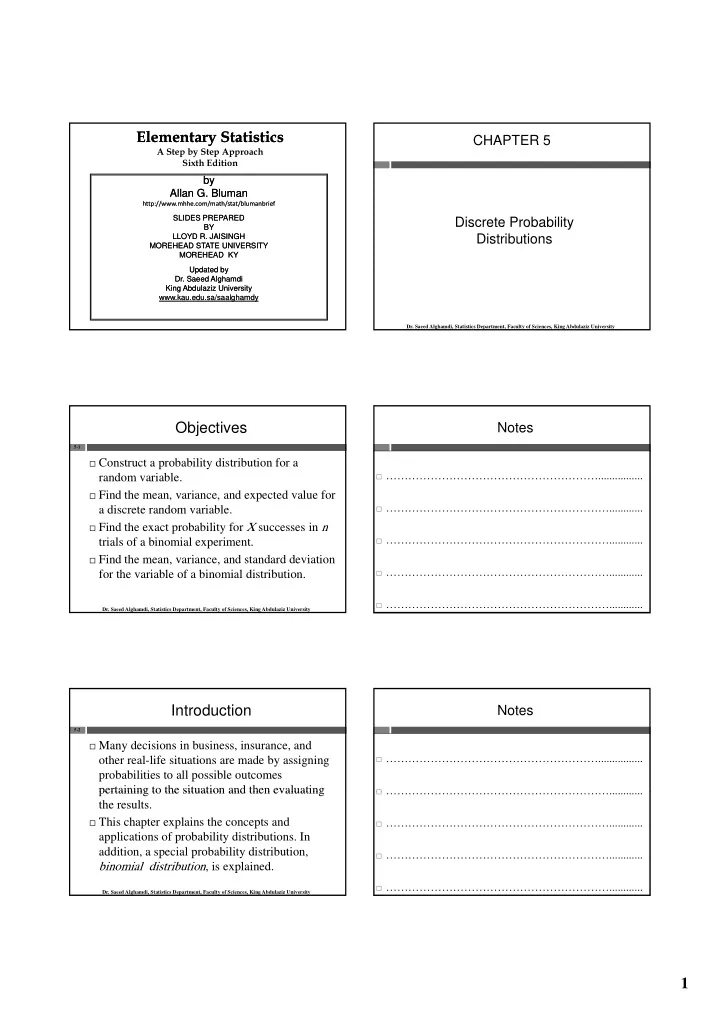
1 Discrete Probability Distribution Notes 5-3 A random variable - - PDF document

1
SMART_READER_LITE
LIVE PREVIEW

1 Discrete Probability Distribution Notes 5-3 A random variable - - PDF document

Elementary Statistics Elementary Statistics CHAPTER 5 A Step by Step Approach Sixth Edition by by Allan G. Allan G. Bluman Bluman http://www.mhhe.com/math/stat/blumanbrief http://www.mhhe.com/math/stat/blumanbrief SLIDES PREPARED SLIDES


slide-1
SLIDE 1

1

by by Allan G. Allan G. Bluman Bluman

http://www.mhhe.com/math/stat/blumanbrief http://www.mhhe.com/math/stat/blumanbrief

SLIDES PREPARED SLIDES PREPARED BY BY

Elementary Statistics Elementary Statistics

A Step by Step Approach Sixth Edition

BY BY LLOYD R. JAISINGH LLOYD R. JAISINGH MOREHEAD STATE UNIVERSITY MOREHEAD STATE UNIVERSITY MOREHEAD KY MOREHEAD KY Updated by Updated by Dr.

  • Dr. Saeed

Saeed Alghamdi Alghamdi King King Abdulaziz Abdulaziz University University www.kau.edu.sa/saalghamdy www.kau.edu.sa/saalghamdy

CHAPTER 5 Discrete Probability Discrete Probability Distributions

  • Dr. Saeed Alghamdi, Statistics Department, Faculty of Sciences, King Abdulaziz University

Objectives

Construct a probability distribution for a

random variable.

Find the mean, variance, and expected value for

a discrete random variable

5-1

a discrete random variable.

Find the exact probability for X successes in n

trials of a binomial experiment.

Find the mean, variance, and standard deviation

for the variable of a binomial distribution.

  • Dr. Saeed Alghamdi, Statistics Department, Faculty of Sciences, King Abdulaziz University

Notes

…………………………………………………................ ……………………………………………………............ ……………………………………………………............ ……………………………………………………............ ……………………………………………………............

Introduction

Many decisions in business, insurance, and

  • ther real-life situations are made by assigning

probabilities to all possible outcomes pertaining to the situation and then evaluating

5-2

pertaining to the situation and then evaluating the results.

This chapter explains the concepts and

applications of probability distributions. In addition, a special probability distribution, binomial distribution, is explained.

  • Dr. Saeed Alghamdi, Statistics Department, Faculty of Sciences, King Abdulaziz University

Notes

…………………………………………………................ ……………………………………………………............ ……………………………………………………............ ……………………………………………………............ ……………………………………………………............

slide-2
SLIDE 2

2 Discrete Probability Distribution

A random variable is a variable whose values

are determined by chance.

A discrete probability distribution consists of

the values a random variable can assume and

5-3

the values a random variable can assume and the corresponding probabilities of the values. The probabilities are determined theoretically

  • r by observation.
  • Dr. Saeed Alghamdi, Statistics Department, Faculty of Sciences, King Abdulaziz University

Notes

…………………………………………………................ ……………………………………………………............ ……………………………………………………............ ……………………………………………………............ ……………………………………………………............

  • Construct a probability distribution for rolling a single die.

Since the sample space is S={1,2,3,4,5,6} and each outcome has a probability , the distribution will be

……………………………………………………………………………………………………………………………………………………………………………………………………………………………………………………………………………………………………………………………….

  • Represent graphically the probability distribution for the sample

f i h i

5-4

1 6 Outcome X 1 2 3 4 5 6 Probability P(X) 1/6 1/6 1/6 1/6 1/6 1/6

space for tossing three coins.

Number of heads X 1 2 3 Probability P(X) 1/8 3/8 3/8 1/8

0.000 0.100 0.200 0.300 0.400 1 2 3 Number of heads Probability

  • Dr. Saeed Alghamdi, Statistics Department, Faculty of Sciences, King Abdulaziz University

Notes

…………………………………………………................ ……………………………………………………............ ……………………………………………………............ ……………………………………………………............ ……………………………………………………............

  • During the summer months, a rental agency keeps track of the

number of chain saws it rents each day during a period of 90

  • days. The number of saws rented per day is represented by the

variable X. The results are shown here. Compute the probability P(X) for each X and construct a probability distribution and graph for the data.

5-5

X 1 2 Total # of days 45 30 15 90 45 30 15 ( 0) 0 5 ( 1) 0 333 d ( 2) 0 167 P X P X P X X 1 2 P(X) 0.5 0.333 0.167

0.000 0.200 0.400 0.600 1 2

( 0) 0.5, ( 1) 0.333 and ( 2) 0.167 90 90 90 P X P X P X = = = = = = = = =

Number of saws Probability

  • Dr. Saeed Alghamdi, Statistics Department, Faculty of Sciences, King Abdulaziz University

Notes

…………………………………………………................ ……………………………………………………............ ……………………………………………………............ ……………………………………………………............ ……………………………………………………............

slide-3
SLIDE 3

3

Requirements for a Probability Distribution

1.

The sum of the probabilities of all the events in the sample space must equal 1; . Th b bilit f h t i th l

5-6

( ) 1 P X =

2.

The probability of each event in the sample space must be between or equal to 0 and 1; .

( ) 1 P X ≤ ≤

  • Dr. Saeed Alghamdi, Statistics Department, Faculty of Sciences, King Abdulaziz University

Notes

…………………………………………………................ ……………………………………………………............ ……………………………………………………............ ……………………………………………………............ ……………………………………………………............

  • Determine whether each distribution is a probability distribution.
  • a. c.
  • b. d.

Y i i b bili di ib i

5-7

X 5 10 15 20 P(X) 1/5 1/5 1/5 1/5 1/5 X 1 2 3 4 P(X) 1/4 1/8 1/16 9/16 X 2 4 6 P(X) ‐1.0 1.5 0.3 0.2 X 2 3 7 P(X) 0.5 0.3 0.4

  • a. Yes, it is a probability distribution.
  • b. No, it is not a probability distribution, since P(X) cannot be 1.5
  • r ‐1.0.
  • c. Yes, it is a probability distribution.
  • d. No, it is not, since

( ) 1.2 P X =

  • Dr. Saeed Alghamdi, Statistics Department, Faculty of Sciences, King Abdulaziz University

Notes

…………………………………………………................ ……………………………………………………............ ……………………………………………………............ ……………………………………………………............ ……………………………………………………............

Mean of a Probability Distribution

In order to find the mean for a probability

distribution, one must multiply each possible

  • utcome by its corresponding probability and find

the sum of the products.

5-8

Rounding Rule: The mean, variance, and standard

deviation should be rounded to one more decimal place than the outcome, X.

1 1 2 2

( ) ( ) . . . ( ) ( )

n n

X P X X P X X P X X P X μ = + + + =∑ i i i i

  • Dr. Saeed Alghamdi, Statistics Department, Faculty of Sciences, King Abdulaziz University

Notes

…………………………………………………................ ……………………………………………………............ ……………………………………………………............ ……………………………………………………............ ……………………………………………………............

slide-4
SLIDE 4

4

  • In a family with two children, find the mean of the

number of children who will be girls. The probability distribution is

5-9

# of girls X 1 2 P(X) 1/4 1/2 1/4

Hence,

P(X) 1/4 1/2 1/4 1 1 1 ( ) 1 2 1 4 2 4 X P X μ = × = × + × + × =

  • Dr. Saeed Alghamdi, Statistics Department, Faculty of Sciences, King Abdulaziz University

Notes

…………………………………………………................ ……………………………………………………............ ……………………………………………………............ ……………………………………………………............ ……………………………………………………............

  • If three coins are tossed, find the mean of the

number of heads that occur. The probability distribution is

5-10

# of heads X 1 2 3 P(X) 1/8 3/8 3/8 1/8

Hence,

X P(X) 3/8 6/8 3/8 3 6 3 12 ( ) 1.5 8 8 8 8 X P X μ = × = + + + = =

  • Dr. Saeed Alghamdi, Statistics Department, Faculty of Sciences, King Abdulaziz University

Notes

…………………………………………………................ ……………………………………………………............ ……………………………………………………............ ……………………………………………………............ ……………………………………………………............

  • The probability distribution shown represents the

number of trips of five nights or more that American adults take per year. Find the mean.

5-11

# of trips X 1 2 3 4 P(X) 0.06 0.70 0.20 0.03 0.01 X P(X) 0.70 0.40 0.09 0.04

Hence,

( ) 0.7 0.4 0.09 0.04 1.23 X P X μ = × = + + + + =

( )

  • Dr. Saeed Alghamdi, Statistics Department, Faculty of Sciences, King Abdulaziz University

Notes

…………………………………………………................ ……………………………………………………............ ……………………………………………………............ ……………………………………………………............ ……………………………………………………............

slide-5
SLIDE 5

5

Variance of a Probability Distribution

The variance of a probability distribution is found by

multiplying the square of each outcome by its corresponding probability, summing those products, and subtracting the square of the mean.

5-12

The formula for calculating the variance is: The formula for the standard deviation is: 2

σ σ =

2 2 2

[ ( )] X P X σ μ = −

i

  • Dr. Saeed Alghamdi, Statistics Department, Faculty of Sciences, King Abdulaziz University

Notes

…………………………………………………................ ……………………………………………………............ ……………………………………………………............ ……………………………………………………............ ……………………………………………………............

  • The probability distribution for the number of spots that appear

when a die is tossed is

5-13

Outcome X 1 2 3 4 5 6 Probability P(X) 1/6 1/6 1/6 1/6 1/6 1/6 1

2

X ( ) X P X i

1/6 2/6 3/6 4/6 5/6 6/6 21/6 1 4 9 16 25 36 ‐

Hence,

2

( ) X P X i

( )

2 2 2 2

21 ( ) 6 91 21 546 441 105 ( ) 2.917 6 6 36 36 36 2.917 1.708 X P X X P X μ σ μ σ = = ⎛ ⎞ = − = − = − = = ⎜ ⎟ ⎝ ⎠ = =

∑ ∑

i i 1/6 4/6 9/6 16/6 25/6 36/6 91/6

  • Dr. Saeed Alghamdi, Statistics Department, Faculty of Sciences, King Abdulaziz University

Notes

…………………………………………………................ ……………………………………………………............ ……………………………………………………............ ……………………………………………………............ ……………………………………………………............

  • Five balls numbered 0, 2, 4, 6 and 8 are placed in a bag. After

the balls are mixed, one is selected, its number is noted and then it is replaced. If this experiment is repeated many times, find the variance and standard deviation of the numbers on the balls. The probability distribution is

5-14

# on ball 2 4 6 8 1/5 1/5 1/5 1/5 1/5 1

( ) P X X

Hence,

2

X ( ) X P X i

2

( ) X P X i

( )

2 2 2 2

20 ( ) 4 5 120 ( ) 4 24 16 8 5 8 2.828 X P X X P X μ σ μ σ = = = = − = − = − = = =

∑ ∑

i i 2/5 4/5 6/5 8/5 20/5 4 16 36 64 ‐ 4/5 16/5 36/5 64/5 120/5

  • Dr. Saeed Alghamdi, Statistics Department, Faculty of Sciences, King Abdulaziz University

Notes

…………………………………………………................ ……………………………………………………............ ……………………………………………………............ ……………………………………………………............ ……………………………………………………............

slide-6
SLIDE 6

6 Expected Value

Expected value or expectation is used in various

types of games of chance, in insurance, and in other areas, such as decision theory.

The expected value of a discrete random variable of

5-15

p a probability distribution is the theoretical average

  • f the variable. The formula is:

The symbol E(X) is used for the expected value.

( ) ( )

E X X P X μ = = ∑ i

  • Dr. Saeed Alghamdi, Statistics Department, Faculty of Sciences, King Abdulaziz University

Notes

…………………………………………………................ ……………………………………………………............ ……………………………………………………............ ……………………………………………………............ ……………………………………………………............

  • One thousand tickets are sold at $1 each for a color television

valued at $350. What is the expected value of the gain if a person purchases one ticket? The problem can be set up as

5-16

Win Lose # on ball $349 ‐$1 1/1000 999/1000 1

( ) P X X

Hence, The meaning of this value is that if a person purchased one ticket each week over a long time, the average loss would be $0.65 per ticket, since theoretically, on average, that person would win the set once for each 1000 tickets purchased.

/ / 349/1000 ‐999/1000 ‐650/1000 ( ) X P X i 650 ( ) ( ) $0.65 1000 E X X P X − = = = −

i ( )

  • Dr. Saeed Alghamdi, Statistics Department, Faculty of Sciences, King Abdulaziz University

Notes

…………………………………………………................ ……………………………………………………............ ……………………………………………………............ ……………………………………………………............ ……………………………………………………............

  • One thousand tickets are sold at $1 each for four prizes of $100,

$50, $25 and $10. After each prize drawing, the winning ticket is then returned to the pool of tickets. What is the expected value

  • f the gain if a person purchases two tickets?

The problem can be set up as

5-17

Gain $98 $48 $23 $8 ‐$2

X

Hence,

2/1000 2/1000 2/1000 2/1000 992/1000 1 196/1000 96/1000 46/1000 16/1000 ‐1984/1000 ‐1.63 ( ) X P X i ( ) ( ) $1.63 E X X P X = = −

i ( ) P X

  • Dr. Saeed Alghamdi, Statistics Department, Faculty of Sciences, King Abdulaziz University

Notes

…………………………………………………................ ……………………………………………………............ ……………………………………………………............ ……………………………………………………............ ……………………………………………………............

slide-7
SLIDE 7

7 The Binomial Distribution

Many types of probability problems have only two

possible outcomes or they can be reduced to two

  • utcomes.

Examples include: when a coin is tossed it can land

5-18

p

  • n heads or tails, when a baby is born it is either a

boy or girl, a multiple-choice question can be classified as correct or incorrect, etc.

  • Dr. Saeed Alghamdi, Statistics Department, Faculty of Sciences, King Abdulaziz University

Notes

…………………………………………………................ ……………………………………………………............ ……………………………………………………............ ……………………………………………………............ ……………………………………………………............

The Binomial Experiment

The binomial experiment is a probability experiment

that satisfies these requirements: 1. Each trial can have only two possible

  • utcomes—success or failure.

5-19

2. There must be a fixed number of trials. 3. The outcomes of each trial must be independent of each other. 4. The probability of a success must remain the same for each trial.

  • Dr. Saeed Alghamdi, Statistics Department, Faculty of Sciences, King Abdulaziz University

Notes

…………………………………………………................ ……………………………………………………............ ……………………………………………………............ ……………………………………………………............ ……………………………………………………............

The Binomial Experiment

The outcomes of a binomial experiment and the

corresponding probabilities of these outcomes are called a binomial distribution.

5-20

The symbol for the probability of success

P S ( )

The symbol for the probability of failure The numerical probability of success The numerical probability of failure

and

The number of trials The number of successes

P F ( ) p q

P S p ( ) = P F p q ( ) = − = 1

n X

  • Dr. Saeed Alghamdi, Statistics Department, Faculty of Sciences, King Abdulaziz University

Notes

…………………………………………………................ ……………………………………………………............ ……………………………………………………............ ……………………………………………………............ ……………………………………………………............

slide-8
SLIDE 8

8 Binomial Probability Formula

In a binomial experiment, the probability of exactly

X successes in n trials is

5-21

! ( )

X n X

n P X p q − = ⋅ ⋅

Where

( ) ( )! ! P X p q n X X −

0,1,2,..., X n =

  • Dr. Saeed Alghamdi, Statistics Department, Faculty of Sciences, King Abdulaziz University

Notes

…………………………………………………................ ……………………………………………………............ ……………………………………………………............ ……………………………………………………............ ……………………………………………………............

  • A coin is tossed 3 times. Find the probability of getting exactly

two heads.

  • This can solved using the sample space

HHH,HHT,HTH,THH,HTT,THT,TTH,TTT There are three ways of getting 2 heads. So,

  • Or using the binomial distribution as following

5-22

3 ( 2 ) 0.375 8 P getting heads = =

  • Or using the binomial distribution as following

‐ we have fixed number of trials (three), so n=3 ‐ there are two outcomes for each trial, H or T ‐ the outcomes are independent of one another ‐ the probability of success (heads) is 1/2, so p=1/2 here X=2 since we need to find the probability of getting 2 heads Thus,

2 1

3! 1 1 3 (2) 0.375 1! 2! 2 2 8 P ⎛ ⎞ ⎛ ⎞ = × × = = ⎜ ⎟ ⎜ ⎟ × ⎝ ⎠ ⎝ ⎠

  • Dr. Saeed Alghamdi, Statistics Department, Faculty of Sciences, King Abdulaziz University

Notes

…………………………………………………................ ……………………………………………………............ ……………………………………………………............ ……………………………………………………............ ……………………………………………………............

  • A survey found that one out of five Americans says he
  • r she has visited a doctor in any given month. If 10

people are selected at random, find the probability that exactly 3 would have visited a doctor last month.

  • In this case n=10, X=3, p=1/5. So

5-23

3 7

10! 1 4 (3) 0.201 7! 3! 5 5 P ⎛ ⎞ ⎛ ⎞ = × × = ⎜ ⎟ ⎜ ⎟ × ⎝ ⎠ ⎝ ⎠

  • Dr. Saeed Alghamdi, Statistics Department, Faculty of Sciences, King Abdulaziz University

Notes

…………………………………………………................ ……………………………………………………............ ……………………………………………………............ ……………………………………………………............ ……………………………………………………............

slide-9
SLIDE 9

9

  • A survey from Teenage Research Unlimited

(Northbrook, Illinois) found that 30% of teenage consumers receive their spending money from part‐ time jobs. If 5 teenagers are selected at random, find the probability that a least 3 of them will have part‐ time jobs.

5-24

  • In this case n=5, p=0.3. So

3 2 4 1 5

( 3 ) ( 3) (3) (4) (5) 5! 5! 5! 0.3 0.7 0.3 0.7 0.3 0.7 2! 3! 1! 4! 0! 5! 0.132 0.028 0.002 0.162 P at least have part time jobs P X P P P − = ≥ = + + = × × + × × + × × × × × = + + =

  • Dr. Saeed Alghamdi, Statistics Department, Faculty of Sciences, King Abdulaziz University

Notes

…………………………………………………................ ……………………………………………………............ ……………………………………………………............ ……………………………………………………............ ……………………………………………………............

Binomial Distribution Properties

mean

μ = ⋅ n p

5-25

The mean, variance, and standard deviation of a variable that has the binomial distribution can be found by using the following formulas. mean variance standard deviation

μ n p σ 2 = ⋅ ⋅ n p q σ = ⋅ ⋅ n p q

  • Dr. Saeed Alghamdi, Statistics Department, Faculty of Sciences, King Abdulaziz University

Notes

…………………………………………………................ ……………………………………………………............ ……………………………………………………............ ……………………………………………………............ ……………………………………………………............

  • A coin is tossed 4 times. Find the mean, variance and

standard deviation of the number of heads that will be

  • btained.
  • In this case n=4, p=0.5 and q=0.5. So

5-26

1 4 2 n p μ = ⋅ = × = 2 p μ

2

4 0.5 0.5 1 n p q σ = ⋅ ⋅ = × × = 4 0.5 0.5 1 1 n p q σ = ⋅ ⋅ = × × = =

  • Dr. Saeed Alghamdi, Statistics Department, Faculty of Sciences, King Abdulaziz University

Notes

…………………………………………………................ ……………………………………………………............ ……………………………………………………............ ……………………………………………………............ ……………………………………………………............

slide-10
SLIDE 10

10

  • A die is rolled 480 times. Find the mean, variance and

standard deviation of the number of 2s that will be

  • btained.
  • In this case n=480, p=1/6 and q=5/6. So

5-27

1 480 80 n p μ = = × = 480 80 6 n p μ = ⋅ = × =

2

1 5 480 66.7 6 6 n p q σ = ⋅ ⋅ = × × = 1 5 480 66.7 8.2 6 6 n p q σ = ⋅ ⋅ = × × = =

  • Dr. Saeed Alghamdi, Statistics Department, Faculty of Sciences, King Abdulaziz University

Notes

…………………………………………………................ ……………………………………………………............ ……………………………………………………............ ……………………………………………………............ ……………………………………………………............