1 4 Introduction How to Avoid Troubled Projects Apply proper - - PDF document

1
SMART_READER_LITE
LIVE PREVIEW

1 4 Introduction How to Avoid Troubled Projects Apply proper - - PDF document

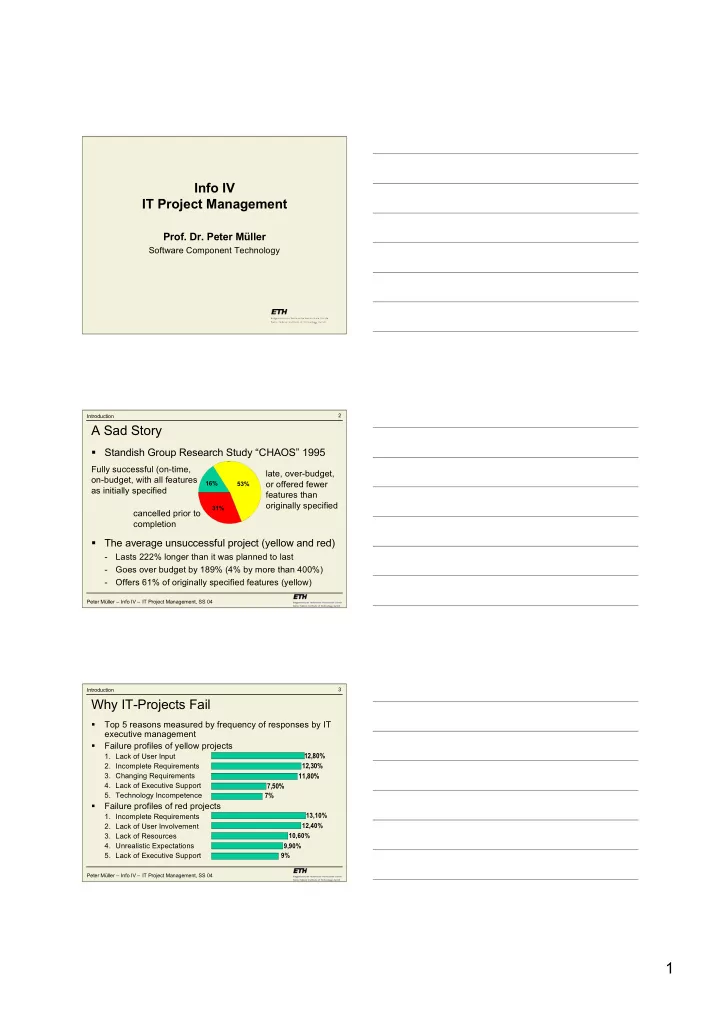
Info IV IT Project Management Prof. Dr. Peter Mller Software Component Technology 2 Introduction A Sad Story Standish Group Research Study CHAOS 1995 Fully successful (on-time, late, over-budget, on-budget, with all features


slide-1
SLIDE 1

1

Info IV IT Project Management

  • Prof. Dr. Peter Müller

Software Component Technology

Peter Müller – Info IV – IT Project Management, SS 04 2

A Sad Story

31% 53% 16%

  • The average unsuccessful project (yellow and red)
  • Lasts 222% longer than it was planned to last
  • Goes over budget by 189% (4% by more than 400%)
  • Offers 61% of originally specified features (yellow)
  • Standish Group Research Study “CHAOS” 1995

Fully successful (on-time,

  • n-budget, with all features

as initially specified late, over-budget,

  • r offered fewer

features than

  • riginally specified

cancelled prior to completion

Introduction Peter Müller – Info IV – IT Project Management, SS 04 3

Why IT-Projects Fail

  • Top 5 reasons measured by frequency of responses by IT

executive management

  • Failure profiles of yellow projects
  • 1. Lack of User Input
  • 2. Incomplete Requirements
  • 3. Changing Requirements
  • 4. Lack of Executive Support
  • 5. Technology Incompetence
  • Failure profiles of red projects
  • 1. Incomplete Requirements
  • 2. Lack of User Involvement
  • 3. Lack of Resources
  • 4. Unrealistic Expectations
  • 5. Lack of Executive Support

7,50% 11,80% 12,30% 7% 12,80% 9,90% 10,60% 12,40% 9% 13,10%

Introduction

slide-2
SLIDE 2

2

Peter Müller – Info IV – IT Project Management, SS 04 4

How to Avoid Troubled Projects

  • Apply proper engineering

 Characteristics of IT-projects  Phases of IT-projects with their purpose, methods, and deliverables

  • Apply proper project management

 Main processes of project management with their inputs, techniques, tools, and outputs  Main areas of project management (scope, time, cost, quality, risk, etc.)

  • Recognize the importance of non-technical aspects

 Some basic rules of successful project management

Introduction Peter Müller – Info IV – IT Project Management, SS 04 5

Agenda

Basics Integration Management Project Lifecycle Project Management Lifecycle

Agenda Peter Müller – Info IV – IT Project Management, SS 04 6

What is a Project?

  • Definition:

A project is a temporary endeavor undertaken to create a unique product or service

  • In contrast: Operations are ongoing and repetitive

Every project has a definite beginning and a definite end The product or service is different in some distinguishing way from all similar products and services

Basics

slide-3
SLIDE 3

3

Peter Müller – Info IV – IT Project Management, SS 04 7

Examples for Projects and Operations

  • Projects
  • Developing a new software application
  • Implementing a new business procedure
  • Adding functionality to an IT system
  • Doing a Diplomarbeit
  • Operations
  • Bugfixing of an existing software application
  • Selling train tickets
  • Running a car factory

Basics Peter Müller – Info IV – IT Project Management, SS 04 8

What is an IT-Project?

  • Definition:

An IT-project is a project to create a product or service, of which the usage of information technology is the decisive characteristic

  • Examples
  • The development of a software application is an IT-

project (IT-based product)

  • The development of a car is not an IT-project, although

information technology is involved substantially

Basics Peter Müller – Info IV – IT Project Management, SS 04 9

From Projects to Operations

Project (Development) Operation (Production)

Ideas, studies Project start Project end Time Project duration Project management Operation management

  • Applications are neither projects nor operations, but

products

Basics

slide-4
SLIDE 4

4

Peter Müller – Info IV – IT Project Management, SS 04 10

Characteristics of Projects

  • Temporary endeavor
  • Unique product or service
  • Performed by people
  • Constrained by limited resources
  • Budget, time, staff
  • Planned, executed, and controlled
  • Have their own organization

Basics Peter Müller – Info IV – IT Project Management, SS 04 11

Core Activities and Project Management

Core Activities Project Management

  • rganizes and leads

the project work to meet project requirements ultimately create the product of a project

Basics Peter Müller – Info IV – IT Project Management, SS 04 12

Project Management

  • Definition of Project Management (PM):

Project Management is the application of knowledge, skills, tools, and techniques to project activities to meet project requirements.

Basics

slide-5
SLIDE 5

5

Peter Müller – Info IV – IT Project Management, SS 04 13

Typical Core Activities in IT-Projects

  • Design of a graphical user interface
  • Installation of a local area network
  • Integration test of all system components
  • Training of users on a new application
  • Implementation of a set of Java classes
  • Documentation of design decisions and code

Basics Peter Müller – Info IV – IT Project Management, SS 04 14

Typical Project Management Activities

  • Communication with team, clients, management
  • Effort estimations
  • Planning activities and assigning resources
  • Comparing actual performance to plan
  • Risk analysis
  • Negotiation with subcontractors
  • Staff acquisition

Basics Peter Müller – Info IV – IT Project Management, SS 04 15

PM Knowledge Areas

Project Integration Management Project Cost Management Project Communications Management Project Scope Management Project Quality Management Project Risk Management Project Time Management Project Human Resource Management Project Procurement Management

Project Management

PM activities fall into nine Knowledge Areas

Basics

slide-6
SLIDE 6

6

Peter Müller – Info IV – IT Project Management, SS 04 16

Agenda

Basics Integration Management Project Life Cycle Project Management Life Cycle

Agenda Peter Müller – Info IV – IT Project Management, SS 04 17

The Triple Constraint

  • Project objectives are equally important
  • Actions in one project area usually affect other areas

Integration Management

Cost Time Scope

   

Peter Müller – Info IV – IT Project Management, SS 04 18

The Triple Constraint

  • Tradeoffs among objectives must be managed
  • Priorities are set by customers and management

Cost Time Scope

   

Integration Management

slide-7
SLIDE 7

7

Peter Müller – Info IV – IT Project Management, SS 04 19

More Competing Objectives

Customer Satisfaction Risk Quality Cost Time Scope

Integration Management Peter Müller – Info IV – IT Project Management, SS 04 20

Project Success

  • Definition:

A project is successful if the specified results are delivered in the required quality and within the predetermined time and resource limits.

  • Computer scientists tend to focus on scope and

quality only

  • The development of a technically perfect application is

not a success if the cost exceeds the price clients are willing to pay

  • Excellent project results often are worthless if they come

too late (temporary market windows, external deadlines)

Integration Management Peter Müller – Info IV – IT Project Management, SS 04 21

Project Integration Management

  • Ensure that various elements of the project are

properly coordinated

  • Estimate cost of staffing alternatives
  • Determine effects of a scope change on schedule
  • Make tradeoffs among competing objectives and

alternatives

  • Primarily task of project manager since he / she is

responsible for seeing the overall “big picture”

Integration Management

slide-8
SLIDE 8

8

Peter Müller – Info IV – IT Project Management, SS 04 22

Integration Management Processes

  • Project plan development
  • Integrates various planning outputs (time, cost, risk, etc.)
  • Produces a formal, consistent document to manage

project execution

  • Project plan execution
  • Produces actual work results
  • Integrated change control
  • Determines that a change has occurred
  • Manages the changes as they occur
  • Results in corrective actions and project plan updates

Integration Management Peter Müller – Info IV – IT Project Management, SS 04 23

Agenda

Basics Integration Management Project Life Cycle Project Management Life Cycle

Agenda Peter Müller – Info IV – IT Project Management, SS 04 24

Projects are Complex

  • At project start, only broad information about

characteristics of product are available

  • Average size of IT projects is 500-2000 person days
  • Different tasks have to be performed such as designing a

GUI, testing a module, installing hardware, training users,

  • r negotiating with customers

 How can we handle this complexity?

Project Life Cycle

Project

Requirements Unique Product

  • r Service
slide-9
SLIDE 9

9

Peter Müller – Info IV – IT Project Management, SS 04 25

Decomposition According to Product

Project Life Cycle

Requirements Unique Product

  • r Service

Subproject Subproject Subproject Subproject

Peter Müller – Info IV – IT Project Management, SS 04 26

Subprojects

  • Decomposition usually follows structure of product
  • Subprojects are easier to manage
  • Subprojects enable one to use specialized staff
  • Remaining and new problems
  • Only broad information about product characteristics
  • Managing the interfaces between subprojects
  • Integrating the results of the subprojects
  • Increased need for communication
  • Subprojects are still complex

Project Life Cycle Peter Müller – Info IV – IT Project Management, SS 04 27

Progressive Elaboration

Characteristics of a unique product or service must be progressively elaborated

Continuing steadily by increments

  • During the project, characteristics are defined in

more detail as the project team develops a better and more complete understanding of the product

Worked out with care and detail

Project Life Cycle

slide-10
SLIDE 10

10

Peter Müller – Info IV – IT Project Management, SS 04 28

Project Phases

Project Life Cycle

Requirements Unique Product

  • r Service

Project

Projects are divided into project phases Precisely documented interfaces between phases: deliverables

Peter Müller – Info IV – IT Project Management, SS 04 29

Deliverables

  • Definition:

Any measurable, tangible, verifiable outcome, result, or item that must be produced to complete a project or part of a project

  • Examples
  • An object-oriented design, described by a UML diagram
  • A project schedule as MS Project file
  • A user guide for a new application
  • Software, delivered as compiled binary

Project Life Cycle Peter Müller – Info IV – IT Project Management, SS 04 30

Project Phases

  • Definition:

A collection of logically related project activities, usually culminating in the completion of a major deliverable

Project Life Cycle

Requirements Unique Product

  • r Service

Project

slide-11
SLIDE 11

11

Peter Müller – Info IV – IT Project Management, SS 04 31

Project Phases

  • Definition:

A collection of logically related project activities, usually culminating in the completion of a major deliverable

Project Life Cycle

Requirements Unique Product

  • r Service

Project

Peter Müller – Info IV – IT Project Management, SS 04 32

Waterfall Model of Project Life Cycle

Project Life Cycle

Analysis Phase Test Phase Design Phase Implementation Phase Deployment Phase Time

Peter Müller – Info IV – IT Project Management, SS 04 33

Properties of the Project Life Cycle

Cost and Staffing Level

Project Life Cycle

  • Stakeholders’ influence on product characteristics

and final cost is highest at project start and decreases progressively

  • Cost of changes and error correction increases

during the project life cycle

Time Start End

slide-12
SLIDE 12

12

Peter Müller – Info IV – IT Project Management, SS 04 34

From Projects to Operations

Operation (Production) Project start Project end Time

  • Project phases are surrounded by related activities

that are not part of the project

Implementation Phase Analysis Phase Deployment Phase Design Phase Test Phase

Ideas, Studies

Project Life Cycle Peter Müller – Info IV – IT Project Management, SS 04 35

Product Life Cycle

Project Life Cycle

Business Requirements

Product

Project Operation

Market Demand Business Need Customer Request Technological Advance Legal Requirement

Peter Müller – Info IV – IT Project Management, SS 04 36

Agenda

Basics Integration Management Project Life Cycle Project Management Life Cycle

Agenda

slide-13
SLIDE 13

13

Peter Müller – Info IV – IT Project Management, SS 04 37

Core and Project Management Processes

Core Processes Project Management Processes

Project Management Life Cycle

Grouped into process groups Grouped into phases

Peter Müller – Info IV – IT Project Management, SS 04 38

Project Management Life Cycle

Project Management Life Cycle

Initiating Processes Planning Processes Executing Processes Controlling Processes Closing Processes

Peter Müller – Info IV – IT Project Management, SS 04 39

Example: Time Management

Project Management Life Cycle

Schedule Development Project Plan Execution Schedule Control Task List for Each Team Member Status Reports Corrective Actions Schedule Updates

slide-14
SLIDE 14

14

Peter Müller – Info IV – IT Project Management, SS 04 40

Process Groups

  • Project groups are not discrete one-time events
  • They overlap and occur at varying levels of

intensity within each phase of the project

Project Management Life Cycle

Level of Activity Time Start End Initiating Planning Controlling Executing Closing

Peter Müller – Info IV – IT Project Management, SS 04 41

Interaction between Phases

  • Input and output of the processes depend on the

phase in which they are carried out

  • But processes are not limited to one phase

(overlaps)

Project Management Life Cycle

Design Phase Implementation Phase

Initiating Processes Planning Processes Executing Processes Controlling Processes Closing Processes Initiating Processes Planning Processes Executing Processes Controlling Processes Closing Processes Peter Müller – Info IV – IT Project Management, SS 04 42

Project Management Processes

Core and Project Management Processes

Core Processes

Project Management Life Cycle

slide-15
SLIDE 15

15

Peter Müller – Info IV – IT Project Management, SS 04 43

Project Management Processes

Core and Project Management Processes

Core Processes

Project Management Life Cycle

BACKUP