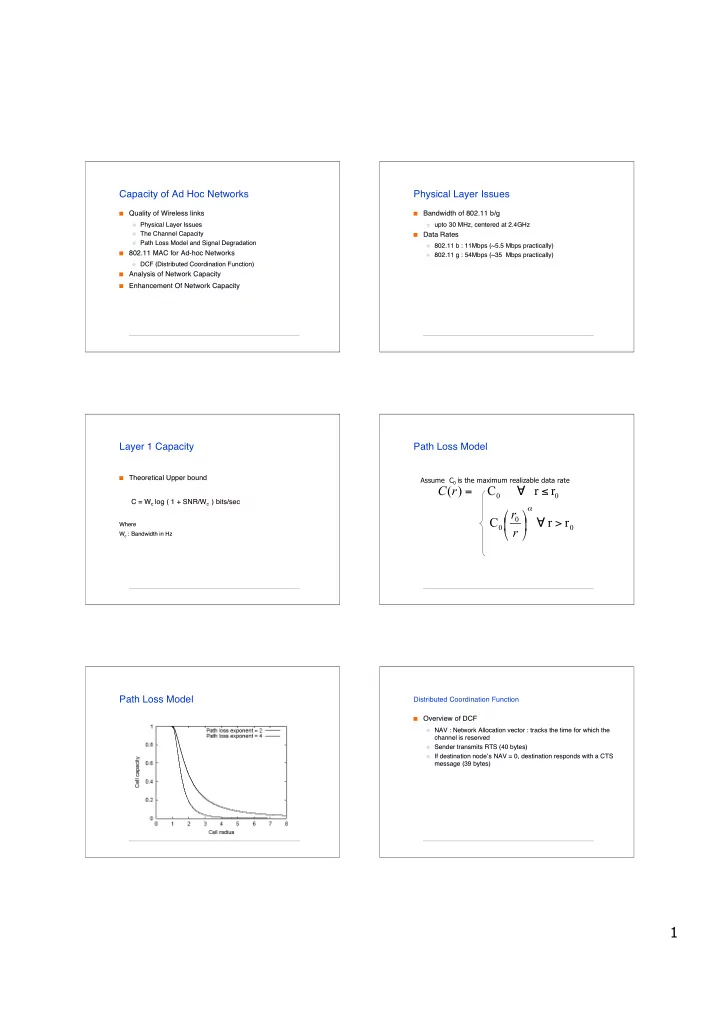
1 Overview Of DCF Timing Diagram for DCF Both RTS and CTS packets - - PDF document

1
SMART_READER_LITE
LIVE PREVIEW

1 Overview Of DCF Timing Diagram for DCF Both RTS and CTS packets - - PDF document

Capacity of Ad Hoc Networks Physical Layer Issues Quality of Wireless links Quality of Wireless links Bandwidth of 802.11 Bandwidth of 802.11 b/g b/g Physical Layer Issues Physical Layer Issues upto upto 30 MHz, centered at


slide-1
SLIDE 1

1

Capacity of Ad Hoc Networks

Quality of Wireless links Quality of Wireless links

 Physical Layer Issues

Physical Layer Issues

 The Channel Capacity

The Channel Capacity

 Path Loss Model and Signal Degradation

Path Loss Model and Signal Degradation

802.11 MAC for Ad-hoc Networks 802.11 MAC for Ad-hoc Networks

 DCF (Distributed Coordination Function)

DCF (Distributed Coordination Function)

Analysis of Network Capacity Analysis of Network Capacity

Enhancement Of Network Capacity Enhancement Of Network Capacity

Physical Layer Issues

Bandwidth of 802.11 Bandwidth of 802.11 b/g b/g

 upto

upto 30 MHz, centered at 2.4GHz 30 MHz, centered at 2.4GHz

Data Rates Data Rates

 802.11 b : 11Mbps (~5.5 Mbps practically)

802.11 b : 11Mbps (~5.5 Mbps practically)

 802.11 g : 54Mbps (~35 Mbps practically)

802.11 g : 54Mbps (~35 Mbps practically)

Layer 1 Capacity

Theoretical Upper bound Theoretical Upper bound C = C = W Wc

c log ( 1 +

log ( 1 + SNR/W SNR/Wc ) bits/sec ) bits/sec

Where Where Wc

c : Bandwidth in Hz

: Bandwidth in Hz

Path Loss Model

Assume C0 is the maximum realizable data rate

r r C r r C ) ( > ! " # $ % & ' ( ! =

)

r r r C

Path Loss Model

Distributed Coordination Function

Overview of DCF Overview of DCF

 NAV : Network Allocation vector : tracks the time for which the

NAV : Network Allocation vector : tracks the time for which the channel is reserved channel is reserved

 Sender transmits RTS (40 bytes)

Sender transmits RTS (40 bytes)

 If destination node

If destination nodeʼs NAV = 0, destination responds with a CTS s NAV = 0, destination responds with a CTS message (39 bytes) message (39 bytes)

slide-2
SLIDE 2

2

Overview Of DCF

Both RTS and CTS packets specify the time for which the Both RTS and CTS packets specify the time for which the channel is being reserved. channel is being reserved.

All other nodes that can listen to RTS or CTS, update their NAV All other nodes that can listen to RTS or CTS, update their NAV to to NAV

NAVnew

new=

= max ( max ( NAV_Curr NAV_Curr, time in RTS/CTS) , time in RTS/CTS)

Each data packet is acknowledged (ACK : 39 bytes) Each data packet is acknowledged (ACK : 39 bytes) Timing Diagram for DCF

Efficiency Of DCF

Consider a data packet of size 1500 bytes Consider a data packet of size 1500 bytes

Link Capacity of 2Mbps Link Capacity of 2Mbps

Effective data throughput Effective data throughput

Mbps 1.80 ~ Mbps . 2 * 47 39 39 40 1500 1500 = + + + + =

c

T

With inter-frame timing, Tc~= 1.7 Mbps

Assumptions

Sources generate data at rate lower than the link capacity Sources generate data at rate lower than the link capacity

essential to ensure that the network is not essential to ensure that the network is not ʻover-loaded

  • ver-loadedʼ

In some of the plots, it is assumed that packets are routed along pre- In some of the plots, it is assumed that packets are routed along pre- determined routes determined routes – in order to neglect the effects of the network layer in order to neglect the effects of the network layer

  • ver-head
  • ver-head

Capacity Of Ad-Hoc Networks

Radios that are sufficiently separated can transmit simultaneously Radios that are sufficiently separated can transmit simultaneously [2]

[2] 

Hence, total one-hop capacity is O(n) for a network with Hence, total one-hop capacity is O(n) for a network with ʻnʼ nodes nodes

If node-density is fixed, we expect the average number of hops in each link to grow If node-density is fixed, we expect the average number of hops in each link to grow as a function of radial distance as a function of radial distance

) ( ) ( ) ( , n O n n O C n O Length Path

  • r

= = ! =

Multi-Hop Performance

MAC Interference among a chain of nodes. The Solid-line circle denotes transmission range (200m approx) and the dotted line circle denotes the interference range (550m approx)

slide-3
SLIDE 3

3

Capacity Of A Chain of Nodes

Since a node interferes with up to 4 other nodes, only ¼ links in Since a node interferes with up to 4 other nodes, only ¼ links in the chain can be operational at any time instant the chain can be operational at any time instant

Hence, effective end-end throughput is given by 0.25*1.7 = Hence, effective end-end throughput is given by 0.25*1.7 = 0.425 Mbps 0.425 Mbps

Chain Throughput

802.11 MAC : Problems

Node 1 experiences interference from 2 other nodes Node 1 experiences interference from 2 other nodes

Nodes in the middle of the chain experience interference from 4 Nodes in the middle of the chain experience interference from 4

  • ther nodes each
  • ther nodes each

Hence node 1 can pump data in to the chain at a higher rate Hence node 1 can pump data in to the chain at a higher rate than can be relayed by the chain than can be relayed by the chain

802.11 MAC : Problems

This rate discrepancy leads to higher packet loss rate and This rate discrepancy leads to higher packet loss rate and retransmissions retransmissions

During the time that these extra packets are transmitted, other During the time that these extra packets are transmitted, other nodes in the interference range cannot transmit leading to even nodes in the interference range cannot transmit leading to even lower efficiency lower efficiency Inefficiency of Exponential Backoff

If a sender doesn If a sender doesnʼ ʼt receive a CTS in response to RTS, the t receive a CTS in response to RTS, the sender retransmits RTS after an exponential sender retransmits RTS after an exponential backoff backoff

Consider a transmission between Nodes 4 and 5 Consider a transmission between Nodes 4 and 5

Node 1 would repeatedly poll Node 2 and the exponential back- Node 1 would repeatedly poll Node 2 and the exponential back-

  • ff period would increase drastically before the end of the
  • ff period would increase drastically before the end of the

transmission transmission Inefficiency of Exponential Back-off

After the end of transmission by node 4, node 1 would still After the end of transmission by node 4, node 1 would still remain in the remain in the ʻ ʻexponential back-off exponential back-offʼ ʼ State, leading to bandwidth State, leading to bandwidth under-utilization under-utilization

Hence, exponential back-off is unsuitable for ad-hoc networks Hence, exponential back-off is unsuitable for ad-hoc networks

slide-4
SLIDE 4

4

The Lattice Layout

Lattice Network Topologies showing just horizontal flows (left) and both vertical and horizontal flows (right) Performance in Lattice Topologies

Minimum vertical separation of 200 m (interference range) for Minimum vertical separation of 200 m (interference range) for lattice layout with horizontal data flows lattice layout with horizontal data flows

For a chain spacing of 200m, 1/3 of all chains can be used For a chain spacing of 200m, 1/3 of all chains can be used simultaneously simultaneously

Hence capacity = 1/4*1/3* 1.7Mbps Hence capacity = 1/4*1/3* 1.7Mbps ~= 140 Kbps/flow ~= 140 Kbps/flow Performance In a Lattice Network Random Layout With Random Traffic

Uneven node density Uneven node density

 Some areas may have very few nodes

Some areas may have very few nodes

Average node density is set at thrice that of regular lattices to Average node density is set at thrice that of regular lattices to ensure connectivity (75 nodes/km ensure connectivity (75 nodes/km2) )

Packets are forwarded along pre-computed shortest paths (no Packets are forwarded along pre-computed shortest paths (no routing) routing) Random Layout With Random Traffic

Due to random choice of destinations, most packets tend to be Due to random choice of destinations, most packets tend to be routed through the centre of the network routed through the centre of the network

 Capacity of the center is network

Capacity of the center is networkʼs capacity bottleneck s capacity bottleneck Random Networks With Random Traffic

Total one-hop throughput (total data bits transmitted by all nodes per second) for lattice networks with just horizontal flows, both horizontal and vertical flows and networks with random node placement and random source- destination pairs. Packet size :1500 bytes

slide-5
SLIDE 5

5

Factors Affecting Capacity

Physical channel conditions Physical channel conditions

Efficiency of the MAC protocol Efficiency of the MAC protocol

 Overheads

Overheads

 back-off

back-off

Degree of Contention amongst the nodes Degree of Contention amongst the nodes

Non-Pipelined Relaying

Only one packet per flow is Only one packet per flow is ʻ ʻin the network in the networkʼ ʼ at any point in time at any point in time

Reduces the degree of contention drastically Reduces the degree of contention drastically

Provides temporal de-coupling between flows that enables Provides temporal de-coupling between flows that enables effective load-balancing effective load-balancing Performance of NPR Scheme network in the flows

  • f

length Average : l network in the regions contention

  • f

number Total : M region contention any

  • f

Capacity : W

  • n

distributi length

  • hop

: ) ( p length) hop (max path any in hops

  • f

no Max. : max . : where . ). ( ) ( . ) (

av h max 1

k hops

  • f

No k k M W k p nPR TC l M W PR TC

l k h av l

!

=

= =

Relative Performance of nPR

For a uniform distribution of hop lengths For a uniform distribution of hop lengths

) ( ) ( )) (log(max , 2 ) log(max . 2 1 max PR TC nPR TC where O

  • r

l l l

= = + = ! ! !

Performance of nPR Performance of nPR

slide-6
SLIDE 6

6

References

 Jiang Jiang Li, Charles Blake et.al, Li, Charles Blake et.al,” Capacity of Ad-hoc Wireless Network Capacity of Ad-hoc Wireless Network”, Proceedings of the , Proceedings of the 7th ACM International Conference on 7th ACM International Conference on Mobile Computing and Networking Mobile Computing and Networking, Rome, Italy, July 2001. , Rome, Italy, July 2001.  A. A.Velayutham Velayutham ,K. ,K.Sundaresan Sundaresan,R. ,R.Sivakumar Sivakumar, , “Non-Pipelined Relay Improves Throughput Performance of Wireless Ad-Hoc Non-Pipelined Relay Improves Throughput Performance of Wireless Ad-Hoc Networks Networks”, submitted for , submitted for Infocom Infocom 2005 2005  Seungjoon Seungjoon Lee, Lee, Suman Banerjee Suman Banerjee, Bobby , Bobby Bhattacharjee Bhattacharjee, , “The Case for a The Case for a Multihop Multihop Wireless Local Area Network Wireless Local Area Network”, IEEE , IEEE Infocom Infocom, Hong Kong, March 2004 , Hong Kong, March 2004  P.Gupta, P.R. Kumar, P.Gupta, P.R. Kumar, “The capacity of Wireless networks The capacity of Wireless networks”, IEEE Transactions on Information theory 46(2):388-404,March , IEEE Transactions on Information theory 46(2):388-404,March 2000 2000  Thomas M.Cover , Joy a Thomas M.Cover , Joy a thomas thomas, , “ Elements of Information Theory Elements of Information Theory” , Wiley 1991 , Wiley 1991