1 What is at the heart of it all? Interest in High Schools u - - PDF document

1
SMART_READER_LITE
LIVE PREVIEW

1 What is at the heart of it all? Interest in High Schools u - - PDF document

How to use the Zoom Na$onal PBIS Leadership Community platform of Prac$ce for Secondary School Leadership Revisited: Using Data and Adaptive Skills to Increase Buy In JoAnne Malloy September 7, 2017 Webinar Agenda Acknowledgements u The


slide-1
SLIDE 1

1

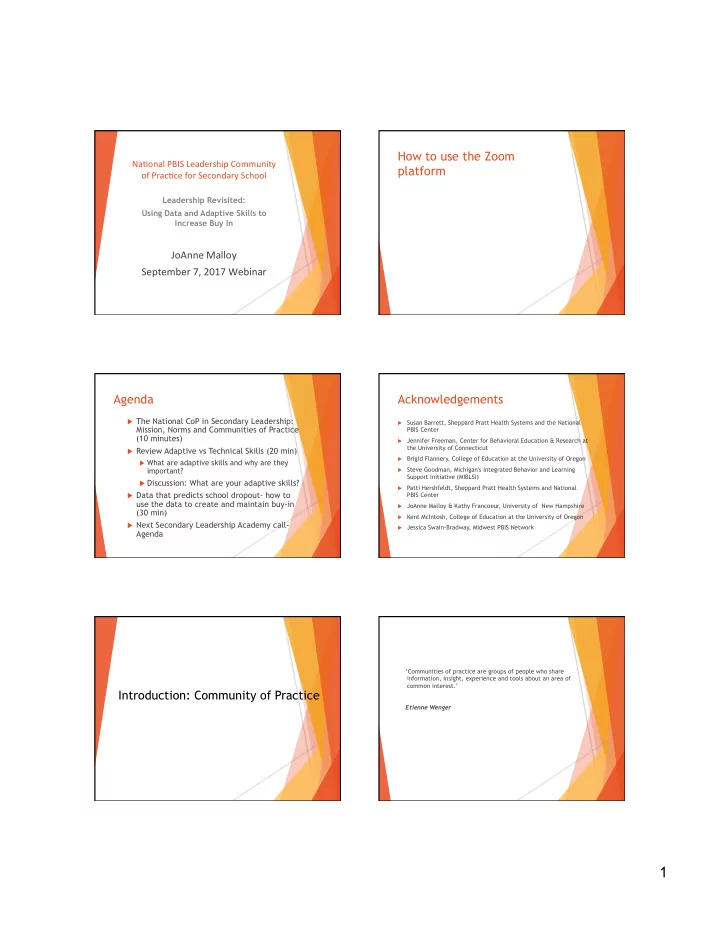
Na$onal PBIS Leadership Community

  • f Prac$ce for Secondary School

Leadership Revisited: Using Data and Adaptive Skills to Increase Buy In

JoAnne Malloy September 7, 2017 Webinar

How to use the Zoom platform Agenda

u The National CoP in Secondary Leadership:

Mission, Norms and Communities of Practice (10 minutes)

u Review Adaptive vs Technical Skills (20 min) u What are adaptive skills and why are they

important?

u Discussion: What are your adaptive skills? u Data that predicts school dropout- how to

use the data to create and maintain buy-in (30 min)

u Next Secondary Leadership Academy call-

Agenda

Acknowledgements

u Susan Barrett, Sheppard Pratt Health Systems and the National

PBIS Center

u Jennifer Freeman, Center for Behavioral Education & Research at

the University of Connecticut

u Brigid Flannery, College of Education at the University of Oregon u Steve Goodman, Michigan's Integrated Behavior and Learning

Support Initiative (MIBLSI)

u Patti Hershfeldt, Sheppard Pratt Health Systems and National

PBIS Center

u JoAnne Malloy & Kathy Francoeur, University of New Hampshire u Kent McIntosh, College of Education at the University of Oregon u Jessica Swain-Bradway, Midwest PBIS Network

Introduction: Community of Practice

‘Communities of practice are groups of people who share information, insight, experience and tools about an area of common interest.’ Etienne Wenger

slide-2
SLIDE 2

2

Interest in High Schools…

u Coaching high school teams u External coaching at a high school- IOWA u RI--- SPDG merging PBIS and RTI- pulling in social

emotional learning--- district level- aligning initiatives

u CA TA Center training – supporting coaching- facilitating

a CoP for high schools

u TN TA Center- supporting PBIS u Aligning SI, MTSS, and PBIS- how to get practices nested

into the MTSS model- communication and data components

u WISC SCTG u Coordinator in WISC---Coaching

What is at the heart of it all?

u the ‘community,’ its membership, relationships

and interactions

u the ‘domain or context,’ its identity and focus u the ‘practice,’ its methods, knowledge and

expertise

u the ‘value’ it brings to its members, the

willingness to learn, contribute to existing knowledge and practice

Why establish a CoP?

u A mechanism to promote rapid sharing of knowledge and

expertise across diverse interest groups

u Provides a forum to explore and test ideas u Opportunity to generate new knowledge and practice u Is responsive to emerging issues and opportunities

*(Cashman, Linehan, Purcell, Rosser, Schultz, & Skalski, 2014)

Major Themes of Our Leadership Academy

u How to gain buy-in u How to align all of our initiatives u How to align PBIS implementation

with CCR and competency-base instruction

u What does implementation look

like? What are the skills needed to implement effectively?

Objectives of Our Community

  • f Practice

u Create a forum to discuss critical issues related to implementation

  • f PBIS in the unique contexts of middle and high schools,

u Share best practices and implementation examples with respect to u Addressing discipline disproportionality, u The integration of mental health and substance abuse supports in schools, u College and career readiness, and u Youth leadership u Professional development models u Team structure and facilitation u Data collection and use u Develop tools and information that will promote best practice in

PBIS leadership.

PBIS National TA Center High School Workgroup

u Jessica Swain-Bradway u Brigid Flannery u Jennifer Freeman u Stephanie Martinez- USF

slide-3
SLIDE 3

3

What are “Adaptive” Challenges?

Adaptive challenges are those that require new learning, those for which there is no clear-cut problem definition and solution. Adaptive challenges require experimentation, discovery and/or adjustment to past practice. Adaptive change is about the human elements of change: values and beliefs, relationships and buy-in or lack thereof. When asking people to think differently, act differently and believe differently, the success rate is

  • ften less than if the solution relies on technical

elements alone…technical information is necessary but not sufficient.

Cashman, et al. (2014). Leading by convening: A blueprint for authentic engagement.

Problems Come Bundled

http://www.ideapartnership.org/

Leading by Convening: A Blueprint for Authentic Engagement

Habits of Interaction Elements of Interaction Coalescing Around Issues Ensuring Relevant Participation Doing the Work Together Adaptive Technical Operational Networking Collaborating Transforming Informing Depth of Interaction

Key Par2cipants Key Advisors Extended Partners Feedback Network Core Team Dissemina2on Web Communica2ons Links

Engaging Everybody

Convene the group. Take responsibility for structuring each convening and follow up. Plan and monitor interac$on. Create engagement strategies. Organize ac$vi$es. Communicate with decision makers. Oversee review and evalua$on. Act as regular contacts for informa$on on the issue. Give advice and help the core team sense issues and adapt ac$vi$es in a variety of contexts. Make opportuni$es for the work to be reviewed within their personal networks. Bring their personal network informa$on back into the work of the Core group. Promote the cross-stakeholder approach to problem iden$fica$on and problem solving. Join the core team periodically when their exper$se is needed Volunteer to become involved and represent the perspec$ve of their organiza$on and/or network. Bring the perspec$ve of their role and/or

  • rganiza$on into the work.

Bring important learnings back to their networks. Iden$fy opportuni$es within their networks to showcase the learning. Hold both their organiza$onal iden$ty and the group iden$ty while interac$ng with the group. Iden$fy other prac$$oners and family members who may become ac$ve Receive informa$on. Redistribute informa$on through newsleUers, news blasts, mee$ngs, etc. Submit informa$on from newsleUers, news blasts, mee$ngs, etc. Customize messages for their par$cular audience.

One Way and Two Way Learning

Plo Plo$ng Learning A ng Learning Ac/vi/es /vi/es in Four Qu Quadrants

Informal Learning From With Formal Learning

slide-4
SLIDE 4

4

19 Operational Decisions Informing Level Networking Level Collaborating Level Transforming Level

Key actions and behaviors that require your attention Sharing/Disseminating: One-way communication Exchanging: Two-way communication Engaging: Working together on the issue over time Committing to approach issues through engagement and consensus building Coalesce the stakeholders around the issue Convener/lead agency identifies the issue and disseminates information in ways that encourage participation. A forum is used to bring a core group of stakeholders together with the intent of gathering feedback to inform decisions on the issue. The core group expands to include a wide array

  • f stakeholders who unite and take joint action
  • n the issue.

There is a unified and unwavering focus on the

  • issue. Trust and respect are evident, even when

there are differences of opinion. The group processes align toward a shared goal. Ensure relevant participation Convener/lead agency identifies stakeholder representatives, and informs them of

  • pportunities to participate.

A core group of stakeholders works with the convener to identify/create an infrastructure for meaningful participation and shared learning. The expanded group of stakeholders recognizes and values the work of others needed to achieve meaningful outcomes. Broad stakeholder networks share ownership and influence in achieving the outcome. Translate work into ways that others participate Convener/lead agency asks stakeholder representatives to disseminate information on the issue A core group of stakeholders uses the infrastructure to exchange information in understandable and mutually respectful ways. The expanded group of stakeholders involves their networks in bridging knowledge and practice. Broad stakeholder networks support their constituents throughout the practice change. Communicate what is changing by actively doing work with the stakeholders Convener/lead agency asks the stakeholder representatives to convey the benefit in making changes throughout their networks. A core group of stakeholders use the infrastructure to exchange information about the changes that are occurring. The expanded group of stakeholders shares the stories of changes achieved because the networks are more engaged in bridging knowledge and practice. Broad stakeholder networks exchange stories of practice change and outcomes. They communicate the changes in ways the advance acceptance and the changes are enthusiastically embraced. Demonstrate what is changing by actively doing the work Stakeholder representatives invite others to participate in discussions on the changes being experienced. A core group of stakeholders intentionally share stories, exchange information and suggest ideas for action. The expanded group of stakeholders embraces shared leadership and participates in joint work across the networks. Within broad stakeholder networks, excellent examples of practice change are routinely

  • bservable.

Creating Active Engagement

Measuring Progress:

Qualitative Rubrics to Quantitative Comparisons

From the Chat:

u What are your adaptive skills? Give examples

IMPLEMENTATION W/ FIDELITY CONTINUUM OF EVIDENCE-BASED INTERVENTIONS CONTENT EXPERTISE & FLUENCY TEAM-BASED IMPLEMENTATION CONTINUOUS PROGRESS MONITORING UNIVERSAL SCREENING DATA-BASED DECISION MAKING & PROBLEM SOLVING

CORE FEATURES MTSS/PBIS

A Systematic, Research-Based Framework

What do you think is getting in the way of PBIS buy in? Using Data to Make Your Case for PBIS

slide-5
SLIDE 5

5

Using Data

Suspension, attendance and course failures are related to one another and strong predictors of high school failure. These indicators are often traced back to a student’s middle school history.

Balfanz, Robert; byrnes, vaughan; and Fox, Joanna (2014)

These data exist in your schools-

u Examples?

Agenda Items for Next Meeting

u Classroom strategies in high schools--- rates for

  • pportunities to respond, feedback and praise…

(Jennifer Freeman)--- Wisconsin Literacy coaches and instructional coaching---(Laurie)---

u Improvement Cycles --- to scale up practices beyond

your early adopters…

u Michele- observational checklist for classroom

teachers---if it’s ready---

Questions? Thank you!

u Evaluate our CoP meeting u Next CoP call is December 7, 12 noon-

1:30 pm est.

u Contact us: u Joanne.malloy@unh.edu u jessica.swainbradway@midwestpbis.

  • rg