1 Entity / Relationship Diagrams Keys in E/R Diagrams Every entity - - PDF document

1
SMART_READER_LITE
LIVE PREVIEW

1 Entity / Relationship Diagrams Keys in E/R Diagrams Every entity - - PDF document

Administrative notes CPSC 534P Background (aka, all you need to know about databases for Dont forget to sign up for a presentation day and one this course in two lectures) discussion day (well decide about other slots after enrollment


slide-1
SLIDE 1

1

CPSC 534P – Background

(aka, all you need to know about databases for this course in two lectures)

Rachel Pottinger September 12 and 14, 2011

Administrative notes

Don‟t forget to sign up for a presentation day and one discussion day (we‟ll decide about other slots after enrollment has settled down) Anyone having topics they‟d like for student request days should send those to me today Sign up for the mailing list – mail majordomo@cs.ubc.ca with “subscribe cpsc534p” in the body

HW 1 is on the web, due beginning of class a week from today General theory – trying to make sure you understand basics and have thought about it – not looking for one, true, answer. State any assumptions you make If you can‟t figure out a detail, write an explanation as to what you did and why.

Office hours?

Overview of the next two classes

Entity Relationship (ER) diagrams Relational databases Object Oriented Databases (OODBs) XML Other data types Database internals (Briefly) Potpourri

Levels of Abstraction

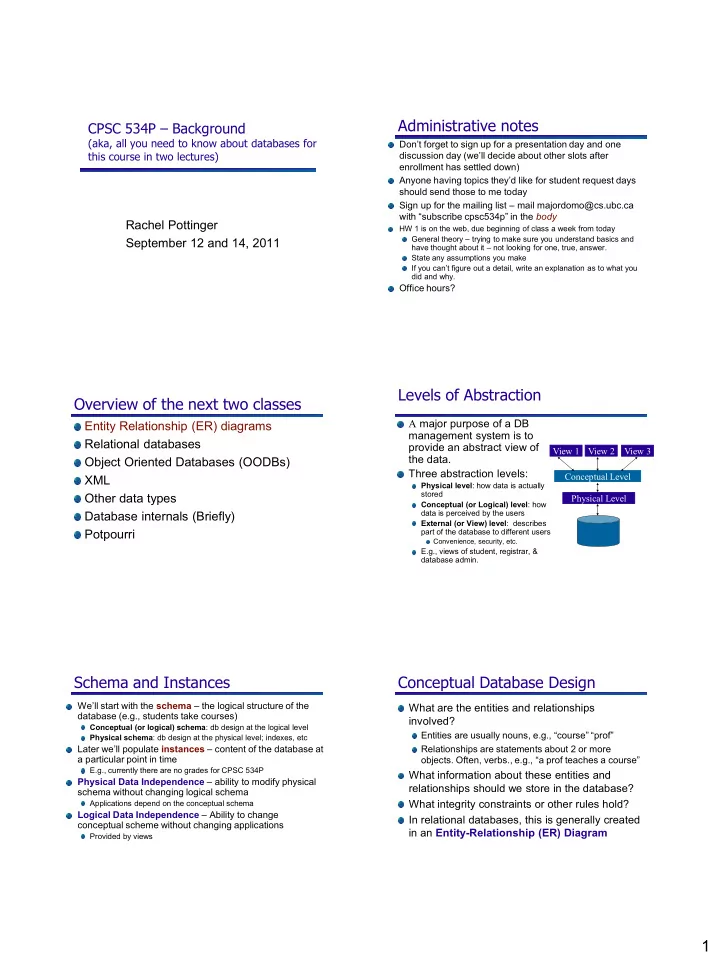
A major purpose of a DB management system is to provide an abstract view of the data. Three abstraction levels:

Physical level: how data is actually stored Conceptual (or Logical) level: how data is perceived by the users External (or View) level: describes part of the database to different users

Convenience, security, etc.

E.g., views of student, registrar, & database admin.

View 1 View 2 View 3 Conceptual Level Physical Level

Schema and Instances

We‟ll start with the schema – the logical structure of the database (e.g., students take courses)

Conceptual (or logical) schema: db design at the logical level Physical schema: db design at the physical level; indexes, etc

Later we‟ll populate instances – content of the database at a particular point in time

E.g., currently there are no grades for CPSC 534P

Physical Data Independence – ability to modify physical schema without changing logical schema

Applications depend on the conceptual schema

Logical Data Independence – Ability to change conceptual scheme without changing applications

Provided by views

Conceptual Database Design

What are the entities and relationships involved?

Entities are usually nouns, e.g., “course” “prof” Relationships are statements about 2 or more

  • bjects. Often, verbs., e.g., “a prof teaches a course”

What information about these entities and relationships should we store in the database? What integrity constraints or other rules hold? In relational databases, this is generally created in an Entity-Relationship (ER) Diagram

slide-2
SLIDE 2

2 Entity / Relationship Diagrams

Entities Attributes Relationships between entities Product address buys

Keys in E/R Diagrams

Every entity set must have a key which is identified by an underline

Product name category price address name sin Person buys makes employs Company Product name category stockprice name price

Roles in Relationships

Purchase What if we need an entity set twice in one relationship? Product Person Store salesperson buyer

Attributes on Relationships

Purchase Product Person Store date Product name category price isa isa Educational Product Software Product Age Group platforms

Subclasses in E/R Diagrams

slide-3
SLIDE 3

3 Summarizing ER diagrams

Basics: entities, relationships, and attributes Also showed inheritance Has things other things like cardinality Used to design databases... But how do you store data in them?

Overview of the next two classes

Entity Relationship (ER) diagrams Relational databases

How did we get here? What‟s in a relational schema? From ER to relational Query Languages

Object Oriented Databases (OODBs) XML Other data types Database internals (Briefly) Potpourri

How did we get the relational model?

Before the relational model, there were two main contenders

Network databases Hierarchical databases

Network databases had a complex data model Hierarchical databases integrated the application in the data model

Example Hierarchical Model

Prime Minister Parliament Government Province Election Elections Won Served Government Headed Admitted During Native Sons

Example IMS (Hierarchical) query: Print the names of all the provinces admitted during a Liberal Government

DLITPLI:PROCEDURE (QUERY_PCB) OPTIONS (MAIN); DECLARE QUERY_PCB POINTER; /*Communication Buffer*/ DECLARE 1 PCB BASED(QUERY_PCB), 2 DATA_BASE_NAME CHAR(8), 2 SEGMENT_LEVEL CHAR(2), 2 STATUS_CODE CHAR(2), 2 PROCESSING_OPTIONS CHAR(4), 2 RESERVED_FOR_DLI FIXED BIRARY(31,0), 2 SEGMENT_NAME_FEEDBACK CHAR(8) 2 LENGTH_OF_KEY_FEEDBACK_AREA FIXED BINARY(31,0), 2 NUMBER_OF_SENSITIVE_SEGMENTS FIXED BINARY(31,0), 2 KEY_FEEDBACK_AREA CHAR(28); /* I/O Buffers*/ DECLARE PRES_IO_AREA CHAR(65), 1 PRESIDENT DEFINED PRES_IO_AREA, 2 PRES_NUMBER CHAR(4), 2 PRES_NAME CHAR(20), 2 BIRTHDATE CHAR(8) 2 DEATH_DATE CHAR(8), 2 PARTY CHAR(10), 2 SPOUSE CHAR(15); DECLARE SADMIT_IO_AREA CHAR(20), 1 province_ADMITTED DEFINED SADMIT_IO_AREA, 2 province_NAME CHAR(20); /* Segment Search Arguments */ DECLARE 1 PRESIDENT_SSA STATIC UNALIGNED, 2 SEGMENT_NAME CHAR(8) INIT('PRES '), 2 LEFT_PARENTHESIS CHAR (1) INIT('('), 2 FIELD_NAME CHAR(8) INIT ('PARTY '), 2 CONDITIONAL_OPERATOR CHAR (2) INIT('='), 2 SEARCH_VALUE CHAR(10) INIT ('Liberal '), 2 RIGHT_PARENTHESIS CHAR(1) INIT(')'); DECLARE 1 province_ADMITTED_SSA STATIC UNALIGNED, 2 SEGMENT_NAME CHAR(8) INIT('SADMIT '); /* Some necessary variables */ DECLARE GU CHAR(4) INIT('GU '), GN CHAR(4) INIT('GN '), GNP CHAR(4) INIT('GNP '), FOUR FIXED BINARY (31) INIT (4), SUCCESSFUL CHAR(2) INIT(' '), RECORD_NOT_FOUND CHAR(2) INIT('GE'); /*This procedure handles IMS error conditions */ ERROR;PROCEDURE(ERROR_CODE); * * * END ERROR; /*Main Procedure */ CALL PLITDLI(FOUR,GU,QUERY_PCB,PRES_IO_AREA,PRESIDENT_SSA); DO WHILE(PCB.STATUS_CODE=SUCCESSFUL); CALL PLITDLI(FOUR,GNP,QUERY_PCB,SADMIT_IO_AREA,province_ADMITTED_SSA); DO WHILE(PCB.STATUS_CODE=SUCCESSFUL); PUT EDIT(province_NAME)(A); CALL PLITDLI(FOUR,GNP,QUERY_PCB,SADMIT_IO_AREA,province_ADMITTED_SSA); END; IF PCB.STATUS_CODE NOT = RECORD_NOT_FOUND THEN DO; CALL ERROR(PCB.STATUS_CODE); RETURN; END; CALL PLITDLI(FOUR,GN,QUERY_PCB,PRES_IO_AREA,PRESDIENT_SSA); END; IF PCB.STATUS_CODE NOT = RECORD_NOT_FOUND THEN DO; CALL ERROR(PCB.STATUS_CODE); RETURN; END; END DLITPLI;

Relational model to the rescue!

Introduced by Edgar Codd (IBM) in 1970 Most widely used model today.

Vendors: IBM, Informix, Microsoft, Oracle, Sybase, etc.

Former Competitor: object-oriented model

ObjectStore, Versant, Ontos A synthesis emerged: object-relational model

Informix Universal Server, UniSQL, O2, Oracle, DB2

Recent competitor: XML data model

slide-4
SLIDE 4

4 Key points of the relational model

Exceedingly simple to understand – main abstraction is a table Query language separate from application language

General form is simple Many bells and whistles

Structure of Relational Databases

Relational database: a set of relations Relation: made up of 2 parts:

Schema : specifies name of relation, plus name and domain (type) of each field (or column or attribute).

e.g., Student (sid: string, name: string, major: string).

Instance : a table, with rows and columns. #Rows = cardinality, #fields = dimension / arity

Relational Database Schema: collection of schemas in the database Database Instance: a collection of instances of its relations (e.g., currently no grades in CPSC 534P)

Example of a Relation Instance

Name Price Category Manufacturer gizmo $19.99 gadgets GizmoWorks Power gizmo $29.99 gadgets GizmoWorks SingleTouch $149.99 photography Canon MultiTouch $203.99 household Hitachi Tuples or rows Attribute names or columns Relation or table Order of rows isn’t important Formal Definition: Product(Name: string, Price: double, Category: string, Manufacturer: string)

Product

Overview of the next two classes

Entity Relationship (ER) diagrams Relational databases

How did we get here? What‟s in a relational schema? From ER to relational Query Languages

Object Oriented Databases (OODBs) XML Other data types Database internals (Briefly) Potpourri

From E/R Diagrams to Relational Schema

Entity set  relation Relationship  relation

Entity Set to Relation

Product name category price Product(name, category, price) name category price gizmo gadgets $19.99

slide-5
SLIDE 5

5 Relationships to Relations

makes Company Product name category Stock price name Makes(product-name, product-category, company-name, year) Product-name Product-Category Company-name Starting-year gizmo gadgets gizmoWorks 1963 Start Year price (watch out for attribute name conflicts)

Overview of the next two classes

Entity Relationship (ER) diagrams Relational databases

How did we get here? What‟s in a relational schema? From ER to relational Query Languages

Object Oriented Databases (OODBs) XML Other data types Database internals (Briefly) Potpourri

Relational Query Languages

A major strength of the relational model: simple, powerful querying of data. Queries can be written intuitively; DBMS is responsible for efficient evaluation.

Precise semantics for relational queries. Optimizer can re-order operations, and still ensure that the answer does not change.

We‟ll look at 3: relational algebra, SQL, and Datalog

Querying – Relational Algebra

Select ()- chose tuples from a relation Project ()- chose attributes from relation Join (⋈) - allows combining of 2 relations Set-difference ( ) Tuples in relation 1, but not in relation 2. Union ( ) Cartesian Product (×) Each tuple of R1 with each tuple in R2

Find products where the manufacturer is GizmoWorks

Name Price Category Manufacturer Gizmo $19.99 Gadgets GizmoWorks Powergizmo $29.99 Gadgets GizmoWorks SingleTouch $149.99 Photography Canon MultiTouch $203.99 Household Hitachi

Product

Name Price Category Manufacturer Gizmo $19.99 Gadgets GizmoWorks Powergizmo $29.99 Gadgets GizmoWorks

Selection: σManufacturer = GizmoWorksProduct Find the Name, Price, and Manufacturers of products whose price is greater than 100

Name Price Category Manufacturer Gizmo $19.99 Gadgets GizmoWorks Powergizmo $29.99 Gadgets GizmoWorks SingleTouch $149.99 Photography Canon MultiTouch $203.99 Household Hitachi

Product

Name Price Manufacturer SingleTouch $149.99 Canon MultiTouch $203.99 Hitachi

Selection + Projection: πName, Price, Manufacturer (σPrice > 100Product)

slide-6
SLIDE 6

6

Find names and prices of products that cost less than $200 and have Japanese manufacturers

Name Price Category Manufacturer Gizmo $19.99 Gadgets GizmoWorks Powergizmo $29.99 Gadgets GizmoWorks SingleTouch $149.99 Photography Canon MultiTouch $203.99 Household Hitachi

Product Company

Cname StockPrice Country GizmoWorks 25 USA Canon 65 Japan Hitachi 15 Japan Name Price SingleTouch $149.99

πName, Price((σPrice < 200Product)⋈ Manufacturer

= Cname (σCountry = „Japan‟Company))

When are two relations related?

You guess they are I tell you so Constraints say so

A key is a set of attributes whose values are unique; we underline a key Product(Name, Price, Category, Manfacturer) Foreign keys are a method for schema designers to tell you so

A foreign key states that an attribute is a reference to the key

  • f another relation

ex: Product.Manufacturer is foreign key of Company Gives information and enforces constraint

The SQL Query Language

Structured Query Language The standard relational query language Developed by IBM (System R) in the 1970s Standards:

SQL-86 SQL-89 (minor revision) SQL-92 (major revision, current standard) SQL-99 (major extensions)

SQL

Data Manipulation Language (DML)

Query one or more tables Insert/delete/modify tuples in tables

Data Definition Language (DDL)

Create/alter/delete tables and their attributes

Transact-SQL

Idea: package a sequence of SQL statements  server

SQL basics

Basic form: (many many more bells and whistles in addition) Select attributes From relations (possibly multiple, joined) Where conditions (selections)

SQL – Selections

SELECT * FROM Company WHERE country=“Canada” AND stockPrice > 50 Some things allowed in the WHERE clause: attribute names of the relation(s) used in the FROM. comparison operators: =, <>, <, >, <=, >= apply arithmetic operations: stockPrice*2

  • perations on strings (e.g., “||” for concatenation).

Lexicographic order on strings. Pattern matching: s LIKE p Special stuff for comparing dates and times.

slide-7
SLIDE 7

7 SQL – Projections

SELECT name AS company, stockPrice AS price FROM Company WHERE country=“Canada” AND stockPrice > 50 SELECT name, stock price FROM Company WHERE country=“Canada” AND stockPrice > 50 Select only a subset of the attributes Rename the attributes in the resulting table

SQL – Joins

SELECT name, store FROM Person, Purchase WHERE name=buyer AND city=“Vancouver” AND product=“gizmo” Product ( name, price, category, maker) Purchase (buyer, seller, store, product) Company (name, stock price, country) Person( name, phone number, city)

Selection: σManufacturer = GizmoWorks(Product)

Name Price Category Manufacturer Gizmo $19.99 Gadgets GizmoWorks Powergizmo $29.99 Gadgets GizmoWorks SingleTouch $149.99 Photography Canon MultiTouch $203.99 Household Hitachi

Product

Name Price Category Manufacturer Gizmo $19.99 Gadgets GizmoWorks Powergizmo $29.99 Gadgets GizmoWorks

What’s the SQL?

Selection + Projection: πName, Price, Manufacturer (σPrice > 100Product)

Name Price Category Manufacturer Gizmo $19.99 Gadgets GizmoWorks Powergizmo $29.99 Gadgets GizmoWorks SingleTouch $149.99 Photography Canon MultiTouch $203.99 Household Hitachi

Product

Name Price Manufacturer SingleTouch $149.99 Canon MultiTouch $203.99 Hitachi

What’s the SQL?

π Name, Price((σPrice <= 200Product)⋈ Manufacturer

= Cname (σCountry = ‘Japan’Company))

Name Price Category Manufacturer Gizmo $19.99 Gadgets GizmoWorks Powergizmo $29.99 Gadgets GizmoWorks SingleTouch $149.99 Photography Canon MultiTouch $203.99 Household Hitachi

Product

Company

Cname StockPrice Country GizmoWorks 25 USA Canon 65 Japan Hitachi 15 Japan Name Price SingleTouch $149.99

What’s the SQL?

Administrative notes

Remember: the 1st homework is due beginning of class Monday Remember: the first paper responses are due on Sunday at 8pm The goal is NOT to only have a summary. Having a good summary will get you a 2 (85%). To get a 3 (100%) you have to show that you‟re thinking critically about the paper. I will not grade this one, but I‟ll tell you what I‟d give you if I were to grade it Look at course website for samples

DB-talks: Fridays, 2-3pm, ICICS/CS 238

slide-8
SLIDE 8

8

Querying – Datalog (Our final query language)

Enables recursive queries More convenient for analysis Some people find it easier to understand Without recursion but with negation it is equivalent in power to relational algebra and SQL Limited version of Prolog (no functions)

Datalog Rules and Queries

A Datalog rule has the following form: head :- atom1, atom2, …, atom,… You can read this as then :- if ... ExpensiveProduct(N) :- Product(N,P,C,M), P > $10 CanadianProduct(N) :- Product(N,P,C,M), Company(M, SP, “Canada”) IntlProd(N) :- Product(N,M,P), NOT Company(M, SP, “Canada”), Company(M1,SP,C) Relations: Product ( name, price, category, maker) Purchase (buyer, seller, store, product) Company (name, stock price, country) Person( name, phone number, city) Negated subgoal Arithmetic comparison or interpreted predicate

Conjunctive Queries

A subset of Datalog Only relations appear in the right hand side of rules No negation Functionally equivalent to Select, Project, Join queries Very popular in modeling relationships between databases

Selection: σManufacturer = GizmoWorks(Product)

Name Price Category Manufacturer Gizmo $19.99 Gadgets GizmoWorks Powergizmo $29.99 Gadgets GizmoWorks SingleTouch $149.99 Photography Canon MultiTouch $203.99 Household Hitachi

Product

Name Price Category Manufacturer Gizmo $19.99 Gadgets GizmoWorks Powergizmo $29.99 Gadgets GizmoWorks

What’s the Datalog?

Selection + Projection: πName, Price, Manufacturer (σPrice > 100Product)

Name Price Category Manufacturer Gizmo $19.99 Gadgets GizmoWorks Powergizmo $29.99 Gadgets GizmoWorks SingleTouch $149.99 Photography Canon MultiTouch $203.99 Household Hitachi

Product

Name Price Manufacturer SingleTouch $149.99 Canon MultiTouch $203.99 Hitachi

What’s the Datalog?

πName,Price((σPrice <= 200Product)⋈ Manufacturer =

Cname (σCountry = ‘Japan’Company))

Name Price Category Manufacturer Gizmo $19.99 Gadgets GizmoWorks Powergizmo $29.99 Gadgets GizmoWorks SingleTouch $149.99 Photography Canon MultiTouch $203.99 Household Hitachi

Product Company

Cname StockPrice Country GizmoWorks 25 USA Canon 65 Japan Hitachi 15 Japan Name Price SingleTouch $149.99

What’s the Datalog?

slide-9
SLIDE 9

9 Bonus Relational Goodness: Views

Views are stored queries treated as relations, Virtual views are not physically stored. Materialized views are stored They are used (1) to define conceptually different views of the database and (2) to write complex queries simply. View: purchases of telephony products:

CREATE VIEW telephony-purchases AS SELECT product, buyer, seller, store FROM Purchase, Product WHERE Purchase.product = Product.name AND Product.category = “telephony”

Summarizing/Rehashing Relational DBs

Relational perspective: Data is stored in relations. Relations have attributes. Data instances are tuples. SQL perspective: Data is stored in tables. Tables have

  • columns. Data instances are rows.

Query languages

Relational algebra – mathematical base for understanding query languages SQL – most commonly used Datalog – based on Prolog, very popular with theoreticians

Bonus! Views allow complex queries to be written simply

Outline

Entity Relationship (ER) diagrams Relational databases Object Oriented Databases (OODBs) XML Other data types Database internals (Briefly) Potpourri

Object-Oriented DBMS’s

Started late 80‟s Main idea:

Toss the relational model! Use the OO model – e.g., C++ classes

Standards group: ODMG = Object Data Management Group. OQL = Object Query Language, tries to imitate SQL in an OO framework.

The OO Plan

ODMG imagines OO-DBMS vendors implementing an OO language like C++ with extensions (OQL) that allow the programmer to transfer data between the database and “host language” seamlessly. A brief diversion: the impedance mismatch

OO Implementation Options

Build a new database from scratch (O2)

Elegant extension of SQL Later adopted by ODMG in the OQL language Used to help build XML query languages

Make a programming language persistent (ObjectStore)

No query language Niche market

We‟ll see a few others

slide-10
SLIDE 10

10 ODL

ODL defines persistent classes, whose

  • bjects may be stored permanently in the

database.

ODL classes look like Entity sets with binary relationships, plus methods. ODL class definitions are part of the extended, OO host language.

ODL – remind you of anything?

interface Student extends Person (extent Students) { attribute string major; relationship Set<Course> takes inverse stds;} interface Student extends Person (extent Students) { attribute string major; relationship Set<Course> takes inverse stds;} interface Person (extent People key sin) { attribute string sin; attribute string dept; attribute string name;} interface Person (extent People key sin) { attribute string sin; attribute string dept; attribute string name;} interface Course (extent Crs key cid) { attribute string cid; attribute string cname; relationship Person instructor; relationship Set<Student> stds inverse takes;} interface Course (extent Crs key cid) { attribute string cid; attribute string cname; relationship Person instructor; relationship Set<Student> stds inverse takes;}

Why did OO Fail?

Why are relational databases so popular?

Very simple abstraction; don‟t have to think about programming when storing data. Very well optimized

Relational db are very well entrenched – OODBs had not enough advantages, and no good exit strategy

Merging Relational and OODBs

Object-oriented models support interesting data types – not just flat files.

Maps, multimedia, etc.

The relational model supports very-high- level queries. Object-relational databases are an attempt to get the best of both. All major commercial DBs today have OR versions – full spec in SQL99, but your mileage may vary.

Outline

Entity Relationship (ER) diagrams Relational databases Object Oriented Databases (OODBs) XML Other data types Database internals (Briefly) Potpourri

XML

eXtensible Markup Language XML 1.0 – a recommendation from W3C, 1998 Roots: SGML (from document community - works great for them; from db perspective, very nasty). After the roots: a format for sharing data

slide-11
SLIDE 11

11 XML is self-describing

Schema elements become part of the data

In XML <persons>, <name>, <phone> are part of the data, and are repeated many times Relational schema: persons(name,phone) defined separately for the data and is fixed

Consequence: XML is very flexible

Why XML is of Interest to Us

XML is semistructured and hierarchical XML is just syntax for data

Note: we have no syntax for relational data

This is exciting because:

Can translate any data to XML Can ship XML over the Web (HTTP) Can input XML into any application Thus: data sharing and exchange on the Web

XML Data Sharing and Exchange

application relational data

Transform Integrate Warehouse

XML Data WEB (HTTP)

application application legacy data

  • bject-relational

From HTML to XML

HTML describes the presentation

HTML

<h1> Bibliography </h1> <p> <i> Foundations of Databases </i> Abiteboul, Hull, Vianu <br> Addison Wesley, 1995 <p> <i> Data on the Web </i> Abiteoul, Buneman, Suciu <br> Morgan Kaufmann, 1999 <h1> Bibliography </h1> <p> <i> Foundations of Databases </i> Abiteboul, Hull, Vianu <br> Addison Wesley, 1995 <p> <i> Data on the Web </i> Abiteoul, Buneman, Suciu <br> Morgan Kaufmann, 1999

XML

<bibliography> <book> <title> Foundations… </title> <author> Abiteboul </author> <author> Hull </author> <author> Vianu </author> <publisher> Addison Wesley </publisher> <year> 1995 </year> </book> … </bibliography> <bibliography> <book> <title> Foundations… </title> <author> Abiteboul </author> <author> Hull </author> <author> Vianu </author> <publisher> Addison Wesley </publisher> <year> 1995 </year> </book> … </bibliography>

XML describes the content

slide-12
SLIDE 12

12 XML Document

<data> <person id=“o555” > <name> Mary </name> <address> <street> Maple </street> <no> 345 </no> <city> Seattle </city> </address> </person> <person> <name> John </name> <address> Thailand </address> <phone> 23456 </phone> <married/> </person> </data> <data> <person id=“o555” > <name> Mary </name> <address> <street> Maple </street> <no> 345 </no> <city> Seattle </city> </address> </person> <person> <name> John </name> <address> Thailand </address> <phone> 23456 </phone> <married/> </person> </data>

person elements name elements attributes

XML Terminology

Elements

enclosed within tags:

<person> … </person>

nested within other elements:

<person> <address> … </address> </person>

can be empty

<married></married> abbreviated as <married/>

can have Attributes

<person id=“0005”> … </person>

XML document has as single ROOT element

XML as a Tree !!

<data> <person id=“o555” > <name> Mary </name> <address> <street> Maple </street> <no> 345 </no> <city> Seattle </city> </address> </person> <person> <name> John </name> <address> Thailand </address> <phone> 23456 </phone> </person> </data> <data> <person id=“o555” > <name> Mary </name> <address> <street> Maple </street> <no> 345 </no> <city> Seattle </city> </address> </person> <person> <name> John </name> <address> Thailand </address> <phone> 23456 </phone> </person> </data>

data person person Mary name address street no city Maple 345 Seattle name address John Thai phone 23456 id

  • 555

Element node Text node Attribute node

Minor Detail: Order matters !!!

Relational Data as XML

<persons> <person> <name>John</name> <phone> 3634</phone> </person> <person> <name>Sue</name> <phone> 6343</phone> </person> <person> <name>Dick</name> <phone> 6363</phone> </person> </persons> <persons> <person> <name>John</name> <phone> 3634</phone> </person> <person> <name>Sue</name> <phone> 6343</phone> </person> <person> <name>Dick</name> <phone> 6363</phone> </person> </persons>

n a m e p h o n e J o h n 3 6 3 4 S u e 6 3 4 3 D i c k 6 3 6 3

person

person person person name name name phone phone phone “John” 3634 “Sue” “Dick” 6343 6363 persons

XML:

XML is semi-structured

Missing elements: Could represent in a table with nulls

<person> <name> John</name> <phone>1234</phone> </person> <person> <name>Joe</name> </person> <person> <name> John</name> <phone>1234</phone> </person> <person> <name>Joe</name> </person>  no phone ! name phone John 1234 Joe

  • XML is semi-structured

Repeated elements Impossible in tables:

<person> <name> Mary</name> <phone>2345</phone> <phone>3456</phone> </person> <person> <name> Mary</name> <phone>2345</phone> <phone>3456</phone> </person>  two phones ! name phone Mary 2345 3456

???

slide-13
SLIDE 13

13 XML is semi-structured

Elements with different types in different

  • bjects

Heterogeneous collections:

<persons> can contain both <person>s and <customer>s

<person> <name> <first> John </first> <last> Smith </last> </name> <phone>1234</phone> </person> <person> <name> <first> John </first> <last> Smith </last> </name> <phone>1234</phone> </person>

 structured name !

Summarizing XML

XML has first class elements and second class attributes XML is semi-structured XML is nested XML is a tree XML is a huge buzzword Will XML replace relational databases?

Outline

Entity Relationship (ER) diagrams Relational databases Object Oriented Databases (OODBs) XML Other data types Database internals (Briefly) Potpourri

Other data formats

Makefiles Forms Application code What format is your data in?

Outline

Entity Relationship (ER) diagrams Relational databases Object Oriented Databases (OODBs) XML Other data types Database internals (Briefly)

Query Optimization & Execution

Potpourri

How SQL Gets Executed: Query Execution Plans

Select Name, Price From Product, Company Where Manufacturer = Cname AND Price <= 200 AND Country = „Japan‟ Product Company ⋈

Manufacturer = Cname

σPrice <= 200 ^ Country = „Japan‟ πName, Price Query optimization also specifies the algorithms for each

  • perator; then queries can be executed
slide-14
SLIDE 14

14 Overview of Query Optimization

Plan: Tree of ordered Relational Algebra operators and choice of algorithm for each operator Two main issues:

For a given query, what plans are considered?

Algorithm to search plan space for cheapest (estimated) plan.

How is the cost of a plan estimated?

Ideally: Want to find best plan. Practically: Avoid worst plans. Some tactics

Do selections early Use materialized views Use Indexes

Tree-Based Indexes

``Find all students with gpa > 3.0‟‟

If data is sorted, do binary search to find first such student, then scan to find others. Cost of binary search can be quite high.

Simple idea: Create an `index‟ file.

Page 1 Page 2 Page N Page 3

Data File

k2 kN k1

Index File

Example B+ Tree

Search begins at root, and key comparisons direct it to a leaf. Search for 5*, 15*, all data entries >= 24* ...

17 24 30 2* 3* 5* 7* 14* 16* 19* 20* 22* 24* 27* 29* 33* 34* 38* 39* 13

Query Execution

Now that we have the plan, what do we do with it?

How do joins work? How do deal with paging in data, etc.

New research covers new paradigms where interleaved with optimization

Outline

Entity Relationship (ER) diagrams Relational databases Object Oriented Databases (OODBs) XML Other data types Database internals (Briefly)

Query Optimization & Execution

Potpourri

Outline

Entity Relationship (ER) diagrams Relational databases Object Oriented Databases (OODBs) XML Other data types Database internals (Briefly) Potpourri

Complexity

slide-15
SLIDE 15

15 Complexity

Characterize algorithms by how much time they take The first major distinction: Polynomial (P) vs. Non- deterministic Polynomial (NP) Agorithms in P can be solved in P. time in size of input

E.g., merge sort is O(n log n) (where n = # of items)

NP algorithms can be solved in NP time; equivalently, they can be verified in in polynomial time NP-complete = a set of algorithms that is as hard as possible but still in NP

E.g., Traveling Salesperson Problem

Co-NP refers to algorithms whose converses are NP complete

Complexity Ice Cream Cone

P NP Co- NP

How to read a research paper Here‟s how I do it:

Read the intro Read as much as I can stand/process Read the related work Read the experiments Read the conclusions Try to write up a summary Go back through and see if it makes sense

http://cseweb.ucsd.edu/~wgg/CSE210/ho wtoread.html

Plagiarism: the worst part of teaching

Your work is to be your work. If you take ideas from somewhere, you must cite it (e.g., if this slide is citation [1], you could say Rachel thinks plagiarism is bad [1]) If you take words from somewhere else, they have to be quoted and cited (e.g., Rachel says that plagiarism is “the worst part of teaching.” [1]) It‟s wrong, and usually makes crappy results

  • anyway. So don‟t do it.

Now what?

Time to read papers Prepare paper responses – it‟ll help you focus on the paper, and allow for the discussion leader to prepare better discussion You all have different backgrounds, interests, and insights. Bring them into class!