1 Research Library Partnership: Library Assessment Interest Group - - PDF document

1
SMART_READER_LITE
LIVE PREVIEW

1 Research Library Partnership: Library Assessment Interest Group - - PDF document

Webinar Series: Evaluating and Sharing Your Librarys Impact Part 1: Part 3: Part 2: April 24 August 14 October 3 Kara Reuter Linda Melissa Hofschire Bowles-Terry User-centered Assessment: Digging into Take Action: Using


slide-1
SLIDE 1

1

#libdata4impact

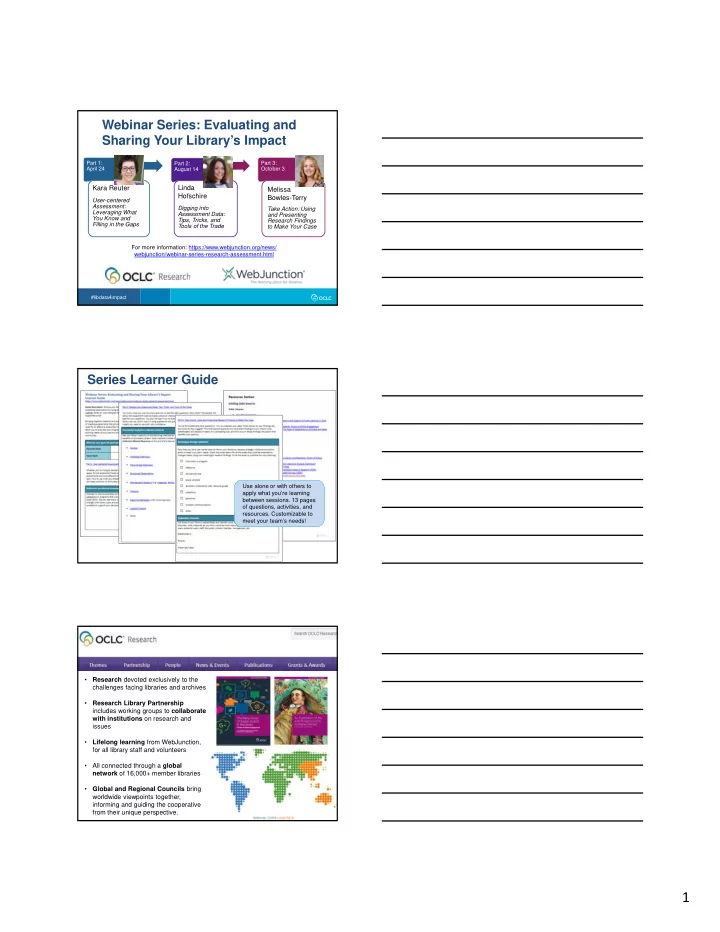
Webinar Series: Evaluating and Sharing Your Library’s Impact

Part 1: April 24

Kara Reuter

User-centered Assessment: Leveraging What You Know and Filling in the Gaps Part 2: August 14

Linda Hofschire

Digging into Assessment Data: Tips, Tricks, and Tools of the Trade Part 3: October 3

Melissa Bowles-Terry

Take Action: Using and Presenting Research Findings to Make Your Case For more information: https://www.webjunction.org/news/ webjunction/webinar-series-research-assessment.html

Series Learner Guide

Use alone or with others to apply what you’re learning between sessions. 13 pages

  • f questions, activities, and
  • resources. Customizable to

meet your team’s needs!

  • Research devoted exclusively to the

challenges facing libraries and archives

  • Research Library Partnership

includes working groups to collaborate with institutions on research and issues

  • Lifelong learning from WebJunction,

for all library staff and volunteers

  • All connected through a global

network of 16,000+ member libraries

  • Global and Regional Councils bring

worldwide viewpoints together, informing and guiding the cooperative from their unique perspective.

slide-2
SLIDE 2

2

#libdata4impact

Research Library Partnership: Library Assessment Interest Group

  • The OCLC Research Library Partnership invites librarians

at partner institutions to participate in a new Library Assessment Interest Group, beginning in April 2018.

  • This interest group will accompany and extend the

Webinar Series: Evaluating and Sharing Your Library's Impact

Lynn Silipigni Connaway

Senior Research Scientist and Director of User Research, OCLC Research connawal@oclc.org @LynnConnaway

#libdata4impact

OCLC Research

slide-3
SLIDE 3

3

#libdata4impact

Some Initial Questions

  • 1. What is your definition of assessment?
  • 2. What comes to mind when you hear the term

“assessment”?

  • 3. What benefits do you see for assessment?
  • 4. What are your concerns?

#libdata4impact

Why Assessment?

  • Answers questions:
  • What do users/stakeholders want & need?
  • How can services/programs better meet

needs?

  • Is what we do working?
  • Could we do better?
  • What are problem areas?
  • Traditional stats don’t tell whole story

#libdata4impact

Importance of Assessment

“Librarians are increasingly called upon to document and articulate the value of academic and research libraries and their contribution to institutional mission and goals.”

(ACRL Value of Academic Libraries, 2010, p. 6)

Association of College and Research Libraries. (2010) Value of Academic Libraries: A Comprehensive Research Review and Report. Researched by Megan Oakleaf. Chicago: Association of College and Research Libraries. http://www.ala.org/acrl/sites/ala.org.acrl/files/content/issues/value/val_report.pdf

slide-4
SLIDE 4

4

#libdata4impact

Steps in Assessment Process

  • 1. Why?
  • Identify purpose
  • 2. Who?
  • Identify team
  • 3. How?
  • Choose model/approach/method
  • 4. Commit!
  • Training/planning

#libdata4impact

Outcomes Assessment Basics

Outcomes: “The ways in which library users are changed as a result of their contact with the library’s resources and programs.”

(ALA/ACRL. 1998)

“Libraries cannot demonstrate institutional value to maximum effect until they define outcomes of institutional relevance and then measure the degree to which they attain them.”

(Kaufman & Watstein, 2008, p. 227)

ALA/ACRL. (1998). Task Force on Academic Library Outcomes Assessment Report. Kaufman, P., & Watstein, S. B. (2008). Library Value (Return on Investment, ROI) and the Challenge of Placing a Value on Public Services. Reference Services Review, 36(3), 226-231.

#libdata4impact

Outputs & Inputs

  • Outputs
  • Quantify the work done
  • Don’t relate factors to overall effectiveness
  • Inputs
  • Raw materials
  • Measured against standards
  • Insufficient for overall assessment
slide-5
SLIDE 5

5

#libdata4impact

Principles for Applying Outcomes Assessment

  • Center on users
  • Assess changes in service/resources use
  • Relate to inputs - identify “best practices”
  • Use variety of methods to corroborate

conclusions

  • Choose small number of outcomes
  • Need not address every aspect of service
  • Adopt continuous process

#libdata4impact

What We Know About Assessment

  • Ongoing process to understand & improve

initiatives

  • Librarians are busy with day-to-day work &

assessment can become another burden

  • Can build on what your library has

already done

Digital Library Manager, Worthington Libraries (OH)

Kara Reuter Leveraging What You Know and Filling in the Gaps

slide-6
SLIDE 6

6

#libdata4impact

Anecdotes Casual observation Majority of one Fine for certain circumstances…

Informal assessment

“Suggestion Box” by John Pavelka, is licensed under CC BY 2.0

#libdata4impact

Data driven Evidence based Accepted methods Recognized as rigorous Generalizable

Formal assessment

“Lego Alien DNA extractor diorama” by Paul Hartzog, is licensed under CC BY-SA 2.0

#libdata4impact

Understand a phenomenon Build meaning Take a snapshot Tell a story

Goal of assessment

“building blocks” by Elisa Maser is licensed under CC BY 2.0

slide-7
SLIDE 7

7

#libdata4impact

  • 1. Define the

problem

  • 2. Environmental

scanning

  • 3. Prepare the plan
  • 4. Collect data
  • 5. Analyze data
  • 6. Interpret and

report

Process

“Steps” by Phil Whitehouse is licensed under CC BY 2.0 Valparaiso, Chile

#libdata4impact

Carney, T. F. (1990). “The Ladder of Analytical Abstraction.” In Miles, M. B. & Huberman, A. M. (1994). Qualitative Data Analysis: An Expanded Sourcebook (2nd ed.). Thousand Oaks, CA: Sage. [p. 92]

Process

Ladder of abstraction

#libdata4impact

Creswell, J. W. (1998). Qualitative Inquiry and Research Design: Choosing Among Five Traditions. Thousand Oaks, CA: Sage. [p. 143]

Process

Data analysis spiral

slide-8
SLIDE 8

8

#libdata4impact

User in their context Community perspective Ask the right question(s)

Define the problem

“FOCUS” by Iain Farrell is licensed under CC BY-ND 2.0 Sachuest Point National Wildlife Refuge, Rhode Island

#libdata4impact

“Family Is Looking Up” by Troy Tolley is licensed under CC BY-ND 2.0 Peru, Indiana

Define the problem

User in context

#libdata4impact

“Community “ by Rebecca Siegel is licensed under CC BY 2.0

Define the problem

Community perspective

slide-9
SLIDE 9

9

#libdata4impact

Kara Reuter, There is such a thing as a stupid question https://www.someecards.com/usercards [now defunct]

Define the problem

Ask the right question(s)

#libdata4impact

Existing data sources Other research

Environmental scanning

“newspaper reading” by balu is licensed under CC BY 2.0

#libdata4impact

Existing data sources

Environmental scanning

slide-10
SLIDE 10

10

#libdata4impact

Other research

Environmental scanning

  • Pew Research Center
  • IMLS Public Libraries

Survey

  • PLA Public Library Data

Service

  • OCLC Reports
  • ACRL White Papers

and Reports

  • NCES Library

Statistics Program

#libdata4impact

What kind of conclusion do you want to come to? How will you analyze the data? What data will you collect? What question(s) will you ask?

Prepare the plan

“End” by Eric Fischer is licensed under CC BY 2.0 San Francisco, California

#libdata4impact

”What went wrong??” by Jerry McFarland, Licensed under CC BY-NC 2.0

What could go wrong?

slide-11
SLIDE 11

11

#libdata4impact

What’s your vision for the library’s future?

The question

#libdata4impact

What’s your vision for the library’s future?

The data

#libdata4impact

Analysis

What’s your vision for the library’s future?

  • Collection/materials
  • Technology
  • Facilities
  • Programming
slide-12
SLIDE 12

12

#libdata4impact

Conclusion

What’s your vision for the library’s future? People envisioned more of what the library already does.

#libdata4impact

“The Tool Box” by Tim Green is licensed under CC BY 2.0 Otley, West Yorkshire, England

We can fix this!

#libdata4impact

What’s your vision for the library’s future? One thing that would make my life better…

The question

slide-13
SLIDE 13

13

#libdata4impact

What’s your vision for the library’s future?

The data

One thing that would make my life better…

#libdata4impact

What’s your vision for the library’s future?

Analysis

  • Collection/materials
  • Technology
  • Facilities
  • Programming

One thing that would make my life better…

  • Freedom

– Time, Money

  • Affection

– Pets, Family

  • Food
  • Fantasy

#libdata4impact

What’s your vision for the library’s future?

Conclusion

People envisioned more of what the library already does. One thing that would make my life better… People long for more freedom in their lives and seek warmth and affection in their

  • relationships. They are both

practically-minded, concerning themselves with food and diet, but also whimsical, wishing for magical or fantastical scenarios.

slide-14
SLIDE 14

14

#libdata4impact

Freedom

Impacts and Outcomes

Fantasy Food Affection

Photos by Worthington Libraries, used with permission

Questions and Discussion

Kara Reuter

Digital Library Manager, Worthington Libraries kreuter@worthingtonlibraries.org

Thank you!

Lynn Silipigni Connaway

Senior Research Scientist and Director of User Research, OCLC Research connawal@oclc.org

#libdata4impact

#libdata4impact

Webinar Series: Evaluating and Sharing Your Library’s Impact

Part 1: April 24

Kara Reuter

User-centered Assessment: Leveraging What You Know and Filling in the Gaps Part 2: August 14

Linda Hofschire

Digging into Assessment Data: Tips, Tricks, and Tools of the Trade Part 3: October 3

Melissa Bowles-Terry

Take Action: Using and Presenting Research Findings to Make Your Case For more information: https://www.webjunction.org/news/ webjunction/webinar-series-research-assessment.html

slide-15
SLIDE 15

15

Series Learner Guide

Use alone or with others to apply what you’re learning between sessions. 13 pages

  • f questions, activities, and
  • resources. Customizable to

meet your team’s needs!