1 mustang Query sessions and analysis ford mustang - - PDF document

1
SMART_READER_LITE
LIVE PREVIEW

1 mustang Query sessions and analysis ford mustang - - PDF document

Table of Content Search Engine Logs Eyetracking data on position bias Use of Click Data for Web Click data for ranker training [Joachims, Search KDD02] Case study: Use of click data for search ranking [ Agichtein et al, SIGIR 06]


slide-1
SLIDE 1

1

Use of Click Data for Web Search

Tao Yang UCSB 290N

Table of Content

  • Search Engine Logs
  • Eyetracking data on position bias
  • Click data for ranker training [Joachims,

KDD02]

  • Case study: Use of click data for search

ranking [ Agichtein et al, SIGIR 06]

3

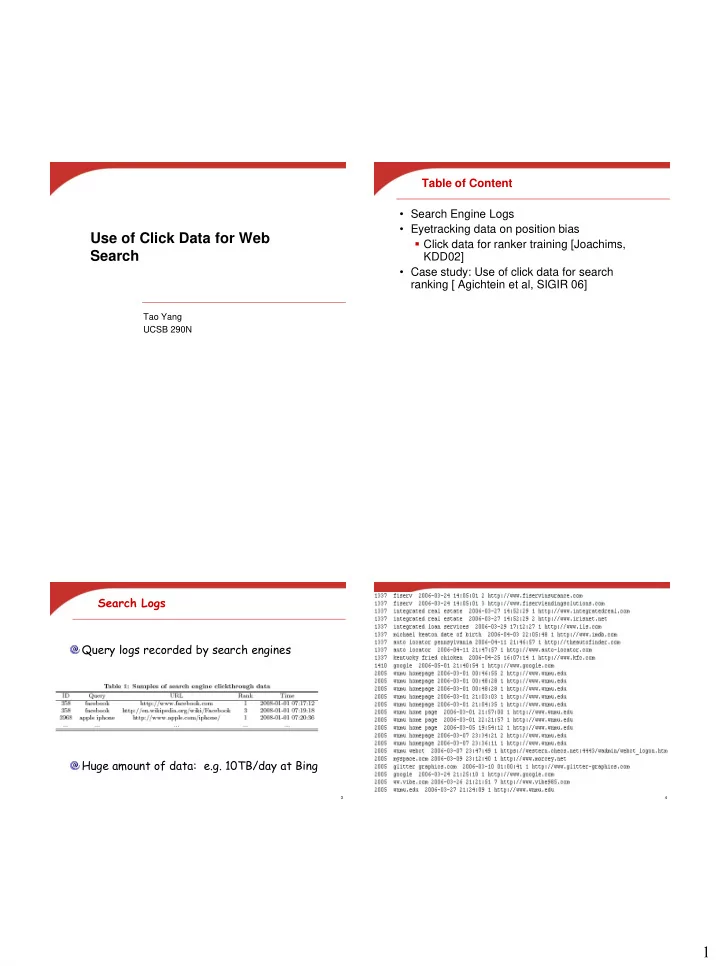
Search Logs Query logs recorded by search engines Huge amount of data: e.g. 10TB/day at Bing

4

slide-2
SLIDE 2

2

5

mustang ford mustang

Nova

www.fordvehicles.com/ cars/mustang www.mustang.com en.wikipedia.org/wiki/ Ford_Mustang AlsoTry

Search sessions

Query sessions and analysis

6

Session

Mission Mission Mission

Query Query Query Click Click Click Query Query Click Click

fixation fixation fixation

Query level Click level Eye-tracking level

Query-URL correlations:

  • Query-to-pick
  • Query-to-query
  • Pick-to-pick

Examples of behavior analysis with search logs

  • Query-pick (click) analysis
  • Session detection
  • Classification
  • x1, x2, …, xN  y
  • eg, whether the session has a commercial intent
  • Sequence labeling
  • x1, x2, …, xN  y1, y2, …, yN
  • eg, segment a search sequence into missions and goals
  • Prediction
  • x1, x2, …, xN-1  yN
  • Similarity
  • Similarity(S1, S2)

Query-pick (click) analysis

  • Search Results for “CIKM”

5/31/2013 8

CIKM'09 Tutorial, Hong Kong, China # of clicks received

slide-3
SLIDE 3

3

Interpret Clicks: an Example

  • Clicks are good…
  • Are these two clicks

equally “good”?

  • Non-clicks may have

excuses:

  • Not relevant
  • Not examined

5/31/2013

CIKM'09 Tutorial, Hong Kong, China

9

Use of behavior data

  • Adapt ranking to user clicks?

5/31/2013 10

CIKM'09 Tutorial, Hong Kong, China # of clicks received

Non-trivial cases

  • Tools needed for non-trivial cases

5/31/2013 11

CIKM'09 Tutorial, Hong Kong, China # of clicks received

Eye-tracking User Study

12 5/31/2013

CIKM'09 Tutorial, Hong Kong, China

slide-4
SLIDE 4

4

Eye tracking for different web sites

Google user patterns

 Higher positions receive more user attention (eye fixation) and clicks than lower positions.  This is true even in the extreme setting where the order of positions is reversed.  “Clicks are informative but biased”.

14 5/31/2013

CIKM'09 Tutorial, Hong Kong, China

[Joachims+07]

Click Position-bias

Normal Position Percentage Reversed Impression Percentage

Clicks as Relative Judgments for Rank Training

  • “Clicked > Skipped Above” [Joachims, KDD02]

5/31/2013

CIKM'09 Tutorial, Hong Kong, China

15

 Preference pairs:

#5>#2, #5>#3, #5>#4.

 Use Rank SVM to optimize

the retrieval function.

 Limitation:

  • Confidence of judgments
  • Little implication to user

modeling 1 2 3 4 5 6 7 8

Additional relation for relative relevance judgments

click > skip above last click > click above click > click earlier last click > click previous click > no-click next

slide-5
SLIDE 5

5

17

Web Search Ranking by Incorporating User Behavior Information Rank pages relevant for a query

  • Eugene Agichtein, Eric Brill, Susan Dumais SIGIR

2006

  • Web Search Ranking
  • Content match

– e.g., page terms, anchor text, term weights

  • Prior document quality

– e.g., web topology, spam features

  • Hundreds of parameters
  • Improve with implicit user feedback from click data

18

Related Work

  • Personalization
  • Rerank results based on user’s clickthrough and

browsing history

  • Collaborative filtering
  • Amazon, DirectHit: rank by clickthrough
  • General ranking
  • Joachims et al. [KDD 2002], Radlinski et al. [KDD

2005]: tuning ranking functions with clickthrough

19

Rich User Behavior Feature Space

  • Observed and distributional features
  • Aggregate observed values over all user interactions

for each query and result pair

  • Distributional features: deviations from the “expected”

behavior for the query

  • Represent user interactions as vectors in

user behavior space

  • Presentation: what a user sees before a click
  • Clickthrough: frequency and timing of clicks
  • Browsing: what users do after a click

20

Ranking Features

Presentation ResultPosition Position of the URL in Current ranking QueryTitleOverlap Fraction of query terms in result Title Clickthrough DeliberationTime Seconds between query and first click ClickFrequency Fraction of all clicks landing on page ClickDeviation Deviation from expected click frequency Browsing DwellTime Result page dwell time DwellTimeDeviation Deviation from expected dwell time for query
slide-6
SLIDE 6

6

More Presentation Features More Clickthough Features Browsing features

24

Training a User Behavior Model

  • Map user behavior features to relevance

judgements

  • RankNet: Burges et al., [ICML 2005]
  • Neural Net based learning
  • Input: user behavior + relevance labels
  • Output: weights for behavior feature values
  • Used as testbed for all experiments
slide-7
SLIDE 7

7

25

User Behavior Models for Ranking

  • Use interactions from previous instances of

query

  • General-purpose (not personalized)
  • Only available for queries with past user interactions
  • Models:
  • Rerank, clickthrough only:

reorder results by number of clicks

  • Rerank, predicted preferences (all user behavior features):

reorder results by predicted preferences

  • Integrate directly into ranker:

incorporate user interactions as features for the ranker

26

Evaluation Metrics

  • Precision at K: fraction of relevant in top K
  • NDCG at K: norm. discounted cumulative

gain

  • Top-ranked results most important
  • MAP: mean average precision
  • Average precision for each query: mean of the

precision at K values computed after each relevant document was retrieved

  

K j j r q q

j M N

1 ) (

) 1 log( / ) 1 2 (

27

Datasets

  • 8 weeks of user behavior data from

anonymized opt-in client instrumentation

  • Millions of unique queries and interaction

traces

  • Random sample of 3,000 queries
  • Gathered independently of user behavior
  • 1,500 train, 500 validation, 1,000 test
  • Explicit relevance assessments for top 10

results for each query in sample

28

Methods Compared

  • Content only: BM25F
  • A variation of TF-IDF model
  • Full Search Engine: RN
  • Hundreds of parameters for content match and

document quality

  • Tuned with RankNet
  • Incorporating User Behavior
  • Clickthrough: Rerank-CT
  • Full user behavior model predictions: Rerank-All
  • Integrate all user behavior features directly: +All
slide-8
SLIDE 8

8

29

Content, User Behavior: Precision at K, queries with interactions

BM25 < Rerank-CT < Rerank-All < +All

0.38 0.43 0.48 0.53 0.58 0.63 1 3 5 10 K

Precision BM25 Rerank-CT Rerank-All BM25+All

30

Content, User Behavior: NDCG

BM25 < Rerank-CT < Rerank-All < +All

0.5 0.52 0.54 0.56 0.58 0.6 0.62 0.64 0.66 0.68 1 2 3 4 5 6 7 8 9 10 K NDCG

BM25 Rerank-CT Rerank-All BM25+All

31

Impact: All Queries, Precision at K

< 50% of test queries w/ prior interactions +0.06-0.12 precision over all test queries

0.4 0.45 0.5 0.55 0.6 0.65 0.7 1 3 5 10 K Precision

RN Rerank-All RN+All

32

Impact: All Queries, NDCG

+0.03-0.05 NDCG over all test queries

0.56 0.58 0.6 0.62 0.64 0.66 0.68 0.7 1 2 3 4 5 6 7 8 9 10 K NDCG

RN Rerank-All RN+All

slide-9
SLIDE 9

9

33

Which Queries Benefit Most

50 100 150 200 250 300 350 0.1 0.2 0.3 0.4 0.5 0.6

  • 0.4
  • 0.35
  • 0.3
  • 0.25
  • 0.2
  • 0.15
  • 0.1
  • 0.05

0.05 0.1 0.15 0.2 Frequency Average Gain

Most gains are for queries with poor ranking

34

Conclusions

  • Incorporating user behavior into web search

ranking dramatically improves relevance

  • Providing rich user interaction features to ranker is

the most effective strategy

  • Large improvement shown for up to 50% of test

queries

35

Full Search Engine, User Behavior: NDCG, MAP

MAP Gain RN 0.270 RN+ALL 0.321 0.052 (19.13%) BM25 0.236 BM25+ALL 0.292 0.056 (23.71%)

0.56 0.58 0.6 0.62 0.64 0.66 0.68 0.7 0.72 0.74 1 2 3 4 5 6 7 8 9 10 K NDCG

RN Rerank-All RN+All