1 The Internet 1966: First experiments in digital packet switched - - PDF document

1
SMART_READER_LITE
LIVE PREVIEW

1 The Internet 1966: First experiments in digital packet switched - - PDF document

The IT Innovation Ecosystem Lessons from the Tire Tracks Diagram Ed Lazowska IT & Public Policy Autumn 2004 National Research Council Computer Science & Telecommunications Board, 2003 1 Overview of Tire Tracks Diagram


slide-1
SLIDE 1

1

1

The IT Innovation Ecosystem

Ed Lazowska IT & Public Policy Autumn 2004 Lessons from the “Tire Tracks Diagram”

National Research Council Computer Science & Telecommunications Board, 2003 4

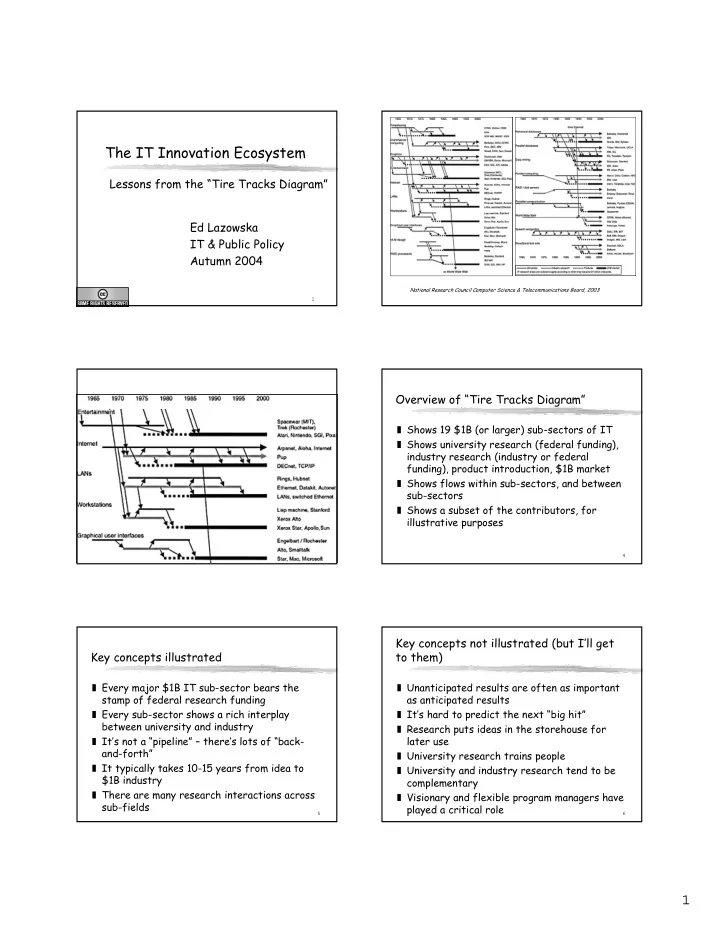
Overview of “Tire Tracks Diagram”

❚ Shows 19 $1B (or larger) sub-sectors of IT ❚ Shows university research (federal funding), industry research (industry or federal funding), product introduction, $1B market ❚ Shows flows within sub-sectors, and between sub-sectors ❚ Shows a subset of the contributors, for illustrative purposes

5

Key concepts illustrated

❚ Every major $1B IT sub-sector bears the stamp of federal research funding ❚ Every sub-sector shows a rich interplay between university and industry ❚ It’s not a “pipeline” – there’s lots of “back- and-forth” ❚ It typically takes 10-15 years from idea to $1B industry ❚ There are many research interactions across sub-fields

6

Key concepts not illustrated (but I’ll get to them)

❚ Unanticipated results are often as important as anticipated results ❚ It’s hard to predict the next “big hit” ❚ Research puts ideas in the storehouse for later use ❚ University research trains people ❚ University and industry research tend to be complementary ❚ Visionary and flexible program managers have played a critical role

slide-2
SLIDE 2

2

7

❚ 1966: First experiments in digital packet switched technology ❚ 1968: ARPA issues RFQ for IMPs

❙ AT&T says it’ll never work, and even if it does, no

  • ne will care

❚ 1969: ARPANET inaugurated with 4 hosts

❙ Len Kleinrock’s student/programmer Charley Kline attempts remote login from UCLA SDS Sigma 7 to SRI SDS 940 ❙ System crashed partway through – thus, the first message on the Internet was “lo”

The Internet

9

❚ 1975: ARPANET has 100 hosts ❚ 1977: Crufty internetworking demonstration

❙ 4-network demonstration of ARPANET, SATNET, Ethernet, and PRnet – from a truck on 101 to England

❚ 1980: Design of TCP/IP completed ❚ 1983: Conversion to TCP/IP completed

❙ Routers allowed full internetworking – “network of networks” ❙ Roughly 500 hosts

10

❚ 1988: ARPANET becomes NSFNET

❙ Regional networks established ❙ Backbone speed 56kbps ❙ Roughly 100,000 hosts and 200 networks

❚ 1989: CNRI interconnects MCImail to the Internet

❙ Wise policy choice

❚ 1990: Backbone speed increased to 1.5Mbps by IBM and MCI

❙ Roughly 250,000 hosts and 1,500 networks ❙ Note: There still was “a backbone”!

11

❚ 1992: NCSA Mosaic stimulates explosive growth of WWW ❚ 1995: Full commercialization, at 45Mbps

❙ 6,000,000 hosts, 50,000 networks

M i l l i

  • ns
  • f

I nt er net host s

50 100 150 200 250 1969 1974 1979 1984 1989 1994 1999

slide-3
SLIDE 3

3

13 14

Key concepts illustrated

❚ Bears the stamp of federal research funding ❚ Shows a rich interplay between university and industry ❚ Not a “pipeline” – there’s lots of “back-and- forth” ❚ 10-15 years from idea to $1B industry

15

(D)ARPA I(P)TO

❚ JCR Licklider, 1962-64 ❚ Ivan Sutherland, 1964-65 ❚ Bob Taylor, 1965-69 ❚ Larry Roberts, 1969-73 ❚ Al Blue (acting), 1973-74 ❚ JCR Licklider, 1974-75 ❚ Dave Russell, 1975-79 ❚ Bob Kahn, 1979-85 ❚ Saul Amarel, 1985-87 ❚ Jack Schwartz, 1987-89 ❚ Barry Boehm, 1989-91 ❚ Steve Squires, 1991-93 ❚ John Toole (acting), 1993-94 ❚ Howard Frank, 1994-97 ❚ David Tennenhouse, 1997-99 ❚ Shankar Sastry 1999-01 ❚ Kathy McDonald (acting), 2001-02 ❚ Ron Brachman, 2002-present

16

IPTO under Bob Kahn, 1979-85

❚ VLSI program

❙ Mead-Conway methodology ❙ MOSIS (Metal Oxide Silicon Implementation Service)

❚ Berkeley Unix

❙ Needed Unix with virtual memory for the VLSI program (big designs) and the Image Understanding program (big images) ❙ Also a Trojan horse for TCP/IP ❙ And a common platform for much systems and application research

17

❚ SUN workstation

❙ Baskett said no existing workstations could adequately handle VLSI designs (Bechtolsheim’s frame buffer approach was unique) ❙ Kahn insisted that it run Berkeley Unix

❚ Clear byproducts

❙ Sun ❙ SGI ❙ RISC (MIPS, SPARC) ❙ TCP/IP adoption ❙ Internet routers (Cisco)

18

Additional key concepts illustrated

❚ Many research interactions across sub-fields

❙ Graphics, workstations, VLSI, computer architecture, operating systems, and networking were being synergistically advanced!

slide-4
SLIDE 4

4

20

❚ Visionary and flexible program managers have played a critical role

21

I SAT St udy:

I m pact

  • f

AI

  • n

DoD

August 2004 Co- Chai r s: Ed Lazowska Al M cLaughl i n

22

St udy Char t er

  • Revi

ew i m pact

  • f

AI t echnol

  • gy
  • n

DoD

– M aj

  • r

syst em s enabl ed by AI t echnol

  • gy

– Si gni f i cant dem onst r at i

  • ns

and new capabi l i t i es – Spi n-

  • f

f s – DoD t

  • ci

vi l i an – “ Spi n-

  • ns”– ci

vi l i an t

  • DoD

– – User speaks a phr ase User speaks a phr ase – – Aut

  • m at

i c Speech Recogni zer Aut

  • m at

i c Speech Recogni zer m at ches i t t

  • pr

er ecor ded m at ches i t t

  • pr

er ecor ded t r ansl at i

  • n

t r ansl at i

  • n

– – Tr ansl at i

  • n

pl ayed t hr

  • ugh

speaker Tr ansl at i

  • n

pl ayed t hr

  • ugh

speaker – – Possi bl e due t

  • decades
  • f

ASR Possi bl e due t

  • decades
  • f

ASR and syst em s r esear ch and syst em s r esear ch

Phr asel at

  • r

Phr asel at

  • r

Phr ase Tr ansl at i

  • n

Devi ce Phr ase Tr ansl at i

  • n

Devi ce f

  • r

M i l i t ar y Use f

  • r

M i l i t ar y Use I m pact I m pact St at us St at us

Depl

  • yed

i n O per at i

  • n

Endur i ng Depl

  • yed

i n O per at i

  • n

Endur i ng Fr eedom and I r aqi Fr eedom Fr eedom and I r aqi Fr eedom – – Faci l i t at ed t i m e Faci l i t at ed t i m e-

  • cr

i t i cal i nf

  • r

m at i

  • n

cr i t i cal i nf

  • r

m at i

  • n

exchange when i nt er pr et er s not exchange when i nt er pr et er s not avai l abl e avai l abl e – – Accept ed by br

  • ad

set

  • f

user s Accept ed by br

  • ad

set

  • f

user s – – I nt er act i

  • n

wi t h ci vi l i ans I nt er act i

  • n

wi t h ci vi l i ans – – i nf

  • r

m at i

  • n
  • n

i nf

  • r

m at i

  • n
  • n

UXO s UXO s and and weapons caches weapons caches – – Cont i nued use i n I r aq and Cont i nued use i n I r aq and Af ghani st an Af ghani st an – – Joi nt For ces Com m and f i el di ng Joi nt For ces Com m and f i el di ng 800+ uni t s 800+ uni t s – – SO CO M f i el di ng 400 uni t s SO CO M f i el di ng 400 uni t s – – Cl ear need f

  • r

2 Cl ear need f

  • r

2-

  • way

voi ce m achi ne way voi ce m achi ne t r ansl at i

  • n

( VM T) t r ansl at i

  • n

( VM T)

Language Under st andi ng/ Tr ansl at i

  • n

24

EARS

TI DES+EARS: Aut

  • m at

ed pr

  • cessi

ng

  • f

Ar abi c t ext & audi

  • Aut
  • m at

ed t r ansl at i

  • n

and cl assi f i cat i

  • n
  • f

f

  • r

ei gn l anguage t ext and audi

  • I

m pact St at us

  • TI

DES: Tr ansl at i

  • n

– f

  • r

ei gn l anguage t ext t

  • Engl

i sh t ext , i ncl udi ng docum ent cl assi f i cat i

  • n
  • EARS: Tr

anscr i pt i

  • n

– conver t s Ar abi c and Chi nese speech t

  • t

ext

  • TI

DES and EARS i nt egr at i

  • n: St

at i st i cal l ear ni ng – r

  • bust

f

  • r

ei gn l anguage pr

  • cessi

ng t

  • ext

r act i nt el l i gence f r

  • m
  • pen

sour ces.

  • CENTCO M

usi ng aut

  • m at

ed pr

  • cessi

ng t

  • pul

l i nt el l i gence f r

  • m

Ar abi c t ext and audi

  • Engl

i sh-

  • nl

y

  • per

at

  • r

s can now f

  • r

m a pi ct ur e i n t hei r m i nd

  • f

what i s bei ng di scussed i n Ar abi c sour ce m at er i al

  • 100’

s

  • f

docum ent s f r

  • m

dozens

  • f

sour ces t r ansl at ed dai l y; 5- 10 sent t

  • NVTC

f

  • r

hum an t r ansl at i

  • n
  • Technol
  • gy

f i r st used by US For ces Kor ea

  • Aut
  • m at

i c speech r ecogni t i

  • n
  • f

Engl i sh i m pr

  • ved

dr am at i cal l y f r

  • m

1984 t

  • 1993.

Now, equal l y dr am at i c i m pr

  • vem ent

f

  • r

Ar abi c ASR t hr

  • ugh

EARS

  • Text

and audi

  • pr
  • cessi

ng

  • f

Ar abi c now possi bl e end- t

  • end.

Two depl

  • ym ent

uni t s t

  • CENTCO M

i n 2004 f

  • r

i nf

  • r

m at i

  • n

expl

  • i

t at i

  • n

f r

  • m

Ar abi c

  • pen

sour ce m at er i al

Language Under st andi ng/ Tr ansl at i

  • n
slide-5
SLIDE 5

5

25

Dynam i c Anal ysi s Repl anni ng Tool ( DART)

Rapi d edi t i ng and anal ysi s

  • f

f

  • r

ce depl

  • ym ent

dat abases

I nt ui t i ve gr aphi cal i nt er f ace: gener at es Engl i sh- l i ke expl anat i

  • ns

AI m et hods ( sear ch, schedul i ng, expl anat i

  • n)

and G UI i ncor por at ed f r

  • m

Ascent Technol

  • gy’

s com m er ci al ai r l i ne appl i cat i

  • n

Bui l t and f i el ded i n 10 w eeks dur i ng O DS Endor sed by al l C I NCs as “a bet t er w ay”

St at us

Fi el ded t

  • ever

y C I NCs J5 i n FY92 Funct i

  • nal

i t y l i ves

  • n

i n G CCS Spaw ned new gener at i

  • n
  • f

schedul i ng al gor i t hm s and anal ysi s m odel s i n dai l y use at USTRANSCO M and AM C Devel

  • pm ent

m et hodol

  • gy

l i ves

  • n

i n CPO F

I m pact

An “80% sol ut i

  • n” t

hat pr

  • vi

ded a pl at f

  • r

m f

  • r

i ncr em ent al t echnol

  • gy

i nser t i

  • n

Used by G en M cCar t hy and t hen M G Zi nni t

  • pl

an depl

  • ym ent
  • f

VI I Cor ps t

  • SW A

I m m edi at e 20X decr ease i n anal ysi s t i m e PLUS new “w hat i f

  • i

ng” capabi l i t y and pr

  • vabl

y bet t er schedul es Led t r ansi t i

  • n

f r

  • m

JO PES t

  • G CCS

Pl anni ng Syst em s

PackBot

Behavior-based AI control systems enable small robots to operate intelligently – autonomously, or seamlessly with supervisory teleoperation AI provides the low-level control of most recent robots Two versions in active use in Afghanistan and Iraq – PackBot Scouts for reconnaissance in caves, etc. – Packbot EODs for explosive

  • rdnance disposal

Keeps soldiers out of harm’s way! They are approximately 50 deployed PackBots in Afghanistan and Iraq carrying out more than 100 missions per day Will be a major component of Army’s Future Combat Systems

Small intelligent robot for reconnaissance and explosive

  • rdnance disposal

Status Impact

Robot i c Syst em s 27

TacAi r

  • Soar

I m pact St at us

  • Ful

l y aut

  • nom ous

i nt el l i gent agent syst em t hat pr

  • vi

des hi gh- f i del i t y, r eal i st i c, ent i t y- l evel behavi

  • r

s f

  • r

a wi de r ange

  • f

ai r cr af t and m i ssi

  • ns

( f r i endl y and enem y)

  • Used

i n i nt er act i ve si m ul at i

  • ns

( m i x

  • f

r eal and com put er

  • gener

at ed pi l

  • t

s)

  • Awar

e: M ai nt ai ns sophi st i cat ed si t uat i

  • n

i nt er pr et at i

  • n
  • Sm ar

t : M akes i nt el l i gent deci si

  • ns
  • Fast

: O per at es ef f ect i vel y, i n r eal t i m e, i n a hi ghl y dynam i c envi r

  • nm ent
  • Soci

al : I nt er act s nat ur al l y wi t h hum ans

  • Al

l

  • ws

exer ci ses t

  • ex

pand si gni f i cant l y ( gr eat er num ber s

  • f

pl ayer s) by pr

  • vi

di ng synt het i c enem y and f r i endl y ai r cr af t t hat seam l essl y i nt er act wi t h r eal pi l

  • t

s, cont r

  • l

l er s, gr

  • und

def enses, et c. Ex am pl es: STO W - 97, Roadr unner , Di st r i but ed M i ssi

  • n

Tr ai ni ng, Endur i ng Fr eedom Reconst r uct i

  • n,

M i l l enni um Chal l enge ‘ 02, Aut

  • m at

ed W i ngm an ( Ar m y hel i copt er ) ,

  • t

her s

  • M ost

sophi st i cat ed synt het i c f

  • r

ce m odel cur r ent l y avai l abl e

  • Aut
  • nom ous

behavi

  • r

⇒ r educed m anpower r equi r em ent s

  • Ful

l i m pl em ent at i

  • n
  • f

coor di nat ed behavi

  • r
  • Not

“ bl ack box ”behavi

  • r

– knowl edge and r easoni ng ar e ex pl i ci t

  • Behavi
  • r

s ar e di st i nct f r

  • m

t he under l yi ng si m ul at i

  • n

pl at f

  • r

m and physi cal m odel s Si m ul at i

  • n/

Tr ai ni ng

I nt el l i gent adver sar i es f

  • r

t act i cal ai r com bat t r ai ni ng

Image Understanding: BCAMS

AI techniques extract meaning from single images or image sequences

  • Motion detection, optical flow, and

tracking

  • Stereo to recover depth
  • Object-specific recognition

algorithms Operational systems – e.g., Bosnian Cantonment Monitoring System (BCAMS) for Dayton Peace Accords:

  • Significantly reduced the number of

photo analysts in the field

  • Produced more accurate information
  • Produced it 5X faster
  • Quicker response to unfolding events

Many techniques have been developed Many commercial and military systems use these techniques Still a long way to go to get to all the capabilities of humans

Image analysis for change detection Status Impact

I m age/ Si gnal Under st andi ng BCAMS Origin 2000

BCAMS Display Image Formation

ETRAC

SIDS & IPIR Reports

29

USPS HandW r i t t en Addr ess I nt er pr et at i

  • n

Syst em

I m pact

$100M l abor cost s saved i n f i r st depl

  • yed

year ( 1997) O ver $1B cum ul at i ve savi ngs si nce adopt i

  • n

St at us

O ver 83%

  • f

al l handwr i t t en USPS m ai l sor t ed aut

  • m at

i cal l y ( 55M pi eces/ day) Above 98% accur acy Adopt ed now i n

  • t

her count r i es New di r ect i

  • n:

wr i t er i dent i f i cat i

  • n

Aut

  • m at

i cal l y adds Post net Bar Code t

  • >83%
  • f

al l handw r i t t en US M ai l w i t h <2% er r

  • r

r at e

An appl i cat i

  • n
  • f

m achi ne l ear ni ng and knowl edge- gui ded i nt er pr et at i

  • n

Spi n- O f f s

Image Guided Surgery

Data from multiple types of scan are segmented, aligned, and correlated to position of patient Lets surgeon do detailed pre-op planning and analysis Provides real-time feedback during surgery on where structures are Surgery is faster than before, lessening possible complications Surgeries that were not previously possible are now routine Surgeons have better feedback and so can be more precise System is used almost every day in brain surgery at Brigham and Women’s hospital in Boston New diagnosis techniques are being tested for neurology,

  • rthopedics, and internal medicine

Image analysis for pre-op planning and in-op guidance Status Impact

Spi n- O f f s
slide-6
SLIDE 6

6

31

Com m er ci al Ai r por t O per at i

  • ns

Resour ce pl anni ng, al l

  • cat

i

  • n,

and schedul i ng f

  • r

ai r por t

  • per

at i

  • ns
  • Engl

i sh- l i ke r ul e ( const r ai nt ) st at em ent s

  • Const

r ai nt

  • di

r ect ed sear ch

  • Bl

ackboar d ar chi t ect ur e

  • Vi

sual i zat i

  • n
  • f

pl ans and schedul es

St at us

  • M any

depl

  • yed

knowl edge- i nt ensi ve appl i cat i

  • ns

i ncl udi ng ai r l i ne and ai r por t r esour ce m anagem ent ,

  • per

at i

  • ns,

m ai nt enance schedul i ng, per sonnel

  • I

nst al l ed at 20 ai r por t s

  • I

n r egul ar use by 5 ai r l i nes

I m pact

  • Dynam i

c, f ast r eschedul i ng

al m ost i nst ant aneous gener at i

  • n
  • f

new schedul es i n r esponse t

  • changi

ng condi t i

  • ns
  • I

nt ui t i ve, “easy t

  • under

st and” r esul t s

  • Saves

m oney

e. g. , r ecent $20K m od f

  • r

m i ni m al r am p pat hs saved

  • ne

ai r l i ne $100K/ dayat

  • ne

US ai r por t

  • Adapt

ed f

  • r

D ART dur i ng O DS

Equipment Gates Stands Personnel Check-in Counters Baggage Belts Slots Runways

Spi n- O ns 32

I m pact

  • f

AI

  • n

DoD: O bser vat i

  • ns
  • AI

t echnol

  • gy

i s havi ng si gni f i cant i m pact

  • n

DoD. M et r i cs i ncl ude:

– savi ng l i ves: CPO F – expedi t i ng pl anni ng and l

  • gi

st i cs: DART – keepi ng t r

  • ops

f r

  • m

har m ’ s way: PackBot – l ar ge

  • per

at i

  • nal

cost savi ngs: ASF – i m pr

  • ved

i nt el l i gence: TI DES/ EARS – r educed t r ai ni ng cost s/ m anpower : TacAi r

  • Soar

– m or e ef f ect i ve sur vei l l ance/ m oni t

  • r

i ng: BCAM S

33

  • AI

yi el ds new capabi l i t i es:

– speech r ecogni t i

  • n:

Phr asel at

  • r

– aut

  • m at

ed l anguage t r ansl at i

  • n:

TI DES – pl anni ng: DART – deci si

  • n

suppor t : CPO F – si m ul at i

  • n/

t r ai ni ng: TacAi r

  • Soar

– i m age under st andi ng: BCAM S – r

  • bot

i cs: PackBot

34

  • Som e
  • f

t he speci f i c syst em s wer e qui ckl y engi neer ed i n r esponse t

  • DoD/

war t i m e needs – e. g. , DART, ACPT, Phr asel at

  • r
  • Al

l syst em s w er e bui l t upon t hr ee

  • r

m or e decades

  • f

sust ai ned DARPA i nvest m ent s i n AI and

  • t

her t echnol

  • gi

es

– t echnol

  • gi

es, pr

  • t
  • t

ypes – t r ai ned peopl e, syner gi st i c i nt er act i

  • ns

– abi l i t y f

  • r

qui ck r eact i

  • n

r esponse

35

“Ideas in the storehouse”

❚ Electronic commerce draws upon:

❙ Internet ❙ Web browsers ❙ Public key cryptography ❙ Databases and transaction processing ❙ Search

36

Unanticipated results are often as important as anticipated results

❚ The development of timesharing in the 1960s (in Tenex, Multics, CalTSS) gave us electronic mail and instant messaging

slide-7
SLIDE 7

7

37

It’s hard to predict the next “big hit”

❚ “Tire Tracks Diagram,” 1995 vs. 2003

National Research Council Computer Science & Telecommunications Board, 1995 National Research Council Computer Science & Telecommunications Board, 2003 40

❚ In our despondency in 1995, we failed to foresee …

❙ Client/Server computing ❙ Entertainment technology ❙ Data mining ❙ Portable communication ❙ World Wide Web ❙ Speech recognition ❙ Broadband last mile

42

Research institutions come in many different shapes and sizes

slide-8
SLIDE 8

8

43

❚ Boston: MIT, Harvard ❚ Research Triangle Park: Duke, UNC, NC State ❚ Austin: University of Texas ❚ So. California: UCSD, UCLA, Caltech ❚ No. California: Stanford, Berkeley, UCSF ❚ Puget Sound region: University of Washington

The correlation between high-tech success and top universities is clear

44

Why?

❚ Education ❚ Technology attraction ❚ Company attraction ❚ Innovation (technology creation) ❚ Entrepreneurship (company creation) ❚ Leadership and intangibles

45

“Competitive advantages” of universities

❚ Students ❚ Long-term research, not tied to today’s products ❚ Inherently multi-disciplinary ❚ Neutral meeting ground ❚ “Open”

Si m ul t aneous M ul t i t hr eadi ng

Saf e war e Engi nee r i ng Cor por at i

  • n

Et c h

47

❚ Entirely appropriately, industry R&D (at least in IT) is heavily focused on D – product and process development ❚ Microsoft’s investment in Microsoft Research – unquestionably one of the world’s great IT research enterprises – is nearly unique

❙ 30 years ago, IBM, Xerox, and AT&T represented a huge proportion of the “IT pie” ❙ Each had a great research laboratory focused more than 18 months out

The nature of industry R&D

48

❙ Today, the “IT pie” is far larger ❙ And the industry’s investment in R&D is far greater (all technology companies do R&D) ❙ But of the newer companies – the ones that have grown the pie – Microsoft stands almost alone in its investment in fundamental research

❘ Dell? Oracle? Cisco? Nada!

❙ Microsoft began this investment in 1991 – when it was a far-from-dominant $1B company – Microsoft (particularly Gates and Myhrvold) should receive enormous credit for taking this step

slide-9
SLIDE 9

9

49

❚ So, how much of Microsoft’s $7B in R&D (>15% of revenues) is “research”?

❙ Microsoft Research – the part of Microsoft’s R&D enterprise that’s looking more than 18 months ahead – is about 700 heads, <5% of this total ❙ This is extraordinary by the standards of other companies … but don’t confuse Microsoft’s R&D expenditures – much less the rest of the industry’s R&D expenditures – with an investment in fundamental research!

50

❚ Why might companies be reluctant to invest in R&D that looks ahead more than one product cycle?

51

❚ Established companies generally don’t capitalize on innovations ❚ The culprit is good management (and shareholder behavior), not bad management ❚ Evolutionary vs. disruptive innovation ❚ “It’s a zero billion dollar market”

52

❚ Example: RISC (Reduced Instruction Set Computer) processors ❚ (One can argue that innovations tend to arise from universities or established companies, and tend to be brought to market by startups.)

53

Federal support of science

❚ Old history

❙ NIH (National Institutes of Health) as a small unit of the Public Health Service since the late 1800s ❙ Army Ballistic Missile Laboratory supported ENIAC at Penn

❚ 1945: Vannevar Bush, Science: The Endless Frontier ❚ 1947: ONR (Office of Naval Research) established

54

❚ 1950: NSF (National Science Foundation) established

❙ Bush had advocated one agency, but got 3+

❘ Civilian natural and physical sciences: NSF ❘ Civilian life sciences: NIH ❘ Defense sciences: ONR, etc.

❚ 1957: Sputnik ❚ 1958: (D)ARPA ((Defense) Advanced Research Projects Agency) established

❙ 1958: ARPA / 1972: DARPA / 1993: ARPA / 1996: DARPA

slide-10
SLIDE 10

10

55

❚ 1962: I(P)TO (Information (Processing) Techniques/Technology Office) established within DARPA

❙ More on DARPA IPTO shortly

56

Recent history in IT specifically

❚ 1985-86: NSF Supercomputer Centers established ❚ 1986: NSF CISE Directorate established ❚ HPC (High Performance Computing) Act of 1991 (the “Al Gore created the Internet” Act)

❙ Multi-agency coordination ❙ Presidential advisory committee

❚ 1992: NCO/HPCC (National Coordination Office for High Performance Computing & Communication) established

57

❚ 1997: PITAC (President’s Information Technology Advisory Committee) established

❙ 1998: PITAC interim report ❙ 1999: PITAC final report

58

Characterizing research

❚ “Fundamental research” and “application-motivated research” are compatible

59

Traditional view

Fundam ent al r esear ch Appl i ed r esear ch

60

Alternative view

Concer n w i t h f undam ent al s Concer n w i t h use

Edi son Past eur ; m uch

  • f

bi

  • m edi

cal and engi neer i ng r esear ch Bohr

slide-11
SLIDE 11

11

61

Trends in federal research funding

❚ How has the federal research investment (basic and applied) fared over the years?

❙ It’s increasing significantly, in constant dollars – a factor of more than 2 in less than 20 years

[NSF data analyzed by AAAS, 2003]

62

Feder al Basi c and Appl i ed Resear ch, FY 1970- 2003

  • bl

i gat i

  • ns

i n bi l l i

  • ns
  • f

const ant FY 2003 dol l ar s

$0 $10 $20 $30 $40 $50 $60 1970 1975 1980 1985 1990 1995 2000 63

❚ What’s the balance of the nation’s research portfolio?

❙ A dramatic shift towards the biomedical sciences in the past 20 years, accelerating in the past 5 years

❘ Biomedical research is important ❘ But it relies critically on advances in other fields, such as physics, engineering, and information technology

❙ There is broad agreement that the nation’s R&D portfolio has become unbalanced

[NSF data analyzed by AAAS, 2003]

64 65

❚ How does support for computing research stack up against the recommendations of PITAC?

❙ It’s fallen off the train

66

slide-12
SLIDE 12

12

67

❚ Research investments are closely linked to creation of the nation’s Science & Technology workforce

❙ So, in what fields are the nation’s Science & Technology jobs?

[John Sargent, U.S. Department of Commerce, 2004]

[First chart: employment growth, 1996-2000] [Second chart: projected employment growth, 2002-2012] [Third chart: total projected job openings, 2002-2012] [Fourth chart: projected degree production vs. projected job

  • penings, 2002-2012, annualized]

68

Recent Occupational Growth

Growth in Numbers

  • 100

100 200 300 400 500 600 700 800 Com put er Syst em s Anal yst s & Sci ent i st s El ect r i cal / El ect r

  • ni

c Engi neer s Com put er Pr

  • gr

am m er s Ci vi l Engi neer s M edi cal Sci ent i st s Chem i st s Bi

  • l
  • gi

cal / Li f e Sci ent i st s Aer

  • space

Engi neer s Engi neer s, n. e. c. At m ospher i c/ Space I ndust r i al Engi neer s G eol

  • gi

st s/ G eodesi st s For est r y/ Conser vat i

  • n

Sci ent i st s M at hem at i cal Sci ent i st s, n. e. c. Agr i cul t ur al Engi neer s Nucl ear Engi neer s Agr i cul t ur al / Food Sci ent i st s M et al l ur gi cal / M at er i al s Engi neer s Pet r

  • l

eum Engi neer s M i ni ng Engi neer s Physi cal Sci ent i st s, n. e. c. Physi ci st s/ Ast r

  • nom er

s M ar i ne Engi neer s M echani cal Engi neer Chem i cal Engi neer s

Em pl

  • ym ent

G r

  • w t

h i n S&E O ccupat i

  • ns

1996- 2001, i n t housands

SO U R CE: U. S. D epar t m ent

  • f

C om mer ce anal ysi s

  • f

Depar t m ent

  • f

Labor C ur r ent Popul at i

  • n

Sur vey dat a

69

IT, Science and Engineering Occupational Projections, 2002-2012

Employment Growth: Numbers

200, 000 400, 000 600, 000 800, 000 1, 000, 000 1, 200, 000 1, 400, 000 Pr

  • f

essi

  • nal

I T O ccupat i

  • ns

Engi neer s Li f e Sci ent i st s Physi cal Sci ent i st s Nat ur al Sci ences M anager s

70

IT, Science and Engineering Occupational Projections, 2002-2012

Total Job Openings

200, 000 400, 000 600, 000 800, 000 1, 000, 000 1, 200, 000 1, 400, 000 1, 600, 000 1, 800, 000 Pr

  • f

essi

  • nal

I T O ccupat i

  • ns

Engi neer s Li f e Sci ent i st s Physi cal Sci ent i st s Nat ur al Sci ences M anager s

71

The Market Perspective

Degree Production vs. Projected Job Openings

Annual Degr ees and Job O peni ngs i n Br

  • ad

S&E Fi el ds

  • 20,

000 40, 000 60, 000 80, 000 100, 000 120, 000 140, 000 160, 000 Engi neer i ng Physi cal Sci ences M at hem at i cal / Com put er Sci ences Bi

  • l
  • gi

cal / Agr i cul t ur al Sci ences PhD M ast er ' s Bachel

  • r

' s Pr

  • j

ect ed Job O peni ngs

SO URCES: Tabul at ed by Nat i

  • nal

Sci ence Foundat i

  • n/

Di v i si

  • n
  • f

Sci ence Resour ces St at i st i cs; degr ee dat a f r

  • m

Depar t m ent

  • f

Educat i

  • n/

Nat i

  • nal

Cent er f

  • r

Educat i

  • n

St at i st i cs: I nt egr at ed Post secondar y Educat i

  • n

Dat a Syst em Com pl et i

  • ns

Sur v ey; and NSF/ S RS: Sur v ey

  • f

Ear ned Doct

  • r

at es; Pr

  • j

ect ed Annual Av er age Job O peni ngs der i v ed f r

  • m

Depar t m ent

  • f

Com m er ce ( O f f i ce

  • f

Technol

  • gy

Pol i cy) anal ysi s

  • f

Bur eau

  • f

Labor St at i st i cs 2002- 2012 pr

  • j

ect i

  • ns

72

NSF CISE Cyber Trust program

❚ FY04 awards announced 9/21/2004

❙ Funded 8.2% of proposals

❘ 32 of 390 proposals

  • 2 of 25 Center proposals
  • 12 of 135 Team proposals
  • 18 of 230 Small Group proposals

❙ Awarded 6.2% of requested funds

❘ $31.5M of $510M

slide-13
SLIDE 13

13

73

Department of Homeland Security FY05 budget request

❚ $1,069M Science & Technology budget request ❚ $17.8M for Cyber Security – 1.67% ❚ One is led to conclude that DHS simply does not care about Cyber Security ❚ (Also, 90% of the DHS S&T budget goes to Development/Deployment rather than Research – fails to prepare us for the future)

74

DARPA Cyber Security research

❚ DARPA’s new Cyber Security research programs have been classified ❚ Let’s assume there are good reasons. There still are two major negative consequences:

❙ Many of the nation’s leading cyber security researchers (namely, those at universities) are excluded from participation ❙ The results may not rapidly impact commercial networks and systems – upon which much of the government, and much of the nation’s critical infrastructure, rely

75

21st century vs. 19th century industries

❚ In 2003, the US government spent:

❙ $5B on basic research in the physical science and engineering ❙ $25B on direct agricultural subsidies

76

❚ Recap:

❙ About $55B of the nation’s $2,319B budget goes to basic and applied research ❙ More than half of this goes to the life sciences (IT is less than 4%) ❙ IT research funding is actually decreasing ❙ More than 80% of the employment growth in all of S&T in the next decade will be in IT – and more than 70% of all job openings (including those due to retirements) ❙ Recent news provides little encouragement!

77

❚ “What the hell were you thinking?”

78

The federal budget: How the sausage is made

❚ Most of the budget is mandatory ❚ Half of what’s discretionary is defense ❚ The rest involves dozens of agencies ❚ They are grouped irrationally, and tradeoffs must be made within those groups ❚ “Balancing the budget” is a foreign concept

slide-14
SLIDE 14

14

79

Feder al FY 2004 budget , $2, 319B

39% 54% 7% Di scr et i

  • nar

y M andat

  • r

y I nt er est 80

M andat

  • r

y com ponent , $1, 255B ( 54% )

39% 21% 15% 25% Soci al Secur i t y M edi car e M edi cai d and SCHI P O t her 81

Di scr et i

  • nar

y com ponent , $908B ( 39%)

48% 52% Def ense Non- Def ense

82

Non- Def ense di scr et i

  • nar

y, $475B ( 52%

  • f

39% )

4% 1% 12% 5% 15% 6% 6% 2% 4% 2% 2% 3% 2% 6% 1% 2% 0% 0% 3% 1% 1% 3% 1% 0% 2% 2% 13%

Agr i cul t ur e Com m er ce Educat i

  • n

Ener gy HHS Hom el and Secur i t y HUD I nt er i

  • r

Just i ce Labor St at e Tr anspor t at i

  • n

Tr easur y Vet er ans Af f ai r s Cor ps

  • f

Engi neer s EPA EOP GSA I nt er nat i

  • nal

Assi st ance Pr

  • gr

am s Jusi ci al Br anch Legi sl at i ve Br anch NASA NSF Sm al l Busi ness Adm i ni st r at i

  • n

SSA Ot her Agenci es Var i

  • us

Suppl em ent al s

83

VA, HUD, and Ot her Agenci es, $90B

32% 35% 17% 9% 6% 1% VA HUD NASA EPA NSF O t her agenci es 84

Feder al FY 2004 r ecei pt s, $2, 319B

33% 7% 32% 3% 3% 22% Per sonal i ncom e t ax Cor por at e i ncom e t ax Soci al secur i t y Ex ci se t ax es O t her Def i ci t

slide-15
SLIDE 15

15

85

IT, economic growth, and productivity

❚ “Advances in information technology are changing our lives, driving our economy, and transforming the conduct of science.”

❘ Computing Research Association

86 87

❚ In the US, our wages are high, so our productivity needs to be high, or we’re SOL

❙ A US worker who is twice as productive can compete with a foreign worker who makes half as much

Productivity

88

The productivity paradox

❚ We all “believe” that IT increases productivity ❚ There have been continuous investments in the application of IT for more than 40 years ❚ But there were at most very modest signs of any increase in organizational productivity from 1975-1995 ❚ “Computers show up everywhere except in the productivity statistics”

❘ – Robert Solow, Nobel prize winning Economist, 1987

89

Between 1995 and 2000

❚ A huge surge in economic growth, driven by dramatic increases in productivity (double the average pace of the preceding 25 years), attributed almost entirely to IT! ❚ “We are now living through a pivotal period in American economic history … It is the growing use of information technology that makes the current period unique.”

❘ Alan Greenspan, Chairman of the Fed, 2000

90

So, what happened?

❚ Not clear the economic data was capturing the right things ❚ Also, it was measuring entire industries, not individual firms (accounting for quality differences) ❚ Changes in processes, stimulated by changes in technology, take time to show impact

slide-16
SLIDE 16

16

91

Impact of IT on the economy, 2004

❚ “We have completed our program of attributing US economic growth to its sources at the industry level. … Our first conclusion is that many of the concepts used in earlier industry-level growth accounting should be replaced … investments in information technology and higher education stand out as the most important sources of growth at both industry and economy-wide levels … the restructuring of the American economy in response to the progress of information technology has been massive and continuous …”

❘ Dale W. Jorgenson, Harvard, Mun S. Ho, Resources for the Future, and Kevin J. Stiroh, Federal Reserve Bank of NY, “Growth

  • f US Industries and Investments in Information Technology and

Higher Education”

92 93 94

❚ Once upon a time, the “content” of the goods we produced was largely physical

Education for the “innovation economy”

95

❚ Then we transitioned to goods whose “content” was a balance of physical and intellectual

96

❚ In the “innovation economy,” the content of goods is almost entirely intellectual rather than physical

slide-17
SLIDE 17

17

97

❚ Every state consumes “innovation economy” goods

❙ Information technology, biotechnology, telecommunications, …

❚ We produce these goods!

❙ Over the past 20 years, the Puget Sound region has had the fastest pro-rata growth in the nation in the “high tech services” sector

98

❚ National and regional studies conclude the 3/4ths of the jobs in software require a Bachelors degree or greater (and it’s highly competitive among those with this credential!)

What kind of education is needed to produce “innovation economy” goods?

Aver age Ear ni ngs as a Pr

  • por

t i

  • n
  • f

Hi gh School G r aduat es’ Ear ni ngs, 1975 t

  • 1999

100

❚ In Washington State:

❙ We rank 48th out of the 50 states in the participation rate in public 4-year higher education

(1997 federal data presented by OFM) ❘ We rank 41st in upper-division enrollment – “Bachelors degree granting capacity” – still in the bottom 20% of states ❘ We rank 4th in community college participation

❙ Washington’s public higher education system is structured for a manufacturing economy, not an innovation economy!

101

❙ On a per capita basis, Washington ranks 32nd among the states in the number of Bachelors degrees granted by all colleges and universities, public and private, and 35th in the percentage of

  • ur Bachelors degrees that are granted in science

and engineering (1997-98 data, Dept. of Ed.) ❙ Private institutions are not filling the gap

102

❙ We rank 43rd in graduate and professional participation rate at public institutions (1997 federal

data presented by OFM)

❙ We rank 41st in the number of students pursuing graduate degrees in science and engineering at all institutions, public and private (1999 data, NSF) ❙ At the graduate level, things are just as grim

slide-18
SLIDE 18

18

103

❙ We rank 5th in the nation in the percentage of our workforce with a recent Bachelors degree in science or engineering, and 6th in the percentage of

  • ur workforce with a recent Masters degree in

science or engineering (1999 data, NSF; “recent degree”

= 1990-98)

❙ We are creating the jobs – and we are importing young people from elsewhere to fill them!

104

❙ UW’s state funding per student is ~25% below the average of its Olympia-defined “peers” (22% behind 24 HECB peers, 26% behind 8 OFM peers) (1999-2000 data, IPEDS) ❙ In 1976, Washington spent $14.35 on higher education per $1,000 of personal income; by 2001, that number had dropped by nearly a factor of two – to $7.65 (Postsecondary Educational Opportunity

#115)

❙ We under-fund the relatively few student places we have. And it’s getting worse

105

W SU and UW St at e Fundi ng, Per St udent , Rel at i ve t

  • O l

ym pi a- Def i ned “ Peer s”

106

❙ Washington ranks 46th out of the 50 states in state support for research ❙ This is the relatively modest “seed corn” from which large-scale federally-funded research programs grow

107

❚ Washington is all geared up to fight the last war!

108

❚ Bachelors degrees, nationwide, 1997:

❙ 222,000 in business ❙ 125,000 in the social sciences ❙ 105,000 in education ❙ 63,000 in all of engineering ❙ 25,000 in computer science

More broadly (some data is not current, but nothing much has changed)

slide-19
SLIDE 19

19

109

❚ China granted only 1/4 as many Bachelors degrees in 1997 as did the US (325,000 vs. 1.2M)

❙ But China granted 2.5 times as many Bachelors degrees in engineering (149,000 vs. 63,000)

❚ In 2003, China and India each produced about 200,000 Bachelors degrees in engineering

110

❚ Proportion of Bachelors degrees that are in engineering:

❙ US: 4% ❙ United Kingdom: 12% ❙ China: 40%

111

❚ What’s the fastest-growing undergraduate major in America today?

112 113

❙ 857 Ph.D. computer scientists

❘ And roughly half of the Ph.D.s in engineering and computer science were awarded to non-residents

❚ At the doctoral level (also 1997):

❙ 40,000 J.D.’s