
SLIDE 1
1
1
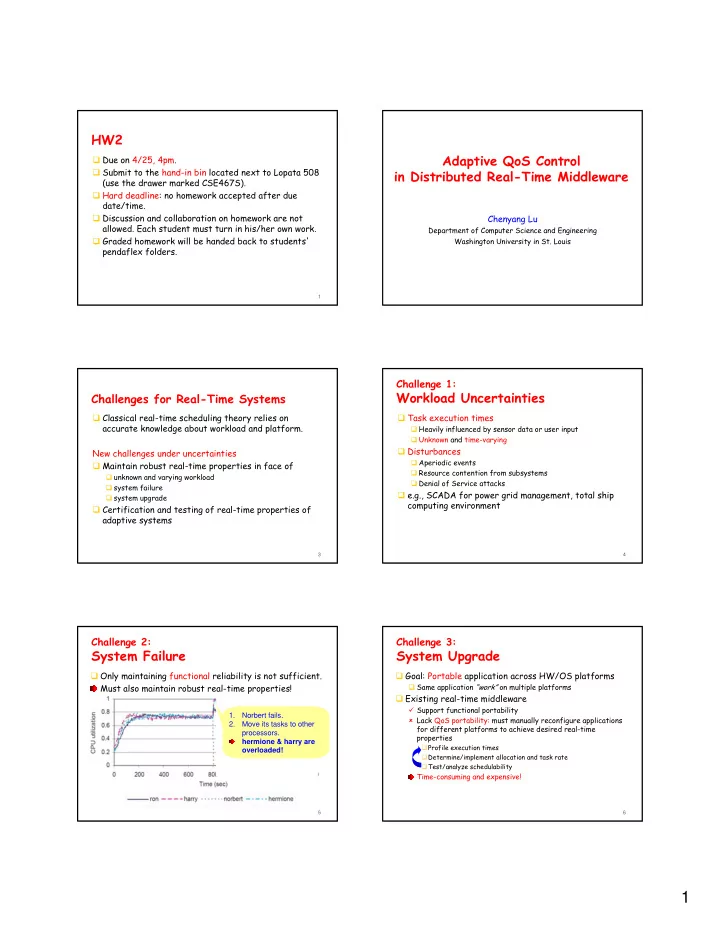
HW2
Due on 4/25, 4pm. Submit to the hand-in bin located next to Lopata 508 (use the drawer marked CSE467S). Hard deadline: no homework accepted after due date/time. Discussion and collaboration on homework are not
- allowed. Each student must turn in his/her own work.
Graded homework will be handed back to students' pendaflex folders.
Adaptive QoS Control in Distributed Real-Time Middleware
Chenyang Lu
Department of Computer Science and Engineering Washington University in St. Louis
3
Challenges for Real-Time Systems
Classical real-time scheduling theory relies on accurate knowledge about workload and platform. New challenges under uncertainties Maintain robust real-time properties in face of
unknown and varying workload system failure system upgrade
Certification and testing of real-time properties of adaptive systems
4
Challenge 1:
Workload Uncertainties
Task execution times
Heavily influenced by sensor data or user input Unknown and time-varying
Disturbances
Aperiodic events Resource contention from subsystems Denial of Service attacks
e.g., SCADA for power grid management, total ship computing environment
5
Challenge 2:
System Failure
Only maintaining functional reliability is not sufficient. Must also maintain robust real-time properties!
1. Norbert fails. 2. Move its tasks to other processors. hermione & harry are
- verloaded!
6
Challenge 3:
System Upgrade
Goal: Portable application across HW/OS platforms
Same application “work” on multiple platforms
Existing real-time middleware
Support functional portability Lack QoS portability: must manually reconfigure applications for different platforms to achieve desired real-time properties
Profile execution times Determine/implement allocation and task rate Test/analyze schedulability