1 Internet Email Internet Commercialization SMTP is Internet Email - - PDF document

1
SMART_READER_LITE
LIVE PREVIEW

1 Internet Email Internet Commercialization SMTP is Internet Email - - PDF document

Background of Chapter Software Infrastructure of the Commercializing Internet Not finished Mostly journalistic Recounting of basic events from secondary sources Focus on interplay between technology and business models Thomas


slide-1
SLIDE 1

1 Software Infrastructure of the Commercializing Internet

Thomas Haigh The Haigh Group University of Wisconsin--Milwaukee Munich, July 24 2006

Background of Chapter

Not finished… Mostly journalistic

Recounting of basic events from secondary sources Focus on interplay between technology and business

models

Search engines/portals to be separated

Software infrastructure chapter Search and portals chapter

Reconstruction of Technology

What happens when an already “shaped”

technology gets

New uses New “relevant social groups” New cultural meanings

Models

VHS vs Beta? –

which is the net?

Ecological?

Extinction of the megafauna Native Americans and Smallpox

Construction of Internet Technologies

Closed, homogenous, small academic

population

Results: Rely on social mechanisms for

security, elimination of troublemakers

Non-commercial

No mechanisms to bill for use of resources

Support for many machine types

Compatibility through standards, not code

Construction of Internet Technologies II

Practical, working network

Rather have it next week than perfect

Decentralized and international

Easy to connect new machines, sub-domains

Many different communication mechanisms

TCP/IP works over many media

Created for experimentation and research

Separation of application protocols from network

mechanisms

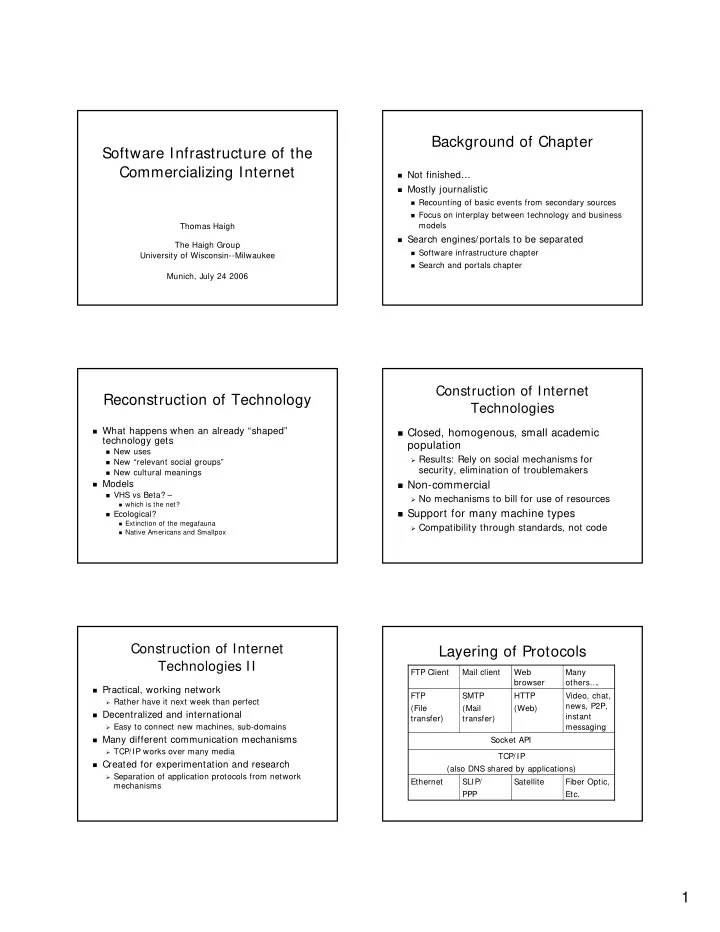
Layering of Protocols

Socket API Fiber Optic, Etc. Satellite SLIP/ PPP Ethernet TCP/IP (also DNS shared by applications) Video, chat, news, P2P, instant messaging HTTP (Web) SMTP (Mail transfer) FTP (File transfer) Many

  • thers….

Web browser Mail client FTP Client

slide-2
SLIDE 2

2 Internet Commercialization

Rapid and unexpected

Though idea of “information superhighway”

and universal networking was not

Driven by virtues

Web and email as killer apps High quality, free(ish) multiplatform software Real, useful, pragmatic

Adopted by existing online services

AOL, Compuserver, etc.

Internet Email

SMTP is Internet Email protocol

“Pushes” messages to destination

Classic example of internet approach

Builds on TCP/IP and DNS Initial version very simple, so easy to implement from RFC Tech support for “hacker” culture?

No frills

Plain text only No verification of sender identity No way to charge sender Very simple addressing mechanism Reading, composition, sorting of email left to other tools

Later standards build on this, eg MIME, add features

Simple Charms

Frame is email as application

Continuities and differences of Internet with earlier

services

In early commercial period, Internet email

Is a lingua-franca between closed systems Is cheap and easy to implement Does the job Has easy to remember addresses

Unlike “official” X.400 standards

Power of Technological Momentum

Biggest opportunities are in fixing design flaws

Perfect environment for spam Internet has no natural defenses against spammers

Plenty of proposed standards available to make email

Secure and authenticated Give proof of receipt Support email directories, etc

But require simultaneous shift of client, server, user

behavior.

Will probably never happen… Especially as Microsoft has a proprietary system

Commercial Internet Email

Traditional packaged application model

struggles

People expect downloads Free software is available and expected Microsoft kills the market with bundling

New models emerge

Webmail – Hotmail as big success

Follows Internet tradition of integrating existing

technologies and code

Web: Business History

Covers the basics

Berners-Lee and CERN Gopher, WAIS, etc Mosaic Netscape Browser wars Java Firefox

slide-3
SLIDE 3

3 Focus and Arguments I

Initial appeal of web as integrator of existing

content

Obvious development of existing ideas New elements: HTML, HTTP, URL

Simplicity of web

Fundamental problems ignored Follows spirit of internet

General confusion of web and Internet

Unlike email, web needs direct TCP/IP connection

Focus and Arguments II

Coevolution of browser and server

Importance of Apache to keep things open

Importance of AOL and ISPs

As distributors, packages of software

Work needed to reconstruct browser as

commerce platform

SSL and credit card protection Creation of logins and sessions – CLUNKY Creation of web development platforms Packaging of internet storefronts, etc.

Influence on Business Models

No support for payment for content

Micropayment hyped but flops Web publishing model shifts fundamentally from AOL

era

Microsoft push to integrate browser creates

insecurities

Layering of protocols allows many new apps

VOIP, P2P, streaming video, etc.

Help Me Frame This

Does the argument seem reasonable? What did I miss out? Can more of the user experience be

squeezed in?