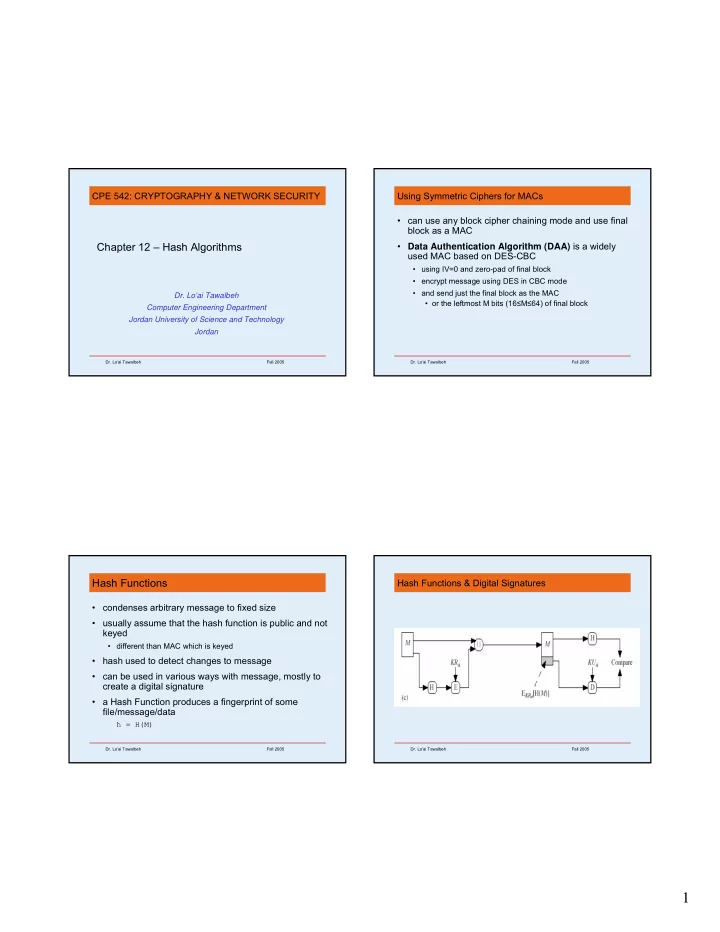
1 Simple Hash Functions Requirements for Hash Functions 1. can be - - PDF document

1
SMART_READER_LITE
LIVE PREVIEW

1 Simple Hash Functions Requirements for Hash Functions 1. can be - - PDF document

CPE 542: CRYPTOGRAPHY & NETWORK SECURITY Using Symmetric Ciphers for MACs can use any block cipher chaining mode and use final block as a MAC Chapter 12 Hash Algorithms Data Authentication Algorithm (DAA) is a widely used MAC


slide-1
SLIDE 1

1

  • Dr. Lo’ai Tawalbeh
Fall 2005

Chapter 12 – Hash Algorithms

  • Dr. Lo’ai Tawalbeh

Computer Engineering Department Jordan University of Science and Technology Jordan

CPE 542: CRYPTOGRAPHY & NETWORK SECURITY

  • Dr. Lo’ai Tawalbeh
Fall 2005

Using Symmetric Ciphers for MACs

  • can use any block cipher chaining mode and use final

block as a MAC

  • Data Authentication Algorithm (DAA) is a widely

used MAC based on DES-CBC

  • using IV=0 and zero-pad of final block
  • encrypt message using DES in CBC mode
  • and send just the final block as the MAC
  • or the leftmost M bits (16≤M≤64) of final block
  • Dr. Lo’ai Tawalbeh
Fall 2005

Hash Functions

  • condenses arbitrary message to fixed size
  • usually assume that the hash function is public and not

keyed

  • different than MAC which is keyed
  • hash used to detect changes to message
  • can be used in various ways with message, mostly to

create a digital signature

  • a Hash Function produces a fingerprint of some

file/message/data

h = H(M)

  • Dr. Lo’ai Tawalbeh
Fall 2005

Hash Functions & Digital Signatures

slide-2
SLIDE 2

2

  • Dr. Lo’ai Tawalbeh
Fall 2005

Requirements for Hash Functions

1. can be applied to any sized message M 2. produces fixed-length output h 3. is easy to compute h=H(M) for any message M 4. given h is infeasible to find x s.t. H(x)=h

  • ne-way property

5. is infeasible to find any x,y s.t. H(y)=H(x)

  • strong collision resistance
  • Dr. Lo’ai Tawalbeh
Fall 2005

Simple Hash Functions

  • are several proposals for simple functions
  • based on XOR of message blocks
  • not secure since can manipulate any message and

either not change hash or change hash also

  • need a stronger cryptographic function (next chapter)
  • Dr. Lo’ai Tawalbeh
Fall 2005

Block Ciphers as Hash Functions

  • can use block ciphers as hash functions
  • using H0=0 and zero-pad of final block
  • compute: Hi = EMi [Hi-1]
  • and use final block as the hash value
  • similar to CBC but without a key
  • resulting hash is too small (64-bit)-
  • Dr. Lo’ai Tawalbeh
Fall 2005

Hash Example: Secure Hash Algorithm-SHA

  • Maximum length of the input is < 2^64 bits and outputs 160-bit digest
  • 1. pad message so its length is congruent to 448 mod 512

(first bit 1, then followed by zeros)

  • 2. append a 64-bit integer value to the msg (cantinas the original msg

length).

  • 3. initialise 5-word (160-bit) buffer (A,B,C,D,E) to

(67452301,efcdab89,98badcfe,10325476,c3d2e1f0)

  • 4. process message in 16-word (512-bit) blocks:
  • expand 16 words into 80 words by mixing & shifting
  • use 4 rounds of 20 bit operations on message block & buffer
  • add output to input to form new buffer value

1.

  • utput hash value is the final buffer value
slide-3
SLIDE 3

3

  • Dr. Lo’ai Tawalbeh
Fall 2005

Hash Example: Secure Hash Algorithm-SHA

  • Dr. Lo’ai Tawalbeh
Fall 2005

SHA-1 Compression Function

  • each round has 20 steps which replaces the 5 buffer

words thus:

(A,B,C,D,E) <-(E+f(t,B,C,D)+(A<<5)+Wt+Kt),A,(B<<30),C,D)

  • A,B,C,D, E refer to the 5 words of the buffer
  • t is the step number
  • f(t,B,C,D) is nonlinear function for round (t)
  • Wt is derived from the message block
  • Kt is a constant value
  • Dr. Lo’ai Tawalbeh
Fall 2005

SHA-1 Compression Function

  • Dr. Lo’ai Tawalbeh
Fall 2005

Wt generation

slide-4
SLIDE 4

4

  • Dr. Lo’ai Tawalbeh
Fall 2005

Revised Secure Hash Standard

  • NIST have issued a revision FIPS 180-2
  • adds 3 additional hash algorithms
  • SHA-256, SHA-384, SHA-512
  • designed for compatibility with increased security

provided by the AES cipher

  • structure & detail is similar to SHA-1
  • hence analysis should be similar
  • Dr. Lo’ai Tawalbeh
Fall 2005

Keyed Hash Functions as MACs

  • have desire to create a MAC using a hash function rather than a

block cipher

  • because hash functions are generally faster
  • Widely available
  • not limited by export controls unlike block ciphers
  • hash includes a key along with the message
  • Incorporation of a secret key to an existing hash function- e.g.,

HMAC

  • Dr. Lo’ai Tawalbeh
Fall 2005

HMAC

  • specified as Internet standard, used in IP security, SSL.
  • uses hash function on the message:

HMACK = Hash[(K+ XOR opad) || Hash[(K+ XOR ipad)||M)]]

  • where K+ is the key padded out to size
  • and opad, ipad are specified padding constants
  • verhead is just 3 more hash calculations than the message needs

alone

  • any of MD5, SHA-1, RIPEMD-160 can be used
  • Dr. Lo’ai Tawalbeh
Fall 2005

HMAC Overview

slide-5
SLIDE 5

5

  • Dr. Lo’ai Tawalbeh
Fall 2005

HMAC Security

  • know that the security of HMAC relates to that of the

underlying hash algorithm

  • attacking HMAC requires either:
  • brute force attack on key used
  • choose hash function used based on speed verses

security constraints