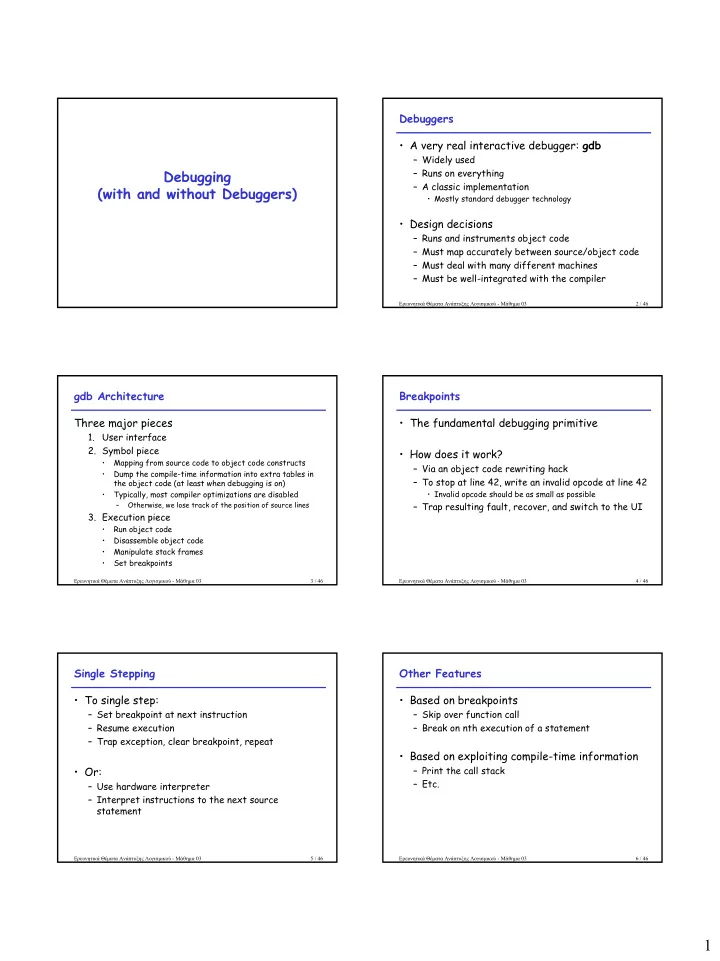

SLIDE 1
1
Debugging (with and without Debuggers)
Ερευνητικά Θέματα Ανάπτυξης Λογισμικού - Μάθημα 03 2 / 46
Debuggers
- A very real interactive debugger: gdb
– Widely used – Runs on everything – A classic implementation
- Mostly standard debugger technology
- Design decisions
– Runs and instruments object code – Must map accurately between source/object code – Must deal with many different machines – Must be well-integrated with the compiler
Ερευνητικά Θέματα Ανάπτυξης Λογισμικού - Μάθημα 03 3 / 46
gdb Architecture Three major pieces
1. User interface
- 2. Symbol piece
- Mapping from source code to object code constructs
- Dump the compile-time information into extra tables in
the object code (at least when debugging is on)
- Typically, most compiler optimizations are disabled
– Otherwise, we lose track of the position of source lines
- 3. Execution piece
- Run object code
- Disassemble object code
- Manipulate stack frames
- Set breakpoints
Ερευνητικά Θέματα Ανάπτυξης Λογισμικού - Μάθημα 03 4 / 46
Breakpoints
- The fundamental debugging primitive
- How does it work?
– Via an object code rewriting hack – To stop at line 42, write an invalid opcode at line 42
- Invalid opcode should be as small as possible
– Trap resulting fault, recover, and switch to the UI
Ερευνητικά Θέματα Ανάπτυξης Λογισμικού - Μάθημα 03 5 / 46
Single Stepping
- To single step:
– Set breakpoint at next instruction – Resume execution – Trap exception, clear breakpoint, repeat
- Or:
– Use hardware interpreter – Interpret instructions to the next source statement
Ερευνητικά Θέματα Ανάπτυξης Λογισμικού - Μάθημα 03 6 / 46
Other Features
- Based on breakpoints
– Skip over function call – Break on nth execution of a statement
- Based on exploiting compile-time information