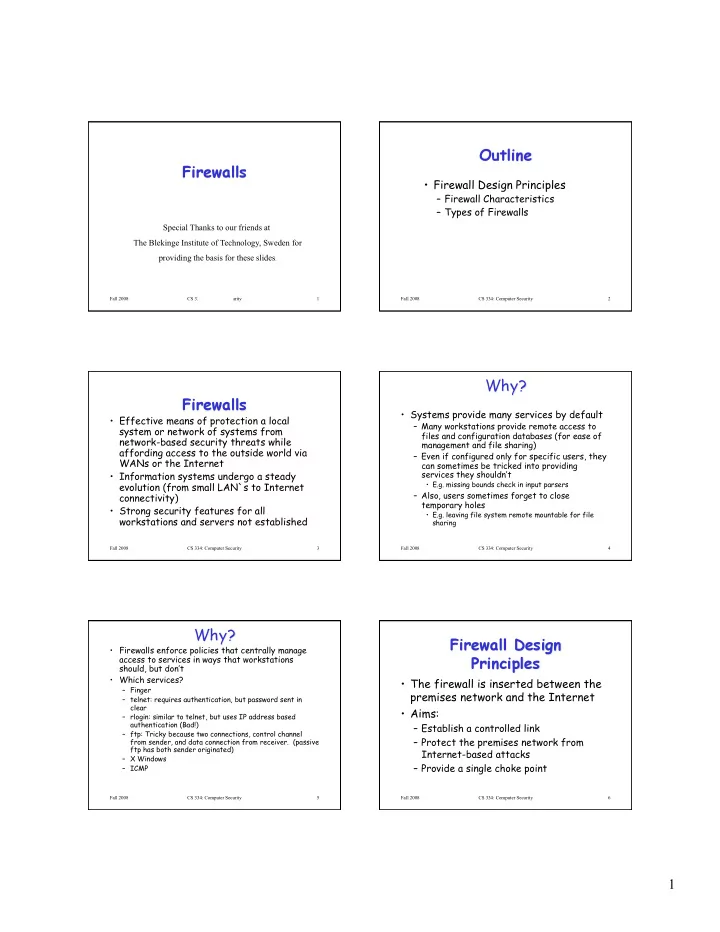
1 Four general techniques: Design goals: All traffic from inside - - PDF document

1
SMART_READER_LITE
LIVE PREVIEW

1 Four general techniques: Design goals: All traffic from inside - - PDF document

Firewall Design Principles Firewall Characteristics Types of Firewalls Special Thanks to our friends at The Blekinge Institute of Technology, Sweden for providing the basis for these slides . Fall 2008 CS 334: Computer Security 1


slide-1
SLIDE 1

1

Fall 2008 CS 334: Computer Security 1

Special Thanks to our friends at The Blekinge Institute of Technology, Sweden for providing the basis for these slides.

Fall 2008 CS 334: Computer Security 2

  • Firewall Design Principles

– Firewall Characteristics – Types of Firewalls

Fall 2008 CS 334: Computer Security 3

  • Effective means of protection a local

system or network of systems from network-based security threats while affording access to the outside world via WANs or the Internet

  • Information systems undergo a steady

evolution (from small LAN`s to Internet connectivity)

  • Strong security features for all

workstations and servers not established

Fall 2008 CS 334: Computer Security 4

  • Systems provide many services by default

– Many workstations provide remote access to files and configuration databases (for ease of management and file sharing) – Even if configured only for specific users, they can sometimes be tricked into providing services they shouldn’t

  • E.g. missing bounds check in input parsers

– Also, users sometimes forget to close temporary holes

  • E.g. leaving file system remote mountable for file

sharing

Fall 2008 CS 334: Computer Security 5

  • Firewalls enforce policies that centrally manage

access to services in ways that workstations should, but don’t

  • Which services?

– Finger – telnet: requires authentication, but password sent in clear – rlogin: similar to telnet, but uses IP address based authentication (Bad!) – ftp: Tricky because two connections, control channel from sender, and data connection from receiver. (passive ftp has both sender originated) – X Windows – ICMP

Fall 2008 CS 334: Computer Security 6

  • The firewall is inserted between the

premises network and the Internet

  • Aims:

– Establish a controlled link – Protect the premises network from Internet-based attacks – Provide a single choke point

slide-2
SLIDE 2

2

Fall 2008 CS 334: Computer Security 7

  • Design goals:

– All traffic from inside to outside must pass through the firewall (physically blocking all access to the local network except via the firewall) – Only authorized traffic (defined by the local security policy) will be allowed to pass – The firewall itself is immune to penetration (use of trusted system with a secure operating system)

Fall 2008 CS 334: Computer Security 8

  • Four general techniques:
  • Service control

– Determines the types of Internet services that can be accessed, inbound

  • r outbound
  • Direction control

– Determines the direction in which particular service requests are allowed to flow

Fall 2008 CS 334: Computer Security 9

  • User control

– Controls access to a service according to which user is attempting to access it

  • Behavior control

– Controls how particular services are used (e.g. filter e-mail)

Fall 2008 CS 334: Computer Security 10

  • Cannot protect against attacks that bypass

the firewall

– E.g. an internal modem pool

  • Firewall does not protect against internal

threats

  • Firewall cannot protect against transfer of

virus infected programs

– Too many different apps and operating systems supported to make it practical to scan all incoming files for viruses

Fall 2008 CS 334: Computer Security 11

  • Three common types of Firewalls:

– Packet-filtering routers – Application-level gateways – Circuit-level gateways – (Bastion host)

Fall 2008 CS 334: Computer Security 12

  • Packet-filtering Router
slide-3
SLIDE 3

3

Fall 2008 CS 334: Computer Security 13

  • Packet-filtering Router

– Applies a set of rules to each incoming IP packet and then forwards or discards the packet – Filter packets going in both directions – The packet filter is typically set up as a list of rules based on matches to fields in the IP or TCP header – Two default policies (discard or forward)

Fall 2008 CS 334: Computer Security 14

  • Advantages:

– Simplicity – Transparency to users – High speed

  • Disadvantages:

– Difficulty of setting up packet filter rules – Lack of Authentication

  • Who really sent the packet?

Fall 2008 CS 334: Computer Security 15 Fall 2008 CS 334: Computer Security 16

  • Can be clever:

– Allow connections initiated from inside network to outside, but not initiated from outside.

  • Traffic flows both way, but if firewall only allows

incoming packets with ACK set in TCP header, this manages the issue.

  • Problem: some apps require outside node to initiate

connection with inside node (e.g. ftp, Xwindows), even if original request initiated by inside node.

  • Solution (sort of): allow packets from outside if they

are connecting to high port number.

Fall 2008 CS 334: Computer Security 17

  • Changes filtering rules dynamically (by

remembering what has happened in recent past)

  • Example: Connection initiated from inside

node S to outside IP address D. For short time allow incoming connections from D to appropriate ports (I.e. ftp port).

  • In practice, much more caution

– Stateful filter notices the incoming port requested by S and only allows connections from D to that port. Requires parsing ftp control packets

Fall 2008 CS 334: Computer Security 18

  • Possible attacks and

appropriate countermeasures

– IP address spoofing

  • Discard packet with inside source

address if it arrives on external interface

– Source routing attacks

  • Discard all source routed packets
slide-4
SLIDE 4

4

Fall 2008 CS 334: Computer Security 19

  • Possible attacks and appropriate

countermeasures

– Tiny fragment attacks

  • Intruder uses IP fragment option to

create extremely small IP packets that force TCP header information into separate packet fragments

  • Discard all packets where protocol type

is TCP and IP fragment offset is small

Fall 2008 CS 334: Computer Security 20

  • Application-level Gateway

Fall 2008 CS 334: Computer Security 21

  • Application-level Gateway

– Also called proxy server – Acts as a relay of application-level traffic – Can act as router, but typically placed between two packet filtering firewalls (for total of three boxes)

  • Two firewalls are routers that refuse to forward

anything from the global net that is not to gateway, and anything to global net that is not from gateway.

  • Sometimes called a bastion host (we use

the term differently)

Fall 2008 CS 334: Computer Security 22

  • Advantages:

– Higher security than packet filters – Only need to scrutinize a few allowable applications – Easy to log and audit all incoming traffic

  • Disadvantages:

– Additional processing overhead on each connection (gateway as splice point)

Fall 2008 CS 334: Computer Security 23

  • Circuit-level Gateway

Fall 2008 CS 334: Computer Security 24

  • Circuit-level Gateway

– Stand-alone system or – Specialized function performed by an Application-level Gateway – Sets up two TCP connections – The gateway typically relays TCP segments from one connection to the

  • ther without examining the contents
slide-5
SLIDE 5

5

Fall 2008 CS 334: Computer Security 25

  • Circuit-level Gateway

– The security function consists of determining which connections will be allowed – Typically use is a situation in which the system administrator trusts the internal users

Fall 2008 CS 334: Computer Security 26

  • Bastion Host

– A system identified by the firewall administrator as a critical strong point in the network´s security – The bastion host serves as a platform for an application-level or circuit-level gateway

Fall 2008 CS 334: Computer Security 27

  • In addition to the use of simple

configuration of a single system (single packet filtering router or single gateway), more complex configurations are possible

  • We won’t go into these

Fall 2008 CS 334: Computer Security 28

  • Assume all bad guys are on outside, and

everyone inside can be trusted.

  • Firewalls can be defeated if malicious code

can be injected into corporate network

– E.g. trick someone into launching an executable from an email message or into downloading something from the net.

  • Often make it difficult for legitimate

users to get their work done.

– Misconfiguration, failure to recognize new app

Fall 2008 CS 334: Computer Security 29

  • If firewall allows anything through, people

figure out how to do what they need by disguising their traffic as allowed traffic

– E.g. file transfer by sending it through email. If size of emails limited, then user breaks them into chunks, etc. – Firewall friendly traffic (e.g. using http for

  • ther purposes)
  • Defeats effort of sysadmin to control traffic
  • Less efficient than not using http

Fall 2008 CS 334: Computer Security 30

  • Chapman, D., and Zwicky, E. Building

Internet Firewalls. O’Reilly, 1995

  • Cheswick, W., and Bellovin, S. Firewalls and

Internet Security: Repelling the Wily

  • Hacker. Addison-Wesley, 2000