1 T9 : Problems Whats best? Ambiguity persists Low KSPC - - PDF document

1
SMART_READER_LITE
LIVE PREVIEW

1 T9 : Problems Whats best? Ambiguity persists Low KSPC - - PDF document

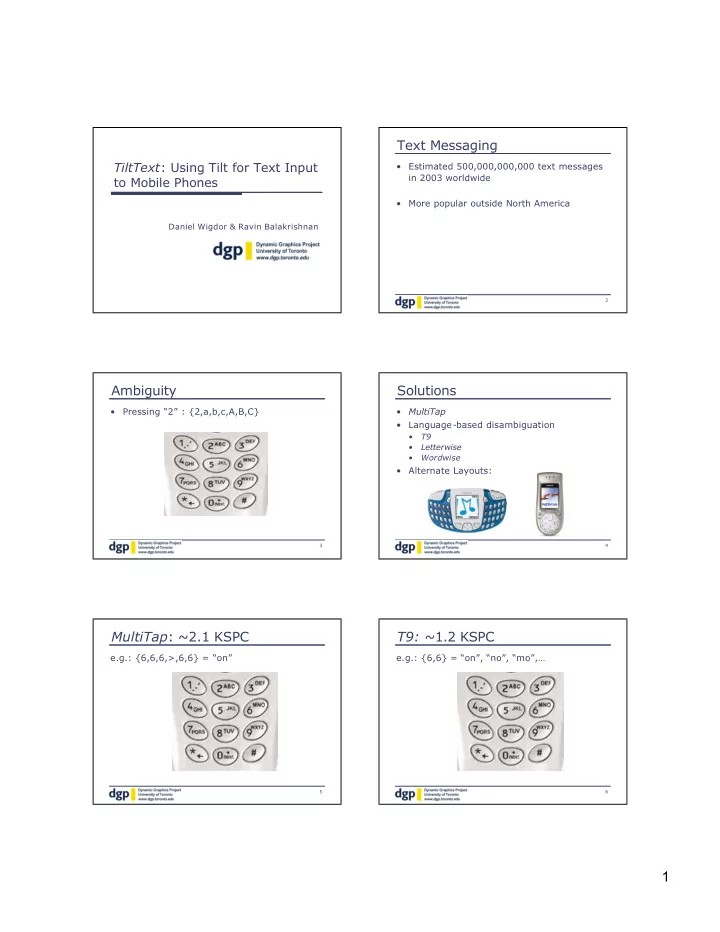
Text Messaging TiltText : Using Tilt for Text Input Estimated 500,000,000,000 text messages in 2003 worldwide to Mobile Phones More popular outside North America Daniel Wigdor & Ravin Balakrishnan 2 Ambiguity Solutions


slide-1
SLIDE 1

1

TiltText: Using Tilt for Text Input to Mobile Phones

Daniel Wigdor & Ravin Balakrishnan

2

Text Messaging

  • Estimated 500,000,000,000 text messages

in 2003 worldwide

  • More popular outside North America

3

Ambiguity

  • Pressing “2” : {2,a,b,c,A,B,C}

4

Solutions

  • MultiTap
  • Language-based disambiguation
  • T9
  • Letterwise
  • Wordwise
  • Alternate Layouts:

5

MultiTap: ~2.1 KSPC

e.g.: {6,6,6,>,6,6} = “on”

6

T9: ~1.2 KSPC

e.g.: {6,6} = “on”, “no”, “mo”,…

slide-2
SLIDE 2

2

7

T9: Problems

  • Ambiguity persists
  • Inconsistent
  • Eyes-free operation impossible
  • Only English-Like text
  • No numerals
  • Real “texting” impossible

(“b4”,”btw”,”lol”,”rotflmao”…)

8

What’s best?

  • Low KSPC
  • Eyes-free
  • Non-language specific

9

Tilt as input

  • Add a tilt sensor to device
  • inexpensive accelerometers
  • Hinckley et al.UIST’00
  • Tilt for text input:
  • Sazawal et al. Unigesture MobileHCI ‘02
  • Partridge et al. TiltTypeUIST’02
  • No formal evaluations

10

TiltText: 1 KSPC + Tilt Action

eg: {7} = …

P Q R S

11

Tilt Detection: Key Tilt

  • Difference between press & release
  • Slow: 3 consecutive actions
  • keypress, tilt, key-release
  • Pilot study: poor performance

12

Tilt Detection: Absolute

  • Relative to a fixed origin
  • Keypress & tilt actions concurrent
  • Consecutive same-tilt: savings
  • Consecutive opposite-tilt: extra cost
  • High error-rate: “creeping posture”
slide-3
SLIDE 3

3

13

Tilt Detection: Relative

  • Most recent tilting gesture
  • floating origin
  • Maintains advantages of Absolute tilt
  • Saves work on consecutive same tilts &

consecutive opposite tilts

  • No “creeping posture”

14

Our Prototype

  • Uses Absolute tilt
  • Implemented on Motorola i95 in Java
  • Tilts from board via serial port

15

The Study

  • Repeated-measures design

10 participants 2 techniques (MultiTap & TiltText) 16 blocks of 20 phrases each in 2 sessions

  • Same phrases for both techniques
  • Technique order between participant
  • Measured time & accuracy
  • Participants told to correct mistakes

16

Results: Overall Speed

  • Overall, TiltText 16% faster (including error correction)

2 4 6 8 10 12 14 16 1 2 3 4 5 6 7 8 9 10 11 12 13 14 15 16 TiltText MultiTap

Block WPM

17

Power-law extrapolation

y = 7.6837x

0.2134

R

2 = 0.9263

y = 8.0297x

0.1184

R

2 = 0.8963

2 4 6 8 10 12 14 16 1 3 5 7 9 11 13 15 17 19 21 23 25 TiltText MultiTap

WPM Block

18

Results: Between Participant

  • Data from 1 st technique seen by each participant
  • TiltText still faster

2 4 6 8 10 12 14 16 1 2 3 4 5 6 7 8 9 10 11 12 13 14 15 16 TiltText MultiTap

Block WPM

slide-4
SLIDE 4

4

19

Results: Error Rate

  • TiltText error rate higher than

MultiTap

Error Rate Percentage Block

2 4 6 8 10 12 14 16 18 20 1 2 3 4 5 6 7 8 9 10 11 12 13 14 15 16 TiltText MultiTap

20

Error Rate: By Letter

  • Error rates much higher for some letters

Correct Letter

5 10 15 20 25 30 35 40 a b c d e f g h i j k l m n o p q r s t u v w x y z

Error Rate Percentage

21

Error Rate: Tilt Direction

  • Direction significantly effects error rate
  • Creeping posture

5 10 15 20 25 30 35 40 Left Forward Right Back

Error Rate Percentage Correct Tilt Direction

22

Conclusions

  • Implemented TiltText
  • Three distinct approaches for tilt
  • Formal study conducted
  • TiltText faster despite errors

23

Future Work

  • Theoretical TiltText speed
  • KSPC is not the whole story
  • Implement relative-tilt system
  • Deeper analysis of error causes
  • Longer study
  • Optimizing letter/key assignments

24

Acknowledgements

  • Michael McGuffin
  • Richard Watson
  • DGP Lab members
  • Study participants
  • Microsoft Research
slide-5
SLIDE 5

5

25