1. 1.8 million tuberculosis infection llion deaths eaths Leading - - PDF document

1
SMART_READER_LITE
LIVE PREVIEW

1. 1.8 million tuberculosis infection llion deaths eaths Leading - - PDF document

10/3/2017 Disclosures I have nothing to disclose Updates in Tuberculosis Chris Keh, MD Assistant Clinical Professor, Division of Infectious Diseases, UCSF TB Controller, TB Prevention and Control Program, Population Health Division, SFDPH


slide-1
SLIDE 1

10/3/2017 1

Updates in Tuberculosis

Chris Keh, MD

Assistant Clinical Professor, Division of Infectious Diseases, UCSF TB Controller, TB Prevention and Control Program, Population Health Division, SFDPH

Disclosures I have nothing to disclose

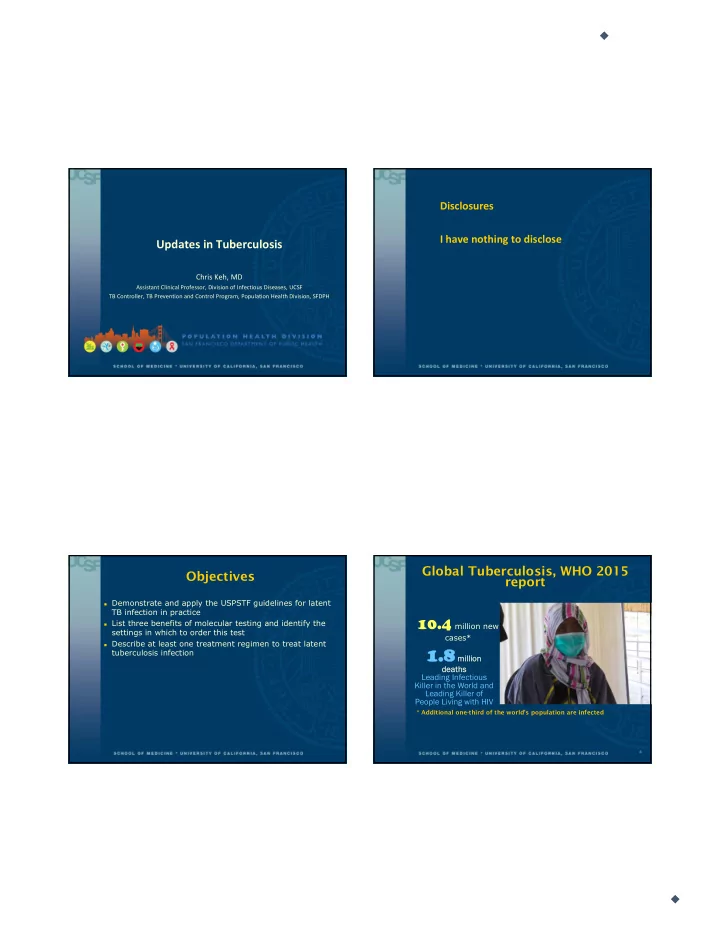
Objectives

 Demonstrate and apply the USPSTF guidelines for latent

TB infection in practice

 List three benefits of molecular testing and identify the

settings in which to order this test

 Describe at least one treatment regimen to treat latent

tuberculosis infection

Global Tuberculosis, WHO 2015 report

10.4 million new

cases*

4

1. 1.8 million

llion deaths eaths Leading Infectious Killer in the World and Leading Killer of People Living with HIV

* Additional one-third of the world’s population are infected

slide-2
SLIDE 2

10/3/2017 2

TB in the U.S.- what lies beneath

9557 cases

10-15 million persons with LTBI

1 out of 5 non-U.S. born has LTBI 1 out of 8 Asian-born has LTBI

How far are we from elimination?

TB elimination: <1 case per million United States, 2015 30 cases per million (all) 12 cases per million (U.S.‐born) 151 cases per million (non‐U.S.‐born) www.cdc.gov

6

San Francisco, 2016 116 cases per million (all) 23 cases per million (U.S. born) 291 cases per million (non‐U.S.‐born)

Incidence Projections to 2060

Hill et al., Epidemiol Infect, 2012 Cut in transmission Increase LTBI treatment, 2x or 4x more

USPSTF, Update for LTBI 2016

B

 Screen for latent tuberculosis infection in

asymptomatic adults at increased risk of infection Recommendation: Grade:

slide-3
SLIDE 3

10/3/2017 3

TB as a spectrum of disease

 Evidence of progression / regression of FDG-avid

granulomas in non-human primates

 Re-think binary definitions: LTBI vs Active Disease  Nomenclature change?: (Latent) Tuberculosis Infection

Diagnostics

10

Screening Tools for LTBI

TST ( e.g. PPD) I GRA ( e.g. QFT, T-spot) Potential for false positive in BCG vaccinated individuals Preferred in prior BCG vaccinated individuals Subjective Less subjective (although issue with indeterminate) Booster effect No booster effect Injection, ≥2 visits Blood draw, single visit Limited in young (2-5 yo)

Rapid Molecular Testing (Active TB)

 Examples: GeneXpert, PCR, Pyrosequencing  Provides rapid identification  Cultures are still necessary for drug susceptibilities  Rapid turnaround time (2-3 hours compared to 4-6

weeks for culture)

Earlier initiation of effective tx Decreased period of infectiousness Improved pt outcome Earlier involvement of MDR expert Earlier request for 1st/2nd line susceptibilities

 Potential use in discontinuation of airborne isolation

http://www.tbcontrollers.org/docs/resources/NTCA_APHL_GeneXpert_Consens us_Statement_Final.pdf

12

slide-4
SLIDE 4

10/3/2017 4 Xpert MTB/RIF Test Performance

Sensitivity Specificity Sm ear pos. TB 95-98% 99% Sm ear neg. TB 60-72% Rifam pin “R” 98-99% 99-100%

NEJM 361:1005, 2010; Am J Crit Care Med 184:132, 2011

13

  • Provides both MTB identification and detection of RIF

resistance (rpoB)

  • Send on any patient with moderate-high suspicion for

active TB

  • Can remain positive for months-years after adequate tx

Xpert MTB/RIF Report

14

 MTB DETECTED or NOT

DETECTED

 Rif Resistance DETECTED or

NOT DETECTED

LTBI Treatment Options

 Isoniazid  Isoniazid + Rifapentine (3HP)  Rifampin  Isoniazid + Rifampin

Treatment Regimens for Latent TB Infection

Drug(s) Duration Interval Minimum Doses

Isoniazid 9 months Daily 270 Twice weekly 76 6 months Daily 180 Twice weekly 52 Isoniazid & Rifapentine 3 months Once weekly 12 Rifampin 4 months Daily 120

slide-5
SLIDE 5

10/3/2017 5

 Once weekly x 12 weeks (12 doses)  Recommended as an equal alternative to INH x 9 mo  Current recommendation for directly observed therapy

(may change in the next year)

 Not recommended in:

Children <2yo HIV-infected patients on ART Pregnant or planning to become pregnant Contact to INH/RIF resistant cases Prior adverse events / hypersensitivity to INH/RIF

INH + Rifapentine (3HP)

 Recommendations for Use of an Isoniazid–Rifapentine Regimen with Direct Observation to Treat

Latent Mycobacterium tuberculosis Infection. MMWR 2011;60:1650–1653

https://www.cdph.ca.gov/Programs/CID/DCDC/CDPH%20Document%20Library/TBCB‐INH‐RIF‐LTBI‐

fact‐sheet.pdf
INH‐RPT INH

  • No. of patients

3,986 3,745 Administration Directly‐observed therapy Self‐administered therapy Frequency Weekly Daily Duration 12 weeks 9 months

Sterling TR, et al; TB Trials Consortium PREVENT TB Study Team. Three months of rifapentine and isoniazid for latent tuberculosis infection. N Engl J Med. 2011 Dec 8;365(23):2155‐66.

Prevent TB Study Results

INH‐RPT INH P‐value Effectiveness 1.9 per 1,000 4.3 per 1,000 Non‐ inferior Completion rate 82.1% 69.0% P<0.001 Hepatotoxicity 0.4% 2.7% P<0.001

Sterling TR, et al; TB Trials Consortium PREVENT TB Study Team. Three months of rifapentine and isoniazid for latent tuberculosis infection. N Engl J Med. 2011 Dec 8;365(23):2155‐66.

Side effects- 3HP

 Possible hypersensitivity (3.8%)  Rash (0.8%)  Hepatotoxicity (0.4%)  Thrombocytopenia (rare)  Other toxicities (3.2%)  Monitoring- similar to INH or RIF  RFP drug-drug interactions similar to RIF  Recommendations for Use of an Isoniazid–Rifapentine Regimen with Direct Observation to Treat

Latent Mycobacterium tuberculosis Infection. MMWR 2011;60:1650–1653

https://www.cdph.ca.gov/Programs/CID/DCDC/CDPH%20Document%20Library/TBCB‐INH‐RIF‐LTBI‐

fact‐sheet.pdf

slide-6
SLIDE 6

10/3/2017 6

Additional New Tools

Risk Assessment Tools

 CA Risk Assessment

Adult, Pediatric,

College/University Students, School Staff / Volunteers

 BCG Atlas

(www.bcgatlas.org)

Database of BCG practices

June 2017

California Tuberculosis Risk Assessment Adults

฀ Use this tool to identify asymptomatic adults for latent TB infection (LTBI) testing. ฀ Re-testing should only be done in persons who previously tested negative, and have new risk factors since the last assessment. ฀ For TB symptoms or abnormal chest x-ray consistent with active TB disease: Evaluate for active TB disease Evaluate for active TB disease with a chest x-ray, symptom screen, and if indicated, sputum AFB smears, cultures and nucleic acid amplification testing. A negative tuberculin skin test or interferon gamma release assay does not rule out active TB disease. Check appropriate risk factor boxes below. LTBI testing is recommended if any of the 3 boxes below are checked. If LTBI test result is positive and active TB disease is ruled out, LTBI treatment is recommended.

฀ Foreign-born person from a country with an elevated TB rate

฀ Includes any country other than the United States, Canada, Australia, New Zealand, or a country in western or northern Europe ฀ If resources require prioritization within this group, prioritize patients with at least one medical risk for progression (see the California Adult Tuberculosis Risk Assessment User Guide for this list) ฀ Interferon Gamma Release Assay is preferred over Tuberculin Skin Test for foreign-           ฀         

฀ Immunosuppression, current or planned

HIV infection, organ transplant recipient, treated with TNF-alpha antagonist (e.g., infliximab, etanercept, others), steroids                          ฀     day     ฀                                          

฀ Close contact to someone with infectious TB disease at any time

See the California Adult Tuberculosis Risk Assessment User Guide for more information about using this tool. Patient Name: ___________________________________ Date of Birth: ____________________________________

(Place sticker here if applicable) To ensure you have the most current version, go to the RISK ASSESSMENT page at: https://cdph.ca.gov/tbcb Provider: ________________________________________ Assessment Date: ________________________________

https://www.cdph.ca.gov/Programs/CID/DCDC/Pages/TB-Risk- Assessment.aspx

Slide 23

TST / IGRA Interpreter

www.TSTin3d.com

Estimates risk

  • f active TB

Limited to up

to age 80

Accounts for

risk factors

Slide 24

Results

slide-7
SLIDE 7

10/3/2017 7

Video Directly Observed Therapy

 Observation of medication ingestion by video

Live vs Recorded Smartphone application, cloud based

 Can be used for active disease and LTBI  Cost-effective and ensures adherence http://www.calit2.net/newsroom/release.php?id=2211

Summary

 Asians have one of the highest case rates in the U.S.

(30x higher than Caucasians)

 Patients born / residing in Asia have a high risk of TB

infection

 TB Elimination Movement- national, state, local  Newer tools can assist in TB elimination

 Rapid diagnostics  IGRA  Shorter-course treatments  LTBI toolkits (e.g. CDC, CTCA/CDPH, in development)  LTBI registry (in development)  Updated guidelines  Risk assessment tools  VDOT

Assistance is right around the corner…

 TB Warmline Consultation (Curry

International TB Center): 1-877-390-6682

 Local Public Health Dept / TB

Control

 California Dept of Public Health,

TB Control Branch, https://www.cdph.ca.gov/Progra ms/CID/DCDC/Pages/TBCB.aspx (510) 620-3000 (or your State TB Control Branch)