1 YOU TELL ME: WHO IS MORE LIKELY TO VOLUNTARILY LEAVE ? Males or - - PDF document

1
SMART_READER_LITE
LIVE PREVIEW

1 YOU TELL ME: WHO IS MORE LIKELY TO VOLUNTARILY LEAVE ? Males or - - PDF document

LABOR AS A QUASI-FIXED FACTOR: Effect of Turnover on Employment Relationship I. Turnover from 2 perspectives II. Efficiency Wages as solution to turnover LIR 809 2 SIDES TO VOLUNTARY TURNOVER WORKERS VIEW FIRMS VIEW Turnover is a


slide-1
SLIDE 1

1

LIR 809

LABOR AS A QUASI-FIXED FACTOR: Effect of Turnover

  • n Employment Relationship
  • I. Turnover from 2 perspectives
  • II. Efficiency Wages as solution to turnover

LIR 809

2 SIDES TO VOLUNTARY TURNOVER

FIRM’S VIEW

Replacement Costs Loss of investment

WORKER’S VIEW

Direct Current Costs Indirect Current Costs Expected Future (may be soon) Benefit

Turnover is an investment Turnover is a cost

LIR 809

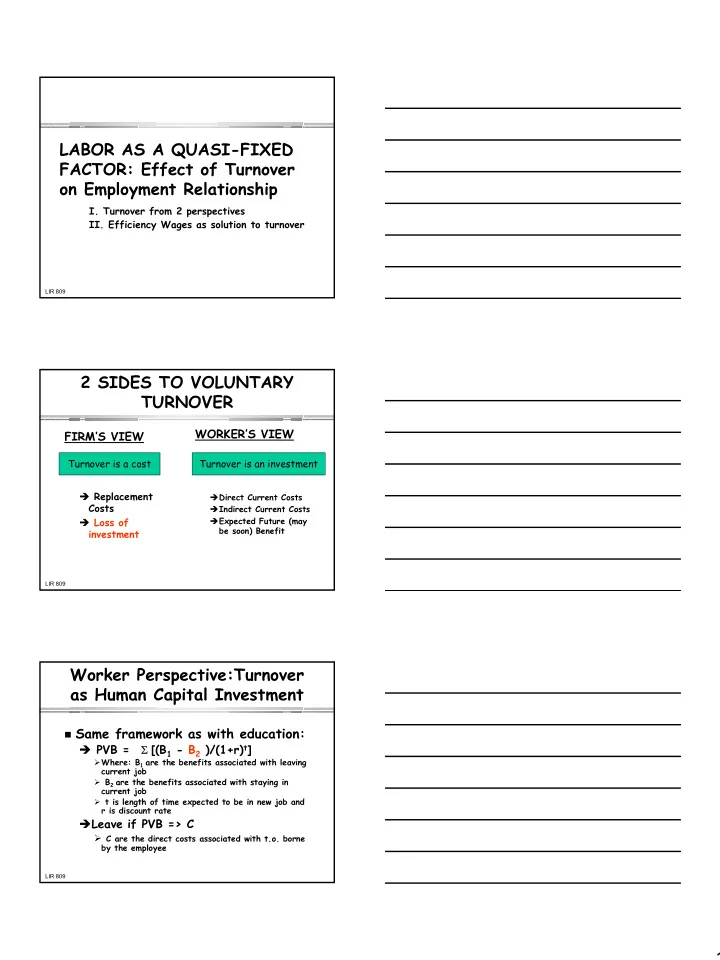
Worker Perspective:Turnover as Human Capital Investment

Same framework as with education:

PVB = Σ [(B1 - B2 )/(1+r)t]

Where: B1 are the benefits associated with leaving current job B2 are the benefits associated with staying in current job t is length of time expected to be in new job and r is discount rate

Leave if PVB => C

C are the direct costs associated with t.o. borne

by the employee

slide-2
SLIDE 2

2

LIR 809

YOU TELL ME: WHO IS MORE LIKELY TO VOLUNTARILY LEAVE?

Males or Females Minority or Non-Minority Older or Younger More Educated or Less Educated Up or down swing of Business Cycle More Job Tenure or Less Urban or Rural Large or small firm

LIR 809

Employer Perspective: Replacement Costs

Incoming employees: takes 13.5

  • mo. to reach 100% efficiency

Co-Worker time: b/n 8% and 14%

  • f workday helping new employee

Departing employee: 1 mo. lost

prod.

Co-worker slack off Vacancy period: 13 wks.

LIR 809

Estimates of Replacement Costs

HR Manager Auto Manu. $133,803 Salaried Journeyman machinist: $102,796 Hourly Journeyman machinist: $58,732 Technical Project Leader Software Co: $32,215 Systems Engineer Software Co: $34,397 Fast Food Chain Store Manager: $21,931 Kitchen or Counter Person Fast Food: $1,521

Source: “Losses Mount in Fight against Turnover,” Bulletin to Management, 50(24), June 17, 1999, p. 185.

slide-3
SLIDE 3

3

LIR 809

Joint Problem with Turnover: Loss

  • f Human Capital Investment

Loss to Individuals: Loss of Firm Specific Human Capital

Investment

Loss to Firms

Loss of both Firm Specific and General Human Capital Investments

LIR 809

EFFICIENCY WAGES: Earnings Schedule As Way To Reduce Turnover

LIR 809

Earnings

Time “Typical” Earnings Schedule revisited Earnings rise quickly early in career Then flatten out later in career

slide-4
SLIDE 4

4

LIR 809

TWO PUZZLES ABOUT EARNINGS

Why do earnings increase with work

experience?

Why do some firms appear to be

paying above-market wages? Answer: Firms are engaging in an

EFFICIENCY WAGE STRATEGY EFFICIENCY WAGE STRATEGY

LIR 809

EXPLANATIONS FOR WHY EFFICIENCY WAGE STRATEGY 4 Explanations

1) Reduce Shirking 2) Raise Morale 3) Improve Job Applicant Quality 4) Lower Turnover

LIR 809

BASIC EFFICIENCY WAGE MODEL

Competitive Product Market Firm production function:

Q = f(e(w)n)

where e is effort per worker, w is wage, & n is number of workers People respond to greater wages with greater effort

slide-5
SLIDE 5

5

LIR 809

Intuition of Efficiency Wages

People respond to greater wages with greater effort People respond to greater wages with greater effort Shows that paying above market may be economically rational Shows that paying above market may be economically rational Also provides basis for increase in earnings over time Also provides basis for increase in earnings over time

LIR 809

Why Earnings Increase over time: MONITORING AND REDUCING TURNOVER

2 Types of Compensation

Time - Based

Reward or pay according to # hours or days or weeks

Output - Based

Reward or pay according to output (e.g., piece rate, commissions, profit-sharing)

LIR 809

EMPLOYER & WORKER PREFERENCE

ERs Prefer Output

based

Tight link b/n pay & Productivity

Efficiency condition:

MPL=W

Workers bear risk

  • f uneven prod.

Attract most productive Minimal monitoring

Workers Prefer

Time-based

Need for stable income (variable earnings but constant expenses)

slide-6
SLIDE 6

6

LIR 809

Each Type Poses Problems for Employers

Piece-Work

Product Quality Misuse of equipment Rate setting Measuring output

Group Production Free Rider Complex output Time-based

Shirking Monitoring (the Agency Problem)

Most Pay is Time Based Most Pay is Time Based

LIR 809

Efficiency Wage Solution to Time-Based Pay

Take advantage of fact that work

takes place in contractual environment

Features of contractual environment

2 Parties agree to exchange Two types of contracts

Explicit Implicit

LIR 809

Implicit vs Explicit

Explicit contracts

Have specific provisions Enforceable by 3rd party

Implicit: Self-Enforcing Contract

Def.: where in both parties’ self- interest to abide by contract Contract generates surplus (get more from contract than next best alternative)

slide-7
SLIDE 7

7

LIR 809

Self-Enforcing Contract in workplace

Worker Objectives Risk-Averse Reward => Contract renewal Firm must eventually pay more than can earn elsewhere Source of surplus: Earning more than next best alternative Firm Objectives

Maximum productivity at lowest monitoring costs Source of Surplus: PV of profits from worker’s efforts > can get from firing worker

LIR 809

EARNINGS SCHEDULE AS SELF-ENFORCING CONTRACT

CASE 1: FLAT EARNINGS

Workers get same (market) wage in each period Analysis:

No Disincentive for Worker Cheating: No Benefit to Worker to Renew Contract No Incentive to Firm to Keep Worker: If paying MPL, can just hire different worker Reason we don’t see flat earnings in L-T employment relationship

LIR 809

Wage Time

CASE 1: Flat earnings

Market Wage

slide-8
SLIDE 8

8

LIR 809

EARNINGS SCHEDULE AS SELF- ENFORCING CONTRACT, CONT.

CASE 2: FLAT EARNINGS

TURNING UP AT END

Workers receive W (=MPL) for all periods until last Pay a Bonus to get worker not to shirk in last period

Size of bonus depends on:

  • Benefit of not putting forth effort
  • Probability of getting caught

LIR 809

EARNINGS SCHEDULE AS SELF- ENFORCING CONTRACT, CONT.

CASE 2, CONT:

Analysis:

Shirking problem: Prevent workers from cheating by paying more than alternative in last period But, violates efficiency condition: Firm must still meet efficiency condition (PVPL = PVCL), but would have to pay W < MPL.

Firm can still cheat and has incentive to do so.

Rare in long-term employment relationship

LIR 809

Case 2: Bonus in last period

Wage Time Market Wage

slide-9
SLIDE 9

9

LIR 809

EARNINGS SCHEDULE AS SELF- ENFORCING CONTRACT, CONT.

CASE 3: LOW START, FLAT IN

MIDDLE, HIGH AT END Entrance Fee: Way for firms to meet efficiency condition over employ. rel. Analysis:

Both parties need surplus since both can cheat (firm can fire; worker can shirk) Bonus must outweigh entrance fee & benefit of shirking; Worker must believe firm will pay

LIR 809

Case 3: Upward Sloping Wages

Wage Time

LIR 809

Case 3: Upward Sloping Wages, Smoothed

Wage Time Marginal Product Wage

slide-10
SLIDE 10

10

LIR 809

EARNINGS SCHEDULE AS SELF- ENFORCING CONTRACT, CONT.

UPWARD SLOPING WAGE PROFILE

Looks like typical earnings function

PUZZLE: How to get people to

leave at end of bonus: Mandatory retirement (What I think your biggest problem is going to be)

LIR 809

EARNINGS SCHEDULE AS SELF- ENFORCING CONTRACT SOLUTION

ILM & Market Coincide Increasing earnings over time =

alternative to close supervision under time-based compensation

Pay workers more than best alternative Offer rewards after years of diligent effort Long-term relationship allows monitor

LIR 809

ILM AS SELF-ENFORCING CONTRACT SOLUTION, Cont

Workers Choose firm based on PV of

lifetime earnings not entry wage

Nature of Contract

Long-term relationship Job security and sustained effort

Features of ILM that solve monitoring

Resource control after long tenure Job complexity