The NO n A Experiment Survey of the NOvA Far Detector Babatunde - - PowerPoint PPT Presentation

the no n a experiment
SMART_READER_LITE
LIVE PREVIEW

The NO n A Experiment Survey of the NOvA Far Detector Babatunde - - PowerPoint PPT Presentation

Dr. OSheg Oshinowo IWAA2012 Conference Fermilab, Batavia, IL, USA September 10-14, 2012 Fermilab The NO n A Experiment Survey of the NOvA Far Detector Babatunde OSheg Oshinowo Horst Friedsam Gary Feldman Fermi National Accelerator

slide-1
SLIDE 1

Fermilab

  • Dr. O’Sheg Oshinowo

IWAA2012 Conference Fermilab, Batavia, IL, USA September 10-14, 2012

The NOnA Experiment

Gary Feldman Harvard University

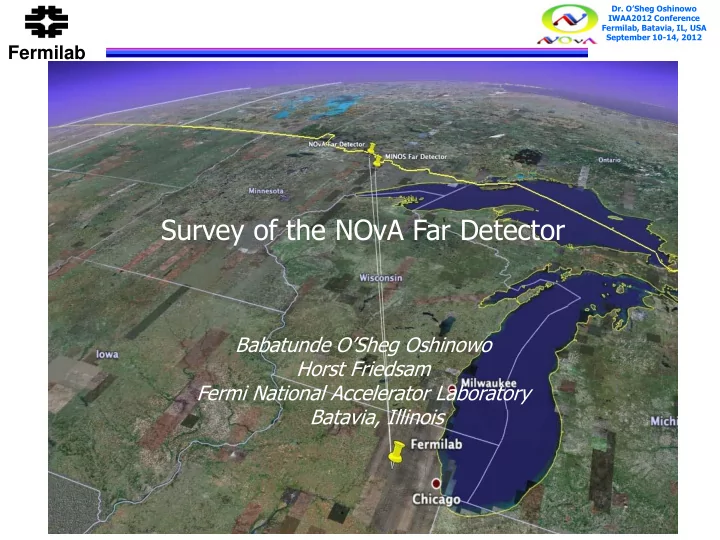
Survey of the NOvA Far Detector

Babatunde O’Sheg Oshinowo Horst Friedsam Fermi National Accelerator Laboratory Batavia, Illinois

slide-2
SLIDE 2

Fermilab

  • Dr. O’Sheg Oshinowo

IWAA2012 Conference Fermilab, Batavia, IL, USA September 10-14, 2012

The NOvA Experiment

  • North America's most advanced neutrino

experiment

  • NOvA is a second-generation experiment on

the NuMI beamline

  • The NOvA project also includes accelerator

upgrades to bring the NuMI beam intensity from 400 kW to 700 kW

  • Uses two detectors to look for changes in the

neutrino beam as it travels: Far Detector in Ash River, Minnesota Near Detector at Fermilab

  • Run for 6 years : 2015 – 2021

NOnA: NuMI Off-Axis ne Appearance Experiment ne = electron neutrino

slide-3
SLIDE 3

Fermilab

  • Dr. O’Sheg Oshinowo

IWAA2012 Conference Fermilab, Batavia, IL, USA September 10-14, 2012

Ash River

Minneapolis Duluth International Falls Fermilab

Ash River

Minneapolis Duluth International Falls Fermilab

  • This site is at 810 km from Fermilab,

about 11 km off-axis

  • The Ash River site is the farthest

available site from Fermilab in the U.S. along the NuMI beamline

Far Detector Site

slide-4
SLIDE 4

Fermilab

  • Dr. O’Sheg Oshinowo

IWAA2012 Conference Fermilab, Batavia, IL, USA September 10-14, 2012

NOvA Detectors

NOvA Detectors:

  • A 14 kTon Far Detector sited 14 mrad
  • ff the NuMI beam axis at a distance
  • f 810 km at a distance of 11 km

(Assembly underway at Ash River)

  • A 0.3 kTon Near Detector identical

to the far detector sited 14 mrad

  • ff the NuMI beam axis at a distance
  • f 1 km from the NuMI Target

(Begin installation Spring 2013)

  • An 84 Ton NDOS (Near Detector On

the Surface) identical to the Near Detector sited on the surface 107 mrad

  • ff the NuMI beam axis in the NOvA

Near Detector Surface Building at Fermilab (IWAA2010; Completed and running since November 2010)

slide-5
SLIDE 5

Fermilab

  • Dr. O’Sheg Oshinowo

IWAA2012 Conference Fermilab, Batavia, IL, USA September 10-14, 2012

NOvA Detector

 The NOvA detectors are constructed from planes of PVC modules  Extrusions have a cellular structure, with 16 isolated cells per extrusion  A module of 32 cells is constructed from two 16-cell PVC extrusions glued together L = 15.6 m for Far Detector L = 4.2 m for Near Detector  Modules are capped by a Manifold and an End Plate/Cap to contain the liquid scintillator  Twelve (12) extrusion modules get placed side by side on a flat assembly table to form one plane of the Far Detector PVC Extrusion PVC Module = Module Plane

slide-6
SLIDE 6

Fermilab

  • Dr. O’Sheg Oshinowo

IWAA2012 Conference Fermilab, Batavia, IL, USA September 10-14, 2012

NOvA Block

  • 32 planes make 1 NOvA block
  • 5 blocks make 1 super block
  • NOvA block (B) configuration is as follows:

B = v0h1v2h3v4h5v6h7v8h9v10 …. v20h21v22h23v24h25v26h27v28h29v30h31 where v are planes of vertical modules and h are planes of horizontal modules number of planes is counted from 0 (Upstream) to 31 (Downstream)

  • Block assembly starts from plane (or layer)

31 (h31) on the assembly table and ends with plane 0 (v0)

slide-7
SLIDE 7

Fermilab

  • Dr. O’Sheg Oshinowo

IWAA2012 Conference Fermilab, Batavia, IL, USA September 10-14, 2012

  • The NOvA Far Detector consists of

928 (15.6 m square) planes

  • Twelve (12) modules make up a plane,

and the planes alternate in having their long dimension vertical and horizontal

  • The Far Detector (FD) consists of 29 blocks:

FD  B0B1B2B3B4 B5……..B25B26B27B28B28 where the number of blocks is counted 0 (Upstream) to 28 (Downstream)

Far Detector

O’Sheg

15.6 m 15.6 m

slide-8
SLIDE 8

Fermilab

  • Dr. O’Sheg Oshinowo

IWAA2012 Conference Fermilab, Batavia, IL, USA September 10-14, 2012

NOvA Far Detector Building

The NOvA Far Detector building contains  The Detector Hall at the south end  Block Assembly area at the north end

slide-9
SLIDE 9

Fermilab

  • Dr. O’Sheg Oshinowo

IWAA2012 Conference Fermilab, Batavia, IL, USA September 10-14, 2012

The NOvA Detector Hall

  • The Detector Hall will house all the 29

NOvA blocks.

  • The first block will rest on the Book End on

the South Wall

  • The Pivoter Rails are used by the Pivoter to

transport each block to the far south end

Pivoter Rails Book End

slide-10
SLIDE 10

Fermilab

  • Dr. O’Sheg Oshinowo

IWAA2012 Conference Fermilab, Batavia, IL, USA September 10-14, 2012

  • The Block Assembly area houses

the NOvA Block Pivoter machine and the Pivoter Assembly Table that is used to build all the blocks

  • All block are assembled on the

assembly table while it is in its horizontal position

Block Assembly Area

Pivoter Assembly Table (Vertical Position)

slide-11
SLIDE 11

Fermilab

  • Dr. O’Sheg Oshinowo

IWAA2012 Conference Fermilab, Batavia, IL, USA September 10-14, 2012

Block Assembly

Alignment Posts

  • Installation of the NOvA Far Detector

is underway

  • The Block assembly starts at the glue

machine where glue is applied to the extrusion modules

  • The modules are then transported to

the assembly table by the lifting fixture to be glued to the next modules to form planes (layers)

  • Alignment Posts attached to the

assembly table are used as guides for the module installation

  • The block is assembled in its

horizontal position starting first with the downstream end

  • Each plane is scanned with the Laser

Scanner once the plane is completed

slide-12
SLIDE 12

Fermilab

  • Dr. O’Sheg Oshinowo

IWAA2012 Conference Fermilab, Batavia, IL, USA September 10-14, 2012

  • Once a block has been finished,

the last module is painted black, the block Pivoter is used to move the block into place within the detector building to the south wall

  • It then pivots 90° to set the block

upright to the ideal location

  • The block will then be filled with

Liquid Scintillator

Block Assembly

slide-13
SLIDE 13

Fermilab

  • Dr. O’Sheg Oshinowo

IWAA2012 Conference Fermilab, Batavia, IL, USA September 10-14, 2012

Purpose:

  • Establish a surface geodetic control network
  • Establish a precision horizontal and

vertical control network in the Far Detector building

  • Floor Flatness measurements
  • Book End as-built measurements
  • Pivoter Rail measurements
  • Pivoter Table Flatness measurements
  • Block measurements

Survey of NOvA Far Detector

Pivoter Rails Book End

Pivoter Table

slide-14
SLIDE 14

Fermilab

  • Dr. O’Sheg Oshinowo

IWAA2012 Conference Fermilab, Batavia, IL, USA September 10-14, 2012

Survey Methodology

 All Survey for the Far Detector was done with:

  • An API Tracker3 Laser Tracker and Spatial

AnalyzerTM

  • Leica Absolute Tracker AT401
  • Trimble S6 Total Station
  • Geodimeter Total Station
  • Leica DNA03 Digital level
  • Trimble GPS Receivers
  • Leica HDS6100 Laser Scanner system

and its associated software

slide-15
SLIDE 15

Fermilab

  • Dr. O’Sheg Oshinowo

IWAA2012 Conference Fermilab, Batavia, IL, USA September 10-14, 2012 Ash River

  • Established a GPS surface geodetic control

network that connects points at Fermilab to Ash River

  • Tie surface control network to the National

Geodetic Survey’s Continuously Operating Reference Stations (CORS) precision geodetic network

  • All long baselines are known to better than

1 cm horizontally and vertically

  • The network based on the NAD83 (North

American Datum 1983) for horizontal datum and the NAVD88 (North American Vertical Datum 1983) for vertical datum

Far Detector Surface Geodetic Network

slide-16
SLIDE 16

Fermilab

  • Dr. O’Sheg Oshinowo

IWAA2012 Conference Fermilab, Batavia, IL, USA September 10-14, 2012

Far Detector Building Control Network

  • Established a primary precision control network

in the Far Detector building for positioning the Far Detector using the API Laser Tracker

  • A secondary control network on the four levels
  • f the west wall of the Detector hall using the

Leica AT401

  • Primary network consists of 49 floor monuments

and 36 wall monuments in the Far Detector Hall and the Detector assembly area. Secondary network consists of 44 wall monuments

  • Tied the new building control network to the

surface network using the Geodimeter Total Station

Floor Monument

Upper Level Lower Level Surface Network

slide-17
SLIDE 17

Fermilab

  • Dr. O’Sheg Oshinowo

IWAA2012 Conference Fermilab, Batavia, IL, USA September 10-14, 2012

Floor Flatness Measurements

  • Floor Flatness measurements using

720 grid points in the Detector Hall made with the Laser Tracker

  • These measurement results will be

used for shimming the Pivoter Table pallets that the blocks sit on

slide-18
SLIDE 18

Fermilab

  • Dr. O’Sheg Oshinowo

IWAA2012 Conference Fermilab, Batavia, IL, USA September 10-14, 2012

Book End As-Built Measurements

  • The surface of the three sections of the Book End
  • n the South Wall were measured with the Laser

Tracker

  • Deltas from the ideal plane defined by the Top Book

End was reported to use for possible adjustments Pivoter Rail Plane

slide-19
SLIDE 19

Fermilab

  • Dr. O’Sheg Oshinowo

IWAA2012 Conference Fermilab, Batavia, IL, USA September 10-14, 2012

Pivoter Rail Measurements

  • The surfaces of the two Pivoter

Rails were mapped with the API Laser Tracker

  • A plane fitted to the Pivoter Rails

measurements was used to define the NOvA Far Detector Building Local Coordinate System

slide-20
SLIDE 20

Fermilab

  • Dr. O’Sheg Oshinowo

IWAA2012 Conference Fermilab, Batavia, IL, USA September 10-14, 2012

Pivoter Table Survey

  • The surface of the Pivoter Table was first

measured with the Trimble S6 Total Station using 24” x 24” (61 cm x 61 cm) grids

  • Measurement of the Table Top was made

with the Table in the vertical position

slide-21
SLIDE 21

Fermilab

  • Dr. O’Sheg Oshinowo

IWAA2012 Conference Fermilab, Batavia, IL, USA September 10-14, 2012

  • Flatness measurement of the east

side of the Pivoter Table was made using the Laser Tracker with the Table in the vertical position

  • Measurements were made at spots

where the alignment posts were installed

Pivoter Table Survey

Alignment Posts

slide-22
SLIDE 22

Fermilab

  • Dr. O’Sheg Oshinowo

IWAA2012 Conference Fermilab, Batavia, IL, USA September 10-14, 2012

  • The surface of the Pivoter Table was

measured with the Laser Tracker using 24” x 24” (61 cm x 61 cm) grids

  • Measurement of the Table Top was made

with the Table in the horizontal position

  • Based on these measurements, the Table

surface was shimmed accordingly and covered with plywood

Pivoter Table Survey

slide-23
SLIDE 23

Fermilab

  • Dr. O’Sheg Oshinowo

IWAA2012 Conference Fermilab, Batavia, IL, USA September 10-14, 2012

NOvA Block Plane Measurements

  • The surface of each of the 32 planes of

the NOvA Block is scanned with the Laser Scanner located on the ceiling inverted directly above the Pivoter Assembly Table (See next presentation by Horst Friedsam)  Overall Block Survey Tolerance:

  • Relative 2 mm (Horizontal) edge to edge;
  • Relative 0.75 mm or better (Vertical)

between adjacent pieces

  • Angular tolerance of ± 2 mm/15.6 m

= ± 0.13 mrad Block on Pivoter Table Laser Scanner

slide-24
SLIDE 24

Fermilab

  • Dr. O’Sheg Oshinowo

IWAA2012 Conference Fermilab, Batavia, IL, USA September 10-14, 2012

What’s Next?

  • The first block, Block 0, was completed on

September 5, 2012

  • Block 0 was tilted to its vertical position on

September 10, 2012 and moved to the Detector Hall south wall Book End

  • Installation of Block 1 is underway
  • After Block 1 is completed and moved to

the Detector Hall, the first two blocks will be filled with Liquid Scintillator

  • The blocks will be surveyed before and

after filling with Liquid Scintillator using the Laser Tracker at the lower level and Trimble S6 at the higher level

  • 28 more blocks to go!
slide-25
SLIDE 25

Fermilab

  • Dr. O’Sheg Oshinowo

IWAA2012 Conference Fermilab, Batavia, IL, USA September 10-14, 2012

Status NOvA Far Detector

  • The first super block is scheduled to be

completed by the end of the year

  • The Far Detector is scheduled to begin

taking data in 2013

  • Data taking will continue as the detector

is completed in spring of 2014

  • The NOvA experiment will run for six

year : 2015 – 2021

slide-26
SLIDE 26

Fermilab

  • Dr. O’Sheg Oshinowo

IWAA2012 Conference Fermilab, Batavia, IL, USA September 10-14, 2012

 I would like to thank

  • Alignment and Metrology Department members

who participated in the NOvA Far Detector survey

  • Dr. Pat Lukens, Dr. Ting Miao and David Pushka
  • NOvA Collaboration

Acknowledgment