SLIDE 2 2
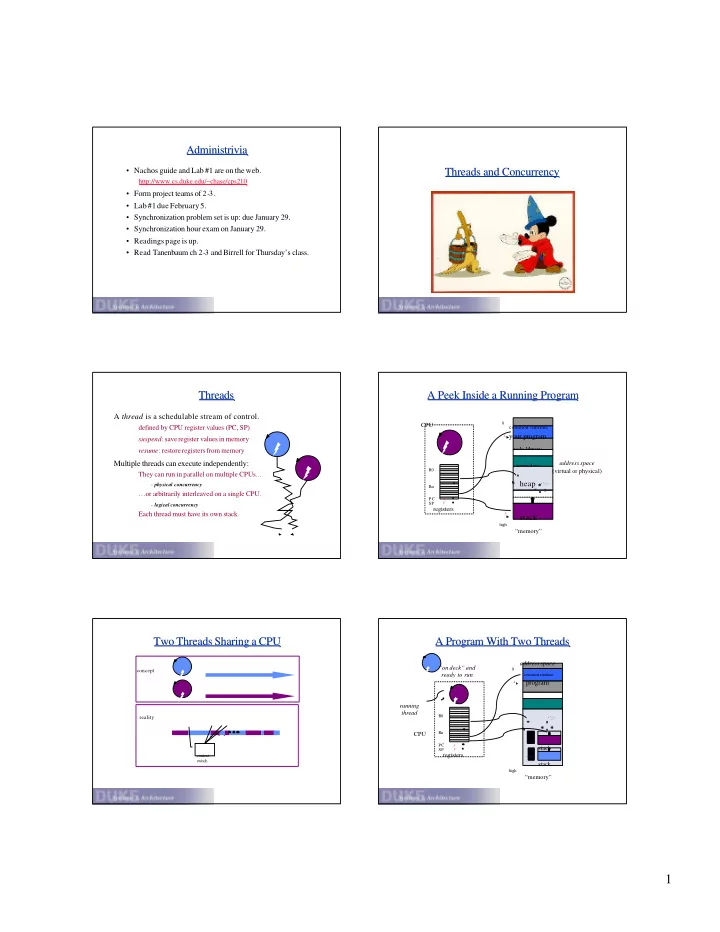
Thread Context Switch Thread Context Switch
high
code library data registers CPU
R0 Rn PC
“memory”
x x
program
common runtime
stack address space
SP y y
stack
- 1. save registers
- 2. load registers
switch in switch
Thread States and Transitions Thread States and Transitions
running ready blocked
Scheduler::Run Scheduler::ReadyToRun (“wakeup”) Thread::Sleep (voluntary) Thread::Yield (voluntary or involuntary)
Blocking in Blocking in Sleep Sleep
- An executing thread may request some resource or action
that causes it to blockor sleep awaiting some event.
passage of a specific amount of time (a pause request) completion of I/O to a slow device (e.g., keyboard or disk) release of some needed resource (e.g., memory) In Nachos, threads block by calling Thread::Sleep.
- A sleeping thread cannot run until the event occurs.
- The blocked thread is awakened when the event occurs.
E.g., Wakeup or Nachos Scheduler::ReadyToRun(Thread* t)
- In an OS, threads or processes may sleep while executing in
the kernel to handle a system call or fault.
Why Threads Are Important Why Threads Are Important
- 1. There are lots of good reasons to use threads.
“easy” coding of multiple activities in an application
e.g., servers with multiple independent clients
parallel programming to reduce execution time
- 2. Threads are great for experimenting with concurrency.
context switches and interleaved executions race conditions and synchronization can be supported in a library (Nachos) without help from OS
- 3. We will use threads to implement processes in Nachos.
(Think of a thread as a process running within the kernel.)
Concurrency Concurrency
Working with multiple threads (or processes) introduces concurrency: several things are happening “at once”.
How can I know the order in which operations will occur?
On a multiprocessor, thread executions may be arbitrarily interleaved at the granularity of individual instructions.
On a uniprocessor, thread executions may be interleaved as the system switches from one thread to another.
context switch (suspend/resume)
Warning: concurrency can cause your programs to behave unpredictably, e.g., crash and burn.
CPU Scheduling 101 CPU Scheduling 101
The CPU scheduler makes a sequence of “moves” that determines the interleaving of threads.
- Programs use synchronization to prevent “bad moves”.
- …but otherwise scheduling choices appear (to the program)
to be nondeterministic. The scheduler’s moves are dictated by a scheduling policy.
Wakeup or ReadyToRun GetNextToRun() SWITCH()
readyList
blocked threads
interrupt current thread
block/yield/terminate