1 Example data: Neratinib vs. EGFR T790M / L858R mutant OBSERVE - - PDF document

1
SMART_READER_LITE
LIVE PREVIEW

1 Example data: Neratinib vs. EGFR T790M / L858R mutant OBSERVE - - PDF document

Irreversible Inhibition Kinetics: Biochemical Rate Constants vs. Cell-based IC 50 Petr Kuzmi , Ph.D. BioKin, Ltd. 1. EGFR inhibition by covalent drugs ( PNAS , January 2014) 2. New results using previously published data 3. PK/PD


slide-1
SLIDE 1

1

Irreversible Inhibition Kinetics:

Biochemical Rate Constants vs. Cell-based IC50

Petr Kuzmič, Ph.D.

BioKin, Ltd.

1. EGFR inhibition by covalent drugs (PNAS, January 2014) 2. New results using previously published data 3. PK/PD simulations

Irreversible Inhibition Kinetics 2

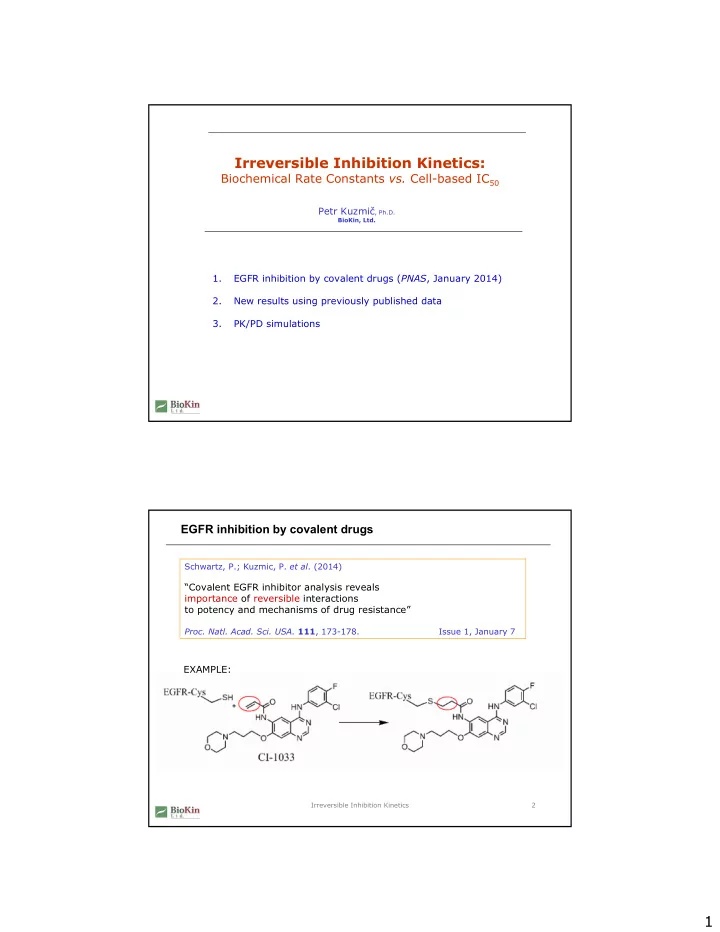
EGFR inhibition by covalent drugs

Schwartz, P.; Kuzmic, P. et al. (2014)

“Covalent EGFR inhibitor analysis reveals importance of reversible interactions to potency and mechanisms of drug resistance”

  • Proc. Natl. Acad. Sci. USA. 111, 173-178.

Issue 1, January 7

EXAMPLE:

slide-2
SLIDE 2

2

Irreversible Inhibition Kinetics 3

Example data: Neratinib vs. EGFR T790M / L858R mutant

OBSERVE FLUORESCENCE INCREASE OVER TIME

[Inhibitor] [Enzyme] = 13 nM “tight binding” inhibition nonlinear “control” progress curve

Irreversible Inhibition Kinetics 4

Conventional kinetic analysis of covalent inhibition

TWO-STEP ALGEBRAIC METHOD

1. Fit [Product] vs. time to obtain kobs 2. Fit kobs vs. [Inhibitor] to obtain kinact and Ki THIS METHOD RELIES ON TWO IMPORTANT ASSUMPTIONS 1. Control progress curve ([I]0 = 0) is strictly linear

Implies near zero substrate consumption or else [S]0 >> KM

2. Inhibitor is not “tight binding”

Implies [E]0 << Ki

slide-3
SLIDE 3

3

Irreversible Inhibition Kinetics 5

Generalized numerical kinetic analysis of covalent inhibition

SINGLE-STEP NUMERICAL METHOD

  • Global fit of [Product] vs. time to obtain microscopic rate constants
  • Numerical-mathematical model is a system of differential equations
  • The model is derived automatically using the software DynaFit

Kuzmic, P. (2009)

“DynaFit – A software package for enzymology”

[a review]

Methods in Enzymology 467, 247-280.

Irreversible Inhibition Kinetics 6

EGFR inhibition by covalent drugs: Mechanistic model

THREE STEPS IN THE INHIBITION BRANCH OF OVERALL MECHANISM

1. kon association 2. koff dissociation 3. kinact inactivation THREE STEPS:

assumed to be extremely rapid

slide-4
SLIDE 4

4

Irreversible Inhibition Kinetics 7

EGFR inhibition by covalent drugs: Results

50 230 2 5 WZ-4002 0.5 2.4 0.2 1.1 Neratinib 0.9 10.7 0.1 1.8 Dacomitinib 40 500 0.1 1.2 Cpd-5 300 1800 0.02 0.2 Cpd-4 20 70 0.1 2 Cpd-3 5 40 0.6 4 Cpd-2 1 2 4 8 Cpd-1 40 180 0.3 2 CL-387785 0.4 1.9 0.2 11 CI-1033 0.6 2.8 0.3 2 Afatinib ±SD Ki, nM ±SD 1000 kinact, s-1 Compound

E + I EI E~I Ki kinact

Irreversible Inhibition Kinetics 8

Chemical reactivity distribution

REACTIVITY VARIES BY TWO TO THREE ORDERS OF MAGNITUDE

slide-5
SLIDE 5

5

Irreversible Inhibition Kinetics 9

Small number of warhead structures in the test panel

Irreversible Inhibition Kinetics 10

Warhead structure type vs. inactivation reactivity

1. large variation of reactivity for a single structure type (CH2=CH-) 2. small variation of reactivity across multiple structure types

slide-6
SLIDE 6

6

Irreversible Inhibition Kinetics 11

Biochemical vs. cellular potency: Summary

FILE: cell-IC50-001.JNB (9/29/2013)

log10 (cellular IC50), M

  • 9
  • 8
  • 7
  • 6
  • 5

log10 (biochemical parameter)

  • 8
  • 6
  • 4
  • 2

kinact, s-1 Ki

*, M

Ki

* / kinact, M.s

Cpd-3

INITIAL (NON-COVALENT) BINDING SEEMS MORE IMPORTANT THAN CHEMICAL REACTIVITY

kinact: R2 = 0.60 Ki: R2 = 0.89 kinact/Ki: R2 = 0.95

Irreversible Inhibition Kinetics 12

Cellular potency: Importance of non-covalent binding

Ki, nM

1 10 100

H1975 IC50, nM

1 10 100 1000

Scaffold 1 Scaffold 2 Scaffold 3 Scaffold 4 Scaffold 5 Scaffold 6

FILE: ki-cell-ic50-large.JNB (10/3/2013)

154 EGFR (W.T.) INHIBITORS ACROSS SIX STRUCTURAL SCAFFOLDS

Ki: R2 = 0.72

slide-7
SLIDE 7

7

Irreversible Inhibition Kinetics 13

EGFR inhibition by covalent drugs: Summary

1. Both binding and reactivity are important for cellular potency 2. Initial binding seems more important by R2 test 3. Chemical structure of warhead has only minor effect on kinact

  • Wide variation of kinact for the same structure
  • Similar kinact for different warhead structures

Warhead alone is not a silver bullet. Waht matter is the balance between binding and reactivity.

Irreversible Inhibition Kinetics:

Biochemical Rate Constants vs. Cell-based IC50

Petr Kuzmič, Ph.D.

BioKin, Ltd.

1. EGFR inhibition by covalent drugs (PNAS, January 2014) 2. New results using previously published data 3. PK/PD simulations

slide-8
SLIDE 8

8

Irreversible Inhibition Kinetics 15

A deeper look at enzyme-inhibitor interactions

E + I EI E~I kon koff kinact 1. kon association 2. koff dissociation 3. kinact inactivation THREE STEPS: Can we pick these two apart?

Irreversible Inhibition Kinetics 16

Confidence interval method

DETAILS NOT SHOWN – MANUSCRIPT IN PREPARATION

OUTLINE:

  • We cannot get “best-fit” values of kon and koff separately
  • However, we can get the lower limits for both kon and koff
  • Monte-Carlo simulation: Lower limits correlate with “true” values
  • Conclusion / Working Hypothesis:

Lower limits on kon and koff are a good measure of “true” values

slide-9
SLIDE 9

9

Irreversible Inhibition Kinetics 17

Results: Lower limits for kon and koff

E + I EI E~I kon koff kinact

2 5 0.02 0.09 0.2 0.5 WZ-4002 0.2 1.1 0.002 0.047 4 21 Neratinib 0.1 1.8 0.004 0.096 0.6 9.4 Dacomitinib 0.1 1.2 0.2 0.2 0.3 0.4 Cpd-5 0.02 0.2 0.01 0.15 0.02 0.09 Cpd-4 0.1 2 0.02 0.16 0.7 2.4 Cpd-3 0.6 4 0.003 0.092 0.3 2.6 Cpd-2 4 8 0.002 0.01 4 8 Cpd-1 0.3 2 0.04 0.06 0.3 0.4 CL-387785 0.2 11 0.002 0.004 1 6 CI-1033 0.3 2.4 0.003 0.044 5 18 Afatinib ±SD 1000 kinact, s-1 ±SD koff, s-1 ±SD kon, µM-1 s-1 Compound

Ki = koff/kon

Irreversible Inhibition Kinetics 18

Biochemical vs. cellular potency

FILE: cell-IC50-001.JNB (9/29/2013)

ASSOCIATION RATE CONSTANT SEEMS MORE IMPORTANT THAN DISSOCIATION

log10 (Cellular IC50), M

  • 9
  • 8
  • 7
  • 6
  • 5

log10 (biochemical parameter)

  • 5
  • 4
  • 3
  • 2
  • 1

1 2 k(on) k(off) k(inact)

koff: R2 = 0.56 kon: R2 = 0.77 kinact: R2 = 0.60

slide-10
SLIDE 10

10

Irreversible Inhibition Kinetics 19

Biochemical vs. cellular potency: Revised summary

  • Both binding and reactivity are important for cellular potency
  • Binding should be dissected into (a) association and (b) dissociation
  • Association seems more important than dissociation
  • Relative order of importance in determining cellular IC50:
  • 1. association (R2 ~ 0.8)
  • 2. dissociation (R2 ~ 0.6) ~ reactivity (R2 ~ 0.6)

DETAILED ANALYSIS: SEPARATELY EVALUATING ALL THREE MICROSCOPIC STEPS

Irreversible Inhibition Kinetics:

Biochemical Rate Constants vs. Cell-based IC50

Petr Kuzmič, Ph.D.

BioKin, Ltd.

1. EGFR inhibition by covalent drugs (PNAS, January 2014) 2. New results using previously published data 3. PK/PD simulations

slide-11
SLIDE 11

11

Irreversible Inhibition Kinetics 21

Possible cellular mechanism

protein re-synthesis protein degradation drug elimination protein degradation

REALISTIC PK/PD MODEL MUST ACCOUNT FOR METABOLISM OF PROTEIN AND DRUG MOLECULES Irreversible Inhibition Kinetics 22

Possible cellular mechanism in DynaFit software

DYNAFIT USES “SYMBOLIC” REPRESENTATION OF ARBITRARY MOLECULAR MECHANISM

[task] task = simulate data = progress [mechanism] E + I <==> E.I : kon koff E.I ---> E~I : kinact I ---> X : kout

  • --> E : ksyn

E ---> X : kdeg E~I ---> X : kdeg ... Example DynaFit input:

slide-12
SLIDE 12

12

Irreversible Inhibition Kinetics 23

Possible cellular mechanism in DynaFit software (cont.)

RATE CONSTANTS AND CONCENTRATIONS MUST BE GIVEN CONSISTENT UNITS

... [constants] ; units µM, sec kon = 1 koff = 0.01 kinact = 0.001 kout = 0.0000641803 ; 3 h drug half-life ksyn = 0.000000001605 ; 0.0001 uM per 12 h * ln(2) kdeg = 0.00001605 ; 12 h protein half-life ... Example DynaFit input (continued): properties of a hypothetical inhibitor

Irreversible Inhibition Kinetics 24

Possible cellular mechanism in DynaFit software (cont.)

... [concentrations] ; units µM E = 0.0001 [responses] E = 1000000 ; 100% free protein at time zero ... Example DynaFit input (continued):

RATE CONSTANTS AND CONCENTRATIONS MUST BE GIVEN CONSISTENT UNITS

slide-13
SLIDE 13

13

Irreversible Inhibition Kinetics 25

Possible cellular mechanism in DynaFit software (cont.)

... [data] mesh linear from 1 to 259200 step 600 directory ./users/COM/Pfizer/140311/data/sim-003 extension txt file i00 | concentration I = 0 file i01 | concentration I = 0.0001 file i02 | concentration I = 0.001 file i03 | concentration I = 0.01 file i04 | concentration I = 0.1 file i05 | concentration I = 1 ... Example DynaFit input (continued):

RATE CONSTANTS AND CONCENTRATIONS MUST BE GIVEN CONSISTENT UNITS Irreversible Inhibition Kinetics 26

DynaFit simulation output: Afatinib – strong inhibitor

target concentration, % time, seconds (total = 72 hours) increasing [inhibitor]

kon = 18 koff = 0.044 kinact = 0.0024

Afatinib:

slide-14
SLIDE 14

14

Irreversible Inhibition Kinetics 27

DynaFit simulation output: Compound 4 – weak inhibitor

target concentration, % time, seconds (total = 72 hours) increasing [inhibitor]

kon = 0.09 koff = 0.15 kinact = 0.00015

  • Compd. 4:

Irreversible Inhibition Kinetics 28

DynaFit simulation output: Compound 3 – intermediate inhibitor

target concentration, % time, seconds (total = 72 hours) increasing [inhibitor]

kon = 2.4 koff = 0.16 kinact = 0.0018

  • Compd. 3:
slide-15
SLIDE 15

15

Irreversible Inhibition Kinetics 29

DynaFit simulation output: “Like” compound 3 – zero inactivation

target concentration, % time, seconds (total = 72 hours) increasing [inhibitor]

kon = 2.4 koff = 0.16 kinact = ~ 0

Irreversible Inhibition Kinetics 30

DynaFit simulation output: “Like” compound 3 – high inactivation

target concentration, % time, seconds (total = 72 hours) increasing [inhibitor]

kon = 2.4 koff = 0.16 kinact = 0.1

slide-16
SLIDE 16

16

Irreversible Inhibition Kinetics 31

“Like” compound 3: kinact vs. free [target]

SIMULATION STUDY: EFFECT OF INACTIVATION RATE CONSTANT

time, hours

20 40 60

free target, %

20 40 60 80 100 120

0.00001 0.0001 0.001 0.01 0.1

kinact, s-1

Irreversible Inhibition Kinetics 32

“Like” compound 3: kinact vs. free [target]

SIMULATION STUDY: EFFECT OF INACTIVATION RATE CONSTANT

time, hours

0.0001 0.001 0.01 0.1 1 10

free target, %

20 40 60 80 100 120

0.00001 0.0001 0.001 0.01 0.1

kinact, s-1 100%

slide-17
SLIDE 17

17

Irreversible Inhibition Kinetics 33

“Like” compound 3: kon vs. free [target]

SIMULATION STUDY: EFFECT OF ASSOCIATION RATE CONSTANT

time, hours

20 40 60

free target, %

20 40 60 80 100

0.01 0.1 1 10 100

kon, µM-1s-1

Irreversible Inhibition Kinetics 34

“Like” compound 3: kon vs. free [target]

SIMULATION STUDY: EFFECT OF ASSOCIATION RATE CONSTANT

time, hours

0.00001 0.0001 0.001 0.01 0.1 1 10

free target, %

20 40 60 80 100

0.01 0.1 1 10 100

kon, µM-1s-1

slide-18
SLIDE 18

18

Irreversible Inhibition Kinetics 35

PK / PK simulations: Summary and conclusions

  • Both binding and reactivity are important for cellular potency
  • Binding is a necessary but not sufficient precondition
  • Reactivity is a necessary but not sufficient precondition
  • The same target suppression can be achieved in two different ways:
  • 1. Have a highly “sticky” molecule, no matter how reactive

(could be very un-reactive but if it really “sticks”, it will do the job)

  • 2. Have a highly reactive molecule, but it must be at least a little “sticky”

(if the molecule does not “stick” at all, it does no matter how “hot” the warhead is)

All these things can be better understood and fine-tuned with a tool like DynaFit.

Irreversible Inhibition Kinetics 36

Acknowledgments

  • Brion Murray

– Pfizer

Leader on the PNAS paper, and in other ways

  • Art Wittwer

– Confluence Technologies (formerly Pfizer)

PK/PD initial scripts (and many other ideas)

  • Phillip Schwartz

– Takeda (formerly Pfizer)

Data collection for EGFR inhibitors

Questions ? http://www.biokin.com