1 BEMP 1: Efficient supply and substitution of compressed air BEMP - - PDF document

1
SMART_READER_LITE
LIVE PREVIEW

1 BEMP 1: Efficient supply and substitution of compressed air BEMP - - PDF document

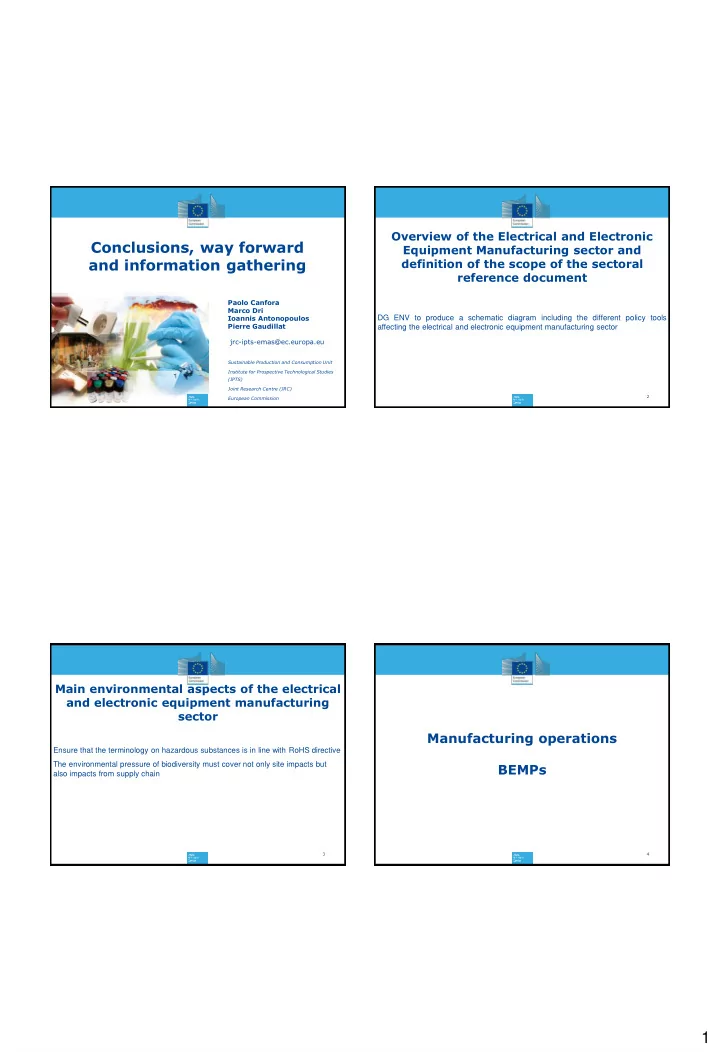
Overview of the Electrical and Electronic Conclusions, way forward Equipment Manufacturing sector and and information gathering definition of the scope of the sectoral reference document Paolo Canfora Marco Dri Ioannis Antonopoulos DG ENV


slide-1
SLIDE 1

1

Conclusions, way forward and information gathering

Paolo Canfora Marco Dri Ioannis Antonopoulos Pierre Gaudillat jrc-ipts-emas@ec.europa.eu

Sustainable Production and Consumption Unit Institute for Prospective Technological Studies (IPTS) Joint Research Centre (JRC) European Commission

Overview of the Electrical and Electronic Equipment Manufacturing sector and definition of the scope of the sectoral reference document

DG ENV to produce a schematic diagram including the different policy tools affecting the electrical and electronic equipment manufacturing sector

2

Main environmental aspects of the electrical and electronic equipment manufacturing sector

Ensure that the terminology on hazardous substances is in line with RoHS directive The environmental pressure of biodiversity must cover not only site impacts but also impacts from supply chain

3 4

Manufacturing operations BEMPs

slide-2
SLIDE 2

2

BEMP 1: Efficient supply and substitution of compressed air

  • Review the content of this BEMP in light of the discussion.
  • Other criteria (apart from energy efficiency), e.g. size, weight, end of life

intervene in the decision between technology options.

  • Paul (Pneurop) to provide some written comments/feedback on the current

text of the BEMP

5

BEMP 2: Energy-efficient cooling technology

  • Agreed!

6

BEMP 3: Efficient energy use in clean-room technology

  • Clarify the applicability of this BEMP for new built or retrofitting
  • Silke to put us in contact with a clean-room construction company to review

BEMP

  • EPI: kWh/cm2 of processed silicon is not universal but still meaningful
  • Consider minimising the external heat load e.g. heat from solar radiation

7

BEMP 4: Energy efficient soldering

  • Mention lead free soldering in a global context
  • Mention the electronics manufacturers for the automotive sector under

applicability

  • Tom to provide data on payback times
  • EPI: kWh/m2 depends on the kind of printed circuit board

manufactured

8

slide-3
SLIDE 3

3

BEMP 5: Minimising the use of perfluorocompound (PFC)

  • Agreed
  • Manfred to send some comments on other PFCs

9

BEMP 6: Substitution and optimised use of VOC-based solvents

  • Silke to help us reach out to the industry association for other examples
  • Miquel to provide information on use of solvents in coating and washing

machines (and their efficiency) and limiting of VOCs emissions

10

BEMP 7: Water savings and recovery in cascade rinsing systems

  • Agreed!

11

BEMP 8: On-site recycling of metals in process chemicals

  • Stephane to help us contact a French ‘frontrunner’ company in the field of

recovery of precious metals from process chemicals with polymers.

12

slide-4
SLIDE 4

4

BEMP 9: Protecting and enhancing biodiversity

  • Add land-use and soil sealing among the environmental pressures addressed.
  • Consider further environmental benefits of increased vegetation.
  • Consider EPI on % of biodiversity friendly premises, compensation of the

biodiversity footprint, implementation of municipality’s biodiversity plan.

  • Marion to provide information on German project on greening premises

(check if EEE companies involved), on improved well-being for employees, benefits of green corridors.

  • Evert to send information on monitoring the effort of companies in the

improvement of biodiversity impacts of their supply chains.

  • Consider developing those aspects into a separate supply chain biodiversity

BEMP.

13

BEMP 10: Use of renewable energy

  • Ensure biomass is sustainably sourced.

14

  • General agreement with the approach and all the proposed BEMPs.
  • Develop a BEMP on waste management on manufacturing premises
  • Change title of this chapter to “manufacturing operations”
  • All to provide feedback on the level of ambition and relevance of the

BEMPs agreed.

BEMPs for manufacturing

  • perations (overview)

15

Day 2

16

slide-5
SLIDE 5

5

BEMPs for supply chain management

17

BEMP 11: Assessment tools for cost-effective and environmentally sound substitution of hazardous substances

  • Maintain Environmental Performance Indicators
  • Provide inventory of materials / full material declaration (best

practice): would be v. difficult, but some frontrunners achieve it.

  • Clarify between process chemicals (OEM/supplier) vs. final product

contents.

  • Update cost data taking into account testing procedures
  • Take into account hazardous chemicals in light of WEEE in addition to

RoHS, REACH

18

BEMP 12: Elimination of certain phthalates [DEHP, DBP, BBP and DIBP]

  • Suggest specifying the concerned substances in the title of the BEMP

(4 phthalates on list of very high concern).

  • Might be under an EU ban in summer 2015, but keep as BEMP in

meantime.

  • Domestic appliance vs ICT: CECED to provide information on current

efforts .

  • Dirk to provide comments on the text of the BEMP and references

19

BEMP 13: Elimination of brominated flame retardants (BFR) and polyvinyl chloride (PVC)

  • Relevance of BEMP is questioned.
  • Comments to be received on technical aspects (by Easter) /

discussion to be pursued among interested parties.

20

slide-6
SLIDE 6

6

BEMP 14: Disclose and set targets for supply chain GHG emissions

  • BEMP to focus on improvement beyond mere reporting, transparency,

and use as internal tool.

  • Stress issues of currently existing methodologies: lack of comparability

/ aimed at internal use

  • Specific data availability issue for EEE sector e.g. emission factors, in

particular for fluorinated GHGs.

  • Include mention of benefits and costs in BEMP itself rather than

references.

  • All to provide data relevant to business case

21

BEMP 15: Conducting Life-Cycle Assessment

  • Consider extending the EPIs to also include results/outputs (e.g. green

product sales, structural reduction of impacts) rather than processes / inputs (LCA implementation).

  • Strengthen economic case:
  • Highlight the upfront cost of first-time LCA implementation.
  • Stress the step of monitoring LCA implementation and resulting

changes / improvements

  • Extend approach to closed-loop / reverse channel

22

BEMP 16: Increasing the content of recycled plastics in EEE – Case study of closed-loop recycling process for polyethylene terephthalate (PET) and polypropylene (PP) plastics in inkjet printing cartridges

  • Revise BEMP
  • extend scope to broader families of products
  • avoid conflicting objectives with compliance / improvement

according to other dimensions e.g. phasing out of chemicals.

  • consider broadening context of BEMP as part of integrated

approach including e.g. refilling, remanufacturing.

  • Norbert to provide data on types of plastic which could be recovered in

closed loop.

23

BEMPs for recycling of waste from electrical and electronic equipment

  • Include environmental pressures such as emissions to soil and water

bodies

  • Change title of chapter (include design and re-use)
  • Include definitions (from CENELEC standard for WEEE and from British

standard for refurbishment)

  • Consider developing a BEMP on design for 'refurbishability' / reparability

(e.g. modular design, minimisation of kinds of screw used)

  • Julia and Conny to provide information

24

slide-7
SLIDE 7

7

BEMP 17: End-of-life removability of rechargeable batteries

  • Consider if possible for smaller smart products with embedded batteries

(e.g. smart watches).

  • Mention safety issue with battery easy removability.
  • Consider possibility of more in-depth cost calculations.
  • On top of environmental/resource efficiency benefit, also safety benefit

at shredders.

25

BEMP 18: Integrated Product Service Offerings (IPSO)

  • Ian to provide information from ZeroWin project (FP7 project): business

case and barriers to IPSO.

  • Move from only B2B to B2C.
  • Look at voluntary agreement under Ecodesign for set-top boxes

(provision about taking back).

  • Consider that this does not work for smaller appliances with low bill of

materials or large (heavy) appliances if the economical/technical value.

  • Marcel to provide information on applicability.

26

BEMP 19: Warranted refurbishment of used products

  • Ian to provide information from ZeroWin project (FP7 project): three

case studies with LCA.

  • Consider

GPP as driver for warrant refurbishment (public administrations buying used equipment).

  • Make clear that this is not about waste but products.
  • Ensure that this is about high quality refurbishment (as good as it was

first brought to the market), mainly possible by the manufacturers.

  • Add also that harnessing parts for services is possible.
  • Martin to provide comments/suggested improvements for the BEMP.

27

BEMP 20: Non-destructive extraction of circuit boards

  • Reconsider this BEMP.
  • If this BEMP is kept, change title to clarify this is not really "non-

destructive" (i.e. this is for recycling not re-use).

28

slide-8
SLIDE 8

8

BEMP 21: Innovative sorting solutions for black plastics from WEEE

  • Consider broadening the scope (the technology described is 20 years
  • ld and only one company is doing it).
  • Stephane to provide information on FP7 project 'WEEELIBS' on black

plastics separation.

  • Norbert to provide suggestion on BEMP for improving plastics

recycling.

29

BEMPs for recycling of waste from electrical and electronic equipment (final overview)

  • Consider developing a BEMP on declaration of non-export of non-

functioning devices

  • Marion to provide information
  • But covered in WEEE and other international fora
  • Consider developing a BEMP on improving WEEE transport (minimising

disruption by minimising loading/unloading) taking into account the relevant CENELEC standard

  • Julia to provide more ideas for BEMPs.

30

The END

31