1 HTTP 1.1 Expiration and Validation in HTTP 1.1 HTTP 1.1 - - PDF document

1
SMART_READER_LITE
LIVE PREVIEW

1 HTTP 1.1 Expiration and Validation in HTTP 1.1 HTTP 1.1 - - PDF document

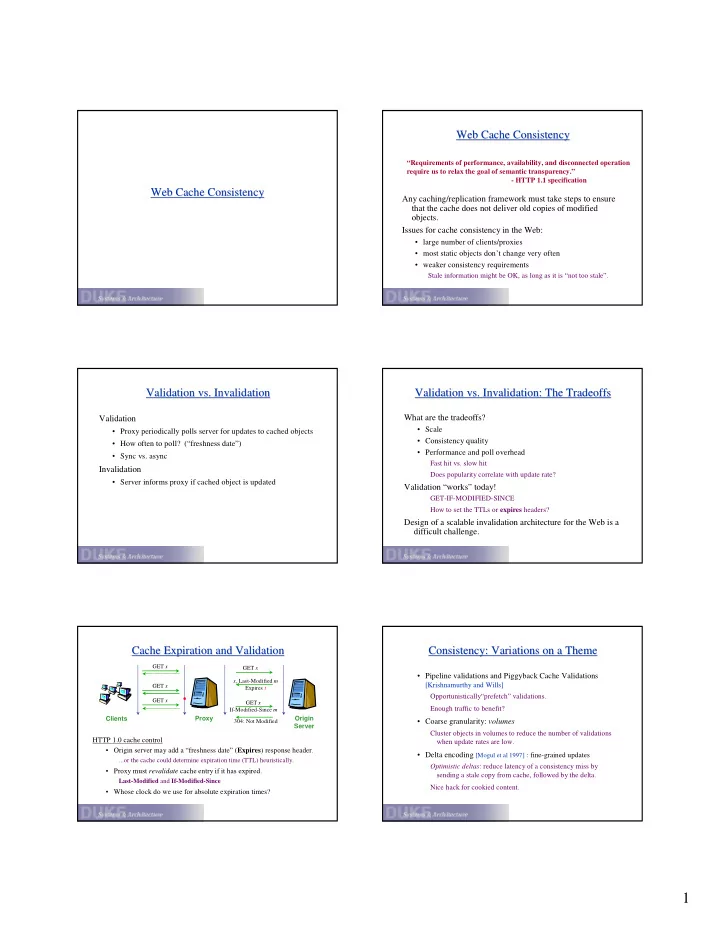
Web Cache Consistency Web Cache Consistency Requirements of performance, availability, and disconnected operation require us to relax the goal of semantic transparency. - HTTP 1.1 specification Web Cache Consistency Web Cache Consistency


slide-1
SLIDE 1

1

Web Cache Consistency Web Cache Consistency Web Cache Consistency Web Cache Consistency

“Requirements of performance, availability, and disconnected operation require us to relax the goal of semantic transparency.”

  • HTTP 1.1 specification

Any caching/replication framework must take steps to ensure that the cache does not deliver old copies of modified

  • bjects.

Issues for cache consistency in the Web:

  • large number of clients/proxies
  • most static objects don’t change very often
  • weaker consistency requirements

Stale information might be OK, as long as it is “not too stale”.

Validation vs. Invalidation Validation vs. Invalidation

Validation

  • Proxy periodically polls server for updates to cached objects
  • How often to poll? (“freshness date”)
  • Sync vs. async

Invalidation

  • Server informs proxy if cached object is updated

Validation vs. Invalidation: The Tradeoffs Validation vs. Invalidation: The Tradeoffs

What are the tradeoffs?

  • Scale
  • Consistency quality
  • Performance and poll overhead

Fast hit vs. slow hit Does popularity correlate with update rate?

Validation “works” today!

GET-IF-MODIFIED-SINCE How to set the TTLs or expires headers?

Design of a scalable invalidation architecture for the Web is a difficult challenge.

Cache Expiration and Validation Cache Expiration and Validation

HTTP 1.0 cache control

  • Origin server may add a “freshness date” (Expires) response header.

...or the cache could determine expiration time (TTL) heuristically.

  • Proxy must revalidate cache entry if it has expired.

Last-Modified and If-Modified-Since

  • Whose clock do we use for absolute expiration times?

Clients Proxy Origin Server

GET x GET x GET x GET x GET x If-Modified-Since m x, Last-Modified m Expires t 304: Not Modified

Consistency: Variations on a Theme Consistency: Variations on a Theme

  • Pipeline validations and Piggyback Cache Validations

[Krishnamurthy and Wills] Opportunistically“prefetch” validations. Enough traffic to benefit?

  • Coarse granularity: volumes

Cluster objects in volumes to reduce the number of validations when update rates are low.

  • Delta encoding [Mogul et al 1997] : fine-grained updates

Optimistic deltas: reduce latency of a consistency miss by sending a stale copy from cache, followed by the delta. Nice hack for cookied content.

slide-2
SLIDE 2

2

HTTP 1.1 HTTP 1.1

Specification effort started in W3C, finished in IETF....much later.

A number of research works influenced the specification. HTTP 1.0 shows the importance of careful specification.

  • performance

persistent connections with pipelining range requests, incremental update, deltas

  • caching

cache control headers

  • negotiation of content attributes and encodings
  • content attributes vs. transport attributes

transport encodings for transmission through proxies

  • Trailer header and trailer headers

Expiration and Validation in HTTP 1.1 Expiration and Validation in HTTP 1.1

HTTP 1.1 cache control allows origin server to:

  • use relative instead of absolute expiration times (max-age);
  • issue opaque validators (ETag for entity tag) instead of

timestamps;

Origin server may specify which of several cached entries to use.

Clients Proxy Origin Server

GET x GET x GET x GET x GET x If-None-Match v x, ETag v max-age t 304: Not Modified, ETag v Age < t Age = 0

Other 1.1 Cache Control Features Other 1.1 Cache Control Features

  • Client may specify that no caching is to occur.

private or no-store

  • Vary headers allow server to specify that certain request headers

must also match if the proxy deems a cached response valid.

language, character set, etc.

  • Server may specify that a response is not cacheable.

Pragma: no-cache header since HTTP 1.0

  • Client may explicitly request the proxy to validate the response.

Pragma: no-cache

  • Proxy may/should/must tell client the age of a cached response.

Age header

  • Proxy may/should/must tell client that it could not validate a non-

fresh cached response with the origin server.

Warning header

The Role of the Content Developer The Role of the Content Developer

  • Use expiration dates where known
  • Limit the scope of cookies
  • If using cookies for personalization, use cache control

headers to disable caching on the personalized objects

What if you forget?

  • Decompose dynamic pages into cacheable and uncacheable

components.

Templates [Douglis97] Edge-side includes (Akamai) Base instance [WebExpress]

Cookies Cookies

HTTP cookies (RFC2109) have brought us a better Web.

  • S optionally includes arbitrary state as a cookie in a response.
  • Cookie is opaque to C, but C saves the cookie.
  • C sends the saved cookie in future requests to S, and possibly to
  • ther servers as well.
  • Allows stateful servers for sessions, personalized content, etc.

But: cookies raise privacy and security issues.

  • What did S put in that cookie? Can anyone else see it? How much

space does it take up on my disk that I paid soooo much for?

  • Cookies may allow third parties who are friends of S1,..., SN to
  • bserve C’s movements among S1,..., SN.

Unverifiable transactions, e.g., DoubleClick and other ad services.

Unverifiable Transactions Unverifiable Transactions

  • Users may not know that they are interacting with DoubleClick.

Amazon and MyCFO trust DoubleClick, but client is ignorant.

  • The user visits pages at many sites that reference DoubleClick.
  • DoubleClick’s cookie allows it to associate all the requests from a given user.
  • If the browser sends Referer headers, DoubleClick may gather information

about all the sites the user visits that reference DoubleClick.

mycfo.com Client doubleclick, akamai, etc.

GET x GET y GET ad Referer mycfo.com

amazon.com

ad, cookie c ad GET ad, cookie c Referer amazon.com/x

slide-3
SLIDE 3

3

WCDP WCDP

Sara Sprenkle led a discussion of WCDP, a protocol for server-driven consistency from IBM. Slides for this portion of the class may be found at: http://www.cs.duke.edu/~sprenkle/wcdp.ppt It is important to understand the context of the server-driven approach, its role in CDNs, the opportunity to use invalidation, and how WCDP addresses the scalability concerns.