1 5/2/2013 Complementary, Alternative & Integrative The terms - - PDF document

1
SMART_READER_LITE
LIVE PREVIEW

1 5/2/2013 Complementary, Alternative & Integrative The terms - - PDF document

5/2/2013 Integration of Presentation Sequences Traditional Medicine 1. Definitions : Complementary, Alternative & Integrative Medicine Into Allopathis 2. Global view Healthcare system 3. Malaysia Experiences 4. Model of integration. Dr


slide-1
SLIDE 1

5/2/2013 1

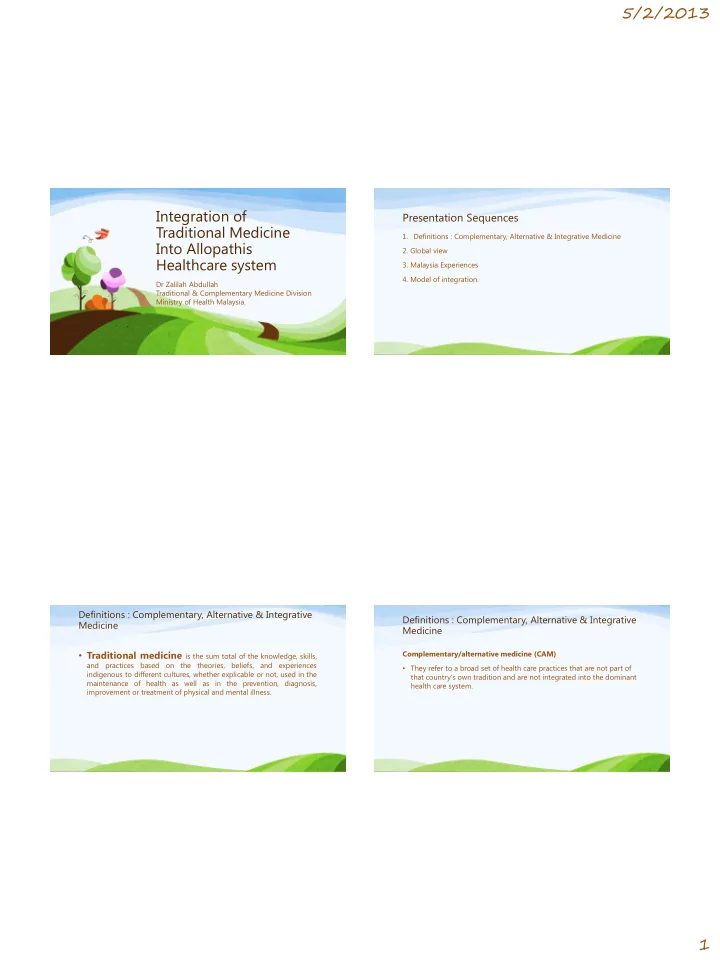
Integration of Traditional Medicine Into Allopathis Healthcare system

Dr Zalilah Abdullah Traditional & Complementary Medicine Division Ministry of Health Malaysia.

Presentation Sequences

  • 1. Definitions : Complementary, Alternative & Integrative Medicine
  • 2. Global view
  • 3. Malaysia Experiences
  • 4. Model of integration.

Definitions : Complementary, Alternative & Integrative Medicine

  • Traditional medicine is the sum total of the knowledge, skills,

and practices based on the theories, beliefs, and experiences indigenous to different cultures, whether explicable or not, used in the maintenance of health as well as in the prevention, diagnosis, improvement or treatment of physical and mental illness.

Definitions : Complementary, Alternative & Integrative Medicine

Complementary/alternative medicine (CAM)

  • They refer to a broad set of health care practices that are not part of

that country's own tradition and are not integrated into the dominant health care system.

slide-2
SLIDE 2

5/2/2013 2

Complementary, Alternative & Integrative

  • The terms “complementary” and “alternative” are often used interchangeably, but they

describe two different approaches.

  • Alternative medicine is defined as a treatment modality used in place of conventional
  • medicine. By definition, alternative treatments are not integrated as part of conventional

medicine.

  • Complementary medicine, however, makes use of non-conventional treatment

modalities, some of which have known efficacy, in combination with conventional treatment.

  • Both alternative and complementary medicine focus on treatment modalities.
  • Integrative medicine, on the other hand, is not about specific non-conventional

treatment modalities, but is an approach to treating patients.

Sources : The Regional Strategy for Traditional Medicine in the Western Pacific (2011–2020)

New Zealand United Kingdom China

UK

Seeking experiences from other countries

Patterns of use of T&CM

Some general points a) Public often choose complementary / traditional medicine to help with a chronic problem or to relieve stress b) Majority of clients already had conventional treatment for the same problems c) New consultations are mainly prompted by recommendations

slide-3
SLIDE 3

5/2/2013 3

Patterns of use of T&CM integration patient professional Both Concerns of medical profession have about complementary/ traditional medicine *

1. Patients are seen by unqualified practitioners

  • risk of missed or delayed diagnosis.

2. Patients may waste money on ineffective treatments whilst discontinuing or declining effective conventional treatment. 3. Conflicting loyalty 4. Adverse effects from complementary/traditional treatment 5. The claimed benefits of complementary/ traditional medicine are scientifically unproven ( yet).

*Integrating complementary therapies in primary care, David peters

Lack of Information Reduce the gaps between medical profession and T&CM practitioners

Malaysia experiences…

Malaysia’s Journey to integrative medicine

1992 1996 1997 1998

Registration Of Traditional Medicine Unit of T&CM was formed GMP for Traditional Medicine Manufacturer Formation

  • f the T&CM

Standing Committee Formation of the 5 T&CM Umbrella Bodies

1999

slide-4
SLIDE 4

5/2/2013 4

13

2001 2002 2003 2004

Formation of The Herbal Medicine Research Centre National Policy on Traditional & Complementary Medicine Global Information Hub National Institute of Natural Products, Vaccine & Biological Traditional & Complementary Medicine Division Integrated Hospital

2007

National Committee in R & D On Herbal Medicine National Survey

Malaysia’s Journey to integrative medicine

2008 2009

13 standards developed for academic program ( Diploma /Bac) T&CM programs in Universities

Malaysia’s Journey to integrative medicine

2012

  • Traditional &

Complementary Medicine Act (756 Act) approved by Parliament

NATIONAL T&CM POLICY IN 2001

Vision

Integration of Traditional and Complementary Medicine (T&CM) into the Malaysian Healthcare System

Mission

Ensure Quality and Safe Use of T&CM practices and products to attain optimal potential in healthcare delivery Practices establish a registry promote rational use ensure T&CM practices in registered facilities facilitate development & integration regulate practices Training T&CM practitioners undo formalised training process for accreditation modern medicine provider had appropriate knowledge ensure the general public had appropriate knowledge Raw Materials sustainability and standardisation & Products GACP & GMP strengthen control on production, import & export development & protection of IPR strengthen farmacovigilance Research & Development prioritise & facilitate R&D establish methods & technologies information data based

Policy Objectives

slide-5
SLIDE 5

5/2/2013 5

Cover Story

Fit4Life, The Star 27 July 2008

Practising Integrative Medicine

2007 2008 2009 2010 2011 2012 Sultanah Nur Zahirah Hospital Terengganu Port Dickson Hospital Negeri Sembilan Raja Perempuan Zainab II Hospital Kelantan Cheras Rehabilitation Centre Kuala Lumpur Sultan Ismail Hospital, Johor Kepala Batas Hospital, Pulau Pinang Putrajaya Hospital, WP Kuala Lumpur Duchess

  • f Kent Hospital

Sabah Sultanah Bahiyah Hospital Kedah Sarawak General Hospital Sultanah Hajah Kalsom Hospital Pahang

T&CM Units in Integrated Hospitals under the Ministry of Health 2013

  • 11. HOSPITAL REHABILITASI

CHERAS

Acupuncture for chronic pain and post stroke management Hospital Putrajaya Hospital Sultan Ismail Hospital Kepala Batas Hospital Sultanah Nur Zahirah Hospital Duchess of Kent Hospital Umum Sarawak Hospital Port Dickson Hospital Sultanah Bahiyah Hospital Sultanah Hajah Kalsom Malay Massage for chronic pain and post stroke management Hospital Raja Perempuan Zainab II Hospital Putrajaya Hospital Sultan Ismail Hospital Kepala Batas Hospital Sultanah Nur Zahirah Hospital Duchess of Kent Hospital Umum Sarawak Hospital Port Dickson Hospital Sultanah Bahiyah Hospital Sultanah Hajah Kalsom Herbal Therapy as Adjunct Treatment for Cancer Patients Hospital Putrajaya Hospital Sultan Ismail Hospital Kepala Batas Malay Postnatal Treatment Hospital Putrajaya Hospital Sultan Ismail Hospital Raja Perempuan Zainab II Hospital Duchess of Kent Hospital Sultanah Bahiyah Shirodhara Hospital Port Dickson

T&CM Services in Integrated Hospitals

slide-6
SLIDE 6

5/2/2013 6

Malay massage treatment regime

Chronic Pain Post stroke No of session 3 7 Regime 3 session within a week (3 days in a row or every

  • ther day)

First week: 3 sesi Second week : 2 sesi Third week : 2 sesi Assessment of treatment effectiveness Done on 3 session Done on 7 session Maximum session 5 10 Cherkin et al. (2003) Annals of Internal Medicine, Vol. 138, No 11, p. 898 -907 A review of the evidence for the effectiveness, safety and cost of acupuncture, massage therapy and spinal manipulation for back pain Tsao (2007) Evidence – based Complementary and Alternative Medicine, p.1-15 Effectiveness of massage therapy for chronic, non – malignant pain: A Review.

Acupuncture

Chronic Pain Post stroke No of session 5 sesi 20 sesi Regime Every day or every other day Every day or every other day Assessment of treatment effectiveness 5th session First 10 session: effectivenss of the acupoint Second 10 session: Effectiveness of the threatment Maximum session 10 30

Acupuncture

Malay postnatal care

Wellness Postnatal care Treatment commences 24 hours after discharge from postnatal ward 3 days after discharge from hospital Type of treatment Wellness massage + Breastcare massage + hot Compression + body Wrapping ( barut/girdle) No of session One off 6 session

slide-7
SLIDE 7

5/2/2013 7

Shirodhara Treatment

  • Three mechanisms: (1) the well-

known relaxing action of essential oils from L. angustifolia mediated by

  • lfactory nerves, (2) the pharmacologic

action of substances absorbed through the skin or mucosa in the sesame oil or lavender essential oil, and (3) the physiologic effect of sesame oil dripped on the forehead induced by the somato-autonomic reflex through thermosensors or pressure sensors in the skin or hair follicles via the trigeminal cranial nerve. J Altern Complement Med. 2008 Oct;14(8):947-56. Pharmaco-physio- psychologic effect of Ayurvedic oil-dripping treatment using an essential oil from Lavendula angustifolia. Uebaba K, Xu FH, Ogawa H, Tatsuse T, Wang BH, Hisajima T, Venkatraman S

  • Shirodhara has anxiolytic and ASC-

inducing effects, and it promotes a decrease of noradrenaline and exhibits a sympatholytic effect, resulting in the activation of peripheral foot skin circulation and immunopotentiation. J Altern Complement

  • Med. 2008

Dec;14(10):1189-98. Psychoneuroimmunolog ic effects of Ayurvedic

  • il-dripping treatment.

Uebaba K, Xu FH, Ogawa H, Tatsuse T, Wang BH, Hisajima T, Venkatraman S.

No of session 5 Type of treatment Head massage + oil Indication Insomnia, Stress, Anxiety. Mild depression

Guidelines on T&CM Practices 2009 - 2012

Standard Operating Procedure for T&CM Unit T&CM Practice Guideline on Acupuncture T&CM Practice Guideline on Malay Massage

T&CM Practice Guideline on Herbal Therapy As An Adjunct Treatment For The Cancer Patients

T&CM Practice Guideline on Malay postnatal Care Good Practice Guideline on Malay Massage Good Practice Guideline on Acupuncture Good Practice Guideline on Reflexology Garispanduan Perkhidmatan Spa T&CM Practice Guideline on Bekam T&CM Practice Guideline on Shirodhara Garispanduan Amalan Pengubatan Islam T&CM Practice Guideline on Chiropractic for T&CM Units

Clerking form used in the Unit.

slide-8
SLIDE 8

5/2/2013 8 Educational Programme

Bachelor Educational Programme Diploma Training Programme  Bachelor of Traditional Chinese Medicine (Acupuncture)  Bachelor of Traditional Chinese Medicine  Bachelor of Complementary Medicine (Natural Medicine)  Bachelor of Homeopathy  Bachelor of Malay Medicine  Bachelor of Ayurveda Medicine  Bachelor of Chiropractic  Diploma in Malay Massage  Diploma in Traditional Chinese Medicine (Acupuncture)  Diploma in Natural Medicine  Diploma in Aromatherapy  Diploma in Islamic Medicine  Diploma in Reflexology Bachelors and diploma educational programmes developed together with MQA & T&CM practitioners Bil Nama program Nama Institusi Tarikh Lulus Menteri 1 Bachelor of Science (Hons) Chinese Medicine INTERNATIONAL MEDICAL UNIVERSITY 25/01/2010 Universiti Antarabangsa INTI 09/06/2009 UNIVERSITI PENGURUSAN & SAINS (MSU) 10/07/2009 Universiti Tunku Abdul Rahman (UTAR Sungai Long) 21/07/2010 KOLEJ SELATAN, SKUDAI 27/08/2010 2 Ijazah Sarjana Muda Sains Perubatan Homeopati (Kepujian) Kolej Universiti Sains Perubatan Cyberjaya (CUCMS) 09/06/2009 3 Bachelor of Science (Hons) Chiropractic INTERNATIONAL MEDICAL UNIVERSITY 4 Diploma in Traditional Chinese Medicine Universiti Pengurusan Dan Sains (MSU) 09/06/2009 Diploma in Traditional Chinese Medicine Kolej Universiti Lincoln (Kampus Utama) 22/08/2011 5 Diploma in Natural Medicine Malacca College of Science and Management (MCSM) *1/07/2009.

Law & regulations

  • Traditional & complementary Medicine Act (756 act) –

gazzetted .

Traditional & complementary Medicine Act registration of practitioners regulations & laws council

slide-9
SLIDE 9

5/2/2013 9

Case study

Case Study

13th August 2008. She was discharged with a tracheostomy in situ, still having significant slurring of speech, able to tolerate normal feeds, needing help with her ADL and only mobilizing with wheel chair ICU-June 2008 Hypoxia Ischemic Encephalopathy (HIE), resulting in a dense stroke to the her Right side of body

R sided hemiparesis. Muscle wasting not very prominent seen

First session 14 August.

  • massage was aimed at the Right leg

first and then slowly moved up to the Right upper limb.

  • This was done to facilitate blood

flow and soften the muscle by concentrating the massage at certain points 4th session 25/8/2008

  • the patient was able

to lift up the right hand until 90 degree and sit without support

  • had already

ambulating with a walking frame.

  • Similar massage

technique was applied to the R upper and lower limbs and the back 12 session ,29/9/2008

  • able to walk long distances with the

walking frame.

  • able to wash the dish, fry eggs and

fish while sitting, own dressing and toilet activities including bath Last session <Oktober 2008

  • She came with her

husband and her daughter.

  • She walked with her

walking frame from the carpark.

  • She was able to sit by

herself and hold her daughter

slide-10
SLIDE 10

5/2/2013 10

treatment

convention physiotherapy Massage

Take home message

Thank you