1 Land Application Training 2012 February 2, 2012 Paul Hay - - - PDF document

1
SMART_READER_LITE
LIVE PREVIEW

1 Land Application Training 2012 February 2, 2012 Paul Hay - - - PDF document

Land Application Training 2012 February 2, 2012 Paul Hay - Presenter Regulatory History for CAFOs & EPA proposes NMPs Chapter revisions to Revised EPA 5 CAFO Final CAFO rules approved EPA issues EPA introduces NMP by NE CAFO


slide-1
SLIDE 1

1

EPA issues CAFO rules

2006 2005 2003 2004 1998 1974/ 76

Revised EPA CAFO rules introduces NMP EPA proposes revisions to CAFO

2007 2008 2011

Final EPA Rule

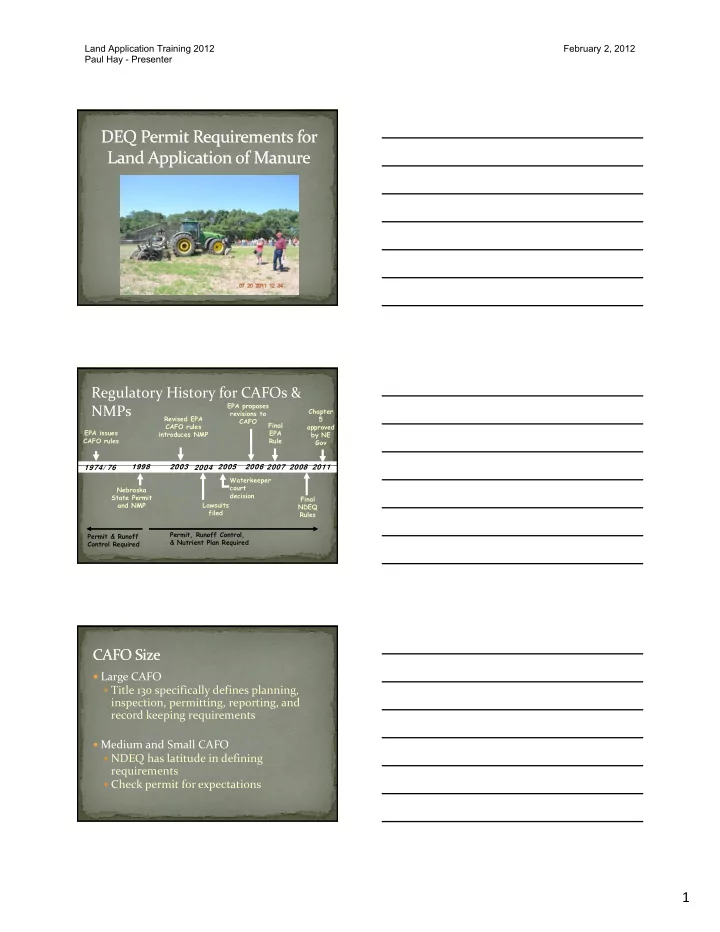
Regulatory History for CAFOs & NMPs

Chapter 5 approved by NE Gov

2006 2005 2003 2004 1998 1974/ 76

Lawsuits filed Waterkeeper court decision

2007 2008 2011

Nebraska State Permit and NMP Final NDEQ Rules Permit & Runoff Control Required Permit, Runoff Control, & Nutrient Plan Required

Large CAFO Title 130 specifically defines planning,

inspection, permitting, reporting, and record keeping requirements

Medium and Small CAFO NDEQ has latitude in defining

requirements

Check permit for expectations Land Application Training 2012 Paul Hay - Presenter February 2, 2012

slide-2
SLIDE 2

2

There is No Minimum Size of Livestock

Operation Exempted From This Rule

Manage Manure as a Nutrient Resource

Nutrient Management Plan

T d b EPA d NDEQ id if Term used by EPA and NDEQ to identify minimum requirements for CAFO’s environmental management plan including nutrients

Land Application Training 2012 Paul Hay - Presenter February 2, 2012

slide-3
SLIDE 3

3

Nutrient Management Plan Can Be Written in Two Formats Linear Linear Narrative

An approach that expresses rates of

application as pounds of nitrogen and phosphorus, including the following specifications:

Form and source of manure Timing and method Timing and method Accounts for nitrogen and phosphorus

in the manure

Maximum application rates from

manure

Field‐specific assessment

All Fields & Crops Realistic yield goal for each crop Nitrogen and phosphorus recommendations from

sources specified by the University of Nebraska

Credits for all nitrogen in the field Consideration of multi‐year phosphorus

application application

Accounting for all other additions of plant

available nitrogen and phosphorus to the field.

For large CAFOs, the maximum amount of

manure calculated at least once each year

Land Application Training 2012 Paul Hay - Presenter February 2, 2012

slide-4
SLIDE 4

4

An approach that expresses rates of application as a narrative

rate of application that results in the amount, in tons or gallons,

  • f manure, litter, and process wastewater to be land applied,

including the following permit terms:

Nitrogen or phosphorus derived from all sources of nutrients,

for each crop identified in the nutrient management plan

Field‐specific assessment of the potential for nitrogen and

p p g phosphorus transport from each field;

Crops to be planted in each field Realistic yield goal for each crop & for each field Nitrogen and phosphorus recommendations from sources

specified by the University of Nebraska

Method & factors used to calculate the amounts of manure to

be land applied:

Results of soil tests conducted Nitrogen or phosphorus derived from all sources of

nutrients, for each crop identified in the nutrient management plan

Actual Application of nitrogen and phosphorus in the

manure

Consideration of multi‐year phosphorus application; Additions nitrogen and phosphorus to the field;

g p p

The form and source of manure, litter, and process

wastewater;

The timing and method of land application; Volatilization of nitrogen & mineralization of organic

nitrogen.

Alternative crops identified in the nutrient management

plan that are not in the planned crop rotation,

Production area including feed storage,

feeding areas, and manure storage

Adequate storage capacity Clean water diversion Clean water diversion Prevention of direct contact of animal

with waters of US

Proper mortality management Chemical management Land Application Training 2012 Paul Hay - Presenter February 2, 2012
slide-5
SLIDE 5

5

Land Application Conservation practices to control nutrient

loss

Protocol for manure and soil sampling Protocol for manure and soil sampling Protocols for land application Record keeping NMP must be based on “…agronomic

utilization of Nitrogen from all sources”

Nutrient budget required for N and P Nutrient budget required for N and P Based upon risk from P‐Index review –

manure application can be restricted to P‐ based rates or even stopped.

NMP Records must include: Basis for estimating application rate Annual pre application calculations of N Annual pre‐application calculations of N

and P to be applied for individual fields

Post‐application of N and P actually

applied for individual fields

Land Application Training 2012 Paul Hay - Presenter February 2, 2012

slide-6
SLIDE 6

6

Large CAFO 100’ setback from down gradient surface

waters open tile lines and wells OR

35’ vegetated buffer 35 vegetated buffer Small or Medium CAFO 30’ setback from streams, lakes, and

impounded waters

Stockpiles Covered or diked to prevent runoff Requirements When ‐ Storage must have 180 days capacity November 15* ‐ Holding pond must Always g p have capacity to hold 25‐yr, 24‐hr storm y ‐ Holding pond must have capacity to hold 25‐yr, 24‐hr storm + normal June runoff November 15*

*Recommended

CAFOs are required to keep records for a

minimum of 5 years

Record and reporting requirements

discussed later

Land Application Training 2012 Paul Hay - Presenter February 2, 2012

slide-7
SLIDE 7

7

All CAFOs must keep records on the transfer

  • f manure

The amount of manure, litter, and process

wastewater transferred to other persons ( i d i ll ) (estimated in tons or gallons)

The date of the transfer The name and address of the recipients Also must provide analysis of the material

to the recipient

Requirements for NPDES permittees Land application training program (good

for 5 years)

Maintain record of training (certificate or

) letter of completion)

Note: Custom Manure Applicators are not

required (but are encouraged) to maintain this certification

Land Application Training 2012 Paul Hay - Presenter February 2, 2012