1 Additional Resources Uniform Guidance: 2 CFR Part 200 - - PDF document

1
SMART_READER_LITE
LIVE PREVIEW

1 Additional Resources Uniform Guidance: 2 CFR Part 200 - - PDF document

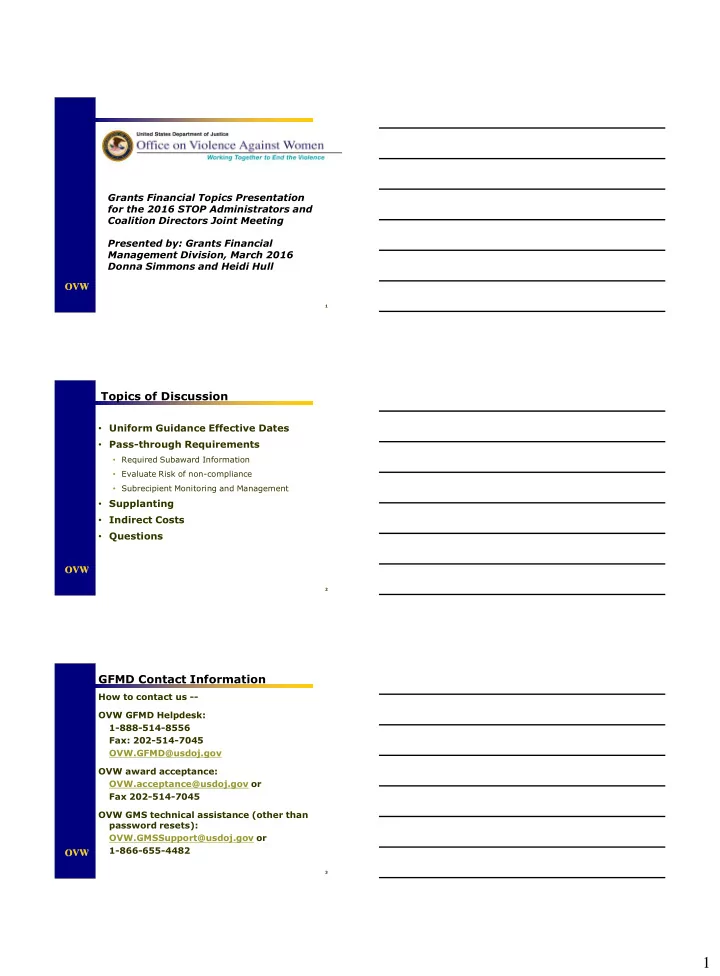
Grants Financial Topics Presentation for the 2016 STOP Administrators and Coalition Directors Joint Meeting Presented by: Grants Financial Management Division, March 2016 Donna Simmons and Heidi Hull OVW 1 Topics of Discussion Uniform


slide-1
SLIDE 1

1

OVW

1

Grants Financial Topics Presentation for the 2016 STOP Administrators and Coalition Directors Joint Meeting Presented by: Grants Financial Management Division, March 2016 Donna Simmons and Heidi Hull OVW

2

Topics of Discussion

  • Uniform Guidance Effective Dates
  • Pass-through Requirements
  • Required Subaward Information
  • Evaluate Risk of non-compliance
  • Subrecipient Monitoring and Management
  • Supplanting
  • Indirect Costs
  • Questions

OVW

3

GFMD Contact Information

How to contact us -- OVW GFMD Helpdesk: 1-888-514-8556 Fax: 202-514-7045 OVW.GFMD@usdoj.gov OVW award acceptance: OVW.acceptance@usdoj.gov or Fax 202-514-7045 OVW GMS technical assistance (other than password resets): OVW.GMSSupport@usdoj.gov or 1-866-655-4482

slide-2
SLIDE 2

2

OVW

4

Additional Resources

Uniform Guidance: 2 CFR Part 200

https://cfo.gov/cofar/

OVW Financial Guide Webinar Part 1: New Uniform Guidance

https://www.youtube.com/watch?v=m0kwPaQBq6 4&feature=youtu.be

Webinar Part 2: New Uniform Guidance

https://www.youtube.com/watch?v=uw4-s- Fl64Q&feature=youtu.be

OVW

5

Uniform Guidance Effective Dates

OVW

6

Uniform Guidance Effective Dates

  • Administrative Requirements and Cost

Principles are effective for federal awards made after December 26, 2014

– Applies to OVW’s FY 2015 Awards and after

  • Audit Standards (Subpart F – Audit

Requirements) became effective for audits

  • f fiscal years that begin on or after

December 26, 2014

slide-3
SLIDE 3

3

OVW

7

Pass-through Requirements

OVW

8

Required Subaward Information

Subawards must contain:

  • Subrecipient Information:
  • Name
  • Unique entity identifier (ie. DUNS)
  • Period of performance
  • Subaward amount
  • Indirect Cost Rate or De Minimis Rate (if used)
  • Requirements/Special Conditions for:
  • Federal statutes/regulations
  • Award terms/conditions
  • Federal agency
  • Potential risk based on Risk Assessment
  • Additional conditions as needed, see: 200.207

NOTE: See section 200.331(a) for complete list

OVW

9

Required Subaward Information

Subawards must also contain:

  • CFDA number
  • Terms and conditions for closeout
  • Allow access to records and financial statements to

ensure compliance

  • Clearly identify as subaward
  • Project description (should respond to FFATA)
  • Federal award number, period of performance, and

award amount

  • Name of Federal agency, Pass-through Entity, and

contact information

NOTE: See section 200.331 for complete list

slide-4
SLIDE 4

4

OVW

10

Assessment of Subrecipients

Provisions for Disclosures

  • Subrecipient must disclose in writing:

– Any potential conflict of interest – Violations of Federal criminal law affecting the award:

 Fraud, bribery, gratuity violations

  • Non-compliance may result in Suspension or

Debarment

NOTE: See sections 200.112-200.113 and 200.331

OVW

11

Evaluate Risk of Non-compliance

Consider the following:

  • Subrecipient’s prior experience
  • Suspension and Debarment
  • Audit results and findings
  • New personnel or substantially changed systems
  • Past monitoring history

NOTE: See sections 200.331(b)

OVW

12

Subrecipient Monitoring and Management Pass-through Entities are required to:

  • Clearly identify the agreement as a subaward and

include all required information

  • Evaluate subrecipient’s potential risk for non-

compliance with Federal statutes, regulations, and award requirements, and add additional special conditions as needed

  • Monitor activities, financial/performance reports, and

audit compliance (as required in Subpart F)

  • When necessary, take enforcement action for non-

compliance

NOTE: See section 200.331

slide-5
SLIDE 5

5

OVW

13

Standards for Financial & Program Management

  • Relate financial data to performance

accomplishments of the award

  • Financial Management Requirements

– Written policies and procedures – Similar to A-110 requirements

  • Effective Internal Controls

– Comply with Federal regulations and award conditions – Safeguard Personally Identifiable Information NOTE: See sections 200.301-200.303

Subrecipient Monitoring and Management OVW

14

Monitoring Tools include -

  • Review financial and programmatic reports
  • Provide training and technical assistance
  • Perform on-site reviews
  • Agreed-upon-procedure engagements
  • See: Audit Services section 200.425

NOTE: See section 200.331

Subrecipient Monitoring and Management OVW

15

Supplanting

slide-6
SLIDE 6

6

OVW

16

Supplanting

  • To deliberately reduce appropriated funds

because of the existence of Federal funds.

  • For example, a State has appropriated

funds for a stated purpose (ie. Victim Services) and then the State receives a Federal award for the same purpose. Because of the receipt of the Federal award, the State reduces their appropriated funds for Victim Services thereby reducing the total available funds for Victim Services.

  • Federal funds should increase the funding

available for a specific purpose.

OVW

17

Indirect Costs

OVW

18

Indirect (F&A) Costs

Federally negotiated rates must be accepted

  • Federal agencies may place limitations under

the following circumstances:

– For a single award or class of awards – If required by statute/regulation or Federal agency head

  • Federal agency must have established

policy/procedure in place to deviate from negotiated rate

NOTE: See section 200.414

slide-7
SLIDE 7

7

OVW

19

Extensions on existing Federally-negotiated rates

  • One-time extension for period of up to 4 years
  • Subject to review and approval from cognizant

agency who negotiates the rate

  • If approved – may not request rate review until

end of extension period

  • Must re-apply to negotiate new rate at end of

extension period

NOTE: See section 200.414

Indirect (F&A) Costs

OVW

20

Final Rate:

  • Rate applicable to a specific time period based on the

financial statement from this period

  • Final rates are not adjusted; they are final

Provisional Rate:

  • Temporary indirect cost rate used until a “Final” rate is

established for the period specified in the agreement

Predetermined:

  • Rate applied to a specific current or future time period
  • Generally not adjusted after the fact

Fixed Carry Forward:

  • Rate applied to a specific current or future time period
  • Based on estimated costs for a future time period
  • Generally adjusted after actual costs are known

Types of Rates

OVW

21

The indirect cost rate is computed on the “Base” specified in the rate agreement Various types of bases you may see:

  • Modified Total Direct Costs (MTDC):

– Includes: All direct salaries/wages, applicable fringe, materials and supplies, services, travel, and up to the first $25,000 of each subaward – Excludes: Equipment, capital expenditures, charges for patient care, rental costs, tuition remission, scholarships and fellowships, participant support costs, and the portion

  • f each subaward in excess of $25,000
  • Salaries and wages including fringe benefits
  • Salaries and wages (excluding fringe

benefits)

Types of Bases
slide-8
SLIDE 8

8

OVW

22

De Minimis Rate may be used by:

  • Recipients that have NEVER had a Federally

approved indirect cost rate agreement

– NOTE: See appendix VII for exceptions

  • Subrecipients (not contractors), using the same

guidelines for recipients

NOTE: See section 200.414

10% De Minimis Indirect Rate

OVW

23

Applying the De Minimis Rate:

  • Charge 10% of Modified Total Direct Costs

(MTDC) without negotiating the rate

  • Costs must be consistently charged as indirect
  • r direct
  • May be used indefinitely
  • Rate must be consistently used for all Federal

awards until (if) a rate is negotiated

NOTE: See section 200.414

10% De Minimis Indirect Rate

OVW

24

Example Using the De Minimis Rate in a Budget

Personnel: $200,000 (Staff Salary) Fringe: $44,000 (22% of Staff Salary) Travel: $10,000 (OVW TA and Training) Equipment: $0 Supplies: $2,000 (General Office Supplies) Consultants/Contracts: $42,000 (One Partner’s Compensation) Other: $2,000 (Victim/Client Emergency Assistance) Total Direct Costs: $300,000 Modified Total Direct Costs: $283,000 (total direct costs minus amount over $25,000 of each subaward = $300,000 - $17,000) Indirect Costs: $28,300 (10% of MTDC) Total Project Amount: $328,300

10% De Minimis Indirect Rate

slide-9
SLIDE 9

9

OVW

25

Indirect Cost as Match

“Unrecovered indirect costs, including indirect costs on cost sharing or matching, may be included as part of cost sharing or matching only with the prior approval of the Federal awarding agency. Unrecovered indirect cost means the difference between the amount charged to the Federal award and the amount which could have been to the Federal award under the non-Federal entity’s approved negotiated indirect cost rate.”

NOTE: See section 200.306.

OVW

26

Questions?