1 Early evidence on health effects Review of health effects (up to - - PDF document

1
SMART_READER_LITE
LIVE PREVIEW

1 Early evidence on health effects Review of health effects (up to - - PDF document

Endotoxin (Lipopolysaccharide (LPS)) First described by Richard Pfeiffer in 1892 (Zf f Hygiene) as heat stable, cell associated material from Emerging biological risks: endotoxins? Vibrio cholerae part of the outer membrane of all gram


slide-1
SLIDE 1

1 Emerging biological risks: endotoxins?

  • Prof. Dick Heederik, PhD

IRAS, Division of Environmental Epidemiology University Utrecht The Netherlands

Endotoxin (Lipopolysaccharide (LPS))

  • First described by Richard Pfeiffer in 1892 (Zf f

Hygiene) as heat stable, cell associated material from Vibrio cholerae

  • part of the outer membrane of all gram negative

bacteria and some blue algae

Measurement of endotoxin (CEN 2002)

  • As described by CEN (NEN-

EN 14031)

– Classical inhalable dust sampling – Extraction filter with dust – Measurement based on (kinetic version of the) Lymulus Amoebocyte Lysate Assay – Results expressed relative to external standard in Endotoxin Units/m3 of air

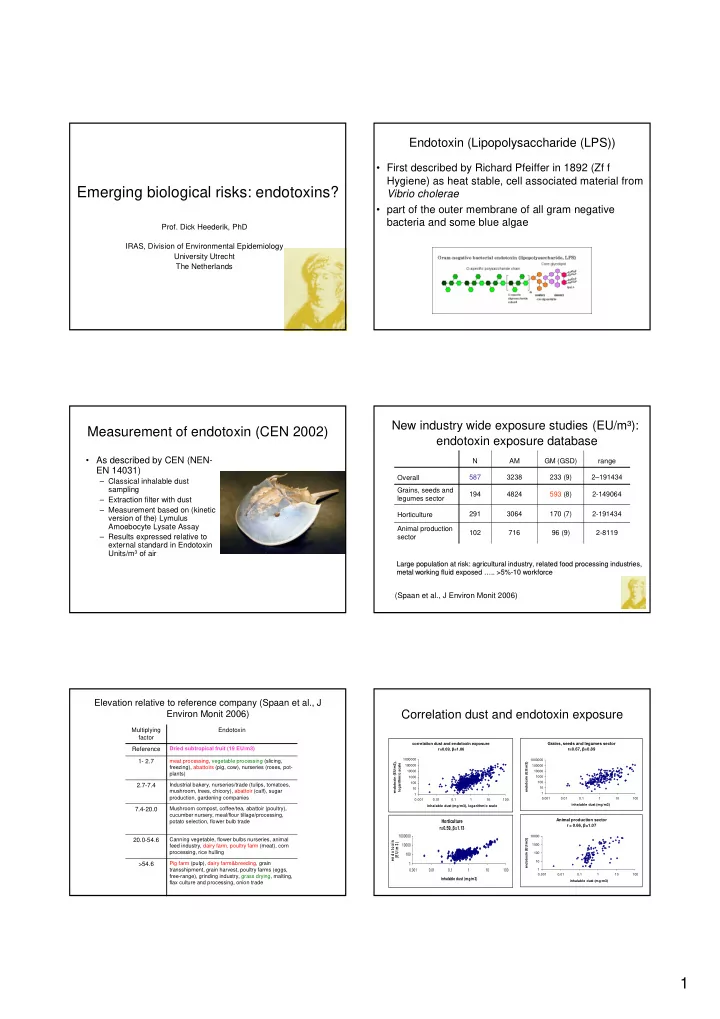
New industry wide exposure studies (EU/m³): endotoxin exposure database

96 (9) 170 (7) 593 (8) 233 (9) GM (GSD) 2-8119 2-191434 2-149064 2–191434 range 716 102 Animal production sector 3064 291 Horticulture 4824 194 Grains, seeds and legumes sector 3238 587 Overall AM N

(Spaan et al., J Environ Monit 2006)

Large Large population population at risk: at risk: agricultural agricultural industry industry, , related related food food processing industries, processing industries, metal metal working working fluid fluid exposed exposed … ….. >5% .. >5%-

  • 10

10 workforce workforce

Elevation relative to reference company (Spaan et al., J Environ Monit 2006)

>54.6 20.0-54.6 7.4-20.0 2.7-7.4 1- 2.7 Reference Multiplying factor

Pig farm (pulp), dairy farm&breeding, grain transshipment, grain harvest, poultry farms (eggs, free-range), grinding industry, grass drying, malting, flax culture and processing, onion trade Canning vegetable, flower bulbs nurseries, animal feed industry, dairy farm, poultry farm (meat), corn processing, rice hulling Mushroom compost, coffee/tea, abattoir (poultry), cucumber nursery, meal/flour tillage/processing, potato selection, flower bulb trade Industrial bakery, nurseries/trade (tulips, tomatoes, mushroom, trees, chicory), abattoir (calf), sugar production, gardening companies meat processing, vegetable processing (slicing, freezing), abattoirs (pig, cow), nurseries (roses, pot- plants) Dried subtropical fruit (19 EU/m3)

Endotoxin

Correlation dust and endotoxin exposure

correlation dust and endotoxin exposure r=0.69, β=1.06 1 10 100 1000 10000 100000 1000000 0.001 0.01 0.1 1 10 100 inhalable dust (mg/m3), logarithmic scale endotoxin (EU/m3), logarithmic scale Grains, seeds and legumes sector r=0.67, β=0.89 1 10 100 1000 10000 100000 1000000 0.001 0.01 0.1 1 10 100 inhalable dust (mg/m3) endotoxin (EU/m3) Horticulture r=0.59, β=1.13 1 100 10000 1000000 0.001 0.01 0.1 1 10 100 inhalable dust (mg/m3) e n d o to x in (E U /m 3 ) Animal production sector r = 0.66, β=1.07 1 10 100 1000 10000 0.001 0.01 0.1 1 10 100 inhalable dust (mg/m3) endotoxin (EU/m3)

slide-2
SLIDE 2

2

Early evidence on health effects

  • Cotton production
  • Neal et al. JAMA 1942

suggested Enterobacter agglomerans might play a role in the development of byssinosis

  • Rylander et al. was among the

first to mention endotoxin in relation to byssinosis (Chest 1986)

  • Since than, exposure and

effects have been described in a range of industries

Review of health effects (up to 1997 www.gr.nl)

  • Experimental animal studies
  • Experimental studies in humans

(injection and inhalation pure endotoxin, inhalation of dust containing endotoxin (cotton, pig stables)

  • A series of large scale
  • bservational epidemiologic

studies in agricultural workers and

  • ther occupational groups:

– Grain processing – (pig) farming – Composting – Metal working fluids, glass fiber production, etc.

Health effects

  • Acute:

– Systemic and respiratory symptoms (dry cough, shortness of breath, fever, shivering, joint pain) ICOH: ODTS 1000 EU/m3 (Rylander, 1997) – (Acute) lung function changes ICOH 100 EU/m3 – Inflammatory response (neutrophile, cytokines)

  • Chronic:

– Accelerated lung function decline (COPD?)

  • Protective effects:

– Atopy and allergy? – Lung cancer?

Acute respiratory changes in cotton dust exposed individuals: card room studies

  • Experimental study in the

US in humans (Castellan et al., 1987)

  • NOEL for acute lung

function changes around 9 ng/m3

  • Formed the basis of the

proposed exposure standard in the Netherlands 50 EU/m3 standard of 200 EU/m3 adapted

Interindividual variability in response

Kline et al. 1999. ARRCCM.

Atopy, and hay fever in farmers’ children (Braun-Fahrländer et al., 2002)

Endotoxin exposure during first year and current endotoxin exposure were associated with reduced atopy prevelance in children from farming and non-farming families

slide-3
SLIDE 3

3

  • ccupational endotoxin exposure protects

against respiratory sensitization ast adult age

Portengen et al., JACI 2005

Endotoxin, respiratory symptoms and BHR (Smit et al., 2007 in preparation)

Modeled endotoxin exposure (EU/m3) 10 100 1000 10000 Lower respiratory symptoms (%) 10 20 30 40 50 60 All participants aged 18-65 (n = 878) 95% SE bands Modeled endotoxin exposure (EU/m3) 10 100 1000 10000 Bronchial responsiveness to metacholine (%) 20 40 60 80 100 Change in FEV1 > 15% Change in FEV1 >20% 95% SE bands, change in FEV1 >15% 95% SE bands, change in FEV1 >20%

Endotoxin, atopy (with and without farm childhood)(Smit et al., in preparation)

Modeled endotoxin exposure (EU/m3)

10 100 1000 10000

Hay fever (%)

5 10 15 20 25 30 35 All participants aged 18-65 (n= 878) 95% SE bands

Modeled endotoxin exposure (EU/m3)

10 100 1000 10000

Atopic sensitisation (%)

20 40 60 80 No farm childhood (n = 235) Farm childhood (n= 194) 95% SE bands, no farm childhood 95% SE bands, farm childhood

Association of lung cancer with cumulative exposure to endotoxin: 20 year latency 0.4-0.7 0.5 338 59

4043-138177

0.4-0.8 0.5 309 57

2083-4042

0.5-0.9 0.7 347 75

2041-2082

0.5-0.9 0.7 408 81

1275-2041 reference

1.0 543 122

>0-1274

0.6-1.0 0.8 1090 208 95%CI RR*

Subcohort

Cases

Cum-exp

(EU-yrs) *Hazard ratio, adjusted for age, smoking Source: Astrakianakis G, et al. JNCI (2007 in press)

Variability issues

  • Variability within and between

laboratories LAL assessment

  • Most information on

laboratories with different protocols (Reynolds et al., 2002, 2005; Chun et al., 2002)

  • Performance improves when

protocols are harmonized (Chun et al., 2002 and Linsel et al., 2003)

  • Major steps in harmonization

can now be made (Spaan et al., 2007; Wouters et al., 2007) – Assay type: KLARE and other kinetic versions (Milton et al., 1992; Thorne et al., 1997) – Storage stability of samples (Douwes et al., 1995; Milton et al., 1997) – Filter media (Douwes et al., 1995; Thorne et al., 1997; Milton et al., 1997) – “Inhibition” and “enhancement” (Hollander et al., 1993) – Extraction medium (Tween

  • ptimal) (Douwes et al., 1995;

Thorne et al., 2003; USA ASTM protocol)

Variability issues

  • Changes over time seem

limited (supplier, lot, etc.)

  • Variability in endotoxin

between workers and over time larger than for chemical agents!

  • Need to allow for this in

the exposure assessment strategy

endotoxin concentration with kabivitrum based assay 2 4 6 8 10 12 repeated analysis

  • 2

2 4 6 8 10 12 kabivitrum 1988 against whittaker 1991 kabivitrum 1988 against kabivitrum 1993 kabivitrum 1993 against whittaker 1993 x = y

slide-4
SLIDE 4

4

Other issues

  • Information from a limited number of

industries

  • Exposure to a complex mixture
  • extrapolation from one industry to

another?

  • Evidence remarkably consistent

across industries

  • Endotoxin often most potent

constituent (in vitro evidence)

  • Fig. 1a: TNF-a productie in WBA - exp.1

100 200 300 400 500 600 700 0.1 1 10 100 zaad extract (microliter/test) cytokine (pg/mL) Lolium-1 Festuca-1 Wheat-1 Cauliflower Red beet LPS

In conclusion

  • No doubt about the role of endotoxin as cause of respiratory disease
  • Quantitative evidence has become stronger, as well as insight in

mechanisms

  • Potential protective effects with regard to atopic responses: two sides of

the coin?

  • Introduction of CEN protocol on EU level needed so reduce interlab

variability

  • High variability in endotoxin levels requires specific measurement

strategy for biological agents

  • Standard setting? SCOEL?