1 Implementation Snoop Caches Implementing Snooping Caches Write - - PDF document

1
SMART_READER_LITE
LIVE PREVIEW

1 Implementation Snoop Caches Implementing Snooping Caches Write - - PDF document

An Example Snoopy Protocol Invalidation protocol, write-back cache Each block of memory is in one state: Cache Coherence and Memory Clean in all caches and up-to-date in memory (Shared) Consistency OR Dirty in exactly one cache


slide-1
SLIDE 1

1

1

Cache Coherence and Memory Consistency

2

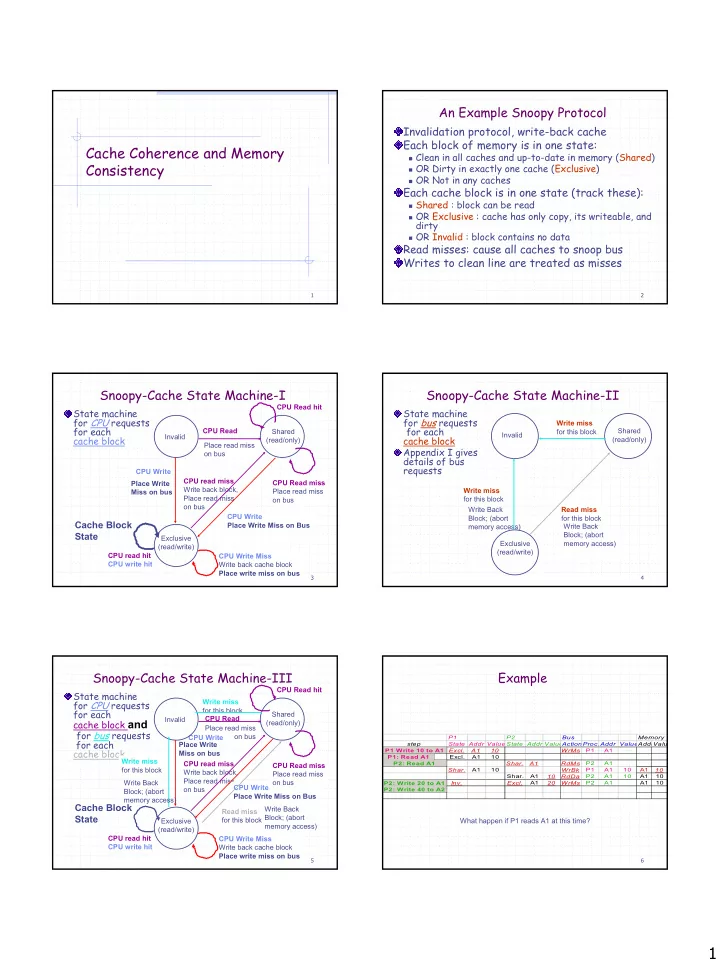
An Example Snoopy Protocol

Invalidation protocol, write-back cache Each block of memory is in one state:

Clean in all caches and up-to-date in memory (Shared) OR Dirty in exactly one cache (Exclusive) OR Not in any caches

Each cache block is in one state (track these):

Shared : block can be read OR Exclusive : cache has only copy, its writeable, and

dirty

OR Invalid : block contains no data

Read misses: cause all caches to snoop bus Writes to clean line are treated as misses

3

Snoopy-Cache State Machine-I

State machine for CPU requests for each cache block

Invalid Shared (read/only) Exclusive (read/write) CPU Read CPU Write CPU Read hit Place read miss

  • n bus

Place Write Miss on bus CPU read miss Write back block, Place read miss

  • n bus

CPU Write Place Write Miss on Bus CPU Read miss Place read miss

  • n bus

CPU Write Miss Write back cache block Place write miss on bus CPU read hit CPU write hit

Cache Block State

4

Snoopy-Cache State Machine-II

State machine for bus requests for each cache block Appendix I gives details of bus requests

Invalid Shared (read/only) Exclusive (read/write) Write Back Block; (abort memory access) Write miss for this block Read miss for this block Write miss for this block Write Back Block; (abort memory access)

5

Place read miss

  • n bus

Snoopy-Cache State Machine-III

State machine for CPU requests for each cache block and for bus requests for each cache block

Invalid Shared (read/only) Exclusive (read/write) CPU Read CPU Write CPU Read hit Place Write Miss on bus CPU read miss Write back block, Place read miss

  • n bus

CPU Write Place Write Miss on Bus CPU Read miss Place read miss

  • n bus

CPU Write Miss Write back cache block Place write miss on bus CPU read hit CPU write hit

Cache Block State

Write miss for this block Write Back Block; (abort memory access) Write miss for this block Read miss for this block Write Back Block; (abort memory access)

6

Example

P1 P2 Bus Memory step State Addr Value State Addr Value ActionProc.Addr ValueAddrValu P1: Write 10 to A1 Excl. A1 10 WrMs P1 A1 P1: Read A1 Excl. A1 10 P2: Read A1 Shar. A1 RdMs P2 A1 Shar. A1 10 WrBk P1 A1 10 A1 10 Shar. A1 10 RdDa P2 A1 10 A1 10 P2: Write 20 to A1 Inv. Excl. A1 20 WrMs P2 A1 A1 10 P2: Write 40 to A2 P1: Read A1 P2: Read A1 P1 Write 10 to A1 P2: Write 20 to A1 P2: Write 40 to A2

What happen if P1 reads A1 at this time?

slide-2
SLIDE 2

2

7

Implementation Snoop Caches

Write Races:

Cannot update cache until bus is obtained

Otherwise, another processor may get bus first, and then write the same cache block!

Two step process:

Arbitrate for bus Place miss on bus and complete operation

If miss occurs to block while waiting for bus,

handle miss (invalidate may be needed) and then restart.

8

Implementing Snooping Caches

Multiple processors must be on bus, access to both addresses and data Add a few new commands to perform coherency, in addition to read and write Processors continuously snoop on address bus

If address matches tag, either invalidate or update

Since every bus transaction checks cache tags, could interfere with CPU just to check:

solution 1: duplicate set of tags for L1 caches just to

allow checks in parallel with CPU

solution 2: L2 cache already duplicate, provided L2

  • beys inclusion with L1 cache

9

MESI Protocol

Simple protocol drawbacks: When writing a block, send invalidations even if the block is used privately Add 4th state (MESI)

Modfied (private,!=Memory) eXclusive (private,=Memory) Shared (shared,=Memory) Invalid

Original Exclusive => Modified (dirty) or Exclusive (clean)

10

MESI Protocol

From local processor P’s viewpoint, for each cache block Modified: Only P has a copy and the copy has been modifed; must respond to any read/write request Exclusive-clean: Only P has a copy and the copy is clear; no need to inform others about further changes Shared: Some other machines may have copy; have to inform others about P’s changes Invalid: The block has been invalidated (possibly

  • n the request of someone else)

11

Memory Consistency

Sequential Memory Access on Uniprocessor execution A ← 10; // First Write to A A ← 20; // Last write to A Read A; // A will have value of 100 If “Read A” returns value 100, the execution is wrong! Memory Consistency on Multiprocessor P1 P2 P3 P4 Initial: A=B=0; A ← 10; A==10 A==10 A==0 B ← 20; B==20 B==0 B==20 (Right) (Right) (Wrong?!) What was expected?

12

Sequential Consistency

Sequential consistency: All memory accesses are in program order and globally serialized, or

Local accesses on any processor is in program order All memory writes appear in the same order on all processors

Any other processor perceives a write to A only when it reads A Programmer’s view about consistency: how memory writes and reads are ordered on every processor Programmer’s view on P3 Programmer’s view on P4 A←10; B←20; Read A (A==10); Read A (A==0); Read B (B==0); Read B (B==10); B←20; A←10; (Consistent) (Inconsistent!)

slide-3
SLIDE 3

3

13

Sequential Consistency

Consider writes on two processors: P1: A ← 0; P2: B ← 0; ..... ..... A ← 1; B ← 1; L1: if (B == 0) ... L2: if (A == 0) ... Is there an explanation that L1 is true and L2 is false? Global View View from P1 View from P2 A ← 0 A ← 0 A ← 0 B ← 0 B ← 0 B ← 0 A ← 1 A ← 1 A ← 1 P1 Reads B L1: Read B==0

  • P2 Reads A
  • L2: Read A==1

B ← 1 B ← 1 B ← 1 What is wrong if both statements (L1 and L2) be true?

Can you find an explanation? If not, how would you prove there is no valid explanation?

14

Sequential Consistency Overhead

What could have been wrong if both L1 and L2 are true?

P1: A ← 0; P2: B ← 0; ..... ..... A ← 1; B ← 1; L1: if (B == 0) ... L2: if (A == 0) ...

A’s invalidation has not arrived at P2, and B’s invalidation has not arrived at P1 Reading A or B happens before the writes Solution I: Delay ANY following accesses (to the memory location or not) until an invalidation is ALL DONE. Overhead: What is the full latency of invalidation? How frequent are invalidations? How about memory level parallelism?

15

Memory Consistence Models

Why should sequential consistency be the only correct one?

It is just the most simple one It was defined by Lamport

Memory consistency models: A contract between a multiprocessor builder and system programmers on how the programmers would reason about memory access ordering Relaxed consistency models: A memory consistency that is weaker than the sequential consistency

Sequential consistency maintains some total ordering of reads and

writes

Processor consistency (total store ordering): maintain program order of

writes from the same processor

Partial store order: writes from the same processor might not be in

program order

16

Memory Consistency Models

P1: A ← 0; P2: B ← 0; ..... ..... A ← 1; B ← 1; L1: if (B == 0) ... L2: if (A == 0) ...

Explain in processor consistency that both L1 and L2 are true:

View from P1 View from P2 Another view from P2 A ← 0 B ← 0 A ← 0 B ← 0 B ← 1 B ← 0 A ← 1 A ← 0 L2: Read A==0 L1: Read B==0 L2: Read A==0 A ← 1 B ← 1 A ← 1 B ← 1

(a) (b) (c) (b) Remote writes appear in a different order (c) Local reads bypasses local writes (relax W->R order) Key point: programmers know how to reason about the shared memory

17

Memory Consistency and ILP Speculate on loads, flush on possible violations

With ILP and SC what will happen on this?

P1 code P2 code P1 exec P2 exec A = 1 B = 1 issue “store A” issue “store B” read B read A issue “load B” issue “load A” commit A , send inv (winner) flush at load A commit B, send inv

SC can be maintained, but expensive, so may also use TSO or PC

Speculative execution and rollback can still improve

performance

Performance on contemporary multiprocessors: ILP + Strong MC ≅ Weak MC