1 Impact Plan - Entrepreneurship STRATEGIES IMMEDIATE OUTCOMES - - PDF document

1
SMART_READER_LITE
LIVE PREVIEW

1 Impact Plan - Entrepreneurship STRATEGIES IMMEDIATE OUTCOMES - - PDF document

Grant Program Review Board of Directors Meeting June 7-8, 2016 Program Agenda 2016 budget status Program updates Six grant proposals Annual Meeting topics Site Visits Financial and Investment Reviews 2 BOD Meeting June


slide-1
SLIDE 1

1

Grant Program Review

Board of Directors Meeting June 7-8, 2016

Program Agenda

 2016 budget status  Program updates  Six grant proposals  Annual Meeting topics  Site Visits  Financial and Investment Reviews

2 BOD Meeting June 7-8, 2016

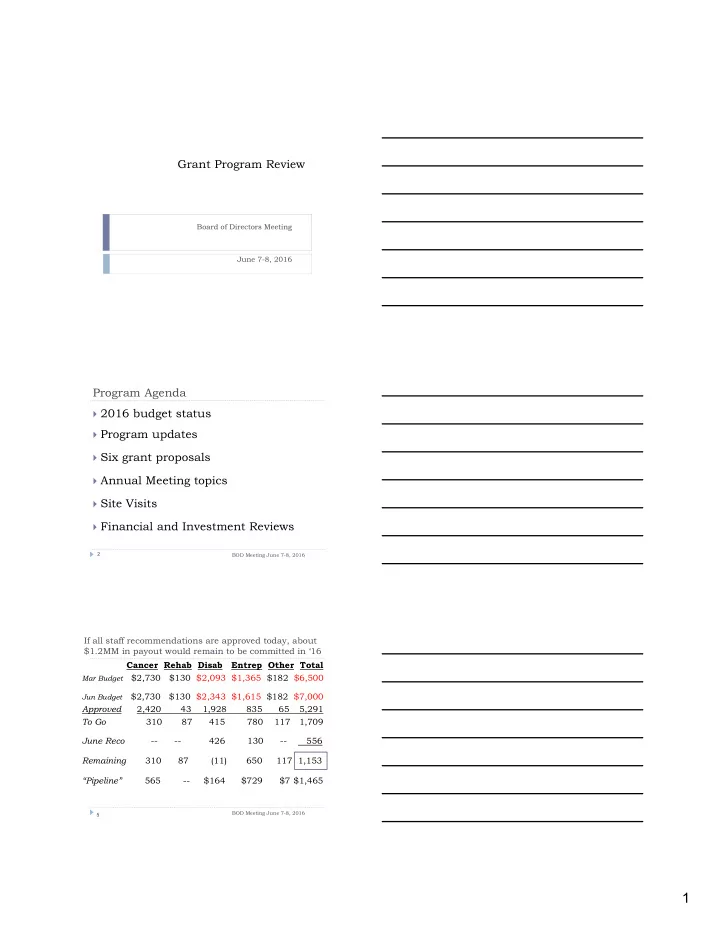
If all staff recommendations are approved today, about $1.2MM in payout would remain to be committed in ‘16 Cancer Rehab Disab Entrep Other Total

Mar Budget $2,730 $130 $2,093 $1,365 $182 $6,500 Jun Budget

$2,730 $130 $2,343 $1,615 $182 $7,000 Approved 2,420 43 1,928 835 65 5,291 To Go 310 87 415 780 117 1,709 June Reco

  • 426 130 --

556 Remaining 310 87 (11) 650 117 1,153 “Pipeline” 565 -- $164 $729 $7 $1,465

5 BOD Meeting June 7-8, 2016

slide-2
SLIDE 2

2

Impact Plan - Entrepreneurship

STRATEGIES IMMEDIATE OUTCOMES INTERMEDIATE OUTCOMES INTENDED IMPACT

1 Fund efforts to improve academic curriculums' ability to build core self- employment skills Collegiate programs will: commit financial and internal resources to promote E-ship as an interdisciplinary learning; sustain greater external stakeholder engagement; link experiential opportunities to the curriculum, employ student entrepreneurial portfolios Entrepreneurship Faculty Business and Non-Business instructors will

  • ptimally employ curricular and co-curricular

components to engage and support students in their pursuit of self-employment 2 Fund efforts to increase the quality and frequency of experiential/co-curricular activities Emerging student entrepreneurs will experience richer experiential co-curricular activities over the course of their programs 3 Fund efforts to increase frequency and quality of interdisciplinary learning Entrepreneurship Students Youth Programs will: sustain greater external stakeholder engagement; link experiential

  • pportunities to the curriculum; employ

experiential portfolios Aspiring entrepreneurs will have the motivation to act, have the right knowledge and have the opportunity to practice the right skills to apply to their business venture 4 Fund efforts to increase stakeholder engagement Emerging entrepreneurs will be successful at starting and running businesses 5 Explore efforts to develop "Portfolio" experiential approaches and link them directly to academic E-ship programs 6 Fund collaborative efforts between academic programs and community based accelerators and incubators Academic and Community based accelerator programs will develop programmatic collaborations continuing the pathway concept Emerging entrepreneurs will have ready

  • pportunities to participate in accelerators /

incubators as the next steps in their development Definitions: Core skill development could include: Vision, Opportunity Recognition, Network and Team development, Financial Management, Marketing, Technology utilization, Sales, Leadership Experiential / Co-curricular activities: Direct quality time with Business owners, Mentorships, Internships, Incubation/Acceleration, Alumni engagement, Entrepreneurs-in-residence, Opportunities to practice applied skills Interdisciplinary: interdepartmental, cross campus student activity and faculty collaboration including Fellows models Stakeholders: faculty and administration, community supporters, practitioners, alumni Entrepreneurial portfolio: A proactively developed set of experiential learning opportunities that engage students with entrepreneurs and the self-employment experience which are linked to the curriculum as per attached example

4 BOD Meeting June 7-8, 2016

Entrepreneurship Program Updates

 SEA  DePaul  Northwestern Law School

5 BOD Meeting June 7-8, 2016

Fellows Program will continue into 2016-2017 academic year

 $345,000 in grants approved to 14

participating schools

 42 funded Fellows and 13 Coleman

Entrepreneurs-in-Residence

 Developing a program evaluation initiative

involving multiple fellows

 Fellows Summit at Hilton Lisle from August 11-

13

 Joe Roberts continues as Program Director

6 BOD Meeting June 7-8, 2016

slide-3
SLIDE 3

3

“Nation of Makers” Community of Practice Launched at White House

7

Barrington High School Entrepreneurship Program

8 BOD Meeting June 7-8, 2016

Entrepreneurship Program Concept

 INCubatoredu Program Expansion

 Classroom redesign 4-5 potential schools  Minimal Viable Product (MVP) grants 4-5 schools

 Block funding request of up $125,000

 Individuals grants up to $25,000 per school  MVP grants up to $2,500 per school 9 BOD Meeting June 7-8, 2016

slide-4
SLIDE 4

4

Hononegah Community High School Entrepreneurship Classroom

10 BOD Meeting June 7-8, 2016 11

  • Effort to develop a local food

manufacturing hub that links local food growers and entrepreneurs through a set

  • f farm-to-market activities

including development of branded artisan foods made and sold through the network.

  • Helps growers reach market

at scale

  • Individuals with I/DD would

be employed at various network sites in multiple capacities

BOD Meeting June 7-8, 2016

Vetting a Local Food Concept to Aid Entrepreneurs & Employees with I/DD Impact Plan – Developmental Disabilities

STRATEGIES IMMEDIATE OUTCOMES INTERMEDIATE OUTCOMES INTENDED IMPACT 1 Fund grantees' ability to assess client residential and vocational interests in light of the changing environment Grantees must discern the vocational and residential goals of program participants and facilitate their efforts to achieve them

Vocational

Individuals in the Chicago metropolitan area with developmental disabilities will experience a higher quality of life and increased self-determination through success in their work, comfort in their home and satisfaction across the varied stages of their lives

2 Fund efforts to expand job

  • pportunities and prepare

individuals for workplace success

Individuals in the Chicago metropolitan area with developmental disabilities have the opportunity to identify from a variety of

  • ptions the work that helps

them to be fulfilled and to participate in the economy

3 Fund efforts to increase self- employment 4 Fund efforts to increase the supply

  • f housing alternatives, including

emerging models which allow for

  • wnership by residents and other

parties

Residential

5 Explore efforts to improve client health outcomes enabling them to reach vocational and residential goals

Individuals in the Chicago metropolitan area with developmental disabilities can choose from a varied and increasing set of

  • ptions the residential

arrangement that gives them comfort and helps them to be fulfilled

6 Catalyze collaboration among grantees 7 Support grantees’ development of non-governmental revenue streams

12 BOD Meeting June 7-8, 2016

slide-5
SLIDE 5

5

We are advancing disabilities grantmaking opportunities in 2016

1.

Advance an understanding of “Quality of Life”

2.

Support transitions of sheltered workshops to community-integrated & employment programs

3.

Create and renew residential environments

4.

Improve direct care staffing

5.

Mobilize individual philanthropic support

13 BOD Meeting June 7-8, 2016

These opportunities align with our disabilities Impact Plan

1.

Advance understanding

  • f “Quality of Life”

2.

Support transitions of sheltered workshops to more community- integrated & employment programs

3.

Create and renew residential environments

4.

Improve direct care staffing

5.

Mobilize individual philanthropic support

  • 1. Intended Impact is

“higher quality of life”

  • 2. Driven by explicit

goals of participants and funders

  • 3. Outcome of

“comfort”

  • 4. Fundamental issue

for providers

  • 5. Response to State

Budget crisis

14 BOD Meeting June 7-8, 2016

Proposed projects and others in pipeline are addressing these opportunities

1.

Advance understanding

  • f “Quality of Life”

2.

Support transitions of sheltered workshops to more community- integrated & employment programs

3.

Create and renew residential environments

4.

Improve direct care staffing

5.

Mobilize individual philanthropic support 1.

PACTT/I4A CQL training

2.

Helping Hand CHOICE; Have Dreams HDA/HFA

3.

Group Home Renewal

4.

I4A collaboration in development

5.

Giving Tuesday match; Forefront

15 BOD Meeting June 7-8, 2016

slide-6
SLIDE 6

6

CFI has taken leadership role with award to Forefront for #ILGive

16

 $100M grant over two years to advance the #ILGive

campaign and increase results from $6M in ‘15 to $9M in ‘16

 Support will ensure #ILGive and “Increasing

Individual Giving” remain a Forefront priority and gain visibility in philanthropy community

 These efforts will be called out at Forefront’s 42nd

Annual Luncheon tomorrow

 Forefront has three asks outstanding:

 $25k pending with Grand Victoria Foundation  $75k 3-year proposal to Forum Fund (CCT DAF); and  $25k request to an anonymous individual

BOD Meeting June 7-8, 2016

#ILGive for Giving Tuesday

22 BOD Meeting June 7-8, 2016

2015 2014 2013 Total Match goal Increased gift New Donors All Donations Match cap $20,000/15,000 $15,000 $20,000 Raised $1,207,405 $860,956 $610,968 $2,679,329 Donors 5,175 4,259 2,141 11,575 CFI match $588,000 $330,000 $330,745 $1,248,745 Met match? 14 (of 48) 6 (of 41) 15 (of 19) 32 (of 108)  Over three years, CFI has paid almost $1.25MM

in matching grants to help organizations raise $2.7MM from over 11,000 donors

Matching award lessons drive recommendation for 2016 program

 The mere availability of a match is the key

Larger matches don’t always translate to more giving

 A match that activates all donors is important

Those that focus on only new donors demotivate current donors

 We have additional grantees who could benefit from

participation in the program

 So, recommendation is to extend an increased number of

  • pportunities to gain a $10,000 matching grant

Potentially upwards of 60 organizations (not all of whom will max)

Specific terms TBD (e.g. match incremental donations)

Max exposure of $600,000 with likely payout substantially less

22 BOD Meeting June 7-8, 2016

slide-7
SLIDE 7

7

Disability Program Update

GiGi's opened the 30th Playhouse in Madison, Wisconsin end of May, 2016!

19 BOD Meeting June 7-8, 2016

Disability Program Update

20 BOD Meeting June 7-8, 2016

Impact Plan - Cancer

STRATEGIES IMMEDIATE OUTCOMES INTERMEDIATE OUTCOMES INTENDED IMPACT 1 Fund capital and program projects that enable the delivery

  • f comprehensive treatment.

Health Care Providers Health Care Providers 2 Fund education programs1 for cancer patients, physicians and health care professionals. Grantees will offer the most effective tools and resources possible to cancer patients, and employ supportive oncology practices4 in which healthcare professionals collaborate Medical professionals will be able to develop and deliver an

  • ptimal comprehensive

treatment plan for the cancer patient. Cancer patients in the Chicago Metro area are fully engaged in their cancer treatment plan, and achieve the best possible

  • utcome and quality of life.

3 Fund collaborative

2 efforts that

include comprehensive clinics

3 ,

psychosocial support and palliative care. Cancer Patients Cancer Patients Cancer patients must be fully engaged in development of a treatment plan and empowered to make decisions regarding their continuity of care. Individuals with cancer are knowledgeable and actively participate in cancer treatment. 4 Fund efforts to promote clear communication of treatment

  • ptions to patients.

1 education programs refer to professional development, disease or treatment specific education, and mentoring, not medical school education 2 collaborations would include efforts between doctors and other health care professionals at same or across institutions 3 multidisciplinary medical team develops treatment options and discusses advantages and disadvantages with the patient 4 refers to services from diagnosis to end of life

21 BOD Meeting June 7-8, 2016

slide-8
SLIDE 8

8

Endowment Renewal

Lurie Children’s Hospital

 Fellowship in Hematology, Oncology & Stem Cell

Transplantation Program

 Supports two Fellows - July 1, 2016 to June 30,

2019

22 BOD Meeting March 1, 2016 23 BOD Meeting March 1, 2016

  • Dr. Larisa Broglie
  • Dr. Paul Lee

Cancer Program Recommendation

Coleman Supportive Oncology Initiative (CSOI)

 Initiative Cycle 1 Design Teams and Improvement

Site Grants ended May 31st

 Initiative Cycle 2 Recommendation

 Potential start date Oct. 1, 2016  Six existing process improvement sites to continue  Potential for new improvement sites t/b/d 24 BOD Meeting June 7-8, 2016

slide-9
SLIDE 9

9

Agenda

Program Request Recommended Entrepreneurship $175,000 $170,000 Disabilities 637,500 637,500 Total $812,500 $807,500

25 BOD Meeting June 7-8, 2016

Agenda - Entrepreneurship

Program Request Recommended Future Founders Fdn $175,000 $170,000 Total E’ship $175,000 $170,000

26 BOD Meeting June 7-8, 2016

Future Founders Foundation Recommended Amount: $170,000

Strengths

 Provides an array of experiential activities and events.

Engages the entrepreneurial community. Extends the reach of campus programs

 Provides higher level mentoring to more advanced students

Weaknesses

 Insufficient program evaluation to date on intentionality and

start-up activity.

 Divergent stakeholder goals  Local campus engagement not as high as possible due to

campus vacancies Why to Fund

 Provides connectivity to community mentors and peers  Offers diverse experiences and deeper mentorship 27 BOD Meeting June 7-8, 2016

slide-10
SLIDE 10

10

Agenda - Disabilities

Applicant Request Recommended Ctr for Independence $200,000 $200,000 The Douglas Center 45,000 45,000 Have Dreams 125,000 125,000 Helping Hand Center 151,000 151,000 PACTT (I4A QOL) 116,500 116,500 Total $637,500 $637,500

28 BOD Meeting June 7-8, 2016

Center for Independence through Conductive Ed Recommended Amount: $200,000

Strengths

 Collaboration by three agencies to develop a prototype for

training individuals w/DD.

 Builds on successful program, Teacher Together, designed to

train individuals w/DD to work as teacher’s aids.

 Individuals w/DD will be placed as interns with expectation

that schools will hire them permanently. Weaknesses

 Challenges of placing individuals w/DD in the school and

classroom environment are not fully known. Why to Fund

 Teaching Together program allows agencies to explore a new

work option for individuals w/DD.

https://www.youtube.com/watch?v=NM6y5x_RCmM

29 BOD Meeting June 7-8, 2016

The Douglas Center Outdoor Recreation Space Recommended Amount: $45,000

Strengths

 Good organization with strong, stable leadership  Quality installation of flexible, durable recreation area  Provides meaningful alternative to otherwise sedentary

activities Weaknesses

 Facility under long-term, stable lease but not owned by The

Douglas Center Why to Fund

 Organization performed on prior sensory room grant and this

project will advance strategy to improve health outcomes

30 BOD Meeting June 7-8, 2016

slide-11
SLIDE 11

11

31 32 33

slide-12
SLIDE 12

12

34

Have Dreams Academy and Academy for HFA Recommended Amount: $125,000

Strengths

 HDA launch indicates strong potential for continued success  HFA partnership between Have Dreams, Swoon and Grandy

Foundation builds new partners on stable base of Project Search/HDA Weaknesses

 New partners will require efforts to ensure alignment and

effective contribution Why to Fund

 Proven organization leads multi-prong effort to expand job

  • pportunities and prepare individuals for workplace success

https://www.youtube.com/watch?v=ddSSMfd5KbE

35 BOD Meeting June 7-8, 2016

Helping Hand Center Discovering CHOICE Program Recommended Amount: $151,000

Strengths

 Expands CHOICE program model to a fourth organization to

aid in sheltered workshop transitions

 Levers existing agency-owned building for community-

integrating activities Weaknesses

 Location is in quasi-industrial location; will require

participants to travel to most community destinations Why to Fund

 Enables another organization to better discern vocational and

recreation needs of participants and facilitate their efforts to achieve them

36 BOD Meeting June 7-8, 2016

slide-13
SLIDE 13

13

PACTT CQL POM Training Collaborative Recommended Amount: $116,500

Strengths

 Strong co-hort of participants ranging from Intersect for

Ability agencies to ISCs and State employees

 Opportune time to build new working relationships as

business practices enter period of transformation

 PACTT as an CQL-accredited agency has important experience

and insights Weaknesses

 Commitments from ISCs and State and less defined than ideal  Highly likely but not guaranteed that CQL POMs will be vital

Why to Fund

 Gives CFI a view on drivers of QOL that may inform future

grantmaking activities

37 BOD Meeting June 7-8, 2016

Annual Meeting Topics

38

Financial Overview

 April 30, 2016 Financial Statements  June 3, 2016 Balance Sheet  2016 Budget  Preliminary 2017 Budget

39 BOD Meeting June 7-8, 2016

slide-14
SLIDE 14

14

Other Business

 Medical Insurance  Renewal of Business Insurance & D & O

36 BOD Meeting June 7-8, 2016

Investment Committee

 Manager Performance  1st Qtr., 2016  Market Update 2016  Asset Allocation  Equity level, Income & Cash  Re-balancing update  New Ideas

35 BOD Meeting June 7-8, 2016

New Business

 Technology  2016 Meeting Schedule

 Annual BOD Meeting:

6/7-8/16

 Regular BOD Meeting:

8/25/16

 Regular BOD Meeting:

11/16/16 or 11/17/16  Ongoing Program Discussion  Impact  Adjournment

36 BOD Meeting June 7-8, 2016

slide-15
SLIDE 15

15

Impact Plan - Cancer

STRATEGIES IMMEDIATE OUTCOMES INTERMEDIATE OUTCOMES INTENDED IMPACT 1 Fund capital and program projects that enable the delivery

  • f comprehensive treatment.

Health Care Providers Health Care Providers 2 Fund education programs1 for cancer patients, physicians and health care professionals. Grantees will offer the most effective tools and resources possible to cancer patients, and employ supportive oncology practices4 in which healthcare professionals collaborate Medical professionals will be able to develop and deliver an

  • ptimal comprehensive

treatment plan for the cancer patient. Cancer patients in the Chicago Metro area are fully engaged in their cancer treatment plan, and achieve the best possible

  • utcome and quality of life.

3 Fund collaborative

2 efforts that

include comprehensive clinics

3 ,

psychosocial support and palliative care. Cancer Patients Cancer Patients Cancer patients must be fully engaged in development of a treatment plan and empowered to make decisions regarding their continuity of care. Individuals with cancer are knowledgeable and actively participate in cancer treatment. 4 Fund efforts to promote clear communication of treatment

  • ptions to patients.

1 education programs refer to professional development, disease or treatment specific education, and mentoring, not medical school education 2 collaborations would include efforts between doctors and other health care professionals at same or across institutions 3 multidisciplinary medical team develops treatment options and discusses advantages and disadvantages with the patient 4 refers to services from diagnosis to end of life

43 BOD Meeting June 7-8, 2016

Impact Plan – Developmental Disabilities

STRATEGIES IMMEDIATE OUTCOMES INTERMEDIATE OUTCOMES INTENDED IMPACT 1 Fund grantees' ability to assess client residential and vocational interests in light of the changing environment Grantees must discern the vocational and residential goals of program participants and facilitate their efforts to achieve them Vocational Individuals in the Chicago metropolitan area with developmental disabilities will experience a higher quality of life and increased self-determination through success in their work, comfort in their home and satisfaction across the varied stages

  • f their lives

2 Fund efforts to expand job

  • pportunities and prepare

individuals for workplace success Individuals in the Chicago metropolitan area with developmental disabilities have the

  • pportunity to identify from a variety
  • f options the work that helps them

to be fulfilled and to participate in the economy 3 Fund efforts to increase self- employment 4 Fund efforts to increase the supply

  • f housing alternatives, including

emerging models which allow for

  • wnership by residents and other

parties Residential 5 Explore efforts to improve client health outcomes enabling them to reach vocational and residential goals Individuals in the Chicago metropolitan area with developmental disabilities can choose from a varied and increasing set of options the residential arrangement that gives them comfort and helps them to be fulfilled 6 Catalyze collaboration among grantees 7 Support grantees’ development of non-governmental revenue streams

44 BOD Meeting June 7-8, 2016

Impact Plan - Entrepreneurship

STRATEGIES IMMEDIATE OUTCOMES INTERMEDIATE OUTCOMES INTENDED IMPACT

1 Fund efforts to improve academic curriculums' ability to build core self- employment skills Collegiate programs will: commit financial and internal resources to promote E-ship as an interdisciplinary learning; sustain greater external stakeholder engagement; link experiential opportunities to the curriculum, employ student entrepreneurial portfolios Entrepreneurship Faculty Business and Non-Business instructors will

  • ptimally employ curricular and co-curricular

components to engage and support students in their pursuit of self-employment 2 Fund efforts to increase the quality and frequency of experiential/co-curricular activities Emerging student entrepreneurs will experience richer experiential co-curricular activities over the course of their programs 3 Fund efforts to increase frequency and quality of interdisciplinary learning Entrepreneurship Students Youth Programs will: sustain greater external stakeholder engagement; link experiential

  • pportunities to the curriculum; employ

experiential portfolios Aspiring entrepreneurs will have the motivation to act, have the right knowledge and have the opportunity to practice the right skills to apply to their business venture 4 Fund efforts to increase stakeholder engagement Emerging entrepreneurs will be successful at starting and running businesses 5 Explore efforts to develop "Portfolio" experiential approaches and link them directly to academic E-ship programs 6 Fund collaborative efforts between academic programs and community based accelerators and incubators Academic and Community based accelerator programs will develop programmatic collaborations continuing the pathway concept Emerging entrepreneurs will have ready

  • pportunities to participate in accelerators /

incubators as the next steps in their development Definitions: Core skill development could include: Vision, Opportunity Recognition, Network and Team development, Financial Management, Marketing, Technology utilization, Sales, Leadership Experiential / Co-curricular activities: Direct quality time with Business owners, Mentorships, Internships, Incubation/Acceleration, Alumni engagement, Entrepreneurs-in-residence, Opportunities to practice applied skills Interdisciplinary: interdepartmental, cross campus student activity and faculty collaboration including Fellows models Stakeholders: faculty and administration, community supporters, practitioners, alumni Entrepreneurial portfolio: A proactively developed set of experiential learning opportunities that engage students with entrepreneurs and the self-employment experience which are linked to the curriculum as per attached example

45 BOD Meeting June 7-8, 2016