1 The Problem and Two Solutions Comprehensive Redesign Example of - - PDF document

1
SMART_READER_LITE
LIVE PREVIEW

1 The Problem and Two Solutions Comprehensive Redesign Example of - - PDF document

Partner Chat Please discuss one or both of the following: What you know (or want to know) about mathematics pathways. Emerging Issues in Mathematics Pathways The current state of math pathways at your institution. Connie Richardson


slide-1
SLIDE 1

1

Emerging Issues in Mathematics Pathways

1

Connie Richardson Charles A Dana Center National Numeracy Network October 14, 2018

Partner Chat

Please discuss one or both of the following:

  • What you know (or want to know) about

mathematics pathways.

  • The current state of math pathways at your

institution.

2

DCMP Vision The DCMP seeks to ensure that ALL students in higher education will be:

  • Prepared to use mathematical and quantitative

reasoning skills in their careers and personal lives,

  • Enabled to make timely progress towards

completion of a certificate or degree, and

  • Supported and Empowered as mathematical

learners.

Students engage in a high-quality learning experience in math pathways designed so that:

Dana Center Principles for Pathways

4

Mathematics pathways are structured so that: 1) All students, regardless of college readiness, enter directly into mathematics pathways aligned to their programs of study. 2) Students complete their first college-level math requirement in their first year of college. 3) Strategies to support students as learners are integrated into courses and are aligned across the institution. 4) Instruction incorporates evidence-based curriculum and pedagogy.

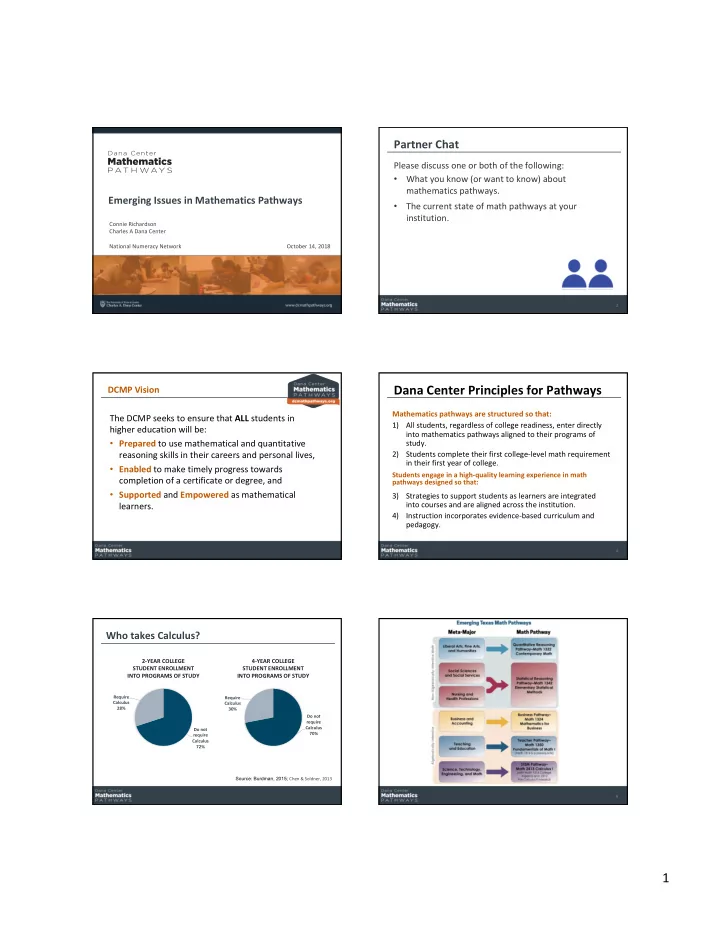
Who takes Calculus?

Do not require Calculus 72% Require Calculus 28%

2-YEAR COLLEGE STUDENT ENROLLMENT INTO PROGRAMS OF STUDY

Do not require Calculus 70% Require Calculus 30%

4-YEAR COLLEGE STUDENT ENROLLMENT INTO PROGRAMS OF STUDY

Source: Burdman, 2015; Chen & Soldner, 2013

6
slide-2
SLIDE 2

2

The Problem and Two Solutions

Example of the problem: Criminal Justice Majors at Sam Houston State University have options:

  • Any Core Math (Core list starts with Precalculus)
  • Students tend to choose the first course in the list (lowest number)

Examples of two solutions: Criminal Justice Majors at University of North Texas

  • Any Core Math (but Precalculus is not in the core!)

University of Texas at Arlington

  • Math 1301 (Quantitative Reasoning) or higher
  • Give QR the lowest course number so that students will choose it.

Third solution: List QR as the Required or Recommended course.

7

Comprehensive Redesign

8

Monograph: Emerging Issues in Math Pathways

  • Faculty and Classroom Issues:
  • QR, Statistics, the path to Calculus, co-requisites
  • Leadership at Campus, System, and State Levels:
  • Successes and challenges, state case studies, HS to college

transition

  • Policy:
  • Major state and institutional level considerations
  • Equity issues
  • Coming soon! Watch for the release of the monograph.
9

Support your work

Dana Center Mathematics Pathways Resource Site: http://www.dcmathpathways.org/

10

Contact information

§ General information about the Dana Center: www.utdanacenter.org § Dana Center Mathematics Pathways Resource Site: www.dcmathpathways.org § To receive monthly updates about the DCMP, contact us at: dcmathpathways@austin.utexas.edu § Connie Richardson, Manager, higher education course programs cjrichardson@austin.utexas.edu

11

About the Dana Center

The Charles A. Dana Center at The University of Texas at Austin works with our nation’s education systems to ensure that every student leaves school prepared for success in postsecondary education and the contemporary workplace. Our work, based on research and two decades of experience, focuses on K–16 mathematics and science education with an emphasis on strategies for improving student engagement, motivation, persistence, and achievement. We develop innovative curricula, tools, protocols, and instructional supports and deliver powerful instructional and leadership development.

12 2016
slide-3
SLIDE 3

Emerging Issues in Mathematics Pathways

1

Connie Richardson Charles A Dana Center National Numeracy Network October 14, 2018

slide-4
SLIDE 4

Partner Chat

Please discuss one or both of the following:

  • What you know (or want to know) about

mathematics pathways.

  • The current state of math pathways at your

institution.

2

slide-5
SLIDE 5

DCMP Vision The DCMP seeks to ensure that ALL students in higher education will be:

  • Prepared to use mathematical and quantitative

reasoning skills in their careers and personal lives,

  • Enabled to make timely progress towards

completion of a certificate or degree, and

  • Supported and Empowered as mathematical

learners.

slide-6
SLIDE 6

Students engage in a high-quality learning experience in math pathways designed so that:

Dana Center Principles for Pathways

4

Mathematics pathways are structured so that: 1) All students, regardless of college readiness, enter directly into mathematics pathways aligned to their programs of study. 2) Students complete their first college-level math requirement in their first year of college. 3) Strategies to support students as learners are integrated into courses and are aligned across the institution. 4) Instruction incorporates evidence-based curriculum and pedagogy.

slide-7
SLIDE 7

Who takes Calculus?

Do not require Calculus 72% Require Calculus 28%

2-YEAR COLLEGE STUDENT ENROLLMENT INTO PROGRAMS OF STUDY

Do not require Calculus 70% Require Calculus 30%

4-YEAR COLLEGE STUDENT ENROLLMENT INTO PROGRAMS OF STUDY

Source: Burdman, 2015; Chen & Soldner, 2013

slide-8
SLIDE 8

6

slide-9
SLIDE 9

The Problem and Two Solutions

Example of the problem: Criminal Justice Majors at Sam Houston State University have options:

  • Any Core Math (Core list starts with Precalculus)
  • Students tend to choose the first course in the list (lowest number)

Examples of two solutions: Criminal Justice Majors at University of North Texas

  • Any Core Math (but Precalculus is not in the core!)

University of Texas at Arlington

  • Math 1301 (Quantitative Reasoning) or higher
  • Give QR the lowest course number so that students will choose it.

Third solution: List QR as the Required or Recommended course.

7

slide-10
SLIDE 10

Comprehensive Redesign

8

slide-11
SLIDE 11

Types of Quantitative Reasoning

  • Campus-wide initiatives to improve students’

quantitative reasoning skills.

  • Individual instructor efforts to improve course success

by improving students’ quantitative reasoning skills.

  • Required capstone/gen ed course or assessment for all

students.

  • Freshmen-level course for math credit, for programs

that don’t have specific algebraic or statistical needs.

9

slide-12
SLIDE 12

Monograph: Emerging Issues in Math Pathways

  • Faculty and Classroom Issues:
  • QR, Statistics, the path to Calculus, co-requisites
  • Leadership at Campus, System, and State Levels:
  • Successes and challenges, state case studies, HS to college

transition

  • Policy:
  • Major state and institutional level considerations
  • Equity issues
  • Coming soon! Watch for the release of the monograph.

10

slide-13
SLIDE 13

Support your work

Dana Center Mathematics Pathways Resource Site: http://www.dcmathpathways.org/

11

slide-14
SLIDE 14

Contact information

§ General information about the Dana Center: www.utdanacenter.org § Dana Center Mathematics Pathways Resource Site: www.dcmathpathways.org § To receive monthly updates about the DCMP, contact us at: dcmathpathways@austin.utexas.edu § Connie Richardson, Manager, higher education course programs cjrichardson@austin.utexas.edu

12

slide-15
SLIDE 15

About the Dana Center

The Charles A. Dana Center at The University of Texas at Austin works with our nation’s education systems to ensure that every student leaves school prepared for success in postsecondary education and the contemporary workplace. Our work, based on research and two decades of experience, focuses on K–16 mathematics and science education with an emphasis on strategies for improving student engagement, motivation, persistence, and achievement. We develop innovative curricula, tools, protocols, and instructional supports and deliver powerful instructional and leadership development.

13 2016