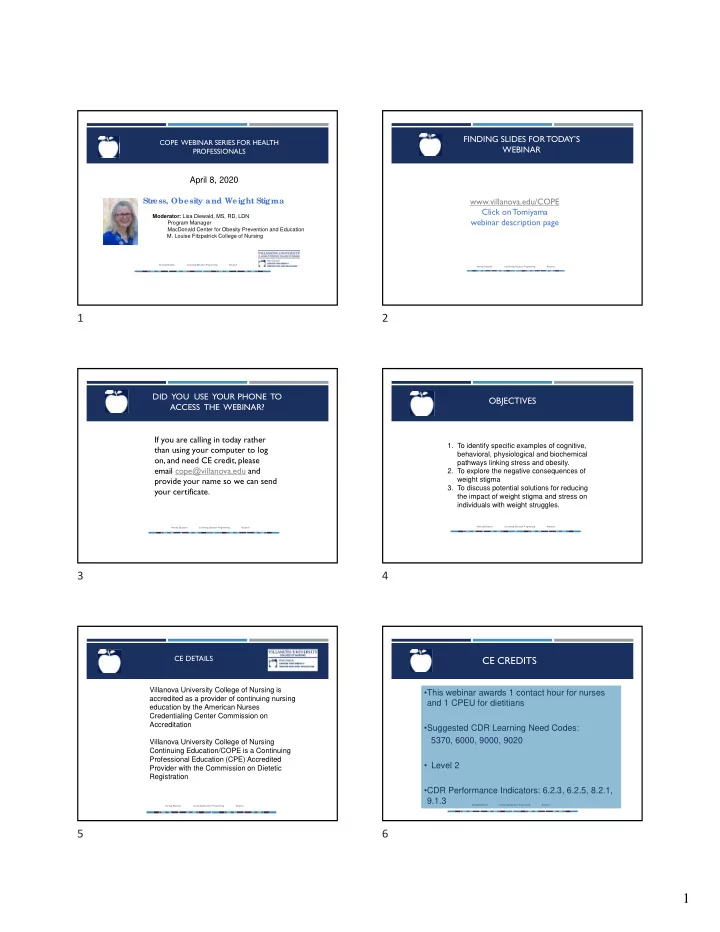
1 DISCLOSURE Stress, Obesity and Weight Stigma The planners and - - PDF document

1
SMART_READER_LITE
LIVE PREVIEW

1 DISCLOSURE Stress, Obesity and Weight Stigma The planners and - - PDF document

FINDING SLIDES FOR TODAYS COPE WEBINAR SERIES FOR HEALTH WEBINAR PROFESSIONALS April 8, 2020 www.villanova.edu/COPE Str ess, Obesity and Weight Stigma Click on Tomiyama Moderator: Lisa Diewald, MS, RD, LDN webinar description page


slide-1
SLIDE 1

1

COPE WEBINAR SERIES FOR HEALTH PROFESSIONALS

April 8, 2020

Str ess, Obesity and Weight Stigma

Moderator: Lisa Diewald, MS, RD, LDN Program Manager MacDonald Center for Obesity Prevention and Education

  • M. Louise Fitzpatrick College of Nursing

Nursing Education Continuing Education Programming Research

FINDING SLIDES FOR TODAY’S WEBINAR www.villanova.edu/COPE Click on Tomiyama webinar description page

Nursing Education Continuing Education Programming Research

DID YOU USE YOUR PHONE TO ACCESS THE WEBINAR? If you are calling in today rather than using your computer to log

  • n, and need CE credit, please

email cope@villanova.edu and provide your name so we can send your certificate.

Nursing Education Continuing Education Programming Research

OBJECTIVES

Nursing Education Continuing Education Programming Research

  • 1. To identify specific examples of cognitive,

behavioral, physiological and biochemical pathways linking stress and obesity.

  • 2. To explore the negative consequences of

weight stigma

  • 3. To discuss potential solutions for reducing

the impact of weight stigma and stress on individuals with weight struggles. CE DETAILS Villanova University College of Nursing is accredited as a provider of continuing nursing education by the American Nurses Credentialing Center Commission on Accreditation Villanova University College of Nursing Continuing Education/COPE is a Continuing Professional Education (CPE) Accredited Provider with the Commission on Dietetic Registration

Nursing Education Continuing Education Programming Research

CE CREDITS

  • This webinar awards 1 contact hour for nurses

and 1 CPEU for dietitians

  • Suggested CDR Learning Need Codes:

5370, 6000, 9000, 9020

  • Level 2
  • CDR Performance Indicators: 6.2.3, 6.2.5, 8.2.1,

9.1.3

Nursing Education Continuing Education Programming Research

1 2 3 4 5 6

slide-2
SLIDE 2

2

Stress, Obesity and Weight Stigma

  • A. Janet Tomiyama

Associate Professor Department of Psychology University of California, Los Angeles

DISCLOSURE

The planners and presenter of this program have no conflicts of interest to disclose. Accredited status does not imply endorsement by Villanova University, COPE or the American Nurses Credentialing Center of any commercial products or medical/nutrition advice displayed in conjunction with an activity.

Stress, Obesity, and Weight Stigma

COPE Webinar Villanova April 8, 2020

  • A. Janet Tomiyama, Ph.D.

Associate Professor Department of Psychology, UCLA

Types of Stressors

“When challenged to provide a definition of stress, most of us fall back on textbook definitions with no soul or shrug our shoulders and agree that it is not a good construct.” (p. 653)

Types of Stressors

Quiz on Lecture

What is stress?

(Baum, 1990, Health Psych)

What is Stress?

Stress is a negative emotional experience accompanied by predictable biochemical, physiological, cognitive, and behavioral changes that are directed either toward altering the stressful event or accommodating to its effects.

Quiz on Lecture

My favorite definition

(Baum, 1990, Health Psych)

Conclusions from Lab Studies of Eating, Part I

Consumption After a High‐Fat Preload

Psychology of Eating

Stress is widespread

7 8 9 10 11 12

slide-3
SLIDE 3

3

Conclusions from Lab Studies of Eating, Part I

Consumption After a High‐Fat Preload

Psychology of Eating

Pathways from stress to obesity?

?

Conclusions from Lab Studies of Eating, Part I

Consumption After a High‐Fat Preload

Psychology of Eating

Pathways from stress to obesity

(Tomiyama, 2019, Ann Rev Psych)

Conclusions from Lab Studies of Eating, Part I

Consumption After a High‐Fat Preload

Psychology of Eating

www.dishlab.org

Conclusions from Lab Studies of Eating, Part I

Consumption After a High‐Fat Preload

Psychology of Eating

Cognitive pathways

  • Stress knocks out executive function
  • …which is necessary for self-regulation/self-control
  • …of both behaviors and emotions!

Conclusions from Lab Studies of Eating, Part I

Consumption After a High‐Fat Preload

Psychology of Eating

Behavioral pathways 1

Eating

  • Stress-induced comfort eating
  • 39% of Americans are comfort eaters!

Solve these anagrams:

  • neci

amoos acelo rtean filru

Conclusions from Lab Studies of Eating, Part I

Consumption After a High‐Fat Preload

Psychology of Eating

Behavioral pathways 3

  • Sleep
  • People who get less than 5.5 hours are 55%

more likely to have obese BMI

  • For every hour more a person sleeps, their

average BMI is 0.35 points less

  • For the average height woman (5’5’’) that

equals 2.2 lbs

13 14 15 16 17 18

slide-4
SLIDE 4

4

Conclusions from Lab Studies of Eating, Part I

Consumption After a High‐Fat Preload

Psychology of Eating

Physiological pathways 1

Hypothalamic-Pituitary-Adrenal (HPA) axis

  • And cortisol, its end product

Conclusions from Lab Studies of Eating, Part I

Consumption After a High‐Fat Preload

Psychology of Eating

Physiological pathways 1

Cortisol also drives eating

(Epel et al., 2001 PNE)

Conclusions from Lab Studies of Eating, Part I

Consumption After a High‐Fat Preload

Psychology of Eating

Physiological pathways 2

Reward processing

  • Stress drives motivation

for high sugar, high fat, and high calorie foods

  • Dopamine system drives

food seeking and eating

  • Stress sensitizes reward

centers in the brain

  • High-sugar/fat/calorie

foods relieve stress

Conclusions from Lab Studies of Eating, Part I

Consumption After a High‐Fat Preload

Psychology of Eating

Physiological pathways 3

Gut microbiome

  • Gut microbiota can increase

HPA axis activity

  • And manufacture appetite-

regulating hormones

  • And maybe even regulate

body weight …but this is still speculative

Conclusions from Lab Studies of Eating, Part I

Consumption After a High‐Fat Preload

Psychology of Eating

Biochemical pathways 1

Leptin

19 20 21 22 23 24

slide-5
SLIDE 5

5

Conclusions from Lab Studies of Eating, Part I

Consumption After a High‐Fat Preload

Psychology of Eating

Biochemical pathways 1

Leptin

  • Leptin may protect against stress eating
  • …but individuals with obesity have higher leptin

levels, indicating leptin resistance

Conclusions from Lab Studies of Eating, Part I

Consumption After a High‐Fat Preload

Psychology of Eating

Biochemical pathways 2

Ghrelin

  • Stimulates reward pathways

In stress-eaters: Ghrelin stays high even after eating

Conclusions from Lab Studies of Eating, Part I

Consumption After a High‐Fat Preload

Psychology of Eating

Biochemical pathways 3

Neuropeptide Y (NPY)

  • Stimulates hunger,

conversion of sugars into fat

  • NPY in combination with

stress leads to greater

  • besity

Conclusions from Lab Studies of Eating, Part I

Consumption After a High‐Fat Preload

Psychology of Eating

Pathways from stress to obesity

(Tomiyama, 2019, Ann Rev Psych)

(Dickerson & Kemeny, 2004, Psychological Bulletin)

Stressors that are (a) social and (b) evaluative elicit the most cortisol

  • (Tomiyama, 2014, Appetite)

25 26 27 28 29 30

slide-6
SLIDE 6

6

  • (Tomiyama, 2014, Appetite)

(Tomiyama et al., 2014, Health Psychology)

It’s not about your actual BMI, it’s how you perceive it

Conclusions from Lab Studies of Eating, Part I

Consumption After a High‐Fat Preload

Psychology of Eating

“Shopping room”

Conclusions from Lab Studies of Eating, Part I

Consumption After a High‐Fat Preload

Psychology of Eating

Methods, continued

  • Weighed
  • Sit in waiting room with a very thin confederate
  • …who is accepted into the shopping activity

(Himmelstein, Incollingo Belsky, Tomiyama, 2014, Obesity)

Conclusions from Lab Studies of Eating, Part I

“Unfortunately your shape and size just aren’t ideal for this style of clothing and we really do want everyone to have fun and feel good. Plus, we want to return the clothing to the designer in good condition.”

Consumption After a High‐Fat Preload

Psychology of Eating

Manipulation

Conclusions from Lab Studies of Eating, Part I

Consumption After a High‐Fat Preload

Psychology of Eating

Study 2: Results

(Himmelstein, Incollingo Belsky, Tomiyama, 2014, Obesity)

31 32 33 34 35 36

slide-7
SLIDE 7

7

Study 1: Stigma correlated with cortisol Study 2: Stigma causes cortisol secretion

Conclusions from Lab Studies of Eating, Part I

Consumption After a High‐Fat Preload

Psychology of Eating

Study 3: Outcome measures

  • Psychological: Anger,

depression, anxiety, rejection, self‐esteem, antifat attitudes

  • Behavioral: M&Ms, potato

chips, Coca‐Cola consumption

(Heldreth, Incollingo Rodriguez, & Tomiyama, 2018, Obesity)

Study 2: Stigma causes cortisol secretion Study 1: Stigma correlated with cortisol Study 3: Stigma causes unhealthy eating

37 38 39 40 41 42

slide-8
SLIDE 8

8

Study 2: Stigma causes cortisol secretion Study 1: Stigma correlated with cortisol Study 3: Stigma causes unhealthy eating 1987 10 11 12 13 14 15 16 17 18 19 40 Follow‐up (ongoing) 1997 2017‐2018 Age

1213 black 1166 white 2379 girls total Richmond, CA Cincinnati, OH Washington, DC

...from 3 sites Participants:

NHLBI Growth and Health Study

Conclusions from Lab Studies of Eating, Part I

  • Have any of these people told you you’re too fat?

– Father – Mother – Sister – Brother – Best girlfriend – Boy you like best – Teacher

Consumption After a High‐Fat Preload

Psychology of Eating

Weight stigma measure

(Hunger & Tomiyama, 2014, JAMA Pediatrics)

Conclusions from Lab Studies of Eating, Part I

For every additional…

  • Family member: 0.54 BMI points higher
  • Others: 0.21 BMI points higher

Consumption After a High‐Fat Preload

Psychology of Eating

Results

(Hunger & Tomiyama, 2014, JAMA Pediatrics)

Study 4: Stigma longitudinally predicts weight gain Ongoing Study: Stigma, stress, eating, and cortisol in daily life Study 1: Stigma correlated with cortisol Study 2: Stigma causes cortisol secretion Study 3: Stigma causes unhealthy eating

Conclusions from Lab Studies of Eating, Part I

Consumption After a High‐Fat Preload

Psychology of Eating

tinyurl.com/uclatextingstudy

tinyurl.com/uclatextingstudy

NSF CAREER: BCS1454735

43 44 45 46 47 48

slide-9
SLIDE 9

9

Conclusions from Lab Studies of Eating, Part I

Consumption After a High‐Fat Preload

Psychology of Eating

Preliminary results

NSF CAREER: BCS1454735

“I went in the store to try on clothes and the sales person told me that they didn't have anything in my size.” “I was at the gym playing ball and one of the other guys said I've got the fat guy.” “I was at the doctor office and of course I was told I need to lose weight, as if I'm not trying.”

Conclusions from Lab Studies of Eating, Part I

Consumption After a High‐Fat Preload

Psychology of Eating

Preliminary results

NSF CAREER: BCS1454735

Mean food servings post-stigma: 3.21 (95% CI: 2.31,4.11) Mean food servings 24 hrs later (control): 2.21 (95% CI: 0.54, 3.13)

Study 2: Stigma causes cortisol secretion Study 3: Stigma longitudinally predicts weight gain Ongoing Study: Stigma, stress, and cortisol in daily life Ongoing Study: Longitudinal study to test full model Study 1: Stigma correlated with cortisol

Conclusions from Lab Studies of Eating, Part I

Consumption After a High‐Fat Preload

Psychology of Eating

Why this matters for providers

49 50 51 52 53 54

slide-10
SLIDE 10

10

Conclusions from Lab Studies of Eating, Part I

Consumption After a High‐Fat Preload

Psychology of Eating

Thank you

tomiyama@psych.ucla.edu www.dishlab.org

  • Look for an email containing a link to an evaluation.

The email will be sent to the email address that you used to register for the webinar.

  • Complete the evaluation soon after receiving it. It

will expire after 3 weeks.

  • You will be emailed a certificate within 2-3 business

days.

  • Remember: If you used your phone to call in, and

want CE credit for attending, please send an email with your name to cope@villanova.edu so you receive your certificate.

TO RECEIVE YOUR CE CERTIFICATE

Villanova.edu/cope

Upcoming FREE Continuing Education Webinar

Presented by: Tanja Kral, Ph.D. Associate Professor of Nutrition Science University of Pennsylvania School of Nursing & Perelman School of Medicine

Early life risk factors for obesity in children with Autism Spectrum Disorder Date to be announced soon!

F OCU S GROU P OPPORT U NI T Y

Want to he lp COPE by partic ipating in an o nline fo c us g ro up to disc uss pro g ramming ide as? E mail lisa.die wald@ villano va.e du fo r mo re info

QUESTIONS & ANSWERS

Moderator: Lisa K. Diewald MS, RD, LDN Email: cope@villanova.edu Website: www.villanova.edu/COPE

55 56 57 58 59