1 IMF KE IMF > KE IMF < KE Increasing EN Special cases: - - PDF document

1
SMART_READER_LITE
LIVE PREVIEW

1 IMF KE IMF > KE IMF < KE Increasing EN Special cases: - - PDF document

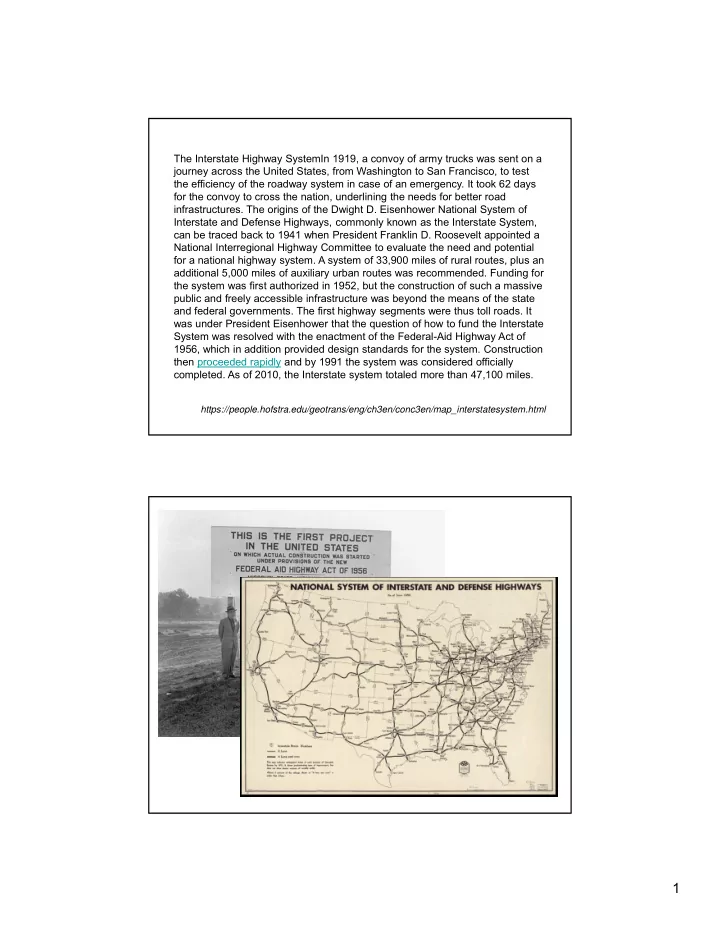
The Interstate Highway SystemIn 1919, a convoy of army trucks was sent on a journey across the United States, from Washington to San Francisco, to test the efficiency of the roadway system in case of an emergency. It took 62 days for the convoy


slide-1
SLIDE 1

1

The Interstate Highway SystemIn 1919, a convoy of army trucks was sent on a journey across the United States, from Washington to San Francisco, to test the efficiency of the roadway system in case of an emergency. It took 62 days for the convoy to cross the nation, underlining the needs for better road

  • infrastructures. The origins of the Dwight D. Eisenhower National System of

Interstate and Defense Highways, commonly known as the Interstate System, can be traced back to 1941 when President Franklin D. Roosevelt appointed a National Interregional Highway Committee to evaluate the need and potential for a national highway system. A system of 33,900 miles of rural routes, plus an additional 5,000 miles of auxiliary urban routes was recommended. Funding for the system was first authorized in 1952, but the construction of such a massive public and freely accessible infrastructure was beyond the means of the state and federal governments. The first highway segments were thus toll roads. It was under President Eisenhower that the question of how to fund the Interstate System was resolved with the enactment of the Federal-Aid Highway Act of 1956, which in addition provided design standards for the system. Construction then proceeded rapidly and by 1991 the system was considered officially

  • completed. As of 2010, the Interstate system totaled more than 47,100 miles.

https://people.hofstra.edu/geotrans/eng/ch3en/conc3en/map_interstatesystem.html

slide-2
SLIDE 2

2 IMF > KE IMF  KE IMF < KE

Increasing EN

Special cases: (1) EN(O) > EN(Cl)

slide-3
SLIDE 3

3 Special cases: (1) EN(O) > EN(Cl) Special cases: (1) EN(O) > EN(Cl) (2) EN(H)  EN(C)

  • A. ion-ion
  • B. dipole-dipole
  • C. London dispersion

Identify the most important intermolecular force for:

ClI BrBr

__________________ Predict which of these molecules has the highest BP? __________________

slide-4
SLIDE 4

4

Are SiF4 and SF4 polar or nonpolar? SiF4 SF4 A. polar polar B. nonpolar polar C. polar nonpolar D. nonpolar nonpolar Are AsF5 and BrF5 polar or nonpolar? AsF5 BrF5 A. polar polar B. nonpolar polar C. polar nonpolar D. nonpolar nonpolar

slide-5
SLIDE 5

5

Which molecule is expected to have the highest boiling point? A. AsF5 52.8 C B. BrF5 40.25 C

Recall: Are SO2 and SO3 polar or nonpolar? SO2 SO3 A. polar polar B. nonpolar polar C. polar nonpolar D. nonpolar nonpolar

slide-6
SLIDE 6

6

The partial negative charge on SO2 is... A.

  • n the sulfur atom’s side.

B.

  • n the oxygen atoms’ side.

http://chemwiki.ucdavis.edu/Wikitexts/UCD_Chem_2A/ChemWiki _Module_Topics/Chemical_Bonding/Electrostatic_Potential_maps

slide-7
SLIDE 7

7

What IMF is responsible for SO3 having a higher BP than SO2? A. ion-ion B. dipole-dipole C. London dispersion BP (C) SO2 10 SO3 45 Which molecule is expected to have the highest boiling point? A. SF4 38 C B. SF6 64 C C. ??????

slide-8
SLIDE 8

8

What IMF is responsible for SF4 having a higher BP than SF6? A. ion-ion B. dipole-dipole C. London dispersion

The straight-chain isomer allows closer contact between the C4H10 molecules.

slide-9
SLIDE 9

9

slide-10
SLIDE 10

10 0.87 atm

slide-11
SLIDE 11

11

benzene water

slide-12
SLIDE 12

12 Identify the strongest intermolecular force for:

CH3OCH3 CH3CH2OH

__________________ __________________ Predict which of these compounds has the higher VP?

  • A. CH3OCH3
  • B. CH3CH2OH
slide-13
SLIDE 13

13

https://www.youtube.com/watch?v=hih0dEYxi3U 55 s 1 s 15 s 35 s

benzene water

Recall…

slide-14
SLIDE 14

14

hexagonal close-packed cubic close-packed

slide-15
SLIDE 15

15

slide-16
SLIDE 16

16

Three Types of Cubic Unit Cells

Each corner atom is shared among 8 unit cells. So a corner atom contributes 1/8 of an atom per unit cell. Each edge atom is shared among 4 unit cells. So an edge atom contributes 1/4 of an atom per unit cell. Each face atom is shared among 2 unit cells. So a face atom contributes 1/2 of an atom per unit cell.

slide-17
SLIDE 17

17

How many atoms in a face- centered cubic cell? A. 4 B. 7 C. 8

  • D. 12
  • E. 14

How many chloride ions in the NaCl unit cell? A. 2 B. 4 C. 6 D. 8

  • E. 10
slide-18
SLIDE 18

18

Which is denser?

  • A. water, H2O(l)
  • B. ice, H2O(s)

Yesterday, upon the stair, I met a man who wasn’t there He wasn’t there again today I wish, I wish he’d go away... When I came home last night at three The man was waiting there for me But when I looked around the hall I couldn’t see him there at all! Go away, go away, don’t you come back any more! Go away, go away, and please don’t slam the door... (slam!) Last night I saw upon the stair A little man who wasn’t there He wasn’t there again today Oh, how I wish he’d go away "Antigonish" by Hughes Mearns 1899

slide-19
SLIDE 19

19 Unit cell showing 3-D structure of diamond Extended 3-D structure of ice

Solubility and Colligative Properties:

Our first glimpse of entropy

slide-20
SLIDE 20

20 Concentration Units: Definitions and Uses

Molarity (M) mol of solute / L of solution solution stoichiometry, Henry’s law, osmotic pressure, equilibrium calc Parts by Mass mass of solute / mass of solution e.g. ppm, ppb (% is pph); especially important in environmental Parts by Volume volume of solute / volume of solution used, but not very useful (volume is not additive) Mass per Volume mass of solute / volume of solution important in medicine; in dilute aq soln, g/100mL  %, mg/L  ppm Mole Fraction (X) mol of solute / (mol of solute + mol of solvent) Raoult’s Law Molality (m) mol of solute / kg of solvent freezing point depression, boiling point elevation

slide-21
SLIDE 21

21

Which of these concentration units will vary with temperature? A. parts by mass,

  • r mass fraction (mass solute/mass solution)

B. mole fraction (mole solute/total moles of solution) C. molarity (mole solute/liters of solution) D. molality (mole solute/kg of solvent)

slide-22
SLIDE 22

22

If less than 1 gram of the substance will dissolve in 100 milliliters (or 100 g) of solvent, the substance is considered insoluble. If more than 10 grams of substance will dissolve in 100 milliliters (or 100 g) of solvent, the substance is considered soluble.

www.mpcfaculty.net/mark_bishop/solubility_entropy.htm

What is the concentration of water in water?

  • A. less than 10 M
  • B. around 20 M
  • C. around 30 M
  • D. around 40 M
  • E. greater than 50 M
slide-23
SLIDE 23

23

http://academic.pgcc.edu/~ssinex/struc_bond/solubilities.htm

Which will be least soluble in water… A. Vitamin A B. Vitamin B C. Vitamin C

slide-24
SLIDE 24

24

slide-25
SLIDE 25

25

Aspartame Dulcin Sodium Cyclamate Saccharine Sucralose

very similar

???

slide-26
SLIDE 26

26

The Lipinski's Rule of Five states that an orally- active drug should respect:  a molecular weight under 500 Daltons,  a limited lipophilicity (expressed by Log P < 5, where P = [drug]org/[drug]aq)  max 5 H-bond donors (expressed as the sum of OHs and NHs),  max 10 H-bond acceptors (expressed as the sum

  • f Os and Ns).

http://www.cedricbrule.com/page.asp?rec=237&dossier=18

slide-27
SLIDE 27

27

How does solubility depend on temperature?

  • A. increases with increasing temperature
  • B. decreases with increasing temperature
  • C. stay the same
  • D. well, it depends...

Figure 11.17 This graph shows how the solubility of several solids changes with temperature.

slide-28
SLIDE 28

28

NH4NO3(s)  NH4

+(aq) + NO3 (aq)

This process is

  • A. endothermic, H > 0
  • r
  • B. exothermic, H < 0

How does solubility depend on temperature?

  • A. increase
  • B. decrease
  • C. stay the same

How about pressure? A. increase….etc.

You already considered how the solubility of a gas depends on pressure (Henry’s law).

slide-29
SLIDE 29

29

slide-30
SLIDE 30

30

Recall....

slide-31
SLIDE 31

31

page 632

slide-32
SLIDE 32

32

page 644 https://www.sciencedaily.com/releases/2018/02/180201123320.htm

slide-33
SLIDE 33

33

slide-34
SLIDE 34

34

  • -------------------- WRONG! ----------------------