1 Phatic vs. ideational communication Phatic vs. ideational - - PDF document

1
SMART_READER_LITE
LIVE PREVIEW

1 Phatic vs. ideational communication Phatic vs. ideational - - PDF document

Implicit analogies Play an important role in how we understand our world, Human Communication 1 especially our inner world Liken one thing to another in some respects and not in Lecture 2 others E.g. water flow as an analogy for electricity 1.


slide-1
SLIDE 1

1

Jan-13-10 Human Communication 1 1

Human Communication 1 Lecture 2

  • 1. Two analogies for

Communication…. Phatic versus Ideational Communication

Jan-13-10 Human Communication 1 2

Implicit analogies

Play an important role in how we understand our world, especially our inner world Liken one thing to another in some respects and not in

  • thers

E.g. water flow as an analogy for electricity Leave matters implicit exactly how far they go If you unplug a socket, will the electricity escape? Unearthing analogies can be revealing about how we are thinking Analogies are often the beginnings of explicit theories

Jan-13-10 Human Communication 1 3

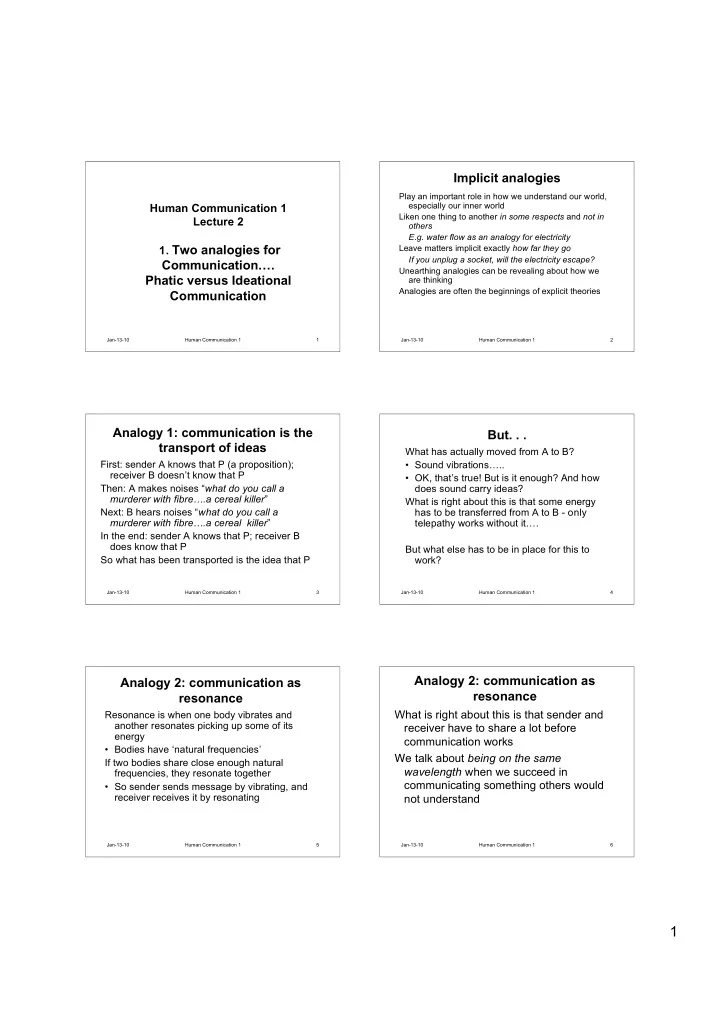
Analogy 1: communication is the transport of ideas

First: sender A knows that P (a proposition); receiver B doesn’t know that P Then: A makes noises “what do you call a murderer with fibre….a cereal killer” Next: B hears noises “what do you call a murderer with fibre….a cereal killer” In the end: sender A knows that P; receiver B does know that P So what has been transported is the idea that P

Jan-13-10 Human Communication 1 4

  • But. . .

What has actually moved from A to B?

  • Sound vibrations…..
  • OK, that’s true! But is it enough? And how

does sound carry ideas? What is right about this is that some energy has to be transferred from A to B - only telepathy works without it…. But what else has to be in place for this to work?

Jan-13-10 Human Communication 1 5

Analogy 2: communication as resonance

Resonance is when one body vibrates and another resonates picking up some of its energy

  • Bodies have ‘natural frequencies’

If two bodies share close enough natural frequencies, they resonate together

  • So sender sends message by vibrating, and

receiver receives it by resonating

Jan-13-10 Human Communication 1 6

Analogy 2: communication as resonance

What is right about this is that sender and receiver have to share a lot before communication works We talk about being on the same wavelength when we succeed in communicating something others would not understand

slide-2
SLIDE 2

2

Jan-13-10 Human Communication 1 7

Phatic vs. ideational communication

These two metaphors both highlight important complimentary aspects of communication – Malinowski, an anthropologist writing in the 1920s introduced the term phatic – Contrasted with ideational communication – Paradigm examples of phatic communication include fashion, ritual – Hard to say what proposition is communicated

Jan-13-10 Human Communication 1 8

Phatic vs. ideational communication

Successful phatic communication creates community Ideational communication transfers propositions

– Telling a joke transfers information but also creates community – Phatic communication may work through ideational communication

Jan-13-10 Human Communication 1 9

Similarities and differences (a)

Both require shared knowledge of codes Both require transmission of energy

  • Resonance metaphor seems particularly apt

for phatic communication

  • Transport of ideas for ideational

But the two are not easily separable - both aspects almost always involved Much human phatic communication depends on complex ideational communication

Jan-13-10 Human Communication 1 10

Similarities and differences (b)

A proposition can be understood without knowing how it fits into the context - phatic communication cannot be decontextualised e.g. the answer to the question: “What did you do this weekend?” would depend on who was asking it - a friend, your mother, the police…. Cognitive science tends to focus on the ideational and background the phatic (sociological approaches do the opposite) though more recent moves to social communication and intelligence But we forget either altogether at our peril

Jan-13-10 Human Communication 1 11

Phatic communication

– A recent name for these is COMMUNITIES OF PRACTICE – The way we do things, the words we use, the knowledge, skills, rights and responsibilities we have, the kinds of people we are, . . . – None of this can succeed without getting ideas across – But merely getting ideas across leaves out the phatic dimension

Jan-13-10 Human Communication 1 12

AL uses computer and voice Week 1 (training)

slide-3
SLIDE 3

3

Jan-13-10 Human Communication 1 13

1 2 3

Designing the Interface - Scanning

Jan-13-10 Human Communication 1 14

“Are you ready?” – Using STANDUP

Jan-13-10 Human Communication 1 15

EM tells AL one of ‘her’ jokes

Jan-13-10 Human Communication 1 16

DA tells punchline

Jan-13-10 Human Communication 1 17

Wider communication to others

Jan-13-10 Human Communication 1 18

Background reading

Standup: Facilitating language play in non- speaking children through computer- supported joke construction http://www.csd.abdn.ac.uk/research/standup/ see the publications page, in particular: Ritchie, G., Manurung, R., Pain, H., Waller, A., Black, R. and O'Mara, D. (2007) A practical application of computational humour. Pp. 91-98 in Proceedings of the 4th International Joint Conference on Computational Creativity, ed. Amilcar Cardoso and Geraint A. Wiggins. London.

slide-4
SLIDE 4

4

Jan-13-10 Human Communication 1 19

  • 2. Levels of representation

in language

Jan-13-10 Human Communication 1 20

A simple model of language use

Utterance:

  • constructed from what speaker wants to convey,
  • interpreted by hearer who reconstructs the

speaker's intended message. Processes involved in language comprehension and understanding can be described in terms of levels of structure: sounds, words, phrases, sentences. Complex processes such as those involved in speech can be decomposed into simpler ones.

Jan-13-10 Human Communication 1 21

Comprehension and production

….may be thought of as inverse processes

  • perating in opposite directions

[oversimplification: there is evidence that comprehension may be simpler that production e.g. in spelling and in learning to speak a second language] Knowledge of language may be thought to be made up of rules for manipulating different levels of structure.

Jan-13-10 Human Communication 1 22

In Comprehension….

  • 1. a sentence is heard (or read)
  • 2. analysed into phonemes (units of sound)

e.g. /f/ /ow/ /n/;

  • 3. phomeme sequence analysed into morphemes

(units of meaning) e.g. 'phon-' '-ing' '-ed';

  • 4. dictionary (lexicon) used to relate these to words;
  • 5. syntactic rules used to analyse phrases and

sentences;

  • 6. semantic rules are used to get meaning;
  • 7. deductive and inferential rules used for

conclusions and to draw inferences from other knowledge.

Jan-13-10 Human Communication 1 23

Simplistic Model….

Whilst this is a simplistic model:

  • serves to suggest the components needed

in designing computer systems and

  • in developing psychological models.

More formally we can structure and analyse language at a number of different levels.

Jan-13-10 Human Communication 1 24

Levels of Structure and Analysis

Phonetics/Phonology: The level of speech sounds. Morphology: The formation of words from their parts. Syntax: The combination of words---grammar. Semantics: The meaning of words, sentences and utterances. Discourse/Pragmatics/Speech Acts: The structure of collections of sentences, the use

  • f language.
slide-5
SLIDE 5

5

Jan-13-10 Human Communication 1 25

Phonetics and Phonology

Phonetics is concerned with the sounds themselves, three perspectives:

  • Articulatory: how we produce them
  • Acoustic: what they are actually like as sound

waves

  • Auditory: how we perceive them

Phonology is about the relation between words and

  • sounds. Consider:

incredible uncouth immoderate impossible unmasked unbelievable innumerate intolerant unnecessary untoward

Jan-13-10 Human Communication 1 26

Phonetics and Phonology

Or consider English plurals: boat---boats (/s/), bag---bags (/z/), wish---wishes (/ez/). This gets even tricker: roof---roofs (/roovz/), wife---wives (/waivz/), wife---wife's (/waifs/). Other suffixes do funny things too: electric (-/ik/)---electricity (-/isitee/) (note the stress moves too), create (-/eit/)---creation (-/aishun/).

Jan-13-10 Human Communication 1 27

Morphology

….addresses the level of structure internal to the word. There are restrictions on the patterns of sound which make up a word:

  • almost all languages compose words from

syllables,

  • with a few exceptions all languages require a
  • ne-to-one correspondance between syllables

and vowels But we can identify meaning-bearing units smaller than words.

Jan-13-10 Human Communication 1 28

Morphology

Inflectional morphology: word forms for different versions of the same underlying word:

  • singular/plural

Usually '-s', sometimes `-ices' (`vertex', `index') or `-i' (`focus') or nothing (`deer'));

  • past/non-past/3rd singular present/present participal

Usually `-ed', nothing, `-s', `-ing', but lots of more or less irregular cases. Compare `quack', `eat', `do' and `is'.

  • basic/comparative/superlative adjectives.

Usually nothing, `-er', `-est' English - very modest in this area Spanish - verbs have about 50 inflected forms, Ancient Greek - 350 Amerindian languages - 10s of 1000s of forms for verbs.

Jan-13-10 Human Communication 1 29

Derivational morphology:

New words from old.

  • 1. Affixation `un-', `re-', `multi-', `-ise', `-able'

Some but not all affixes combine and even iterate e.g. `reunionisation'.

  • 2. Simple juxtaposition
  • without spaces (`toothbrush'),
  • with hyphens (`toothbrush-holder')
  • with spaces (``toothbrush-holder box label loss

enquiry'' or even ``repair manual binder delivery van repair manual . . .''). Different languages have different preferences

Jan-13-10 Human Communication 1 30

Syntax (grammar)

Structuring words into sentences in a given language. Different languages do things differently,

  • all try to organise by a convention of use
  • enables hearers/readers to tell what

speakers/writers meant: Who did what to whom; What goes with what.

slide-6
SLIDE 6

6

Jan-13-10 Human Communication 1 31

Syntax (grammar)

Some languages use word order to manage things: English: Robin kissed Kim I gave the children cold sandwiches French: Robin a baissé Kim Italian: Ho dato ai bambini congelati panini Some languages (also) use adpositions to sort things out: English prepositions: The funeral took place today in Leicester of the two victims . . . Japanese postpositions: Watashi no kodoma wa hon o yomimasu Or languages may use inflection to do the job: Latin: Puell am bon am naut a amat Russian: devochk u horosh uyu matros liubil

Jan-13-10 Human Communication 1 32

Semantics

What do words mean, how is this related to what sentences mean and how utterances are interpreted? Sentences are abstract, names for types of utterances. Utterances are concrete specific examples of actual use, spoken or written, of sentences. Sentences have meaning in the abstract, while utterances have concrete interpretations.

Jan-13-10 Human Communication 1 33

Semantics

Consider the sentence: “Last week I arrived on Tuesday before leaving

  • n Monday.”

This is always false, regardless of when, where and by whom it is uttered. On the other hand the truth or falsity of: “Last week I went to the Picnic Basket three times.” can only be determined on an utterance-by- utterance basis.

Jan-13-10 Human Communication 1 34

Pragmatics: Discourse + Dialogue

How can utterances be used in a discourse or dialogue? Some important aspects of language operate above the single utterance level. Reference in general and pronouns in particular are the most obvious examples: “Robin and Kim went to see 2001 last week. They thought it was great, but the cinema was nearly empty.”

Jan-13-10 Human Communication 1 35

Pragmatics: Discourse + Dialogue

Not just any sequence of question and answer is acceptable or useful in a dialogue. Where you are in a discourse affects how you should say things: “Is there a night flight to London?” “No, the next flight is tomorrow.” “No, but there is a flight to Paris.” Dialogue is in any case much more than just question and answer:

  • how we manage to orchestrate our talk so that we make

the most of the rather narrow channel we share is a major open question.

Jan-13-10 Human Communication 1 36

Speech Acts and Planning

Speaking is an action, performed in service of achieving some goal. “Please open the window.” “When does the next bus leave?” “Do you know the time?” Speech Acts: Requests, Statements, Questions, Commands and Commissives are main types. Commissives: when by right of authority you can make something happen by speaking: “I hereby christen this ship the S.S. Rustbucket.” “You're out!”

slide-7
SLIDE 7

7

Jan-13-10 Human Communication 1 37

Exercises and study (a)

Exercises: Take a communication situation and describe how the phatic and ideational aspects of communication figure in your example situation. e.g. http://www.youtube.com/watch?v=WxB1gB6K-2A What are the difficulties that you encounter in fitting these concepts to your example?

Jan-13-10 Human Communication 1 38

Practicalities: Tutorials

Tutorials start next week

  • Don’t change unilaterally, contact Kendal

in the ITO with proposed swaps You can find your group assignment at

http://www.inf.ed.ac.uk/admin/itodb/mgroups/stus/hc1.html