1 Processes and the Kernel The Kernel Processes and the Kernel - - PDF document

1
SMART_READER_LITE
LIVE PREVIEW

1 Processes and the Kernel The Kernel Processes and the Kernel - - PDF document

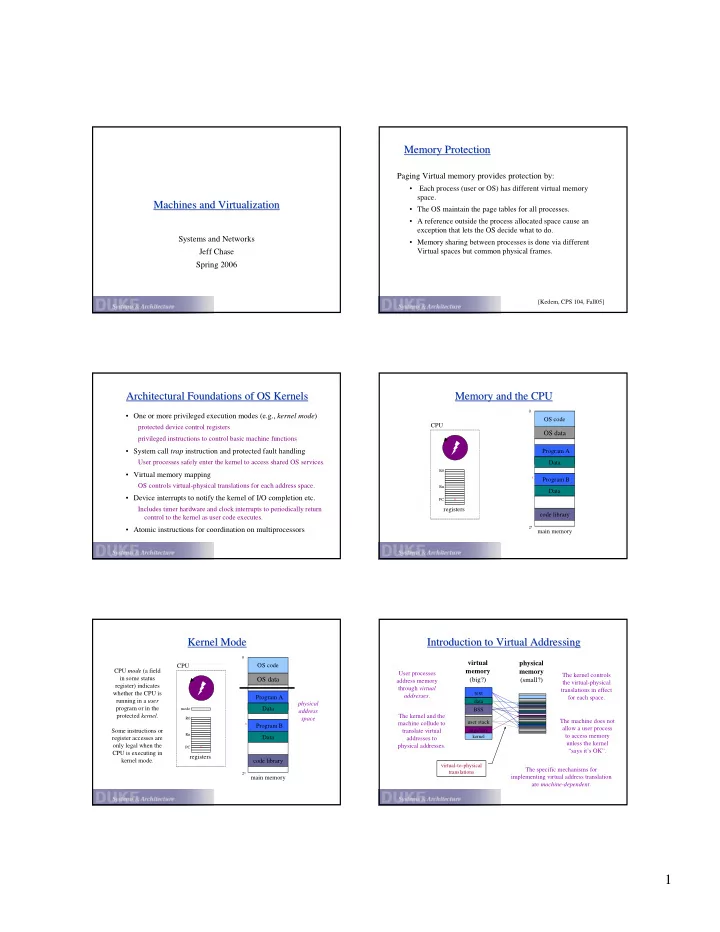
Memory Protection Memory Protection Paging Virtual memory provides protection by: Each process (user or OS) has different virtual memory space. Machines and Virtualization Machines and Virtualization The OS maintain the page tables


slide-1
SLIDE 1

1

Machines and Virtualization Machines and Virtualization

Systems and Networks Jeff Chase Spring 2006

Memory Protection Memory Protection

Paging Virtual memory provides protection by:

  • Each process (user or OS) has different virtual memory

space.

  • The OS maintain the page tables for all processes.
  • A reference outside the process allocated space cause an

exception that lets the OS decide what to do.

  • Memory sharing between processes is done via different

Virtual spaces but common physical frames.

[Kedem, CPS 104, Fall05]

Architectural Foundations of OS Kernels Architectural Foundations of OS Kernels

  • One or more privileged execution modes (e.g., kernel mode)

protected device control registers privileged instructions to control basic machine functions

  • System call trap instruction and protected fault handling

User processes safely enter the kernel to access shared OS services.

  • Virtual memory mapping

OS controls virtual-physical translations for each address space.

  • Device interrupts to notify the kernel of I/O completion etc.

Includes timer hardware and clock interrupts to periodically return control to the kernel as user code executes.

  • Atomic instructions for coordination on multiprocessors

Memory and the CPU Memory and the CPU

2n

code library

OS data

OS code Program A

data

Data Program B Data registers CPU

R0 Rn PC

main memory

x x

Kernel Mode Kernel Mode

2n

code library

OS data

OS code Program A

data

Data Program B Data registers CPU

R0 Rn PC

main memory

x x mode

CPU mode (a field in some status register) indicates whether the CPU is running in a user program or in the protected kernel. Some instructions or register accesses are

  • nly legal when the

CPU is executing in kernel mode. physical address space

Introduction to Virtual Addressing Introduction to Virtual Addressing

text data BSS user stack args/env

kernel

data

virtual memory (big?) physical memory (small?)

virtual-to-physical translations

User processes address memory through virtual addresses. The kernel and the machine collude to translate virtual addresses to physical addresses. The kernel controls the virtual-physical translations in effect for each space. The machine does not allow a user process to access memory unless the kernel “says it’s OK”. The specific mechanisms for implementing virtual address translation are machine-dependent.

slide-2
SLIDE 2

2

Processes and the Kernel Processes and the Kernel

data data

processes in private virtual address spaces system call traps

...and upcalls (e.g., signals)

shared kernel code and data in shared address space Threads or processes enter the kernel for services. The kernel sets up process execution contexts to “virtualize” the machine. CPU and devices force entry to the kernel to handle exceptional events.

The Kernel The Kernel

  • Today, all “real” operating systems have protected kernels.

The kernel resides in a well-known file: the “machine” automatically loads it into memory (boots) on power-on/reset. Our “kernel” is called the executive in some systems (e.g., XP).

  • The kernel is (mostly) a library of service procedures shared

by all user programs, but the kernel is protected:

User code cannot access internal kernel data structures directly, and it can invoke the kernel only at well-defined entry points (system calls).

  • Kernel code is like user code, but the kernel is privileged:

The kernel has direct access to all hardware functions, and defines the machine entry points for interrupts and exceptions.

Protecting Entry to the Kernel Protecting Entry to the Kernel

Protected events and kernel mode are the architectural foundations of kernel-based OS (Unix, XP, etc).

  • The machine defines a small set of exceptional event types.
  • The machine defines what conditions raise each event.
  • The kernel installs handlers for each event at boot time.

e.g., a table in kernel memory read by the machine

The machine transitions to kernel mode

  • nly on an exceptional event.

The kernel defines the event handlers. Therefore the kernel chooses what code will execute in kernel mode, and when.

user kernel

interrupt or exception trap/return

Example: System Call Traps Example: System Call Traps

User code invokes kernel services by initiating system call traps.

  • Programs in C, C++, etc. invoke system calls by linking to a

standard library of procedures written in assembly language.

the library defines a stub or wrapper routine for each syscall stub executes a special trap instruction (e.g., chmk or callsys or int) syscall arguments/results passed in registers or user stack

read() in Unix libc.a library (executes in user mode): #define SYSCALL_READ 27 # code for a read system call move arg0…argn, a0…an # syscall args in registers A0..AN move SYSCALL_READ, v0 # syscall dispatch code in V0 callsys # kernel trap move r1, _errno # errno = return status return Alpha CPU architecture

Faults Faults

Faults are similar to system calls in some respects:

  • Faults occur as a result of a process executing an instruction.

Fault handlers execute on the process kernel stack; the fault handler may block (sleep) in the kernel.

  • The completed fault handler may return to the faulted context.

But faults are different from syscall traps in other respects:

  • Syscalls are deliberate, but faults are “accidents”.

divide-by-zero, dereference invalid pointer, memory page fault

  • Not every execution of the faulting instruction results in a fault.

may depend on memory state or register contents

The Role of Events The Role of Events

A CPU event is an “unnatural” change in control flow.

Like a procedure call, an event changes the PC. Also changes mode or context (current stack), or both. Events do not change the current space!

The kernel defines a handler routine for each event type.

Event handlers always execute in kernel mode. The specific types of events are defined by the machine.

Once the system is booted, every entry to the kernel occurs as a result of an event.

In some sense, the whole kernel is a big event handler.

slide-3
SLIDE 3

3

CPU Events: Interrupts and Exceptions CPU Events: Interrupts and Exceptions

An interrupt is caused by an external event.

device requests attention, timer expires, etc.

An exception is caused by an executing instruction.

CPU requires software intervention to handle a fault or trap. unplanned deliberate sync fault syscall trap async interrupt AST

control flow event handler (e.g., ISR: Interrupt Service Routine)

exception.cc

AST: Asynchronous System Trap Also called a software interrupt or an Asynchronous or Deferred Procedure Call (APC or DPC) Note: different “cultures” may use some of these terms (e.g., trap, fault, exception, event, interrupt) slightly differently.

Mode, Space, and Context Mode, Space, and Context

At any time, the state of each processor is defined by:

  • 1. mode: given by the mode bit

Is the CPU executing in the protected kernel or a user program?

  • 2. space: defined by V->P translations currently in effect

What address space is the CPU running in? Once the system is booted, it always runs in some virtual address space.

  • 3. context: given by register state and execution stream

Is the CPU executing a thread/process, or an interrupt handler? Where is the stack?

These are important because the mode/space/context determines the meaning and validity of key operations.

The Virtual Address Space The Virtual Address Space

A typical process VAS space includes:

  • user regions in the lower half

V->P mappings specific to each process accessible to user or kernel code

  • kernel regions in upper half

shared by all processes, but accessible only to kernel code

  • NT (XP?) on x86 subdivides kernel region into an

unpaged half and a (mostly) paged upper half at 0xC0000000 for page tables and I/O cache.

  • Win95/98 uses the lower half of system space as a

system-wide shared region.

text data BSS user stack args/env data kernel text and kernel data

2n-1 2n-1 0x0 0xffffffff

A VAS for a private address space system (e.g., Unix, NT/XP) executing on a typical 32-bit system (e.g., x86).

sbrk() jsr

Process and Kernel Address Spaces Process and Kernel Address Spaces

data

2n-1-1 2n-1 2n-1

data

0x7FFFFFFF 0x80000000 0xFFFFFFFF 0x0

n-bit virtual address space 32-bit virtual address space

The OS Directs the MMU The OS Directs the MMU

The OS controls the operation of the MMU to select:

(1) the subset of possible virtual addresses that are valid for each process (the process virtual address space); (2) the physical translations for those virtual addresses; (3) the modes of permissible access to those virtual addresses;

read/write/execute

(4) the specific set of translations in effect at any instant.

need rapid context switch from one address space to another

MMU completes a reference only if the OS “says it’s OK”.

MMU raises an exception if the reference is “not OK”.

Virtual Address Translation Virtual Address Translation

VPN

  • ffset

29 13

Example: typical 32-bit architecture with 8KB pages.

address translation

Virtual address translation maps a virtual page number (VPN) to a physical page frame number (PFN): the rest is easy.

PFN

  • ffset

+

00 virtual address physical address{ Deliver exception to OS if translation is not valid and accessible in requested mode.

slide-4
SLIDE 4

4

Completing a VM Reference Completing a VM Reference

raise exception probe page table load TLB probe TLB access physical memory access valid? page fault? signal process allocate frame page on disk? fetch from disk zero-fill load TLB

start here MMU OS

Virtual Memory as a Cache Virtual Memory as a Cache

text data idata wdata header symbol table, etc. program sections text data BSS user stack args/env

kernel

data process segments physical page frames

virtual memory (big) physical memory (small) executable file backing storage

virtual-to-physical translations

pageout/eviction page fetch

Wrapping Up Wrapping Up

There is lots more to say about address translation, but we don’t want to spend too much time on it now.

  • On NT/x86, each address space has a page directory
  • One page: 4K bytes, 1024 4-byte entries (PTEs)
  • Each PDIR entry points to a “page table”
  • Each “page table” is one page with 1024 PTEs
  • each PTE maps one 4K page of the address space
  • Each page table maps 4MB of memory: 1024*4K
  • One PDIR for a 4GB address space, max 4MB of tables
  • Load PDIR base address into a register to activate the VAS

What did we just do? What did we just do?

We used special machine features to “virtualize” a core resource: memory.

  • Each process/space only gets some of the memory.
  • The OS decides how much you get.
  • The OS decides what parts of the program and its data are in

memory, and what parts you will have to wait for.

  • You can’t tell exactly what you have.
  • The OS isolates each process from its competitors.

Virtualization involves a clean abstract interface with a level

  • f indirection that enables the system to interpose on

important actions, securely and transparently, in order to cover up ugly details of the environment.

Sharing the CPU Sharing the CPU

We have seen how an operating system can share and “virtualize” one hardware resource: memory. How can does an OS share the CPU among multiple running programs (processes)?

  • Safely
  • Fairly (?)
  • Efficiently

Sharing Disks Sharing Disks

How should the OS mediate/virtualize/share the disk(s) among multiple users or programs?

  • Safely
  • Fairly
  • Securely
  • Efficiently
  • Effectively
  • Robustly
slide-5
SLIDE 5

5

Classical View: The Questions Classical View: The Questions

The basic issues/questions in this course are how to:

  • allocate memory and storage to multiple programs?
  • share the CPU among concurrently executing programs?
  • suspend and resume programs?
  • share data safely among concurrent activities?
  • protect one executing program’s storage from another?
  • protect the code that implements the protection, and

mediates access to resources?

  • prevent rogue programs from taking over the machine?
  • allow programs to interact safely?

A Simple Page Table A Simple Page Table

PFN 0 PFN 1 PFN i

page #i

  • ffset

user virtual address

PFN i +

  • ffset

process page table physical memory page frames

In this example, each VPN j maps to PFN j, but in practice any physical frame may be used for any virtual page.

Each process/VAS has its own page table. Virtual addresses are translated relative to the current page table. The page tables are themselves stored in memory; a protected register holds a pointer to the current page table.

Page Tables (2) Page Tables (2)

32 bit address with 2 page table fields Two-level page tables

Second-level page tables Top-level page table

[from Tanenbaum]