1 How are embedded systems different Timing and Concurrency than - - PDF document

1
SMART_READER_LITE
LIVE PREVIEW

1 How are embedded systems different Timing and Concurrency than - - PDF document

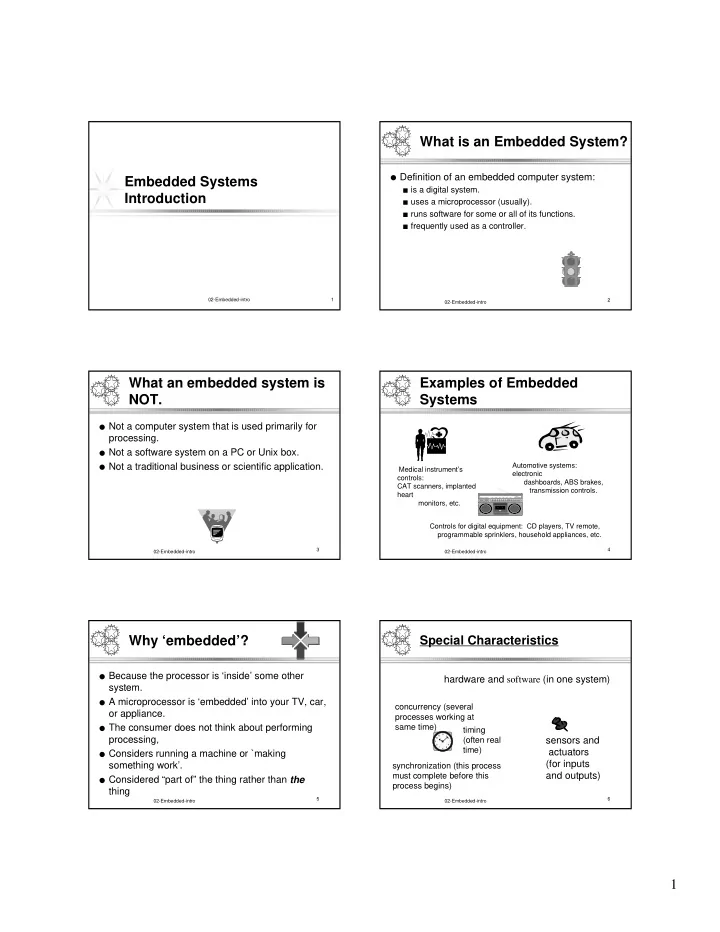
What is an Embedded System? Definition of an embedded computer system: Embedded Systems is a digital system. Introduction uses a microprocessor (usually). runs software for some or all of its functions. frequently used as a


slide-1
SLIDE 1

1

02-Embedded-intro 1

Embedded Systems Introduction

2 02-Embedded-intro

What is an Embedded System?

  • Definition of an embedded computer system:

■ is a digital system. ■ uses a microprocessor (usually). ■ runs software for some or all of its functions. ■ frequently used as a controller.

3 02-Embedded-intro

What an embedded system is NOT.

  • Not a computer system that is used primarily for

processing.

  • Not a software system on a PC or Unix box.
  • Not a traditional business or scientific application.

4 02-Embedded-intro

Examples of Embedded Systems

Automotive systems: electronic dashboards, ABS brakes, transmission controls. Medical instrument’s controls: CAT scanners, implanted heart monitors, etc. Controls for digital equipment: CD players, TV remote, programmable sprinklers, household appliances, etc.

5 02-Embedded-intro

Why ‘embedded’?

  • Because the processor is ‘inside’ some other

system.

  • A microprocessor is ‘embedded’ into your TV, car,
  • r appliance.
  • The consumer does not think about performing

processing,

  • Considers running a machine or `making

something work’.

  • Considered “part of” the thing rather than the

thing

6 02-Embedded-intro

Special Characteristics

hardware and software (in one system) sensors and actuators (for inputs and outputs)

synchronization (this process must complete before this process begins) timing (often real time) concurrency (several processes working at same time)

slide-2
SLIDE 2

2

7 02-Embedded-intro

Timing and Concurrency

Engine shaft angle Fire Injectors Fire Spark Watch Emissions

8 02-Embedded-intro

How are embedded systems different than traditional software?

  • Responding to sensors (Was this button

pushed?)

  • Turning on actuators (Turn on power to the

boiler.)

  • Real-time (Respond to temperature change

within 3 seconds.)

9 02-Embedded-intro

Differences between ES and traditional software development

  • Not dealing with only sequential code.
  • Routine can stop at completion or in response to

an external event.

  • Many parts of system might be running

concurrently.

  • Safety-critical component of many systems.

10 02-Embedded-intro

Small and Many!

  • Most embedded systems use 4-, 8-, or 16-bit processors.

32-bit used for intensive applications like printer controls.

  • 8-bit processors have about 64K of memory, that limits

amount of code.

  • “By 1990 a total of about 45 million recognizable computers (i.e., PCs,

Macintosh, even CP/M systems) were in place. Yet over 1 billion microprocessors and microcontrollers were shipped in that year alone!”

Ganssle, J. The Art of Programming Embedded Systems Academic Press, 1992, San Diego, Cal.

11 02-Embedded-intro

hardware or

✂✁☎✄✝✆✂✞✠✟☛✡✌☞ ?
  • Where to place functionality?

■ ex: A Sort algorithm

◆ Faster in hardware, but more expensive. ◆ More flexible in software but slower. ◆ Other examples?

  • Must be able to explore these various trade-offs:

■ Cost. ■ Speed. ■ Reliability. ■ Form (size, weight, and power constraints.) 12 02-Embedded-intro

hardware/software Codesign or ‘Codesign’

  • Model the hardware and the software system in a

unified approach.

  • Use similar design models.
  • Need for ‘model continuity’ spanning levels of the

design process.

slide-3
SLIDE 3

3

13 02-Embedded-intro

Traditional Embedded System Development Approach

  • Decide on the hardware
  • Give the chip to the software people.
  • Software programmer must make software ‘fit’ on

the chip and only use that hardware’s capabilities.

14 02-Embedded-intro

Increased Complexity

  • Systems are becoming more and more complex.
  • Harder to think about total design.
  • Harder to fix ‘bugs.’
  • Harder to maintain systems over time.
  • Therefore, the traditional development process

has to change,

15 02-Embedded-intro

Less Time to Develop

  • In embedded electronics, the total design cycle must

decrease.

  • Historically, design for automotive electronic systems

takes 3-5 years to develop.

  • Must become a 1-3 year development cycle.
  • Must still be reliable and safe.
  • B. Wilkie, R. Frank and J. Suchyta - Motorola Semiconductor Products Sectors, ‘Silicon or Software: The Foundation of

Automotive Electronics’, IEEE Vehicular Tech., August 95.

16 02-Embedded-intro

Solutions to Complexity:

  • Need to keep design process abstract for a longer

period of time.

  • Decomposable hierarchy (object-oriented).
  • Reuse previous designs:

■ When a design changes, reuse similar sections. ■ Don’t throw away last year’s design and start from scratch!

  • Automated verification systems.

17 02-Embedded-intro

Example: Fly-by-Wire Airplane

  • How would you start to think about developing this

complex/large system?

  • What are potential problems with deciding on the

hardware right away?

  • What are possible concurrent systems needs?
  • What type of timing constraints might be needed?

18 02-Embedded-intro

Fly-by-Wire Airplane Continued

  • What would be the sensors and actuators of this

system?

  • How concerned should developers be about the

safety of the system?

  • Would testing be enough?