1 Step 4: Repair the Problem Step 5: Test Solution Obvious, but - - PDF document

1
SMART_READER_LITE
LIVE PREVIEW

1 Step 4: Repair the Problem Step 5: Test Solution Obvious, but - - PDF document

Introduction Debugging is methodical process for removing The Game Development mistakes in program So important, whole set of tools to help. Process: Called debuggers Trace code, print values, profile Debugging New


slide-1
SLIDE 1

1

The Game Development Process: Debugging Introduction

 Debugging is methodical process for removing

mistakes in program

 So important, whole set of tools to help.

Called “debuggers”

 Trace code, print values, profile  New Integrated Development Environments

g p (IDEs) (such as Game Maker) have it built in  But debugging still frustrating

 Beginners not know how to proceed  Even advanced can get “stuck”

 Don’t know how long takes to find

 Variance can be high

 What are some tips? What method can be

applied?

Outline

5-step debugging process Prevention Game Maker specifics D b

i ti

Debugging tips

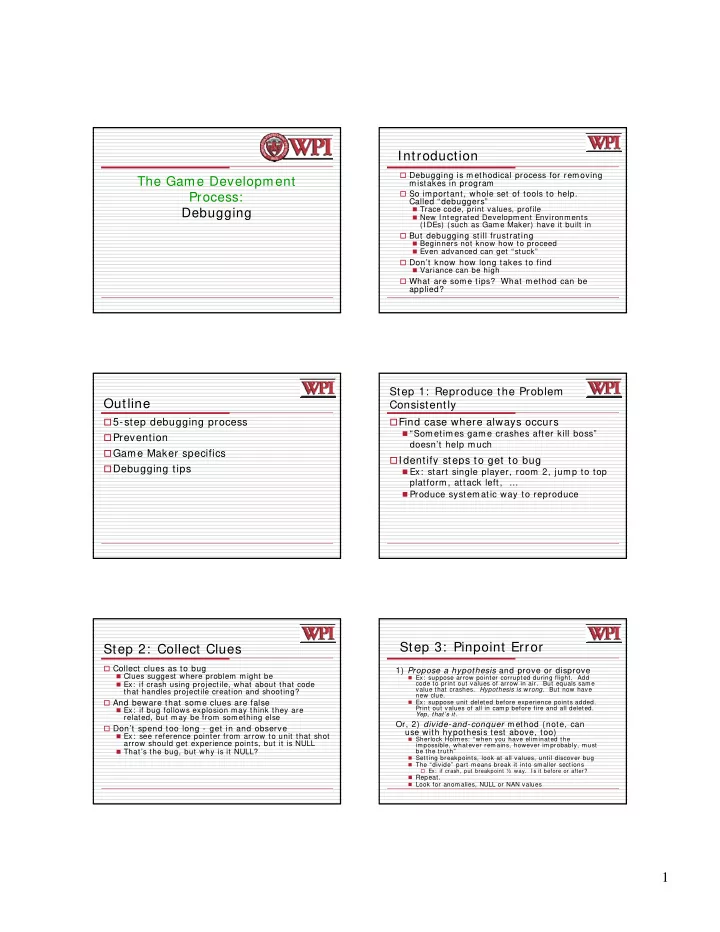
Step 1: Reproduce the Problem Consistently

Find case where always occurs

 “Sometimes game crashes after kill boss”

doesn’t help much Identify steps to get to bug

g g

 Ex: start single player, room 2, jump to top

platform, attack left, …

 Produce systematic way to reproduce

Step 2: Collect Clues

 Collect clues as to bug

 Clues suggest where problem might be  Ex: if crash using projectile, what about that code

that handles projectile creation and shooting?  And beware that some clues are false

 Ex: if bug follows explosion may think they are  Ex: if bug follows explosion may think they are

related, but may be from something else  Don’t spend too long - get in and observe

 Ex: see reference pointer from arrow to unit that shot

arrow should get experience points, but it is NULL

 That’s the bug, but why is it NULL?

Step 3: Pinpoint Error

1) Propose a hypothesis and prove or disprove

 Ex: suppose arrow pointer corrupted during flight. Add

code to print out values of arrow in air. But equals same value that crashes. Hypothesis is wrong. But now have new clue.

 Ex: suppose unit deleted before experience points added.

Print out values of all in camp before fire and all deleted. p Yep, that’s it.

Or, 2) divide-and-conquer method (note, can use with hypothesis test above, too)

 Sherlock Holmes: “when you have eliminated the

impossible, whatever remains, however improbably, must be the truth”

 Setting breakpoints, look at all values, until discover bug  The “divide” part means break it into smaller sections

 Ex: if crash, put breakpoint ½ way. I s it before or after?

 Repeat.  Look for anomalies, NULL or NAN values

slide-2
SLIDE 2

2

Step 4: Repair the Problem

 Propose solution. Exact solution depends

upon stage of problem.

 Ex: late in code cannot change data structures.

Too many other parts use.

 Worry about “ripple” effects.

Id ll t i i l d t fi

 Ideally, want original coder to fix

 If not possible, at least try to talk with original

coder for insights.  Consider other similar cases, even if not yet

reported

 Ex: other projectiles may cause same problem

as arrows did

Step 5: Test Solution

Obvious, but can be overlooked if

programmer is sure they have fix (but programmer can be wrong!)

So, test that solution repairs bug So, test that solution repairs bug

 Best by independent tester

Test if other bugs introduced (beware

“ripple” effect)

Outline

5-step debugging process (done) Prevention

(next)

Game Maker specifics D b

i ti

Debugging tips

Debugging Prevention

 Add infrastructure, tools to assist

 Alter game variables on fly (speed up debugging)  Visual diagnostics (maybe on avatars)  Log data (events, units, code, time stamps)

 Indent code, use comments (in Game Maker)  Indent code, use comments (in Game Maker)  Use consistent style, variable names

 Ex: spr_boss, obj_boss

 Avoid duplicating code – hard to fix if bug

 Use a script

 Avoid hard-coded values – makes brittle  Always initialize variables when declared  Verify coverage (test all code) when testing

Outline

5-step debugging process (done) Prevention

(done)

Game Maker specifics

(next)

D b

i ti

Debugging tips

Game Maker – Print Messages

Display a Message

 object  main2  info

Or, in code (control  code)

 show_message(“Executed this code“)  show message(“num:“ + string(num here))  show_message( num: + string(num_here))

Beware if done every step!

 Save code ahead of time  Use task manager to kill

 Ctrl-Alt-Delete  Task Manager  Process is name of game file, not

GameMaker.exe

slide-3
SLIDE 3

3

Game Maker – Debug Mode

 Ex: easy  obj_hero.y  obj_hero.can_shoot

  • Save/load
  • Look at instances, global

variables, local variables

  • Execute code
  • Set speed

Game Maker – Print Debug Messages

 Like show_message()

but in debug mode

  • nly

 Note, doesn’t pause

 In code

 show_debug_message

(“Executed this code“)  Need to run in debug

mode

 Debug information  Tools  Show messages

Game Maker – Log Messages

 Write messages to file  Example:

 At beginning (maybe create log object)

 global.log_name = “logfile“;

global.fid = file text open write(global.log name); _ _ p _ (g g_ );

 Then, where needed:

 file_text_write_string(global.fid,”Debug message here”) ;

 Close when done (object  event other  game

end):

 file_text_close(global.fid)

 More file operations (look online) possible

 Note: files also useful for save/ load game, etc.

Game Maker – Script/ Code Syntax

Game Maker – Error Messages (1 of 2)

Pay attention! Refers to:

  • Object

 Help pinpoint problem

 Refer to object and method and offending code

  • Object
  • Event
  • Line number
  • Variable name

Game Maker – Error Messages (2 of 2)

 Can write messages

to log file

 Can ignore messages

 Use “error_last” and

“ d” f “error_occurred” for custom handling

 Typically, use only

in release

slide-4
SLIDE 4

4

Debugging Tips (1 of 3)

 One thing at a time

 Fix one thing at a time – don’t try to fix multiple

problems

 Change one thing at a time – test hypothesis.

Change back if doesn’t fix problem. St t ith i l th t k th dd

 Start with simpler case that works - then add more

complex code, one thing at a time  Question your assumptions – don’t even assume

simple stuff works, or “mature” products

 Ex: libraries and tutorials can have bugs

Debugging Tips (2 of 3)

 Check code recently changed – if bug appears,

may be in latest code (not even yours!)

 Use debugger – breakpoints, memory

watches, stack …

 B eak comple calc lations into steps

ma

 Break complex calculations into steps – may

be equation that is at fault or “cast” badly

 Check boundary conditions – classic “off by

  • ne” for loops, etc.

 Minimize randomness –

 Ex: can be caused by random seed or player

  • input. Fix input (script player) so reproducible

Debugging Tips (3 of 3)

 Take a break – too close, can’t see it. Remove

to provide fresh prospective

 Explain bug to someone else – helps retrace

steps, and others provide alternate hypotheses hypotheses

 Debug with partner – provides new techniques

 Same advantage with code reviews, peer

programming  Get outside help – tech support for consoles,

Web examples, libraries, …