1 Case study 1 Case study 2 Problem Problem Sort a huge - - PDF document

1
SMART_READER_LITE
LIVE PREVIEW

1 Case study 1 Case study 2 Problem Problem Sort a huge - - PDF document

Sorting applications Sorting algorithms are essential in a broad variety of applications Organize an MP3 library. Display Google PageRank results. Advanced Topics in Sorting List RSS news items in reverse chronological order. Find


slide-1
SLIDE 1

1 Advanced Topics in Sorting

anhtt-fit@mail.hut.edu.vn dungct@it-hut.edu.vn

http://www.4shared.com/file/79096214/fb2ed224/lect01.html

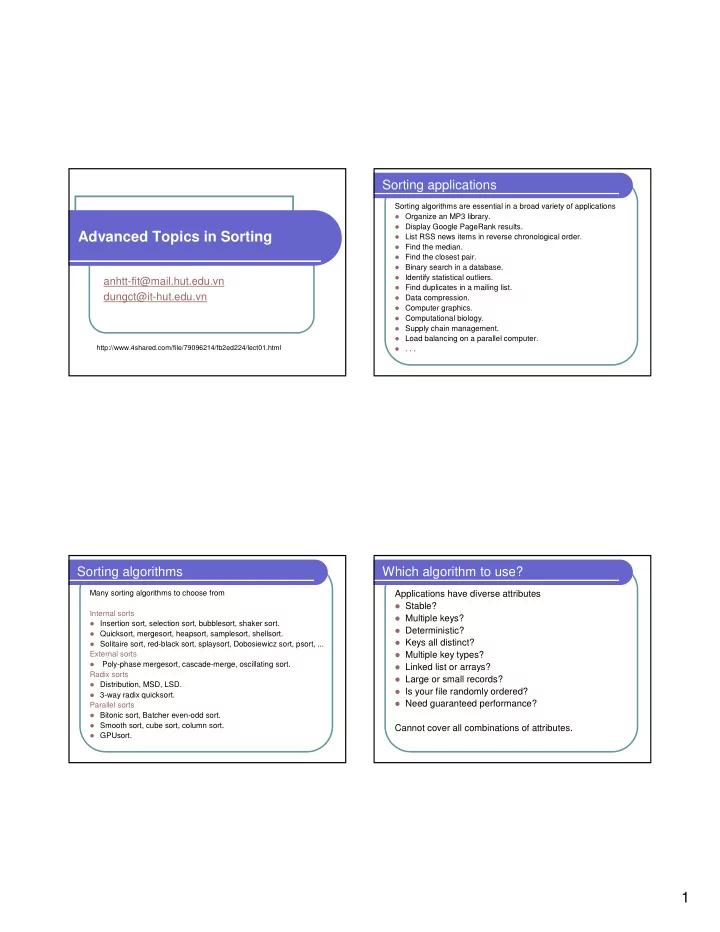
Sorting applications

Sorting algorithms are essential in a broad variety of applications

Organize an MP3 library. Display Google PageRank results. List RSS news items in reverse chronological order. Find the median. Find the closest pair. Binary search in a database. Identify statistical outliers. Find duplicates in a mailing list. Data compression. Computer graphics. Computational biology. Supply chain management. Load balancing on a parallel computer. . . .

Sorting algorithms

Many sorting algorithms to choose from Internal sorts

Insertion sort, selection sort, bubblesort, shaker sort. Quicksort, mergesort, heapsort, samplesort, shellsort. Solitaire sort, red-black sort, splaysort, Dobosiewicz sort, psort, ...

External sorts

  • Poly-phase mergesort, cascade-merge, oscillating sort.

Radix sorts

Distribution, MSD, LSD. 3-way radix quicksort.

Parallel sorts

Bitonic sort, Batcher even-odd sort. Smooth sort, cube sort, column sort. GPUsort.

Which algorithm to use?

Applications have diverse attributes

Stable? Multiple keys? Deterministic? Keys all distinct? Multiple key types? Linked list or arrays? Large or small records? Is your file randomly ordered? Need guaranteed performance?

Cannot cover all combinations of attributes.

slide-2
SLIDE 2

2

Case study 1

Problem

  • Sort a huge randomly-ordered file of small

records. Example

  • Process transaction records for a phone

company. Which sorting method to use?

1.

Quicksort: YES, it's designed for this problem

2.

Insertion sort: No, quadratic time for randomly-

  • rdered files

3.

Selection sort: No, always takes quadratic time

Case study 2

Problem

  • Sort a huge file that is already almost in
  • rder.

Example

  • Re-sort a huge database after a few

changes. Which sorting method to use?

1.

Quicksort: probably no, insertion simpler and faster

2.

Insertion sort: YES, linear time for most definitions

  • f "in order"

3.

Selection sort: No, always takes quadratic time

Case study 3

Problem: sort a file of huge records with tiny keys. Ex: reorganizing your MP3 files. Which sorting method to use?

1.

Mergesort: probably no, selection sort simpler and faster

2.

Insertion sort: no, too many exchanges

3.

Selection sort: YES, linear time under reasonable assumptions Ex: 5,000 records, each 2 million bytes with 100-byte keys.

  • Cost of comparisons: 100 x 50002 / 2 = 1.25 billion
  • Cost of exchanges: 2,000,000 x 5,000 = 10 trillion
  • Mergesort might be a factor of log (5000) slower.

Duplicate keys

Often, purpose of sort is to bring records with duplicate keys together.

Sort population by age. Finding collinear points. Remove duplicates from mailing list. Sort job applicants by college attended.

Typical characteristics of such applications.

Huge file. Small number of key values.

Mergesort with duplicate keys: always ~ N lg N compares Quicksort with duplicate keys

algorithm goes quadratic unless partitioning stops on equal keys! 1990s Unix user found this problem in qsort()

slide-3
SLIDE 3

3

Exercise: Create Sample Data

Write a program that generates more than 1

million integer numbers. These number are in range of 40 different discrete values.

3-Way Partitioning

3-way partitioning. Partition elements into 3 parts:

Elements between i and j equal to partition

element v.

No larger elements to left of i. No smaller elements to right of j.

Scope for improvements- duplicate keys

A 3-way partitioning method

10 19 10 3 10 17 2 10 13 5 10 1

Pivot

Scope for improvements- duplicate keys

A 3-way partitioning method

10 19 10 3 10 17 2 10 13 5 10 1

Pivot

Equal to pivot, push to left

slide-4
SLIDE 4

4

Scope for improvements- duplicate keys

A 3-way partitioning method

10 19 10 3 10 17 2 10 13 5 1 10

Pivot

Scope for improvements- duplicate keys

A 3-way partitioning method

10 19 10 3 10 17 2 10 13 5 1 10

Pivot

Scope for improvements- duplicate keys

A 3-way partitioning method

10 19 10 3 10 17 2 10 13 5 1 10

Pivot

Stop moving from left, an element greater than pivot is found

Scope for improvements- duplicate keys

A 3-way partitioning method

10 19 10 3 10 17 2 10 13 5 1 10

Pivot

Equal to pivot, push to right

slide-5
SLIDE 5

5

Scope for improvements- duplicate keys

A 3-way partitioning method

10 10 19 3 10 17 2 10 13 5 1 10

Pivot

Scope for improvements- duplicate keys

A 3-way partitioning method

10 10 19 3 10 17 2 10 13 5 1 10

Pivot

Stop moving from right, an element less than than pivot is found

Scope for improvements- duplicate keys

A 3-way partitioning method

10 10 19 3 10 17 2 10 13 5 1 10

Pivot

Exchange

Scope for improvements- duplicate keys

A 3-way partitioning method

10 10 19 13 10 17 2 10 3 5 1 10

Pivot

Repeating the process till red & blue arrows crosses each other…

slide-6
SLIDE 6

6

Scope for improvements- duplicate keys

A 3-way partitioning method

10 10 10 13 19 17 2 1 3 5 10 10

Pivot

We reach here………

Scope for improvements- duplicate keys

A 3-way partitioning method

10 10 10 13 19 17 2 1 3 5 10 10

Pivot

Exchange the pivot with red arrow content, we get…

Scope for improvements- duplicate keys

A 3-way partitioning method

17 10 10 13 19 10 2 1 3 5 10 10

Pivot Moving left to the pivot

Scope for improvements- duplicate keys

A 3-way partitioning method

17 10 10 13 19 10 10 10 3 5 2 1

Pivot Moving right to the pivot

slide-7
SLIDE 7

7

Scope for improvements- duplicate keys

A 3-way partitioning method

17 13 19 10 10 10 10 10 3 5 2 1

Partition- 2 Partition- 1 Partition- 3

Scope for improvements- duplicate keys

A 3-way partitioning method

17 13 19 10 10 10 10 10 3 5 2 1

Partition- 2 Partition- 1 Partition- 3

  • Apply Quick sort to partition-1 and partition-3, recursively……
  • What if all the elements are same in the given array??????????
  • Try to implement it….

Implementation solution

3-way partitioning (Bentley- McIlroy): Partition elements into 4 parts:

no larger elements to left of i no smaller elements to right

  • f j

equal elements to left of p equal elements to right of q

Afterwards, swap equal keys into center.

Code

void sort(int a[], int l, int r) { if (r <= l) return; int i = l-1, j = r; int p = l-1, q = r; while(1) { while (a[++i] < a[r])); while (a[r] < a[--j])) if (j == l) break; if (i >= j) break; exch(a, i, j); if (a[i]==a[r]) exch(a, ++p, i); if (a[j]==a[r]) exch(a, --q, j); } exch(a, i, r); j = i - 1; i = i + 1; for (int k = l ; k <= p; k++) exch(a, k, j--); for (int k = r-1; k >= q; k--) exch(a, k, i++); sort(a, l, j); sort(a, i, r); }

v l r v r j i l r = v > v < v

slide-8
SLIDE 8

8

Demo

demo-partition3.ppt

Quiz 1

Write two quick sort algorithms

2-way partitioning 3-way partitioning

Create two identical arrays of 1 millions

randomized numbers having value from 1 to 10.

Compare the time for sorting the numbers

using each algorithm

Guide

Fill an array by random numbers const int TOPITEM = 1000000; void fill_array(void) { int i; float r; srand(time(NULL)); for (i = 1; i < TOPITEM; i++) { r = (float) rand() / (float) RAND_MAX; data[i] = r * RANGE + 1; } }

Demand memory

For 1000000 elements int *w=(int *)malloc(1000000);

slide-9
SLIDE 9

9

CPU Time Inquiry

#include <time.h> clock_t start, end; double cpu_time_used; start = clock(); ... /* Do the work. */ end = clock(); cpu_time_used = ((double) (end - start)) / CLOCKS_PER_SEC;

Generalized sorting

In C we can use the qsort function for sorting

void qsort( void *buf, size_t num, size_t size, int (*compare)(void const *, void const *) );

The qsort() function sorts buf (which contains num items, each of

size size).

The compare function is used to compare the items in buf.

compare should return negative if the first argument is less than the second, zero if they are equal, and positive if the first argument is greater than the second.

Example

int int_compare(void const* x, void const *y) { int m, n; m = *((int*)x); n = *((int*)y); if ( m == n ) return 0; return m > n ? 1: -1; } void main() { int a[20], n; /* input an array of numbers */ /* call qsort */ qsort(a, n, sizeof(int), int_compare); }

Function pointer

Declare a pointer to a function

int (*pf) (int);

Declare a function

int f(int);

Assign a function to a function pointer

pf = &f;

Call a function via pointer

ans = pf(5); // which are equivalent with ans = f(5)

In the qsort() function, compare is a function

pointer to reference to a compare the items

slide-10
SLIDE 10

10

Quiz 2

Write a function to compare strings so that it

can be used with qsort() function

Write a program to input a list of names, then

use qsort() to sort this list and display the result.

Solution

#include <stdio.h> #include <stdlib.h> #include <string.h> int cstring_cmp(const void *a, const void *b) { const char **ia = (const char **)a; const char **ib = (const char **)b; return strcmp(*ia, *ib); } void print_cstring_array(char **array, size_t len) { size_t i; for(i=0; i<len; i++) printf("%s | ", array[i]); putchar('\n'); }

Solution

int main() { char *strings[] = { "Zorro", "Alex", "Celine", "Bill", "Forest", "Dexter" }; size_t strings_len = sizeof(strings) / sizeof(char *); puts("*** String sorting..."); print_cstring_array(strings, strings_len); qsort(strings, strings_len, sizeof(char *), cstring_cmp); print_cstring_array(strings, strings_len); return 0; }

Solution: You can get strings from input also

int main() { char strings[20]; char *strings_array[20]; int i = 0; int n; printf("\n Number of strings to sort:"); scanf("%d",&n); fflush(stdin); while(i<n){ gets(strings); strings_array[i++] = strdup(strings); } print_cstring_array(strings_array, n); puts("*** String sorting..."); qsort(strings_array, n, sizeof(char *), cstring_cmp); print_cstring_array(strings_array, n); return 0; }

slide-11
SLIDE 11

11

Quiz 3: Using qsort with array of structure

Create an array of records, each record is in

type of: struct st_ex { char product[16]; float price; };

Write a program using qsort to sort this array

by the price and by product names.

Solution

Create on your own function to compare two

float numbers int struct_cmp_by_price(const void *a, const void *b) { struct st_ex *ia = (struct st_ex *)a; struct st_ex *ib = (struct st_ex *)b; return (int)(100.f*ia->price - 100.f*ib->price); }

Solution

And by product names int struct_cmp_by_product(const void *a, const void *b) { struct st_ex *ia = (struct st_ex *)a; struct st_ex *ib = (struct st_ex *)b; return strcmp(ia->product, ib->product); }

Solution: function for Output

void print_struct_array(struct st_ex *array, size_t len) { size_t i; for(i=0; i<len; i++) printf("[ product: %s \t price: $%.2f ]\n", array[i].product, array[i].price); puts("--"); }

slide-12
SLIDE 12

12

Solution: And test

void main() { struct st_ex structs[] = {{"mp3 player", 299.0f}, {"plasma tv", 2200.0f}, {"notebook", 1300.0f}, {"smartphone", 499.99f}, {"dvd player", 150.0f}, {"matches", 0.2f }}; size_t structs_len = sizeof(structs) / sizeof(struct st_ex); puts("*** Struct sorting (price)..."); print_struct_array(structs, structs_len); qsort(structs, structs_len, sizeof(struct st_ex), struct_cmp_by_price); print_struct_array(structs, structs_len); puts("*** Struct sorting (product)..."); qsort(structs, structs_len, sizeof(struct st_ex), struct_cmp_by_product); print_struct_array(structs, structs_len); }

Quiz 4

How to use qsort() to sort an array in

descendant order?

Write your own generalized quick sort function

(using 3-way partitioning algorithm).

Then, use this function to sort different kinds of

data (integer numbers, phone number records, etc.)

Generalized sorting

We can use also heap sort and merge sort void heapsort( void *buf, size_t num, size_t size, int (*compare)(void const *, void const *) ); void mergesort( void *buf, size_t num, size_t size, int (*compare)(void const *, void const *) );

Exercise

Using the grade data file of your class last

semester.

You write a compare function that takes the

pointers to struct of student as parameters to use qsort to sort the student list.

Change from qsort to heapsort