1 Naval Station Norfolk is Hampton Roads Regions largest employer - - PowerPoint PPT Presentation

1 naval station norfolk is hampton roads region s largest
SMART_READER_LITE
LIVE PREVIEW

1 Naval Station Norfolk is Hampton Roads Regions largest employer - - PowerPoint PPT Presentation

Naval Station Norfolk Transit Extension Study January 7, 2015 1 Naval Station Norfolk is Hampton Roads Regions largest employer with approximately 60-70,000 jobs and employees from the entire Region Higher Distribution Higher Employment


slide-1
SLIDE 1

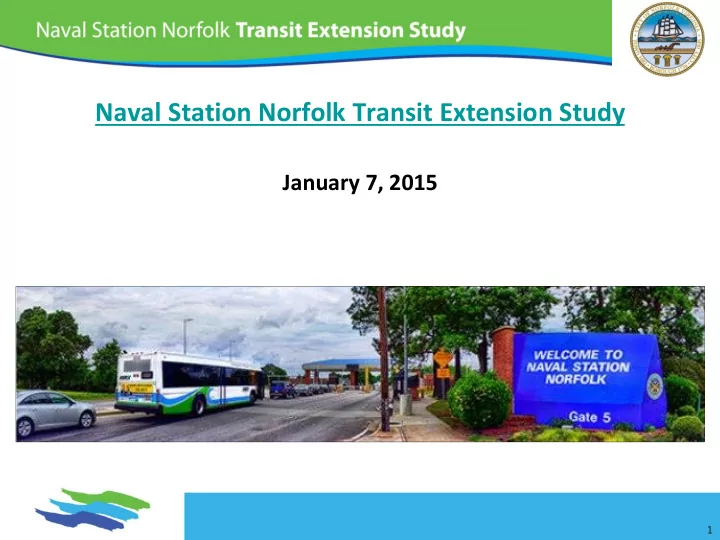
Naval Station Norfolk Transit Extension Study

January 7, 2015

1
slide-2
SLIDE 2

2

Source: U.S. Census Longitudinal Employer-Household Dynamics

  • Naval Station Norfolk is Hampton Roads Region’s largest employer with

approximately 60-70,000 jobs and employees from the entire Region

Higher Employment Higher Distribution

slide-3
SLIDE 3

Local Corridor Planning

The study will include defining the “Purpose and Need” and “Reasonable Alternatives” for detailed analysis in a future Environmental Impact Statement compliant with the National Environmental Policy Act (NEPA) and Federal Transit Administration regulations.

3

slide-4
SLIDE 4

Pretlow Public Library Granby High School Norview Community Center Old Dominion University Norfolk Airport Hilton Norview High School Holiday Inn Greenwich Road Blair Middle School

^ ^ ^ ^

KROC Center Norfolk Marriott Waterside Tidewater Community College

Public / Stakeholder Meetings

slide-5
SLIDE 5

Public Developed Purpose And Need

To provide improved transit service, possibly in the form of a light rail extension, from The Tide light rail system to, and possibly onto, Naval Station Norfolk in order to: 1. Develop Transit Connections to Many Points Within Norfolk 2. Address Heavy Traffic and Congestion 3. Reduce Travel Time 4. Increase Park and Ride Locations 5. Provide Better Interconnectivity of Transit Modes 6. Consider for Future Light Rail System Expansion

5

slide-6
SLIDE 6

Public Identified Key Connection Points and Potential Corridors

  • Top activity centers

– ODU – Norfolk Int’l Airport – Ghent/21st Street – Wards Corner – Janaf

6

slide-7
SLIDE 7

7

Segments For Further Study

slide-8
SLIDE 8

8

Conceptual Corridors with Stations for Further Study

slide-9
SLIDE 9

9

Resiliency Considerations

slide-10
SLIDE 10

10

Light Rail Transit (LRT)

The Tide, Norfolk, Virginia

Pros

  • Travel time reliability with

dedicated right-of-way

  • Improved mobility options
  • Opportunities for transit-
  • riented development

Cons

  • Higher capital costs than bus

rapid transit or streetcar

  • Requires more infrastructure

than bus rapid transit

slide-11
SLIDE 11
  • 11

Bus Rapid Transit (BRT)

RTA HealthLine, Cleveland, Ohio

Pros

  • Lower capital costs per mile

than LRT

  • May have faster timeline for

project construction and

  • peration

Cons

  • Perceived public opinion

that BRT operates similar to fixed route buses

  • Often has lower ridership

when compared with light rail transit

slide-12
SLIDE 12
  • 12

Streetcar

Sun Link Streetcar, Tucson, Arizona

Pros

  • More passenger capacity

standard buses

  • Similar economic development
  • pportunities to LRT
  • Can operate in tightly

constrained urban settings better than LRT Cons

  • Mixed traffic scenario and lower
  • perating speeds can slow travel

times

  • Not practical as commuter
  • ption for longer travel

corridors

slide-13
SLIDE 13

13

Separate Corridors with Technology Choices and Phasing Options

These figures illustrate possible representations of conceptual transportation corridors. No Corridor has been selected for advanced study at this time.

slide-14
SLIDE 14

14

Entire “Circuit” as a Single Technology System

These figures illustrate possible representations of conceptual transportation corridors. No Corridor has been selected for advanced study at this time.

slide-15
SLIDE 15

15

Combinations of Corridors, Technologies, and Phasings

These figures illustrate possible representations of conceptual transportation corridors. No Corridor has been selected for advanced study at this time.

slide-16
SLIDE 16

NSNTES Corridor Analysis - Next Steps

Corridor Planning - Phase 3

  • Completed “technical” data analysis (October 2014)
  • Present analysis to the public and Norfolk City Council (November/December 2014)
  • City Staff will review data and present recommendation to Council (Early 2015)
  • Norfolk Council selection of preferred corridor(s) for additional analysis (Spring 2015)

Environmental Impact Study and Early Design

  • Draft Environmental Impact Statement projected to begin in mid 2015 (Funded)
  • Final EIS, ROD, and Engineering (Unfunded)

Project Final Design and Construction

  • Pending Record of Decision and identification of funding
  • Potential design and construction window between 2020 to 2025

16

slide-17
SLIDE 17
  • Regional Vision Plan

– Provides a Conceptual Blueprint for Connectivity – Unconstrained by Funding

  • Virginia Beach extension

study entering FEIS /PE in 2015

  • Norfolk extension study

entering DEIS in 2015

  • Peninsula and Chesapeake

considering extension studies in 2015 and beyond

17

slide-18
SLIDE 18

Thank You

18