1. Motivation The present state of the art in software engineering - - PowerPoint PPT Presentation

1 motivation
SMART_READER_LITE
LIVE PREVIEW

1. Motivation The present state of the art in software engineering - - PowerPoint PPT Presentation

Bugs Now Show-Up in Everyday Life Vrification de labsence derreurs Bugs now appear frequently in everyday life (banks, lexcution dans des logiciels industriels cars, telephones, . . . ) Example (HSBC bank ATM 1 at 19


slide-1
SLIDE 1

« Vérification de l’absence d’erreurs à l’exécution dans des logiciels industriels critiques de contrôle/commande par interprétation abstraite »

Patrick Cousot

École normale supérieure 45 rue d’Ulm, 75230 Paris cedex 05, France

Patrick.Cousot@ens.fr www.di.ens.fr/~cousot

XIVes Rencontres INRIA – Industrie, Confiance et Sécurité — Rocquencourt — Jeudi 11 octobre 2007

Rencontres INRIA–Industrie, 11/10/2007 — 1 — ľ

  • P. Cousot

1. Motivation

Rencontres INRIA–Industrie, 11/10/2007 — 2 — ľ

  • P. Cousot

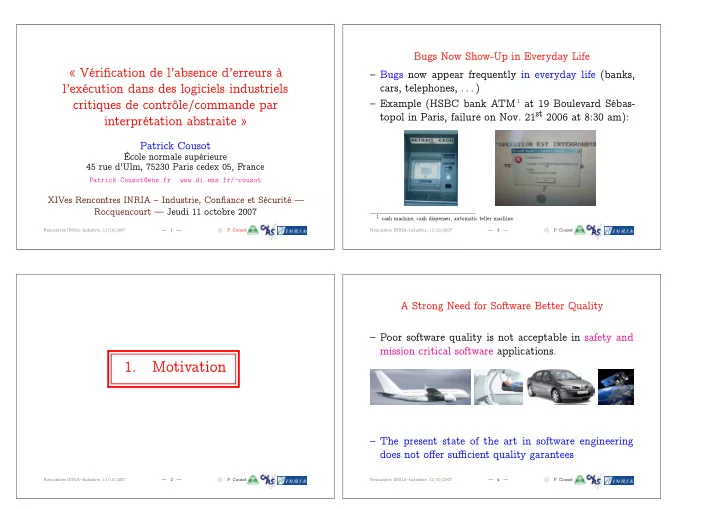
Bugs Now Show-Up in Everyday Life – Bugs now appear frequently in everyday life (banks, cars, telephones, . . . ) – Example (HSBC bank ATM 1 at 19 Boulevard Sébas- topol in Paris, failure on Nov. 21st 2006 at 8:30 am):

1 cash machine, cash dispenser, automatic teller machine.

Rencontres INRIA–Industrie, 11/10/2007 — 3 — ľ

  • P. Cousot

A Strong Need for Software Better Quality – Poor software quality is not acceptable in safety and mission critical software applications. – The present state of the art in software engineering does not offer sufficient quality garantees

Rencontres INRIA–Industrie, 11/10/2007 — 4 — ľ

  • P. Cousot
slide-2
SLIDE 2

Tool-Based Software Design Methods – New tool-based software design methods will have to emerge to face the unprecedented growth and complex- ification of critical software – E.g. FCPC (Flight Control Primary Computer)

  • A220: 20 000 LOCs,
  • A340:

130 000 LOCS (V1), 250 000 LOCS (V2),

  • A380: 1.000.000 LOCS

Rencontres INRIA–Industrie, 11/10/2007 — 5 — ľ

  • P. Cousot

2. Informal Introduction to Ab- stract Interpretation

Rencontres INRIA–Industrie, 11/10/2007 — 6 — ľ

  • P. Cousot

Abstract Interpretation There are two fundamental concepts in computer science (and in sciences in general) : – Abstraction : to reason on complex systems – Approximation : to make effective undecidable com- putations These concepts are formalized by abstract interpretation

References [POPL ’77]

  • P. Cousot and R. Cousot. Abstract interpretation: a unified lattice model for static analysis of programs by construction
  • r approximation of fixpoints. In 4th ACM POPL.

[Thesis ’78]

  • P. Cousot. Méthodes itératives de construction et d’approximation de points fixes d’opérateurs monotones sur un treillis,

analyse sémantique de programmes. Thèse ès sci. math. Grenoble, march 1978. [POPL ’79]

  • P. Cousot & R. Cousot. Systematic design of program analysis frameworks. In 6th ACM POPL.

Rencontres INRIA–Industrie, 11/10/2007 — 7 — ľ

  • P. Cousot

Principle of Abstraction

Rencontres INRIA–Industrie, 11/10/2007 — 8 — ľ

  • P. Cousot
slide-3
SLIDE 3

Operational semantics x(t) t

Rencontres INRIA–Industrie, 11/10/2007 — 9 — ľ

  • P. Cousot

Safety property x(t) t

Rencontres INRIA–Industrie, 11/10/2007 — 10 — ľ

  • P. Cousot

Test/Debugging is Unsafe x(t) t

Rencontres INRIA–Industrie, 11/10/2007 — 11 — ľ

  • P. Cousot

Bounded Model Checking is Unsafe x(t) t

Rencontres INRIA–Industrie, 11/10/2007 — 12 — ľ

  • P. Cousot
slide-4
SLIDE 4

Over-Approximation (Cont’d) x(t) t

Rencontres INRIA–Industrie, 11/10/2007 — 13 — ľ

  • P. Cousot

Abstract Interpretation is Sound x(t) t

Rencontres INRIA–Industrie, 11/10/2007 — 14 — ľ

  • P. Cousot

Soundness and Incompleteness

Rencontres INRIA–Industrie, 11/10/2007 — 15 — ľ

  • P. Cousot

Soundness Requirement: Erroneous Abstraction 2 x(t) t

2 This situation is always excluded in static analysis by abstract interpretation.

Rencontres INRIA–Industrie, 11/10/2007 — 16 — ľ

  • P. Cousot
slide-5
SLIDE 5

Soundness Requirement: Erroneous Abstraction 3 x(t) t

3 This situation is always excluded in static analysis by abstract interpretation.

Rencontres INRIA–Industrie, 11/10/2007 — 17 — ľ

  • P. Cousot

Imprecision ) False Alarms x(t) t

Rencontres INRIA–Industrie, 11/10/2007 — 18 — ľ

  • P. Cousot

3. The Astrée static analyzer

http://www.astree.ens.fr/

Rencontres INRIA–Industrie, 11/10/2007 — 19 — ľ

  • P. Cousot

Project Members

Bruno Blanchet 4 Patrick Cousot Radhia Cousot Jérôme Feret Laurent Mauborgne Antoine Miné David Monniaux 5 Xavier Rival

4 Nov. 2001 —– Nov. 2003. 5 Nov. 2001 —– Aug. 2007.

Rencontres INRIA–Industrie, 11/10/2007 — 20 — ľ

  • P. Cousot
slide-6
SLIDE 6

Programs Analyzed by Astrée and their Semantics

Rencontres INRIA–Industrie, 11/10/2007 — 21 — ľ

  • P. Cousot

Programs analysed by Astrée – Application Domain: large safety critical embedded real-time synchronous software for non-linear control

  • f very complex control/command systems.

– C programs:

  • with

´ basic numeric datatypes, structures and arrays ´ pointers (including on functions), ´ floating point computations ´ tests, loops and function calls ´ limited branching (forward goto, break, continue)

Rencontres INRIA–Industrie, 11/10/2007 — 22 — ľ

  • P. Cousot

– with (cont’d)

  • union

NEW

[Min06a]

  • pointer arithmetics & casts

NEW

[Min06a] – without

  • dynamic memory allocation
  • recursive function calls
  • unstructured/backward branching
  • conflicting side effects
  • C libraries, system calls (parallelism)

Such limitations are quite common for embedded safety-critical software.

Rencontres INRIA–Industrie, 11/10/2007 — 23 — ľ

  • P. Cousot

The Class of Considered Periodic Synchronous Programs

declare volatile input, state and output variables; initialize state and output variables; loop forever

  • read volatile input variables,
  • compute output and state variables,
  • write to output variables;

__ASTREE_wait_for_clock (); end loop

Task scheduling is static: – Requirements: the only interrupts are clock ticks; – Execution time of loop body less than a clock tick, as verified by the aiT WCET Analyzers [FHL+01].

Rencontres INRIA–Industrie, 11/10/2007 — 24 — ľ

  • P. Cousot
slide-7
SLIDE 7

Concrete Operational Semantics – International norm of C (ISO/IEC 9899:1999) – restricted by implementation-specific behaviors depend- ing upon the machine and compiler (e.g. representa- tion and size of integers, IEEE 754-1985 norm for floats and doubles) – restricted by user-defined programming guidelines (such as no modular arithmetic for signed integers, even though this might be the hardware choice) – restricted by program specific user requirements (e.g. assert, execution stops on first runtime error 6)

6 semantics of C unclear after an error, equivalent if no alarm

Rencontres INRIA–Industrie, 11/10/2007 — 25 — ľ

  • P. Cousot

Different Classes of Run-time Errors

  • 1. Errors terminating the execution

7.

Astrée warns and continues by taking into account only the executions that did not trigger the error.

  • 2. Errors not terminating the execution with predictable outcome 8.

Astrée warns and continues with worst-case assumptions.

  • 3. Errors not terminating the execution with unpredictable
  • utcome 9. Astrée warns and continues by taking into ac-

count only the executions that did not trigger the error. ) Astrée is sound with respect to C standard, unsound with respect to C implementation, unless no false alarm.

7 floating-point exceptions e.g. (invalid operations, overflows, etc.) when traps are activated 8 e.g. overflows over signed integers resulting in some signed integer. 9 e.g. memory corruptionss.

Rencontres INRIA–Industrie, 11/10/2007 — 26 — ľ

  • P. Cousot

Specification Proved by Astrée

Rencontres INRIA–Industrie, 11/10/2007 — 27 — ľ

  • P. Cousot

Implicit Specification: Absence of Runtime Errors – No violation of the norm of C (e.g. array index out of bounds, division by zero) – No implementation-specific undefined behaviors (e.g. maximum short integer is 32767, NaN) – No violation of the programming guidelines (e.g. static variables cannot be assumed to be initialized to 0) – No violation of the programmer assertions (must all be statically verified).

Rencontres INRIA–Industrie, 11/10/2007 — 28 — ľ

  • P. Cousot
slide-8
SLIDE 8

Modular Arithmetic

Rencontres INRIA–Industrie, 11/10/2007 — 29 — ľ

  • P. Cousot

Modular arithmetics is not very intuitive In C:

% cat -n modulo-c.c 1 #include <stdio.h> 2 int main () { 3 int x,y; 4 x = -2147483647 / -1; 5 y = ((-x) -1) / -1; 6 printf("x = %i, y = %i\n",x,y); 7 } 8 % gcc modulo-c.c % ./a.out x = 2147483647, y = -2147483648

Rencontres INRIA–Industrie, 11/10/2007 — 30 — ľ

  • P. Cousot

Static Analysis with Astrée

% cat -n modulo.c 1 int main () { 2 int x,y; 3 x = -2147483647 / -1; 4 y = ((-x) -1) / -1; 5 __ASTREE_log_vars((x,y)); 6 } 7 % astree –exec-fn main –unroll 0 modulo.c\ |& egrep -A 1 "(<integers)|(WARN)" modulo.c:4.4-18::[call#main@1:]: WARN: signed int arithmetic range {2147483648} not included in [-2147483648, 2147483647] <integers (intv+cong+bitfield+set): y in [-2147483648, 2147483647] /\ Top, x in {2147483647} /\ {2147483647} > Astrée signals the overflow and goes on with an unkown value.

Rencontres INRIA–Industrie, 11/10/2007 — 31 — ľ

  • P. Cousot

Float Overflow

Rencontres INRIA–Industrie, 11/10/2007 — 32 — ľ

  • P. Cousot
slide-9
SLIDE 9

Float Arithmetics does Overflow In C:

% cat -n overflow.c 1 void main () { 2 double x,y; 3 x = 1.0e+256 * 1.0e+256; 4 y = 1.0e+256 * -1.0e+256; 5 __ASTREE_log_vars((x,y)); 6 } % gcc overflow.c % ./a.out x = inf, y = -inf

% astree –exec-fn main

  • verflow.c |& grep "WARN"
  • verflow.c:3.4-23::[call#main1:]:

WARN: double arithmetic range [1.79769e+308, inf] not included in [-1.79769e+308, 1.79769e+308]

  • verflow.c:4.4-24::[call#main1:]:

WARN: double arithmetic range [-inf, -1.79769e+308] not included in [-1.79769e+308, 1.79769e+308]

Rencontres INRIA–Industrie, 11/10/2007 — 33 — ľ

  • P. Cousot

The Ariane 5.01 maiden flight failure – June 4th, 1996 was the maiden flight of Ariane 5 – The launcher self- detroyed after 42 seconds

  • f

flight because

  • f

a software overflow

A 16 bits piece of code of Ariane 4 had been reused within the new 32 bits code for Ariane 5. This caused an uncaught overflow, ultimately making the launcher uncontrolable.

Rencontres INRIA–Industrie, 11/10/2007 — 34 — ľ

  • P. Cousot

The Ariane 5.01 maiden flight failure – June 4th, 1996 was the maiden flight of Ariane 5 – The launcher was de- troyed after 40 seconds

  • f

flight because

  • f

a software overflow

10 10 A 16 bit piece of code of Ariane 4 had been reused within the new 32 bit code for Ariane 5.

This caused an uncaught overflow, making the launcher uncontrolable.

Rencontres INRIA–Industrie, 11/10/2007 — 34 — ľ

  • P. Cousot

Rounding

Rencontres INRIA–Industrie, 11/10/2007 — 35 — ľ

  • P. Cousot
slide-10
SLIDE 10

Example of accumulation of small rounding errors

% cat -n rounding-c.c 1 #include <stdio.h> 2 int main () { 3 int i; double x; x = 0.0; 4 for (i=1; i<=1000000000; i++) { 5 x = x + 1.0/10.0; 6 } 7 printf("x = %f\n", x); 8 } % gcc rounding-c.c % ./a.out x = 99999998.745418 %

since (0:1)10 = (0:0001100110011001100 : : :)2

Rencontres INRIA–Industrie, 11/10/2007 — 36 — ľ

  • P. Cousot

Static analysis with Astrée

% cat -n rounding.c 1 int main () { 2 double x; x = 0.0; 3 while (1) { 4 x = x + 1.0/10.0; 5 __ASTREE_log_vars((x)); 6 __ASTREE_wait_for_clock(()); 7 } 8 } % cat rounding.config __ASTREE_max_clock((1000000000)); % astree –exec-fn main –config-sem rounding.config –unroll 0 rounding.c\ |& egrep "(x in)|(\|x\|)|(WARN)" | tail -2 direct = <float-interval: x in [0.1, 200000040.938] > |x| <= 1.*((0. + 0.1/(1.-1))*(1.)^clock - 0.1/(1.-1)) + 0.1 <= 200000040.938

Rencontres INRIA–Industrie, 11/10/2007 — 37 — ľ

  • P. Cousot

The Patriot missile failure – “On February 25th, 1991, a Patriot missile . . . failed to track and inter- cept an incoming Scud (˜).” – The software failure was due to accu- mulated rounding error (y)

(˜) This Scud subsequently hit an Army barracks, killing 28 Americans. (y)– “Time is kept continuously by the system’s internal clock in

tenths of seconds” – “The system had been in operation for over 100 consecutive hours” – “Because the system had been on so long, the resulting inac- curacy in the time calculation caused the range gate to shift so much that the system could not track the incoming Scud”

Rencontres INRIA–Industrie, 11/10/2007 — 38 — ľ

  • P. Cousot

Filtering

Rencontres INRIA–Industrie, 11/10/2007 — 39 — ľ

  • P. Cousot
slide-11
SLIDE 11

Ellipsoid Abstract Domain for Filters

2d Order Digital Filter:

j

Switch

  • a

b i z-1

Unit delay

z-1 B

+ + +

t x(n)

Unit delay Switch Switch

– Computes Xn =  ¸Xn`1 + ˛Xn`2 + Yn In – The concrete computation is bounded, which must be proved in the abstract. – There is no stable interval or octagon. – The simplest stable surface is an ellipsoid. execution trace unstable interval stable ellipsoid

Rencontres INRIA–Industrie, 11/10/2007 — 40 — ľ

  • P. Cousot

Filter Example [Fer04]

typedef enum {FALSE = 0, TRUE = 1} BOOLEAN; BOOLEAN INIT; float P, X; void filter () { static float E[2], S[2]; if (INIT) { S[0] = X; P = X; E[0] = X; } else { P = (((((0.5 * X) - (E[0] * 0.7)) + (E[1] * 0.4)) + (S[0] * 1.5)) - (S[1] * 0.7)); } E[1] = E[0]; E[0] = X; S[1] = S[0]; S[0] = P; /* S[0], S[1] in [-1327.02698354, 1327.02698354] */ } void main () { X = 0.2 * X + 5; INIT = TRUE; while (1) { X = 0.9 * X + 35; /* simulated filter input */ filter (); INIT = FALSE; } }

Rencontres INRIA–Industrie, 11/10/2007 — 41 — ľ

  • P. Cousot

Time Dependence

Rencontres INRIA–Industrie, 11/10/2007 — 42 — ľ

  • P. Cousot

Arithmetic-Geometric Progressions (Example 1)

% cat count.c typedef enum {FALSE = 0, TRUE = 1} BOOLEAN; volatile BOOLEAN I; int R; BOOLEAN T; void main() { R = 0; while (TRUE) { __ASTREE_log_vars((R)); if (I) { R = R + 1; } else { R = 0; } T = (R >= 100); __ASTREE_wait_for_clock(()); }} % cat count.config __ASTREE_volatile_input((I [0,1])); __ASTREE_max_clock((3600000)); % astree –exec-fn main –config-sem count.config count.c|grep ’|R|’ |R| <= 0. + clock *1. <= 3600001.

potential overflow!

Rencontres INRIA–Industrie, 11/10/2007 — 43 — ľ

  • P. Cousot
slide-12
SLIDE 12

Arithmetic-Geometric Progressions: Example 2

% cat retro.c typedef enum {FALSE=0, TRUE=1} BOOL; BOOL FIRST; volatile BOOL SWITCH; volatile float E; float P, X, A, B; void dev( ) { X=E; if (FIRST) { P = X; } else { P = (P - ((((2.0 * P) - A) - B) * 4.491048e-03)); }; B = A; if (SWITCH) {A = P;} else {A = X;} } void main() { FIRST = TRUE; while (TRUE) { dev( ); FIRST = FALSE; __ASTREE_wait_for_clock(()); }} % cat retro.config __ASTREE_volatile_input((E [-15.0, 15.0])); __ASTREE_volatile_input((SWITCH [0,1])); __ASTREE_max_clock((3600000));

|P| <= (15. + 5.87747175411e-39 / 1.19209290217e-07) * (1 + 1.19209290217e-07)ˆclock

  • 5.87747175411e-39 /

1.19209290217e-07 <= 23.0393526881

Rencontres INRIA–Industrie, 11/10/2007 — 44 — ľ

  • P. Cousot

4. The industrial use of Astrée

References [1]

  • D. Delmas and J. Souyris. Astrée: from Research to Industry. Proc. 14th Int. Symp. SAS ’07, G. Filé and H. Riis-Nielson (eds),

22–24 Aug. 2007, Kongens Lyngby, DK, LNCS 4634, pp. 437–451, Springer. Rencontres INRIA–Industrie, 11/10/2007 — 45 — ľ

  • P. Cousot

Example application – Primary flight control software of the Airbus A340 fam- ily/A380 fly-by-wire system – C program, automatically generated from a propri- etary high-level specification (à la Simulink/Scade) – A340 family: 132,000 lines, 75,000 LOCs after prepro- cessing, 10,000 global variables, over 21,000 after ex- pansion of small arrays, now ˆ 2 – A380: ˆ 3/7

Rencontres INRIA–Industrie, 11/10/2007 — 46 — ľ

  • P. Cousot

Benchmarks (Airbus A340 Primary Flight Control Software) – V1 11, 132,000 lines, 75,000 LOCs after preprocessing – Comparative results (commercial software): 4,200 (false?) alarms, 3.5 days; – Our results:

0 alarms,

40mn on 2.8 GHz PC, 300 Megabytes ` ! A world première in Nov. 2003!

11 “Flight Control and Guidance Unit” (FCGU) running on the “Flight Control Primary Computers” (FCPC). The three primary computers (FCPC) and two secondary computers (FCSC) which form the A340 and A330 electrical flight control system are placed between the pilot’s controls (sidesticks, rudder pedals) and the control surfaces of the aircraft, whose movement they control and monitor.

Rencontres INRIA–Industrie, 11/10/2007 — 47 — ľ

  • P. Cousot
slide-13
SLIDE 13

(Airbus A380 Primary Flight Control Software) – 0 alarms (Nov. 2004), after some additional parametriza- tion and simple abstract domains developments – Now at 1,000,000 lines! 34h, 8 Gigabyte ` ! A world grand première!

Rencontres INRIA–Industrie, 11/10/2007 — 48 — ľ

  • P. Cousot

5. Conclusion

Rencontres INRIA–Industrie, 11/10/2007 — 49 — ľ

  • P. Cousot

Characteristics of the Astrée Analyzer (Cont’d) Sound: – Astrée is a bug eradicator: finds all bugs in a well-defined class (runtime errors) – Astrée is not a bug hunter: finding some bugs in a well-defined class (e.g. by bug pattern detection like FindBugsŮ, PREfast or PMD) – Astrée is exhaustive: covers the whole state space (6= MAGIC, CBMC) – Astrée is comprehensive: never omits potential er- rors (6= UNO, CMC from coverity.com) or sort most probable ones to avoid overwhelming messages (6= Splint)

Rencontres INRIA–Industrie, 11/10/2007 — 50 — ľ

  • P. Cousot

Characteristics of the Astrée Analyzer (Cont’d) Static: compile time analysis (6= run time analysis Rational Purify, Parasoft Insure++) Program Analyzer: analyzes programs not micromodels of programs (6= PROMELA in SPIN or Alloy in the Alloy Analyzer) Automatic: no end-user intervention needed (6= ESC Java, ESC Java 2), or PREfast (annotate functions with intended use)

Rencontres INRIA–Industrie, 11/10/2007 — 51 — ľ

  • P. Cousot
slide-14
SLIDE 14

Characteristics of the Astrée Analyzer (Cont’d) Multiabstraction: uses many numerical/symbolic abstract domains (6= symbolic constraints in Bane or the canonical abstraction of TVLA) Infinitary: all abstractions use infinite abstract domains with widening/narrowing (6= model checking based analyzers such as Bandera, Bogor, Java PathFinder, Spin, VeriSoft) Efficient: always terminate (6= counterexample-driven au- tomatic abstraction refinement BLAST, SLAM)

Rencontres INRIA–Industrie, 11/10/2007 — 52 — ľ

  • P. Cousot

Characteristics of the Astrée Analyzer (Cont’d) Extensible/Specializable: can easily incorporate new abstrac- tions (and reduction with already existing abstract domains) (6= general-purpose analyzers PolySpace Verifier) Domain-Aware: knows about control/command (e.g. dig- ital filters) (as opposed to specialization to a mere programming style in C Global Surveyor) Parametric: the precision/cost can be tailored to user needs by options and directives in the code

Rencontres INRIA–Industrie, 11/10/2007 — 53 — ľ

  • P. Cousot

Characteristics of the Astrée Analyzer (Cont’d) Automatic Parametrization: the generation of parametric directives in the code can be programmed (to be specialized for a specific application domain) Modular: an analyzer instance is built by selection of O- CAML modules from a collection each implement- ing an abstract domain Precise: very few or no false alarm when adapted to an application domain ` ! it is a VERIFIER!

Rencontres INRIA–Industrie, 11/10/2007 — 54 — ľ

  • P. Cousot

The Future of the Astrée Analyzer – Astrée has shown usable and useful in one industrial context (electric flight control); – More applications are forthcoming (ES_PASSS project); – Industrialization is simultaneously under consideration.

Rencontres INRIA–Industrie, 11/10/2007 — 55 — ľ

  • P. Cousot
slide-15
SLIDE 15

THE END, THANK YOU

Rencontres INRIA–Industrie, 11/10/2007 — 56 — ľ

  • P. Cousot

6. Bibliography

Rencontres INRIA–Industrie, 11/10/2007 — 57 — ľ

  • P. Cousot

[BCC+02] B. Blanchet, P. Cousot, R. Cousot, J. Feret, L. Mauborgne, A. Miné, D. Monni- aux, and X. Rival. Design and implementation of a special-purpose static program analyzer for safety-critical real-time embedded software, invited chapter. In T. Mogensen, D.A. Schmidt, and I.H. Sudborough, editors, The Essence of Compu- tation: Complexity, Analysis, Transformation. Essays Dedicated to Neil D. Jones, LNCS 2566, pages 85–108. Springer, 2002. [BCC+03] B. Blanchet, P. Cousot, R. Cousot, J. Feret, L. Mauborgne, A. Miné, D. Monniaux, and X. Rival. A static analyzer for large safety-critical software. In Proc. ACM SIGPLAN ’2003 Conf. PLDI, pages 196–207, San Diego, CA, US, 7–14 June

  • 2003. ACM Press.

[CCF+05] P. Cousot, R. Cousot, J. Feret, L. Mauborgne, A. Miné, D. Monniaux, and X. Rival. The Astrée analyser. In M. Sagiv, editor, Proc. 14th ESOP ’2005, Edinburg, UK, volume 3444 of LNCS, pages 21–30. Springer, 2–10 Apr. 2005. [CCF+06] P. Cousot, R. Cousot, J. Feret, L. Mauborgne, A. Miné, D. Monniaux, and X.

  • Rival. Combination of abstractions in the Astrée static analyzer, invited paper.

In M. Okada and I. Satoh, editors, 11th ASIAN 06, Tokyo, JP, 6–8 Dec. 2006. LNCS , Springer. To appear.

Rencontres INRIA–Industrie, 11/10/2007 — 58 — ľ

  • P. Cousot

[CCF+07] P. Cousot, R. Cousot, J. Feret, L. Mauborgne, A. Miné, D. Monniaux, and X.

  • Rival. Varieties of static analyzers: A comparison with Astrée, invited paper. In
  • M. Hinchey, He Jifeng, and J. Sanders, editors, Proc. 1st TASE ’07, pages 3–17,

Shanghai, CN, 6–8 June 2007. IEEE Comp. Soc. Press. [Cou07]

  • P. Cousot. Proving the absence of run-time errors in safety-critical avionics code,

invited tutorial. In Proc. 7th Int. Conf. EMSOFT ’2007, LNCS. Springer, 2007. To appear. [DS07]

  • D. Delmas and J. Souyris. Astrée: from research to industry. In G. Filé and
  • H. Riis-Nielson, editors, Proc. 14th Int. Symp. SAS ’07, Kongens Lyngby, DK,

LNCS 4634, pages 437–451. Springer, 22–24 Aug. 2007. [Fer04]

  • J. Feret.

Static analysis of digital filters. In D. Schmidt, editor, Proc. 30th ESOP ’2004, Barcelona, ES, volume 2986 of LNCS, pages 33–48. Springer, Mar. 27 – Apr. 4, 2004. [Fer05]

  • J. Feret. The arithmetic-geometric progression abstract domain. In R. Cousot,

editor, Proc. 6th Int. Conf. VMCAI 2005, pages 42–58, Paris, FR, 17–19 Jan.

  • 2005. LNCS 3385, Springer.

Rencontres INRIA–Industrie, 11/10/2007 — 59 — ľ
  • P. Cousot
slide-16
SLIDE 16

[FHL+01]

  • C. Ferdinand, R. Heckmann, M. Langenbach, F. Martin, M. Schmidt, H. Theiling,
  • S. Thesing, and R. Wilhelm. Reliable and precise WCET determination for a real-

life processor. In T.A. Henzinger and C.M. Kirsch, editors, Proc. 1st Int. Work. EMSOFT ’2001, volume 2211 of LNCS, pages 469–485. Springer, 2001. [Mau04]

  • L. Mauborgne. Astrée: Verification of absence of run-time error. In P. Jacquart,

editor, Building the Information Society, chapter 4, pages 385–392. Kluwer Acad. Pub., 2004. [Min] A. Miné. The Octagon abstract domain library. http://www.di.ens.fr/~mine/oct/. [Min04a]

  • A. Miné. Relational abstract domains for the detection of floating-point run-time
  • errors. In D. Schmidt, editor, Proc. 30th ESOP ’2004, Barcelona, ES, volume

2986 of LNCS, pages 3–17. Springer, Mar. 27 – Apr. 4, 2004. [Min04b]

  • A. Miné. Weakly Relational Numerical Abstract Domains. Thèse de doctorat

en informatique, École polytechnique, Palaiseau, FR, 6 Dec. 2004. [Min05]

  • A. Miné. Weakly relational numerical abstract domains: Theory and application,

invited paper. In 1st Int. Work. on Numerical & Symbolic Abstract Domains, NSAD ’05, Maison Des Polytechniciens, Paris, FR, 21 Jan. 2005.

Rencontres INRIA–Industrie, 11/10/2007 — 60 — ľ

  • P. Cousot

[Min06a]

  • A. Miné. Field-sensitive value analysis of embedded C programs with union types

and pointer arithmetics. In Proc. LCTES ’2006, pages 54–63. ACM Press, June 2006. [Min06b]

  • A. Miné. The octagon abstract domain. Higher-Order and Symbolic Computa-

tion, 19:31–100, 2006. [Min06c]

  • A. Miné. Symbolic methods to enhance the precision of numerical abstract do-
  • mains. In E.A. Emerson and K.S. Namjoshi, editors, Proc. 7th Int. Conf. VMCAI

2006, pages 348–363, Charleston, SC, US, 8–10, Jan. 2006. LNCS 3855, Springer. [Mon05]

  • D. Monniaux. The parallel implementation of the Astrée static analyzer. In
  • Proc. 3rd APLAS ’2005, pages 86–96, Tsukuba, JP, 3–5 Nov. 2005. LNCS 3780,

Springer. [MR05]

  • L. Mauborgne and X. Rival. Trace partitioning in abstract interpretation based

static analyzer. In M. Sagiv, editor, Proc. 14th ESOP ’2005, Edinburg, UK, volume 3444 of LNCS, pages 5–20. Springer, Apr. 2—-10, 2005. [Riv05a]

  • X. Rival. Abstract dependences for alarm diagnosis. In Proc. 3rd APLAS ’2005,

pages 347–363, Tsukuba, JP, 3–5 Nov. 2005. LNCS 3780, Springer.

Rencontres INRIA–Industrie, 11/10/2007 — 61 — ľ

  • P. Cousot

[Riv05b]

  • X. Rival. Understanding the origin of alarms in Astrée. In C. Hankin and I.

Siveroni, editors, Proc. 12th Int. Symp. SAS ’05, pages 303–319, London, UK, LNCS 3672, 7–9 Sep. 2005.

Rencontres INRIA–Industrie, 11/10/2007 — 62 — ľ

  • P. Cousot