1 Mayors Transport Strategy Mike Keegan, Transport for London - - PowerPoint PPT Presentation

1 mayor s transport strategy
SMART_READER_LITE
LIVE PREVIEW

1 Mayors Transport Strategy Mike Keegan, Transport for London - - PowerPoint PPT Presentation

1 Mayors Transport Strategy Mike Keegan, Transport for London https://www.youtube.com/watch?v=kEwKjpmLjMw&feature=youtu.be 2 MAYORS TRANSPORT STRATEGY London is set to grow over the next 25 years Londons population is due to

slide-1
SLIDE 1

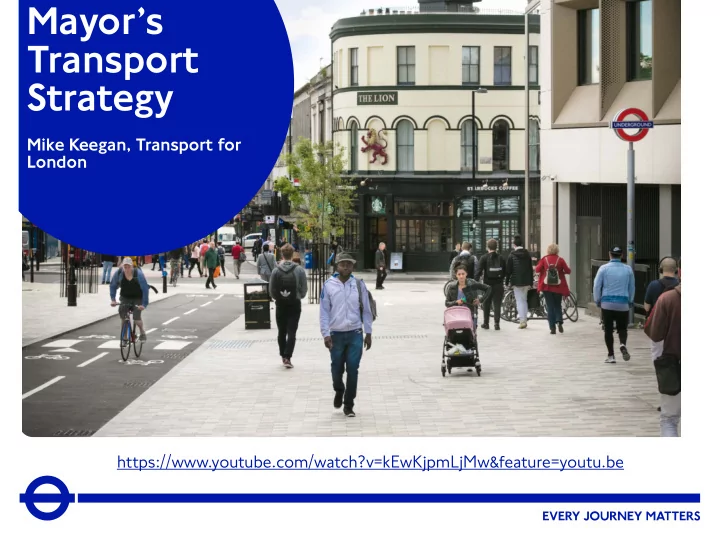
1 Mayor’s

Transport Strategy

Mike Keegan, Transport for London https://www.youtube.com/watch?v=kEwKjpmLjMw&feature=youtu.be

slide-2
SLIDE 2

2 MAYOR’S TRANSPORT STRATEGY

London is set to grow over the next 25 years

  • London’s population is due to

grow from 8.7m – 10.5m in 25 years.

  • Street environments need to

improve for both walking and cycling.

  • Overcrowded or unreliable

public transport can deter people from switching from the car.

  • Limited space means building

more roads is not an option.

slide-3
SLIDE 3

3 MAYOR’S TRANSPORT STRATEGY

London’s transport matters

  • Transport is an important part
  • f almost every aspect of

Londoners’ daily lives.

  • Many Londoners use public

transport every day - It can influence where people choose to live and work.

  • Streets make up 80% of the

city’s public space and are where most travel happens.

  • Through our influence over the

transport network we can help to shape the whole city.

slide-4
SLIDE 4

4 MAYOR’S TRANSPORT STRATEGY

Car dependency and active travel

  • Traffic dominance causes road

danger, air pollution and makes streets unpleasant places to be.

  • Congestion holds back the

economy.

  • Too few people are walking and

cycling – there is an inactivity crisis that contributes to the city’s health problems.

  • Too many people still use

private cars because the alternatives are unappealing or don’t meet their needs.

slide-5
SLIDE 5

5 MAYOR’S TRANSPORT STRATEGY

By 2041 the aim is for 80% of Londoners’ trips to be on foot, by cycle or using public transport

slide-6
SLIDE 6

6

A spatial approach for London’s transport system

MAYOR’S TRANSPORT STRATEGY 6

6

Central London Inner London Outer London

‘A world-leading cultural and economic centre that is highly accessible by public transport and a great place to be for both people and businesses’ ‘A dense, mixed place to live and work with most travel by public transport, walking and cycling’

‘A denser place with lively town centres where the majority of Londoners live and a significant proportion work, with travel within and between centres by public transport, walking and cycling’

The future of transport will look different in central, inner and outer London and the Strategy will be pursued in ways that are tailored to each.

slide-7
SLIDE 7

7 MAYOR’S TRANSPORT STRATEGY

Healthy Streets Approach

  • The Healthy Streets Approach will

ensure that transport decisions prioritise human health and quality

  • f life.
  • This is the first transport strategy

anywhere in the world to apply the Healthy Streets Approach to the entire transport system of a city like London.

  • Using the approach to create a city

that is not dominated by traffic will improve the city in a whole range of ways.

slide-8
SLIDE 8

8

Healthy Streets is essential to all three MTS themes

  • 1. Healthy Streets and

healthy people

“Creating streets and street networks that encourage walking, cycling and public transport use will reduce car dependency and the health problems it creates”

  • 3. New homes and jobs

“Planning the city around walking, cycling and public transport use will unlock growth in new areas and ensure that London grows in a way that benefits everyone”

  • 2. A good public

transport experience

“An easy to use and accessible public transport system is an essential part of the Healthy Streets Approach as it gives people alternatives to car use”

slide-9
SLIDE 9
  • We need to change the look and feel of all streets, using different approaches in

different places

  • A comprehensive approach across the network is needed, especially to tackle

poor air quality and to achieve large scale mode shift away from cars

Long trips car  public transport Short trips public transport/car  active travel

9

  • 1. Healthy Streets and healthy people
slide-10
SLIDE 10

10 MAYOR’S TRANSPORT STRATEGY

Healthy Streets & healthy people

  • The Healthy Streets

Approach will be adopted.

  • Active, inclusive and safe

travel.

  • Making more efficient

use of the street network.

  • Improving air quality and

the environment.

slide-11
SLIDE 11

11

  • 2. A good public transport experience
  • Easy to use, efficient, affordable & accessible public transport will encourage

people to switch away from cars

  • Thinking about the whole journey: All public transport journeys start or finish
  • n foot or

by cycle

slide-12
SLIDE 12

12 MAYOR’S TRANSPORT STRATEGY

A good public transport experience

  • Improving affordability and

customer service.

  • Improving public transport

accessibility.

  • Shaping and growing the

bus network.

  • Improving rail services and

tackling crowding.

slide-13
SLIDE 13

13

  • 3. New homes and jobs
  • Growth and regeneration are
  • pportunities to set ambitious

standards for new development

  • Spatial planning can support

long term aspirations to promote active travel (e.g. higher density, mixed land-use, decrease car- dependence...)

  • This will help car-dependent

Londoners living in the least walkable areas of London to become active

Growth areas

slide-14
SLIDE 14

14 MAYOR’S TRANSPORT STRATEGY

New homes and jobs

The principles of ‘good growth’ include:

  • Good access to public

transport

  • High density, mixed use

developments

  • People choose to walk and

cycle

  • Car-free and car-lite places
  • Inclusive, accessible design
  • Carbon-free travel
  • Efficient freight.
slide-15
SLIDE 15

15 MAYOR’S TRANSPORT STRATEGY

Delivering the vision

  • Adapting to new

technology, taking part in new trials of new technology with a safety first approach.

  • Working with the DfT to

ensure connected and autonomous vehicles emerge in a way consistent with the strategy.

  • Delivering in partnership

with boroughs and other

  • rganisations.
slide-16
SLIDE 16

16 MAYOR’S TRANSPORT STRATEGY

Next steps

Date te Ac Activit ity

21 June Launch of public consultation https://tfl.gov.uk/mayors-transport- strategy 02 October Consultation closes January 2018 London Assembly review period Early 2018 Launch Final Strategy

slide-17
SLIDE 17

17 MAYOR’S TRANSPORT STRATEGY

Find out more

Visit: https://tfl.gov.uk/corporate/about-

tfl/how-we-work/planning-for-the-future/the- mayors-transport-strategy

Or search “Mayor’s Transport Strategy”