1 Filling rule This section follows closely [1] and [4, 5]. The - - PDF document

1 filling rule
SMART_READER_LITE
LIVE PREVIEW

1 Filling rule This section follows closely [1] and [4, 5]. The - - PDF document

1 Filling rule This section follows closely [1] and [4, 5]. The following notion of mixing was first introduced by Aldous in [2] in the continuous time case and later studied in discrete time by Lov asz and Winkler in [4, 5]. It is defined as


slide-1
SLIDE 1

1 Filling rule

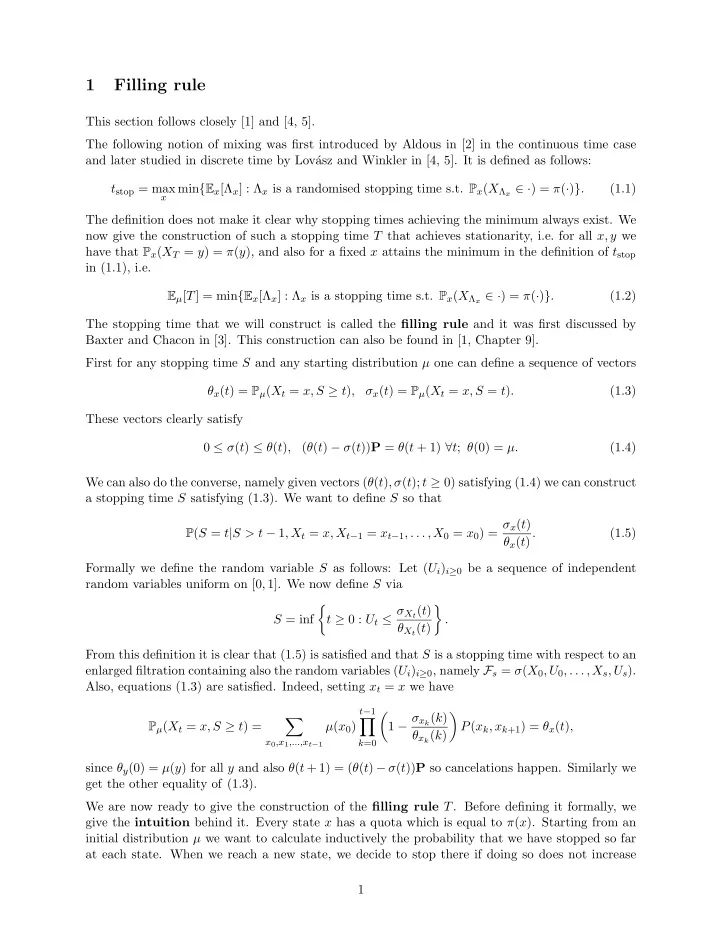
This section follows closely [1] and [4, 5]. The following notion of mixing was first introduced by Aldous in [2] in the continuous time case and later studied in discrete time by Lov´ asz and Winkler in [4, 5]. It is defined as follows: tstop = max

x

min{Ex[Λx] : Λx is a randomised stopping time s.t. Px(XΛx ∈ ·) = π(·)}. (1.1) The definition does not make it clear why stopping times achieving the minimum always exist. We now give the construction of such a stopping time T that achieves stationarity, i.e. for all x, y we have that Px(XT = y) = π(y), and also for a fixed x attains the minimum in the definition of tstop in (1.1), i.e. Eµ[T] = min{Ex[Λx] : Λx is a stopping time s.t. Px(XΛx ∈ ·) = π(·)}. (1.2) The stopping time that we will construct is called the filling rule and it was first discussed by Baxter and Chacon in [3]. This construction can also be found in [1, Chapter 9]. First for any stopping time S and any starting distribution µ one can define a sequence of vectors θx(t) = Pµ(Xt = x, S ≥ t), σx(t) = Pµ(Xt = x, S = t). (1.3) These vectors clearly satisfy 0 ≤ σ(t) ≤ θ(t), (θ(t) − σ(t))P = θ(t + 1) ∀t; θ(0) = µ. (1.4) We can also do the converse, namely given vectors (θ(t), σ(t); t ≥ 0) satisfying (1.4) we can construct a stopping time S satisfying (1.3). We want to define S so that P(S = t|S > t − 1, Xt = x, Xt−1 = xt−1, . . . , X0 = x0) = σx(t) θx(t) . (1.5) Formally we define the random variable S as follows: Let (Ui)i≥0 be a sequence of independent random variables uniform on [0, 1]. We now define S via S = inf

  • t ≥ 0 : Ut ≤ σXt(t)

θXt(t)

  • .

From this definition it is clear that (1.5) is satisfied and that S is a stopping time with respect to an enlarged filtration containing also the random variables (Ui)i≥0, namely Fs = σ(X0, U0, . . . , Xs, Us). Also, equations (1.3) are satisfied. Indeed, setting xt = x we have Pµ(Xt = x, S ≥ t) =

  • x0,x1,...,xt−1

µ(x0)

t−1

  • k=0
  • 1 − σxk(k)

θxk(k)

  • P(xk, xk+1) = θx(t),

since θy(0) = µ(y) for all y and also θ(t + 1) = (θ(t) − σ(t))P so cancelations happen. Similarly we get the other equality of (1.3). We are now ready to give the construction of the filling rule T. Before defining it formally, we give the intuition behind it. Every state x has a quota which is equal to π(x). Starting from an initial distribution µ we want to calculate inductively the probability that we have stopped so far at each state. When we reach a new state, we decide to stop there if doing so does not increase 1

slide-2
SLIDE 2

the probability of stopping at that state above the quota. Otherwise we stop there with the right probability to exactly fill the quota and we continue with the complementary probability. We will now give the rigorous construction by defining the sequence of vectors (θ(t), σ(t); t ≥ 0) for any starting distribution µ. If we start from x, then simply µ = δx. First we set θ(0) = µ. We now introduce another sequence of vectors (Σ(t); t ≥ −1). Let Σx(−1) = 0 for all x. We define inductively σx(t) =

  • θx(t),

if Σx(t − 1) + θx(t) ≤ π(x); π(x) − Σx(t − 1),

  • therwise.

Then we let Σx(t) =

s≤t σx(s) and define θ(t + 1) via (1.4).

Then σ will satisfy (1.3) and Σx(t) = Pµ(XT = x, T ≤ t). Also note from the description above it follows that Σx(t) ≤ π(x), for all x and all t. Thus we get that Pµ(XT = x) = lim

t→∞ Σx(t) ≤ π(x)

and since both Pµ(XT = ·) and π(·) are probability distributions, we get that they must be equal. Hence the above construction yielded a stationary stopping time. It only remains to prove the mean-optimality (1.2). Before doing so we give a definition. Definition 1.1. Let S be a stopping time. A state z is called a halting state for the stopping time if S ≤ Tz a.s. where Tz is the first hitting time of state z. We will now prove that the filling rule has a halting state, i.e. that there exists z such that T ≤ Tz a.s. For each x we define tx = min{t : Σx(t) = π(x)} ≤ ∞. Take z such that tz = max

x

tx ≤ ∞. We will show that T ≤ Tz a.s. If there exists a t such that Pµ(T > t, Tz = t) > 0, then Σx(t) = π(x), for all x, since the state z is the last one to be filled. So if the above probability is positive, then we get that Pµ(T ≤ t) =

  • x

Σx(t) = 1, which is a contradiction. Hence, we obtain that Pµ(T > t, Tz = t) = 0 and thus by summing over all t we deduce that Pµ(T ≤ Tz) = 1. The next theorem is a criterion for mean-optimality of a stopping rule. Theorem 1.2 (Lov´ asz and Winkler). Let µ and ρ be two distributions. Let S be a stopping time such that Pµ(XS = x) = ρ(x) for all x. Then S is mean optimal in the sense that Eµ[S] = min{Eµ[U] : U is a stopping time s.t. Pµ(XU ∈ ·) = ρ(·)} if and only if it has a halting state. Using this criterion, we see that the filling rule is mean-optimal. Proof of Theorem 1.2. We define the exit frequencies for S via νx = Eµ S−1

  • k=0

1(Xk = x)

  • , for

all x. Since Pµ(XS = ·) = ρ(·), we can write Eµ S

  • k=0

1(Xk = x)

  • = Eµ

S−1

  • k=0

1(Xk = x)

  • + ρ(x) = νx + ρ(x).

2

slide-3
SLIDE 3

We also have that Eµ S

  • k=0

1(Xk = x)

  • = µ(x) + Eµ

S

  • k=1

1(Xk = x)

  • .

Since S is a stopping time, it is easy to see that Eµ S

  • k=1

1(Xk = x)

  • =
  • y

νyP(y, x). Hence we get that νx + ρ(x) = µ(x) +

  • y

νyP(y, x). (1.6) Let T be another stopping time with Pµ(XT = ·) = ρ(·) and let ν′

x be its exit frequencies. Then

they would satisfy (1.6), i.e. ν′

x + ρ(x) = µ(x) +

  • y

ν′

yP(y, x).

Thus if we set d = ν′ − ν, then d as a vector satisfies d = dP, and hence d must be a multiple of the stationary distribution, i.e. for a constant α we have that d = απ. Suppose first that S has a halting state, i.e. there exists a state z such that νz = 0. Therefore we get that ν′

z = απ(z), and hence α ≥ 0. Thus ν′ x ≥ νx for all x and

Eµ[T] =

  • x

ν′(x) ≥

  • x

νx = E[S] µ, and hence proving mean-optimality. We will now show the converse, namely that if S is mean-optimal then it should have a halting

  • state. The filling rule was proved to have a halting state and thus is mean-optimal. Hence using

the same argument as above we get that S is mean optimal if and only if min

x νx = 0, which is the

definition of a halting state. Remark 1.3. Note that the first part, i.e. assuming that a stopping rule has a halting state and then showing that it is mean optimal, did not use the filling rule.

References

[1] D. Aldous and J. Fill. Reversible Markov Chains and Random Walks on Graphs. In preparation, http://www.stat.berkeley.edu/∼aldous/RWG/book.html. [2] D. J. Aldous. Some inequalities for reversible Markov chains.

  • J. London Math. Soc. (2),

25(3):564–576, 1982. [3] J. R. Baxter and R. V. Chacon. Stopping times for recurrent Markov processes. Illinois J. Math., 20(3):467–475, 1976. 3

slide-4
SLIDE 4

[4] L. Lov´ asz and P. Winkler. Efficient stopping rules for markov chains. In Proceedings of the twenty-seventh annual ACM symposium on Theory of computing, STOC ’95, pages 76–82, New York, NY, USA, 1995. ACM. [5] L. Lov´ asz and P. Winkler. Mixing times. In Microsurveys in discrete probability (Princeton, NJ, 1997), volume 41 of DIMACS Ser. Discrete Math. Theoret. Comput. Sci., pages 85–133.

  • Amer. Math. Soc., Providence, RI, 1998.

4