
http://www.ugrad.cs.ubc.ca/~cs314/Vjan2013
Advanced Rendering
University of British Columbia CPSC 314 Computer Graphics Jan-Apr 2013 Tamara Munzner
2Advanced Rendering
3Reading for This Module
- FCG Sec 8.2.7 Shading Frequency
- FCG Chap 4 Ray Tracing
- FCG Sec 13.1 Transparency and Refraction
- Optional: FCG Chap 24 Global Illumination
Global Illumination Models
- simple lighting/shading methods simulate
local illumination models
- no object-object interaction
- global illumination models
- more realism, more computation
- leaving the pipeline for these two lectures!
- approaches
- ray tracing
- radiosity
- photon mapping
- subsurface scattering
Ray Tracing
- simple basic algorithm
- well-suited for software rendering
- flexible, easy to incorporate new effects
- Turner Whitted, 1990
Simple Ray Tracing
- view dependent method
- cast a ray from viewer’s
eye through each pixel
- compute intersection of
ray with first object in scene
- cast ray from
intersection point on
- bject to light sources
projection reference point pixel positions
- n projection
plane
7Reflection
- mirror effects
- perfect specular reflection
n
θ θ
8Refraction
- happens at interface
between transparent object and surrounding medium
- e.g. glass/air boundary
- Snell’s Law
- light ray bends based on
refractive indices c1, c2
2 2 1 1sin sin θ θ c c = n
θ 1 θ 2
d t
9Recursive Ray Tracing
- ray tracing can handle
- reflection (chrome/mirror)
- refraction (glass)
- shadows
- spawn secondary rays
- reflection, refraction
- if another object is hit,
recurse to find its color
- shadow
- cast ray from intersection
point to light source, check if intersects another object
projection reference point pixel positions
- n projection
plane
10Basic Algorithm
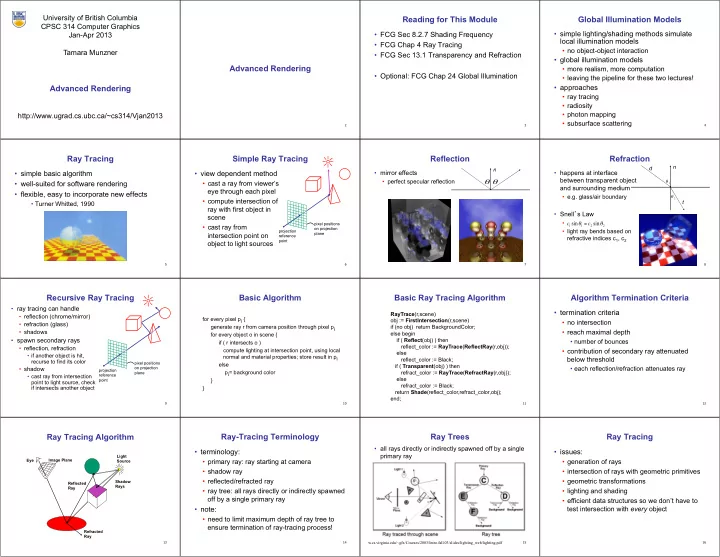
for every pixel pi { generate ray r from camera position through pixel pi for every object o in scene { if ( r intersects o ) compute lighting at intersection point, using local normal and material properties; store result in pi else pi= background color } }
11Basic Ray Tracing Algorithm
RayTrace(r,scene)
- bj := FirstIntersection(r,scene)
if (no obj) return BackgroundColor; else begin if ( Reflect(obj) ) then reflect_color := RayTrace(ReflectRay(r,obj)); else reflect_color := Black; if ( Transparent(obj) ) then refract_color := RayTrace(RefractRay(r,obj)); else refract_color := Black; return Shade(reflect_color,refract_color,obj); end;
12Algorithm Termination Criteria
- termination criteria
- no intersection
- reach maximal depth
- number of bounces
- contribution of secondary ray attenuated
below threshold
- each reflection/refraction attenuates ray
Ray Tracing Algorithm
Image Plane Light Source Eye Refracted Ray Reflected Ray Shadow Rays
14Ray-Tracing Terminology
- terminology:
- primary ray: ray starting at camera
- shadow ray
- reflected/refracted ray
- ray tree: all rays directly or indirectly spawned
- ff by a single primary ray
- note:
- need to limit maximum depth of ray tree to
ensure termination of ray-tracing process!
15Ray Trees
www.cs.virginia.edu/~gfx/Courses/2003/Intro.fall.03/slides/lighting_web/lighting.pdf
- all rays directly or indirectly spawned off by a single
primary ray
16Ray Tracing
- issues:
- generation of rays
- intersection of rays with geometric primitives
- geometric transformations
- lighting and shading
- efficient data structures so we don’t have to
test intersection with every object