1 Agenda Welcome & Introduction Desi Barrett, Webinar Program - - PDF document

1 agenda
SMART_READER_LITE
LIVE PREVIEW

1 Agenda Welcome & Introduction Desi Barrett, Webinar Program - - PDF document

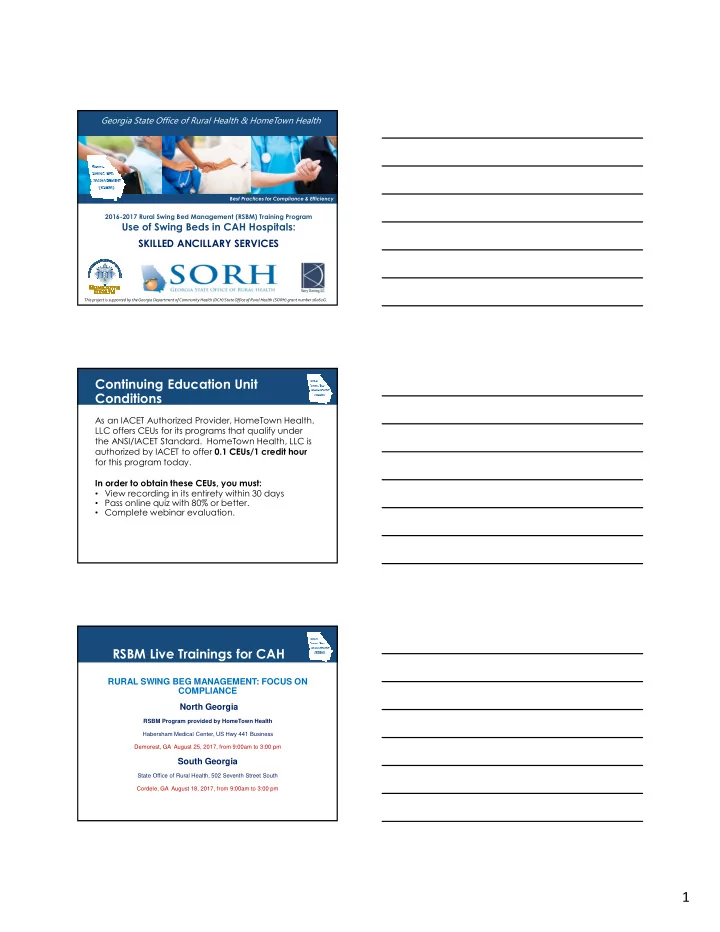
Georgia State Office of Rural Health & HomeTown Health Best Practices for Compliance & Efficiency 2016-2017 Rural Swing Bed Management (RSBM) Training Program Use of Swing Beds in CAH Hospitals: SKILLED ANCILLARY SERVICES This project


slide-1
SLIDE 1

1

Georgia State Office of Rural Health & HomeTown Health

This project is supported by the Georgia Department of Community Health (DCH) State Office of Rural Health (SORH) grant number 16062G.

2016-2017 Rural Swing Bed Management (RSBM) Training Program

Use of Swing Beds in CAH Hospitals: SKILLED ANCILLARY SERVICES

Best Practices for Compliance & Efficiency

Continuing Education Unit Conditions

As an IACET Authorized Provider, HomeTown Health, LLC offers CEUs for its programs that qualify under the ANSI/IACET Standard. HomeTown Health, LLC is authorized by IACET to offer 0.1 CEUs/1 credit hour for this program today. In order to obtain these CEUs, you must:

  • View recording in its entirety within 30 days
  • Pass online quiz with 80% or better.
  • Complete webinar evaluation.

RSBM Live Trainings for CAH

RURAL SWING BEG MANAGEMENT: FOCUS ON COMPLIANCE North Georgia

RSBM Program provided by HomeTown Health Habersham Medical Center, US Hwy 441 Business Demorest, GA August 25, 2017, from 9:00am to 3:00 pm

South Georgia

State Office of Rural Health, 502 Seventh Street South Cordele, GA August 18, 2017, from 9:00am to 3:00 pm

slide-2
SLIDE 2

2

Agenda

Welcome & Introduction

Desi Barrett, Webinar Program Manager

CAH Swing Bed Presentation: Skilled Ancillary Services

Kerry Dunning RSMB Program Trainer Kerry Dunning, LLC

Next Steps Dashboard & Calendar

Desi Barrett, Webinar Program Manager

RSBM Program Trainer Kerry Dunning LLC

  • Ms. Dunning has 20 years in health care consulting and over 30 years in the industry.
  • She specializes in the post-acute market working with hospital based skilled nursing

and swing bed programs, critical access hospitals, freestanding skilled facilities, inpatient/outpatient rehab programs, inner city teaching hospitals and rural health care systems.

  • Ms. Dunning worked for HCA and HealthTrust hospitals in administrative roles;

Horizon Rehabilitation and ServiceMaster Rehabilitation as a Sr. Vice President and Chief Operating Officer; with GPS Healthcare as the Chief Senior Services Officer; and has spent more than 20 years as an independent consultant.

  • In addition to serving as an Adjunct Instructor in the College of Health at the

University of North Florida, Ms. Dunning regularly leads workshops and webinars regarding Medicare, skilled nursing (including MDS), swing bed programming, and reimbursement cycle improvement. She also works on international health care projects and research.

  • Her favorite job is on-site helping facilities take better care of patients.

Kerry Dunning, MHA, MSH, CPAR, RAC-CT Kerry Dunning LLC CAH June 2017

slide-3
SLIDE 3

3

Kerry Dunning has no proprietary interest in any product, instrument, device, service, or material discussed during this learning event. The education offered by Kerry Dunning, LLC in this program is compensated by the Georgia Department of Community Health (DCH) State Office of Rural Health (SORH) under grant number 16062G.

Based upon Center for Medicare and Medicaid (CMS) Swing Bed Providers guidelines, Georgia State Office of Rural Health identified needs, and hospital based skilled nursing and swing bed program best practices, participants will be able to:

  • 1. Recall CMS, OIG and MedPAC data regarding ancillary services

usage

  • 2. Recognize the required documentation to support ancillary services

being provided

  • 3. Understand the importance of physician documentation to support

ancillary service usage

  • 4. Comprehend SNF consolidated billing provisions set forth by

Medicare for CAH hospitals.

  • 5. Explain how to set up a self-audit of ancillary services, including

tracking usage by physicians

9

RCS – expected in 18 months

slide-4
SLIDE 4

4

Swing beds must follow skilled nursing

guidelines but the rules are not always well defined.

CAH swing beds must be vigilant in

understanding Medicare intent, documenting to CMS standards, and achieving measurable

  • utcomes

Staff need to understand cost and how it is

matched to medical necessity

10 11

SWING BED GUIDELINES

USED TO BE THE ONLY GUIDELINES THE RULES HAVE CHANGED Enrolled in Medicare Part A Medicare Advantage follow Medicare intent but insurance is a separate product Benefit days available to use Applies to Medicare and MC Advantage 3-day qualifying acute inpatient admission Required by Medicare A; others vary from 1 to 3; some headed for no qualifying hx stay Qualifying condition

  • Services must be provided for a

condition which was treated during the qualifying acute inpatient admission;

  • r
  • Arose while the patient was in the

swing bed for treatment of another condition for which the patient had been previously treated in a hospital The qualifiers have not changed f

  • Important that diagnoses documented

during stay (including thx treatment codes) are captured on the claim

  • Still true for Medicare A but used less

because of reduced LOS Within 30 days of discharge Medicare A but insurance has to be pre-certed Requires daily skilled nursing services or skilled rehabilitation which can only be provided in a SNF or Swing Bed All payors will consider Home Health or Outpatient services as an alternative to the more expensive inpatient stay

Ancillary “defines” why the complexity is such that the service can only be provided in a SWB BUT Ancillary cost “drives” the expenses that can cost more than the reimbursement CMS

  • Non-therapy services costs comprise about 25% of the daily costs of

care for Medicare SNF residents

  • An ALJ determined that Medicare paid for the hospital services under

Part B as outpatient and ancillary charges and, therefore, Medicare would not cover the SNF services because the beneficiary did not have a three-day qualifying inpatient hospital stay.

OIG

  • According to Medicare reimbursement rules, supplies and services that

can be considered ancillary are limited to only those supplies and services that are directly identifiable to an individual patient, furnished at the direction of a physician because of special medical needs, and are either not reusable, represent a cost for each preparation, or are complex medical equipment.

MedPAC

  • SNF Therapy Costs, and as a subset how other ancillary services are

paid, and is the patient getting all services needed

12

slide-5
SLIDE 5

5

In 2011, Medicare spent nearly $32 billion on skilled nursing care* Skilled nursing facilities offer:

  • Post-hospital and post-surgical care
  • Assistance with activities of daily living
  • Incontinence, catheter & colostomy care
  • Individualized care plans
  • Medication administration and IV services
  • Therapeutic and special diets
  • Diabetic management
  • Medical supplies and durable medical equipment during the stay
  • Restorative Rehabilitation services (SNF)
  • PT/OT/Speech-language pathology services
  • Pharmacy
  • Ambulance transportation

*Source: Medicare Payment Advisory Commission

13

“SNF” regulations are the standard for any SWB program

Ancillary services fall into three broad categories:

diagnostic, therapeutic and custodial.

  • If your physician sends you for an x-ray of your injured

leg, she is using a diagnostic ancillary service

  • If after repairing the bone in your leg, she sends you to a

physical therapist for proper exercise routines, she is using a therapeutic ancillary service

  • Nursing homes providing custodial care are an ancillary

service also

Non-therapy diagnostic tests and other typically

Part B services are provided in the skilled setting

14

CAHs have a 25 bed limit CAH-based swing beds are cost-reimbursed No MDS assessments are required CAH SWBs are exempt from SNF PPS Consolidated

Billing provisions

BUT

The Atlanta Regional Office is now supplying at least

  • ne different interpretation of extraordinary cost and

not consistent with the scope of services offered at the skilled level of care

15

slide-6
SLIDE 6

6

  • Although the Skilled Nursing Facility Prospective Payment System (SNF PPS) bundling

rules do not apply to CAHs, the hospital bundling rules apply to CAHs (section 1862(a)(14) of the Social Security Act). Section 1862(a)(14) is implemented in the regulations at Title 42 Section 415.11(m) of the Code of Federal Regulations (CFR). The title of 42 CFR 415.11 is “Particular services excluded from coverage.”

  • (m) Services to hospital patients—(1) Basic rule. Except as provided in paragraph

(m)(3) of this section, any service furnished to an inpatient of a hospital or to a hospital

  • utpatient (as defined in §410.2 of this chapter) during an encounter (as defined in

§410.2 of this chapter) by an entity other than the hospital unless the hospital has an arrangement (as defined in §409.3 of this chapter) with that entity to furnish that particular service to the hospital's patients. As used in this paragraph (m)(1), the term “hospital” includes a CAH.

  • (2) Scope of exclusion. Services subject to exclusion from coverage under the provisions
  • f this paragraph (m) include, but are not limited to, clinical laboratory services;

pacemakers and other prostheses and prosthetic devices (other than dental) that replace all or part of an internal body organ (for example, intraocular lenses); artificial limbs, knees, and hips; equipment and supplies covered under the prosthetic device benefits; and services incident to a physician service.

16

(3) Exceptions. The following services are not excluded from coverage: (i) Physicians' services that meet the criteria of §415.102(a) of this chapter for payment on a reasonable charge or fee schedule basis. (ii) Physician assistant services, as defined in section 1861(s)(2)(K)(i) of the Act, that are furnished after December 31, 1990. (iii) Nurse practitioner and clinical nurse specialist services, as defined in section 1861(s)(2)(K)(ii) of the Act. (iv) Certified nurse-midwife services, as defined in section 1861(ff) of the Act, that are furnished after December 31, 1990. (v) Qualified psychologist services, as defined in section 1861(ii) of the Act, that are furnished after December 31, 1990. (vi) Services of an anesthetist, as defined in §410.69 of this chapter. CMS reads these regulations to say that if the services are provided under arrangement to the CAH patient, then the CAH bills for the service and would be paid accordingly based on costs. If not, the separate entity would bill for the

  • service. If the ESRD facility is providing dialysis to the CAH swing bed patient under

arrangement, the CAH bills for the service. If not, the ESRD facility would bill for the service. Lana Dennis/CMS/Atlanta Regional Office

17

On May 1, you asked about several services provided to a CAH swing bed patient. I offered the initial information below and indicated I would research your inquiry further. Currently, the technical advisor of the Center for Medicare’s Chronic Care Policy Group/Division of Institutional Post- Acute Care and the acting director of the Division of Acute Care within the Center for Medicare’s Hospital and Ambulatory Policy Group are discussing this. I will provide you additional information as soon as I can.

18
slide-7
SLIDE 7

7

CAH SWBs are treated as SNF and subject to:

  • SNF Part A coverage, deductible, coinsurance
  • Physician certification/recertification provisions

Extended Care services must be provided directly or under

arrangement

  • Nursing care provided by or under supervisions of registered

professional nurse

  • Room and Board
  • PT, OT, ST
  • Medical Social Services
  • Drugs, biologicals, supplies, appliances and equipment, furnished for use

in the SWWB

  • Other services necessary to the health of the patients as are generally

provided by SNFs, or by others under arrangement

All Services outside the extended care scope will remain on the

claim (services will be reimbursed at cost)

19

“Emergency” services are defined in the regulations at 42 CFR 424.101

as “. . . services that are necessary to prevent death or serious impairment of health and, because of the danger to life or health, require use of the most accessible hospital available and equipped to furnish those services.”

In this context, “false alarm” situations may occasionally arise, in

which the initial assessment of a beneficiary’s condition as life- threatening subsequently proves to be unfounded (for example, where a patient’s chest pain and shortness of breath initially appear to be symptoms of a heart attack, but upon subsequent examination turn out to be merely a bad case of indigestion).

Such situations still qualify for the emergency services exclusion from

SNF CB as long as the initial symptoms provided a reasonable basis for assuming the onset of a medical emergency, even though this assumption ultimately was not borne out by subsequent events.

20

Ensuring orders from qualified practitioners with

appropriate diagnostic justification (i.e., medically necessary services) is an ongoing challenge for healthcare providers, particularly with diagnostic testing.

IF the diagnosis codes are not justified, then the

medical necessity for the services may be questioned and overpayments determined.

21

slide-8
SLIDE 8

8

The two most expensive services paid within the RUG per

diem allowed

  • The acuity level of patients in skilled settings continues to rise
  • The number of medications per patient is increasing
  • The demand for and the demand for skilled services is projected to

dramatically rise due to the aging population

The U.S. Health Care System loses billions of dollars

annually manufacturing, distributing, and disposing of unused medications

  • The estimated cost of unused medications for the more than 2.5

million residents in nursing homes is estimated to be more than one billion dollars annually.

  • On average, the average cost of medication waste per resident is over

$500 per year.

22

  • Medications only brought into the skilled nursing facility by patients may be utilized

upon a written order from the patient's physician.

  • All medications brought into the skilled nursing facility and utilized by inpatients will

be verified by a Pharmacist as the proper medication prior to administration.

  • Only upon a written order from the patient's physician may a patient use his/her home medication. The

usual information for a drug order is required (i.e. drug name, strength, dose, directions). For their safety, patients cannot keep any medications at their bedside. 'Patient may take own med' is not considered a valid order and should be revised with the physician. A revised order must be written in the patient's chart.

  • The medications are entered on to the electronic health record with the notation "Home

Meds" state that the medication has been identified and the location where the medications will be stored. There is not a charge for administration of these medications

OR

  • If your stay in a nursing home is being covered under the Medicare Skilled Nursing

Facility (SNF) benefit, your prescription drugs will be covered by Medicare Part A, not by your Medicare private drug plan (Part D).

23

In December 2006, CMS released updated surveyor guidance

for unnecessary drugs (greatly expanded from earlier OBRA guidelines), focusing on the resident’s entire medication regimen and the components of medication management:

1.

Indication

2.

Monitoring, dosage

3.

Duration

4.

Attempts to discontinue or reduce dosage

5.

Prevention, identification and response to adverse consequences.

24

slide-9
SLIDE 9

9

Thus, medications lacking a diagnosis for use can be

deemed “Unnecessary”, causing a denial in payment.

SOM Appendix PP/ F-tag 329 states “each resident’s

regimen must be free from unnecessary drugs. An unnecessary drug is any drug when used: (i) in excessive dose (including duplicate therapy or (ii) for excessive duration or (iii) without adequate monitoring or (iv) without indications for its use. NOTE: this guidance applies to all categories of medications including antipsychotic medications”.

25

Every year there are more tests available for doctors to

  • rder.

What are the required components of a valid physician

  • rder?
  • Physicians should sign all orders for diagnostic services to avoid

potential denials.

  • If the signature is missing on a progress note, which supports intent,

the ordering physician must complete an attestation statement and submit it with the response.

  • Should include beneficiary name, order date, specific tests ordered,

and valid provider signature.

What is documentation of intent to order?

  • A progress note or office note to support intent (tests to be performed

should be clearly indicated).

26

Following the RAI manual for guidance: make

certain that you record all time spent in the patient’s room when conducting each treatment.

These services can be provided by nursing

(competency based) as well as RT

Nebulizer and “skilled” level of care have

been questioned

27

slide-10
SLIDE 10

10

§483.25(i) Nutrition Based on a resident’s comprehensive assessment, the

facility must ensure that a resident--

§483.25(i)(1) Maintains acceptable parameters of

nutritional status, such as body weight and protein levels, unless the resident’s clinical condition demonstrates that this is not possible; and

§483.25(i)(2) Receives a therapeutic diet when there is

a nutritional problem.

28

INTENT: §483.25(i) Nutritional Status The intent of this requirement is that the resident maintains,

to the extent possible, acceptable parameters of nutritional status and that the facility:

Provides nutritional care and services to each resident,

consistent with the resident’s comprehensive assessment;

Recognizes, evaluates, and addresses the needs of every

resident, including but not limited to, the resident at risk or already experiencing impaired nutrition; and

Provides a therapeutic diet that takes into account the

resident’s clinical condition, and preferences, when there is a nutritional indication.

29

Although the Resident Assessment Instrument (RAI) is the

  • nly assessment tool specifically required, a more in-depth

nutritional assessment may be needed to identify the nature and causes of impaired nutrition and nutrition-related risks.

The assessment will identify usual body weight, a history of

reduced appetite or progressive weight loss or gain prior to admission, medical conditions such as a cerebrovascular accident, and events such as recent surgery, which may have affected a resident’s nutritional status and risks.

What are the appropriate diagnoses needed?

30

slide-11
SLIDE 11

11

Consistent with the symptoms or diagnoses of the

illness or injury under treatment

Necessary and consistent with generally accepted

professional medical standards (i.e., not experimental

  • r investigational)

Not furnished primarily for the convenience of the

patient, the attending physician, or the family

Furnished at the most appropriate level that can be

provided safely and effectively to the patient

31

  • COMPREHENSIVE ASSESSMENT
  • The facility must conduct initially and

periodically a comprehensive, accurate, standardized, reproducible assessment of each resident’s functional capacity.

  • COMPREHENSIVE CARE PLAN
  • An OIG report found that SNFs did not

meet quality-of-care requirements.

  • 37 percent of SNF stays in 2009, either the

plan did not meet Medicare requirements or the care was not administered according to the plan.

  • Medicare paid approximately $4.5 billion

for stays that had such care-plan problems.

  • DISCHARGE PLANNING
  • Determining the appropriate post-hospital

discharge destination for a patient

  • Identifying what the patient requires for a

smooth and safe transition from the acute care hospital/post-acute care facility to his or her discharge destination

  • Beginning the process of meeting the patient’s

identified pre- and post-discharge needs

32

Discharge Planning If the physician does not document medical necessity

for ancillary services in their progress notes and the nurses obtain telephone orders from the physicians for ancillary services, the nurses ask the physicians for a diagnosis/reason associated with the ancillary service.

Skilled programs must pay attention to ancillary

cost by reviewing the costs each month

  • The standardized ancillary cost is $116/day (MedPAC

2015)

33

slide-12
SLIDE 12

12

Develop a Medicare educational program for all staff,

not only at the time of hire but also yearly.

Review Medicare documentation weekly. Provide ongoing mentoring of your nursing staff. Review the updated Medicare Benefit Policy Manual

for Extended Care SNF Services.

Commit, as a leader, to guarantee your systems truly

reflect the Medicare documentation standards.

34

  • 1. To be complete. (This implies a need to go beyond a rational diagnostic

process.)

  • 2. The “they say” excuse. (Who are “they” and do they really say that?
  • 3. The “we’ll get in trouble if we don’t” excuse.
  • 4. The “if we don’t order everything at once, it won’t get done” excuse,

commonly given in large city hospitals.

  • 5. The “as long as he is in the hospital, we might as well” excuse.
  • 6. The “academic” excuse. The false idea that the evaluation of a patient should

be somehow different or more complete in an academic institution.

  • 7. The “malpractice” excuse.
  • 8. The “protocol” excuse: the patient is a candidate for a study that requires these

tests for its protocol.

  • 9. The “if it were my mother or father, I’d want it done” excuse.
  • 10. The “how do we know he doesn’t have it?” excuse.
  • 11. The “knowledge is good” excuse.
  • 12. The “fishing expedition.” (I don’t have any idea what’s wrong with this

patient, but maybe if I order a lot of tests, something will turn up.)

35

For

  • Medical Necessity
  • Appropriate documentation
  • Results of tests provided to physicians timely

Who reviews? What education is provided? Bottom line – can your ancillary services pass the test

  • f need, cost efficiency and outcomes?
  • How do you know?

36

slide-13
SLIDE 13

13

  • Services were delivered by the institution in compliance with the Physician’s plan of treatment
  • Services are documented in health or other appropriate records as having been rendered to the

patient

  • Charges are reported on the bill accurately
  • The health record documents clinical data on diagnoses, treatments and outcomes. It was not

designed to be a billing document. A patient health record generally documents pertinent information related to care. The health record may not back up each individual charge on the patient

  • bill. Other signed documentation for services provided to the patient may exist within the

provider’s ancillary departments in the form of department treatment logs, daily charges records, individual service/order tickets, and other documents.

  • Auditors may have to review a number of other documents to determine valid charges. Auditors

must recognize that these sources of information are accepted as reasonable evidence that the services ordered by the physician were actually provided to the patient.

  • Providers must ensure that proper policies and procedures exist to specify what documentation

and authorization must be in the health record and in the ancillary records and/or logs.

  • These procedures document that services have been properly ordered for and delivered to
  • patients. When sources other than the health record are providing such documentation, the provider

should make those sources available to the auditor.

37

Based upon Center for Medicare and Medicaid (CMS) Swing Bed Providers guidelines, Georgia State Office of Rural Health identified needs, and hospital based skilled nursing and swing bed program best practices, participants will be able to:

  • 1. Recall CMS, OIG and MedPAC data regarding ancillary services

usage

  • 2. Recognize the required documentation to support ancillary services

being provided

  • 3. Understand the importance of physician documentation to support

ancillary service usage

  • 4. Comprehend SNF consolidated billing provisions set forth by

Medicare for CAH hospitals.

  • 5. Explain how to set up a self-audit of ancillary services, including

tracking usage by physicians

Upcoming Live Sessions!

▪ Live RSBM Training Workshops & Hospital Consults: Focus on Compliance ▪ Includes: Swing Bed Basics, Medicare Intent, MDS and RAI Manual, RUGs/CAH Reimbursement, Medical Necessity Documentation, Case Studies/Small Groups, Identified Issues Review August 18, 2017 – Cordele, GA August 25, 2017 – Demorest, GA Registration now available on your program dashboard!

slide-14
SLIDE 14

14

Program Dashboard & Ongoing Communication

Online Dashboard: www.hthu.net/swingbedcah Password Protected: cah Ongoing Email Communication will come from HomeTown Health on a monthly basis.

Your RSBM Team

Kerry Dunning,

Trainer & Program Director, Kerry Dunning, LLC

Jennie Price,

Director of Business Development, HomeTown Health University

Desi Barrett,

Webinar Program Manager, HomeTown Health

Kristy Thomson,

COO HomeTown Health

Contact Information

Desi Barrett, Webinar Program Manager

hthtech@hometownhealthonline.com

Kristy Thomson, COO Kristy.Thomson@hometownhealthonline.com Jennie Price, Director of Business Development Jennie.price@hometownhealthonline.com Kerry Dunning, RSBM Program Trainer Kerry.dunning@kerrydunningllc.com