1/8/2014 Pancreas 1,2,3 Functions: Secretes insulin which assists - - PDF document

1 8 2014
SMART_READER_LITE
LIVE PREVIEW

1/8/2014 Pancreas 1,2,3 Functions: Secretes insulin which assists - - PDF document

1/8/2014 Pancreas 1,2,3 Functions: Secretes insulin which assists w/ glucose transport Secretes glucagon which assists with breakdown Diabetes Mellitus of glycogen in liver Barclay Dugger MEd, ATC, LAT Review on the pancreas What


slide-1
SLIDE 1

1/8/2014 1

Diabetes Mellitus Barclay Dugger MEd, ATC, LAT

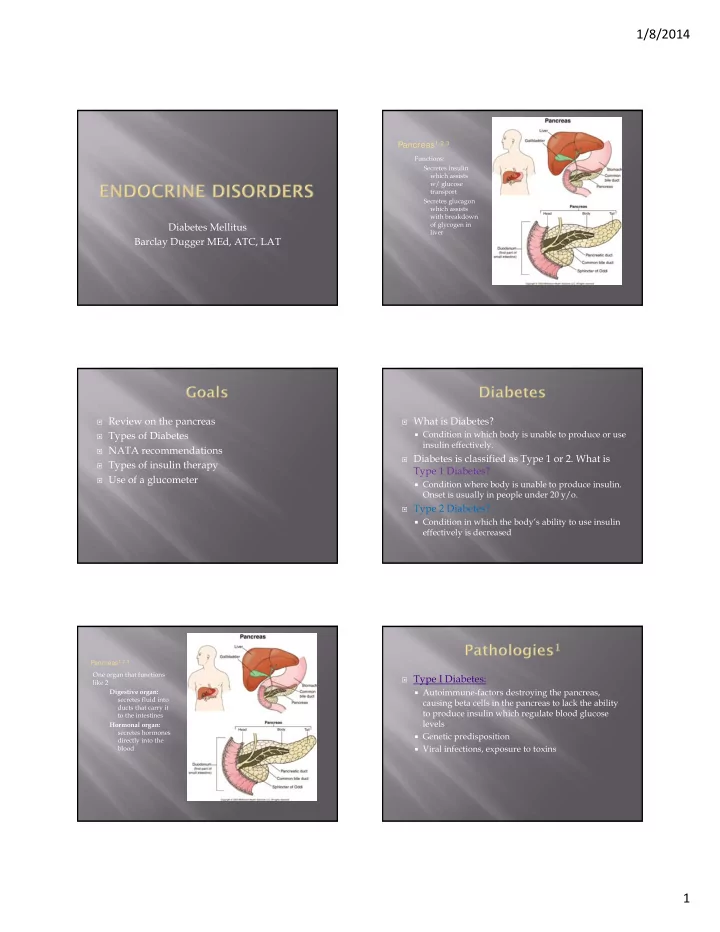
 Review on the pancreas  Types of Diabetes  NATA recommendations  Types of insulin therapy  Use of a glucometer Pancreas1,2,3 One organ that functions like 2 Digestive organ: secretes fluid into ducts that carry it to the intestines Hormonal organ: secretes hormones directly into the blood

Pancreas1,2,3

Functions: Secretes insulin which assists w/ glucose transport Secretes glucagon which assists with breakdown

  • f glycogen in

liver  What is Diabetes?  Condition in which body is unable to produce or use

insulin effectively.

 Diabetes is classified as Type 1 or 2. What is

Type 1 Diabetes?

 Condition where body is unable to produce insulin.

Onset is usually in people under 20 y/o.

 Type 2 Diabetes?  Condition in which the body’s ability to use insulin

effectively is decreased

 Type I Diabetes:  Autoimmune-factors destroying the pancreas,

causing beta cells in the pancreas to lack the ability to produce insulin which regulate blood glucose levels

 Genetic predisposition  Viral infections, exposure to toxins

slide-2
SLIDE 2

1/8/2014 2

 Type II Diabetes:  What is it? Pancreas produces adequate insulin but insulin

receptors are not working properly  Complications-concerns? No cure; increased fat in blood, commonly associated with obesity, ateriosclerosis, peripheral neuropathy, chronic infections, osteoporosis  How can you detect it? Monitoring blood glucose levels

 Type I & Type II Diabetes:  Signs/symptoms?

 Polydipsia (excessive thirst)  Polyphagia (excessive hunger)  Polyuria (frequent urination)  weight loss  may present initially with ketoacidosis

 Type I Diabetes:  What is ketoacidosis?  When the body is unable to move glucose from the blood to

the cells, it turns to fats as an energy source  Ketones are produced as a by product of the breakdown of fats for fuel  These toxic acids build up in the blood and eventually spill

  • ver into the urine

 Ketones are responsible for the fruity odor noticed on the breaths of persons suffering from extreme hyperglycemia and DKA

Time Measurement Taken Blood Serum Levels After fasting for 8 hours 60-80mm/dl 2-3 hours after fasting 100-140 mm/dl Random and unplanned Less than 126

Normal Blood Glucose Levels Abnormal Blood Glucose Levels

 Each athlete with diabetes should have a

diabetes care plan that includes blood glucose monitoring and insulin guidelines, treatment guidelines for hypoglycemia and hyperglycemia, and emergency contact information.

slide-3
SLIDE 3

1/8/2014 3

 Hypoglycemia typically presents with

tachycardia, sweating, palpitations, hunger, nervousness, headache, trembling, or dizziness; in severe cases, loss of consciousness and death can occur.

 Mild hypoglycemia (the athlete is conscious

and able to swallow and follow directions) is treated by administering approximately 10–15 g of carbohydrates (examples include 4–8 glucose tablets or 2 tablespoons of honey) and reassessing blood glucose levels immediately and 15 minutes later.

 Severe hypoglycemia (the athlete is

unconscious or unable to swallow or follow directions) is a medical emergency, requiring activation of emergency medical services (EMS) and, if the health care provider is properly trained, administering glucagon.

 Physicians should determine a safe blood

glucose range to return an athlete to play after an episode of mild hypoglycemia or hyperglycemia.

 Hyperglycemia can present with or without

  • ketosis. Typical signs and symptoms of

hyperglycemia without ketosis include nausea, dehydration, reduced cognitive performance, feelings of sluggishness, and fatigue.

 Hyperglycemia with ketoacidosis may include the

signs and symptoms listed earlier as well as Kussmaul breathing (abnormally deep, very rapid sighing respirations characteristic of diabetic ketoacidosis), fruity odor to the breath, unusual fatigue, sleepiness, loss of appetite,

 increased thirst, and frequent urination.

 Type I-insulin injections  Type II-diet and exercise  Rapid-acting  Short-acting  Intermediate-acting  Long acting  Pre-mixed  Onset: The amount of time insulin takes to

enter blood stream.

 Peak: Time when insulin is most effective.  Duration: How long the insulin lowers blood

sugar.

slide-4
SLIDE 4

1/8/2014 4

 Rapid-acting- Used at time of meal

Onset= 15-30 minutes Peak= 30-90 Duration= 1-5 hours Drug Name: Humalog, Lispro, Novolog, Aspart, Glulisine.

 Short-acting: Used from a meal to within 1

hour Onset= 30” – 1 hour Peak= 2-5 hours Duration= 2-8 hours Drug Name: Novolin, Vesolulin(insulin pump)

 Intermediate-acting: Used for half a day or

before sleep Onset= 1-2.5 hours Peak= 3-12 hours Duration= 18-24 hours Drugs Name: Lente (L)

 Long-acting: About a full day

Onset= 30” – 3 hours Peak= 6-20 hours Duration= 24-36 hours Drugs Names: Ultralente, Lantus, Levemir, Detemir.

 Pre-mixed: Used twice a day or before meals

Onset= 10-30”, time it takes to enter blood stream Peak= 30”-12 hours, when most effective Duration= 14-24 hours, how long it lowers blood sugar Drug Names: Humulin 70/30, Humulin 50/50, Novolin 70/30, Novolog 50/50,

 http://www.youtube.com/watch?v=s8nzOrbe

M5Q

slide-5
SLIDE 5

1/8/2014 5

Jimenez, C., Corcoran, M.H., Crawley, J.T., Hornsby, W.G., Peer, K. S., Philbin, R.D., & Riddell, M.C. (2007). National athletic trainers’ association position statement: management

  • f the athlete with type I diabetes mellitus.

Journal of Athletic Training, 42 (4), 536-545 Cuppetta, M., Walsh, K. M. (2012) General Medical Conditions in the Athlete (Second Edition) Elsevier-Mosby

slide-6
SLIDE 6

1/8/2014 1

 Overview of pulmonary system  Evaluation of patient with breathing difficultly  Auscultation of lung sounds  Asthma  Exercise Induced Bronchospasm  Spirometer use  Nebulizer use  The pulmonary system is involved primarily in

the exchange of oxygen and carbon dioxide, which are vital in the production of the energy involved in metabolism at the cellular level.

 Respiration can be divided into ventilation and

  • xygenation.
  • a. During ventilation, air moves through the

respiratory tract.

 The upper respiratory tract:  Nasal passages  Paranasal sinuses  Pharynx  Larynx  Responsible for warming, humidifying, and filtering the

air as it reaches the lower respiratory tract

 The lower respiratory tract:  Trachea  Right and left bronchi  Lung parenchyma  History and Inspection

 The first step is to take a thorough history; it

includes questions about how long a problem has existed, what exacerbates the condition, and the severity of symptoms.

 Describe the characteristics of the condition, and

timing of it; shortness of breath should also be noted.

 The chest is inspected after the history is taken.  The examiner inspects the chest for shape and

configuration, including any skeletal deformities, as well as bruising of the ribs or chest wall.

 Respiratory Patterns  Tachypnea: Refers to breathing that has become more rapid than

24 breaths per minute

 Hyperpnea: Refers to a type of tachypnea in which breaths are

usually large and deep, resulting in hyperventilation

 Bradypnea: When breathing slows to fewer than 12 breaths per

minute

 Hypopnea: When breathing becomes slow and shallow and is

seen in an adaptive response to painful situations, such as rib fractures

 Dyspnea: Refers to the subjective sensation of difficulty in

breathing or shortness of breath

 Orthopnea: Describes a type of dyspnea that begins or increases

as the patient lies down

slide-7
SLIDE 7

1/8/2014 2

 Respiration Patterns  Breathing involves several simultaneous patterns.  Decreases in pH as well as corresponding increases

in carbon dioxide result from normal cellular metabolism and stimulate an increase in ventilation to remove these by-products.

 Neural control of breathing comes from the phrenic

nerve, which arises from cervical nerve roots C3, C4, and C5.

 Auscultation  Auscultation is the skilled listening by a trained ear

for sounds produced by the body.

 Perform auscultation after history, observation, and palpation in order to gather as much information as possible first.  Perform in a quiet environment.  Listen for the presence or absence of sounds as well as their frequency, loudness, quality, and duration.  Make sure the earpieces of the stethoscope fit comfortably, and point the earpieces toward the face.

 The examiner must listen systematically at each

position throughout inspiration and expiration and evaluate lungs in the anterior, posterior, and lateral aspects to ensure that each lobe of the lungs is properly examined.

 When the athletic trainer listens to the lungs,

three different sounds can be appreciated in normal individuals.

Bronchial breath sounds are loud, high-pitched, and predominantly expiratory.

These sounds represent air moving through large airways and sound more tubular.

Normally heard over the trachea

Bronchiovesicular breath sounds are heard when air moves through medium-sized airways, such as the mainstem bronchi.

Can be heard both anteriorly and posteriorly, toward the center of the thorax

Sounds are of medium pitch and moderate intensity.

Vesicular breath sounds predominate in most of the peripheral lung tissue and represent the air as it moves into the smaller airways, such as the bronchioles.

These sounds are soft, low-pitched noises that involve mostly inspiration.  https://www.youtube.com/watch?v=yFWWS

IGB6-0

 https://www.youtube.com/watch?v=O2yOP

O0NBnM

slide-8
SLIDE 8

1/8/2014 3

 Most of the abnormal breath sounds heard will be

superimposed on normal breath sounds and are called adventitious breath sounds.

 Crackles, or rales, are adventitious sounds that occur as

a result of disruption of airflow in the smaller airways, usually by fluid.

 Wheezes are also adventitious sounds that represent

airway obstruction from mucus, spasm, or even a foreign body.

 Stridor is also cause by airway obstruction and can

  • ften be confused with wheezing.

 Pleural rubs are sounds that occur outside the

respiratory tree and result from friction between visceral and parietal pleura in conditions that cause inflammation of the pleura, such as pleurisy.

 http://www.youtube.com/watch?v=UMqkhV

h6Eb8

 http://www.wilkes.med.ucla.edu/lungintro.h

tm

 http://www.cvmbs.colostate.edu/clinsci/calla

n/breath_sounds.htm

 Asthma is a pulmonary disorder characterized by

reversible airway obstruction that results from hyperreactivity of the bronchial –wall smooth muscles causing narrowing, edema, and inflammation of the mucous membrane which produces excess mucous.

 Allergens, stress or anxiety, smoke or other

environmental pollutants, cold ambient temperatures, and even exercise commonly trigger this hyperreactivity.

 Asthma generally has two components:  Inflammation, characterized by mucosal edema and increased

secretions

 Bronchospasm of smooth muscle, resulting in an increase in

airway resistance and impeded flow

 Signs and Symptoms  Episodic, paroxysmal attacks of shortness of breath and

wheezing as well as other symptoms, such as chest tightness and dry cough

 Episodes can be transient, lasting a few minutes to hours, or

prolonged over several days.

 Severe attacks can be associated with much respiratory distress

and tachypnea.

 Wheezing may be audible by the unaided ear in some cases.  Mild cases may present only as a chronic cough.  On examination, both the respiratory rate and heart rate may be

elevated, depending on the severity of the condition.  Referral and Diagnostic Tests  Response to β-agonist medications, such as albuterol.  A decrease in the predicted forced expiratory

volume within the first second (FEV1) as measured by spirometry, is considered the “gold standard” for diagnosis.

 A peak flow meter provides a quick record of

pulmonary function and can be used to help assess the severity of the asthma or the effectiveness of medication.
slide-9
SLIDE 9

1/8/2014 4

 Differential Diagnosis  Asthma should be differentiated from other upper

and lower respiratory diseases, including laryngeal dysfunction, croup, infiltrative lung disease, and even foreign body aspiration.

 The examiner must always consider cardiac failure,

chronic obstructive pulmonary disease, or airway tumors, especially in smokers.

 Treatment  Inhaled β-agonist medications, both long and short

acting, are the mainstays in the treatment of asthma.

 Attention needs to be given to the avoidance of

known triggers and treatment of allergies.

 Other medications used to treat asthma include:  Oral and inhaled steroids  Prognosis and Return to Participation  In general, athletes with mild asthma may

participate in most sports.

 Athletes might prefer sports that involve

competition in warm temperate climates.

 Individuals with moderate to severe asthma are

unlikely to be involved in vigorous activities because their performance will be limited.

 Symptoms usually occur 10 to 15 minutes after

the onset of exercise and are defined by a fall in FEV1 of 15% or more during exercise.

 EIB occurs in about 80% to 90% of patients with

intrinsic asthma.

 EIB is more common in athletes who compete

in cold ambient temperatures.

 Signs and Symptoms  Shortness of breath, wheezing, chest congestion,

flared nostrils, hyperventilation, pallor and diaphoresis.

 Dry cough that develops after practice or exercise

(locker-room cough).

 Unusual fatigue compared with similarly trained

athletes; will often complain that they feel out of shape despite regular training

 Differential Diagnosis  Acute sinusitis, otitis media, bronchitis, or even

pneumonia need to be excluded.

 Environmental allergies can account for many of the

nonspecific symptoms that mimic EIB.

slide-10
SLIDE 10

1/8/2014 5

 Treatment  Inhaled β2-agonist (e.g., albuterol) from a metered-

dosed inhaler, taken 15 to 30 minutes before the

  • nset of exercise.

 Pre–warm-up bursts of physical activity at 80% to

90% of the individual’s maximal workload to induce a refractory period that lasts up to 3 hours after the initial attack of EIB.

 Prognosis and Return to Participation  Athletes with controlled EIB need not be excluded or

discouraged from participation.

 Asthma Identification & Diagnosis  Pulmonary Function Testing (VO2 max)  Asthma Management Plan into the EAP  Asthma Pharmacologic & Non-Pharmacologic

Treatment

 Asthma Education

https://www.youtube.com/watch?v=CrZPvtdX6go

https://www.youtube.com/watch?v=xxWayVVT-PA

 Baker, R., Collins, J., D’Alonzo, G., Miller, M.

G., Weiler, J. M. (2005). National athletic trainers association position statement: Management of asthma in athletes. Journal

  • f Athletic Training , 40 (3), 224-245.

 Cuppetta, M., Walsh, K. M. (2012) General

Medical Conditions in the Athlete (Second Edition) Elsevier-Mosby