1/7/2020 Disclosures Effective Grassroots Involvement in the - - PDF document

1 7 2020
SMART_READER_LITE
LIVE PREVIEW

1/7/2020 Disclosures Effective Grassroots Involvement in the - - PDF document

1/7/2020 Disclosures Effective Grassroots Involvement in the Policymaking Process I Heidi Ecker, have no conflicts of interest or financial Heidi Ann Ecker relationships to disclose. Senior Director of Government Affairs & Political


slide-1
SLIDE 1

1/7/2020 1

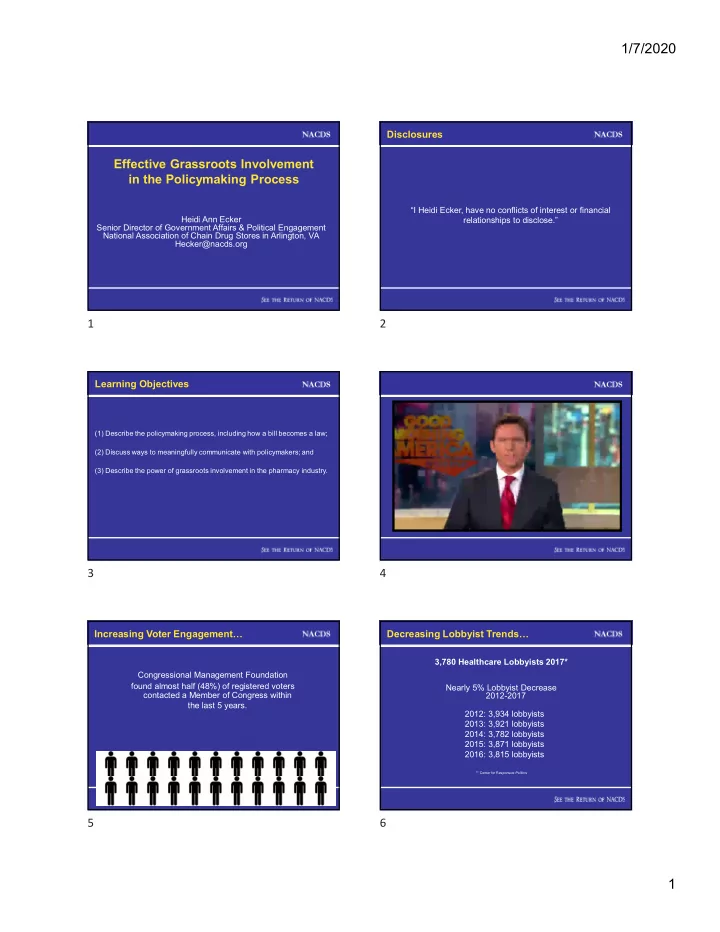
Effective Grassroots Involvement in the Policymaking Process

Heidi Ann Ecker Senior Director of Government Affairs & Political Engagement National Association of Chain Drug Stores in Arlington, VA Hecker@nacds.org

Disclosures

“I Heidi Ecker, have no conflicts of interest or financial relationships to disclose.”

(1) Describe the policymaking process, including how a bill becomes a law; (2) Discuss ways to meaningfully communicate with policymakers; and (3) Describe the power of grassroots involvement in the pharmacy industry.

Learning Objectives Increasing Voter Engagement…

Congressional Management Foundation found almost half (48%) of registered voters contacted a Member of Congress within the last 5 years.

Decreasing Lobbyist Trends…

Nearly 5% Lobbyist Decrease 2012-2017 2012: 3,934 lobbyists 2013: 3,921 lobbyists 2014: 3,782 lobbyists 2015: 3,871 lobbyists 2016: 3,815 lobbyists

** Center for Responsive Politics

3,780 Healthcare Lobbyists 2017*

1 2 3 4 5 6

slide-2
SLIDE 2

1/7/2020 2

Shifting Power to Voters…

Increased campaign finance and lobby reforms More issues, more ways to keep informed “Recount” elections show 1 vote matters Policymakers more accountable to “the people” The Result? Flourishing grassroots…

Grassroots: Powerful voter opinions that “personify” policy impact and influence policy outcomes. Barriers to Involvement

  • Having the time to act in a busy workday
  • Policy happenings seem far from home
  • Policy changes won’t impact me, my patients
  • What difference can one person really make?
  • I don’t know where to start

What’s Your Role in the Community?

  • Apathetic
  • Intimidated
  • Sympathetic
  • Advocate

If You Vote, You are Engaged! Elections: Nov. 3, 2020

Grassroots Program: Organized effort of like-minded Benefits: Many voices unified strengthens power What it’s Like: Online, Email Updates, Calls to Action

Grassroots Program…

7 8 9 10 11 12

slide-3
SLIDE 3

1/7/2020 3

MEMBERS OF CONGRESS: How leader roles are relevant to issues Your Policymakers

Representing Home

Your Power: Vote in Elections Grant Policymaker Jobs Pharmacy Expert Use Mailing Address, Zip Code: Two U.S. Senators One U.S. Representative

(P.O. Boxes Not Acceptable!)

Your Policymakers

Representing Work

Your Power: Community Jobs Constituents Served Pharmacy Expert Play Role in Your Work/School Community Two US Senators One US Representative

Your Policymakers

Home

Your Power: Vote in Elections Grant Policymaker Jobs Pharmacy Expert Your Power: Community Jobs Constituents Served Pharmacy Expert

Work

U.S. Congress

Comparison House Senate Chamber Size Large (435) Small (100) Party 232 Democrats 198 Republicans 1 Independent 4 Vacancies CA/MD/NY/WI 45 Democrats 53 Republicans 2 Independents Term 2 years 6 years Constituency District area State area Election Less competitive More competitive Partisan More partisan Less partisan

Congress and Your Policymakers

Speaking at Event Party Obligations Committee Meetings Staff Meetings Caucus Gatherings Constituent Meeting

  • Cong. Session (7hr)

Fundraisers

Elected Official’s Daily Life

Votes (1K last yr)

13 14 15 16 17 18

slide-4
SLIDE 4

1/7/2020 4

What Policymakers Care About

Policy impact on constituents To-the-point rationale Supportive data Personal stories Any relative cost savings Know what they care about

Do Your Homework

U.S. Congress – Leadership

President Pro Tempore

  • Sen. Charles Grassley (R-IA)

Majority (Republican) Leader

  • Sen. Mitch McConnell (R-KY)

Majority Whip

  • Sen. John Thune (R-SD)

Minority (Democratic) Leader

  • Sen. Chuck Schumer (D-NY)

Minority Whip

  • Sen. Dick Durbin (D-IL)

NRCC Chairman

  • Rep. Tom Emmer (R-MN)

Four Key Healthcare Committees

Senate Finance Committee: tax-related health programs Medicare, Medicaid, CHIP, other tax-financed programs Senate Health, Education, Labor & Pensions Committee: public health Aging, Biomedical Research/Development, Occupational health House Energy & Commerce Committee: public health Health & Human Services, Federal Trade Commission, Food & Drug Admin. House Ways & Means Committee: tax-related health programs Medicare and Social Security

Other committees could play a role on issues important to pharmacy.

Key Policymakers: Alaska

Newly Elected Members of Congress

  • Sen. Lisa Murkowski (R) HELP
  • Sen. Dan Sullivan (R)
  • Rep. Don Young (R-At Large)

THE POLICYMAKING PROCESS

19 20 21 22 23 24

slide-5
SLIDE 5

1/7/2020 5 Effective Communication

Formal Bill Approval Overview Process is Complicated Don’t Have to Be an Expert in Process/Procedure to Get Involved! Politics & Reality of Policy

2015-2016 Bills Introduced: 12,063 Public Laws Enacted: 329 Percentage of Total: 2.7% 2005-2006 Bills Introduced: 13,068 Public Laws Enacted: 483 Percentage of Total: 3.6%

*Source: Resume of Congressional Record Activity Congressional Record

MEANINGFUL COMMUNICATIONS: What you need to know before linking constituency – issues – leaders

  • Constituent Connection
  • Your Role to Issue
  • Share Issue Concerns
  • Include a Formal “Ask”
  • Say Thank You

Effective Communications (all vehicles)

Be as Brief as Possible

Meaningful Communications

Approach Research (job,party,support) Long-term relationship Proactive vs. reactive Convo Don’t use professional jargon Never mention political contributions Unanswerable questions great for follow up Going In Don’t be intimidated: you are an expert Presume no exposure to issue Stick to key messages Don’t judge staff (age/title)

We Must be Memorable Given Competition!

Alliance for Quality Nursing Home Care American College of Emergency Physicians American Dental Association American Hospital Association American Medical Association American Nurses Association Amgen Inc AstraZeneca PLC Bayer AG Biotechnology Industry Organization Blue Cross/Blue Shield Bristol-Myers Squibb Eli Lilly & Co GlaxoSmithKline Healthcare-NOW! Medtronic Inc National Association of Social Workers National Physicians Alliance Pharmaceutical Care Management Assn Pharmaceutical Rsrch & Mfrs of America Physicians for a National Health Program Service Employees Shout America UnitedHealth Group

25 26 27 28 29 30

slide-6
SLIDE 6

1/7/2020 6

TOOLS & TACTICS: strategic/effective communication tactics Letter Phone Calls

You: Call Sen/Rep Office (will speak to staff) State Name, Address, Pharmacy Role Speak to Receptionist, Staffer on Issue Briefly Review Issue & Why You Care Staff: Asks name, address (to confirm constituent) Takes notes about your issue/concerns Keeps tally about number of calls on issues Reports call “tally” to team

Meetings

How Meetings are Scheduled What to Expect to Accomplish Meeting Location & Area Length of Each Meeting Who Attends a Meeting Policymaker Schedules are Fluid…Be Prepared for Anything!

Flow of an Effective Meeting

1 Open with introductions / business cards / pleasantries 2 Stress constituency connection 3 Review how your role connects to issue 4 Share issue opinions / supportive stories 5 Point to “Leave Behind” packet for details 6 Entertain questions, but only if you know answer 7 Directly ask office to support the issue 8 Close with: (1) forward requested details; (2) always available resource; and (3) provide thanks

31 32 33 34 35 36

slide-7
SLIDE 7

1/7/2020 7

Four Different Meeting Scenarios

Meeting Type A (Agree) Office Reaction: After introducing issue, office agrees Your Response: Reconfirm: “I’m pleased to hear you will support…” Ask them to work other Members to build support Meeting Type B (Blank Canvass) Office Reaction Office not familiar with issue (i.e. new/not aware) Your Response Describe position, ask questions to get feedback Highlight “Leave Behind” as helpful in staff memo-writing

Four Different Meeting Scenarios

Meeting Type C (No Commitment) Office Reaction Office listens, asks few/no questions Noncommittal: “I’ll think about what you have said” Your Response This a common meeting: tell your story Ask questions to see what influences their decision Meeting Type D (Disagree) Office Reaction After introducing the issue, office disagrees Your Response Ask why they may not support Determine if the problem is the issue or politics Agree no bill’s perfect, find out problem part of bill

How to Report on Your Efforts

  • Meetings Can Reveal Important Details
  • Four Types of Meaningful Reporting

1) Advocate Perspective 2) Relationship Perspective 3) Issue Perspective 4) Follow Up Perspective

  • “Recon” Can Happen Anywhere
  • It’s All for Nothing if Not Shared

Establishing a Long-Term Relationship Town Hall Meetings

Purpose of Town Halls Held When Home Announced to Mailing Lists What it’s Like to Attend Benefits: Educate Leader and Public Advocate: Voter, Pharmacy, Issue

Watch one for starters!

Pharmacy Tour Arranging Tour Preparing for Tour Pharmacy Tours

Pharmacy advocates host pharmacy tours for members of the U.S. Congress.

37 38 39 40 41 42

slide-8
SLIDE 8

1/7/2020 8

Regular Interaction with Hill Contacts

  • Write thank you notes
  • Clip Newspapers Articles
  • Write Letter to the Editor
  • Connect to Your District
  • Participate in Home Events

Today is the beginning of a journey…

Which of the following is not accurate about the US Congress?

  • A. The Senate is made of 100 Senators
  • B. The House of Representatives is made of 435 Representatives
  • C. Representatives serve a term of 5 years.
  • D. Senators serve a term of 6 years.
  • 2. How many key healthcare committees are in the US Congress?
  • A. 1 B. 4 C. 8 D. 10
  • 3. What is the most effective mode of communication to a policymaker?
  • A. Phone Call
  • B. Faxed Letter
  • C. Emailed Letter
  • D. Face-to-Face Meeting

Post-Test Questions

  • 4. The following are acceptable policymaker communications except for:
  • A. Political contributions made to his/her campaign
  • B. Directly ask the policymaker to support your bill
  • C. Discuss your connection to the state/district
  • D. Tell personal stories to support your position
  • 5. The following are goals of everyday grassroots communications except for:
  • A. Sharing personal stories to personify policy impact.
  • B. Developing relationships with policymakers and their staff to be a resource

when it comes to pharmacy issues.

  • C. Participating in a 1-time constituent communication about a policy issue.
  • D. Influencing the way that policymakers and their staff view policies.

Post-Test Questions

Heidi Ann Ecker NACDS Senior Director, Government Affairs and Political Engagement Phone: (703) 837-4121 Email: Hecker@nacds.org

…YOU! PHARMACY IS COUNTING ON…

43 44 45 46 47