
SLIDE 1
3
- 1
3 2
- 1
- 1
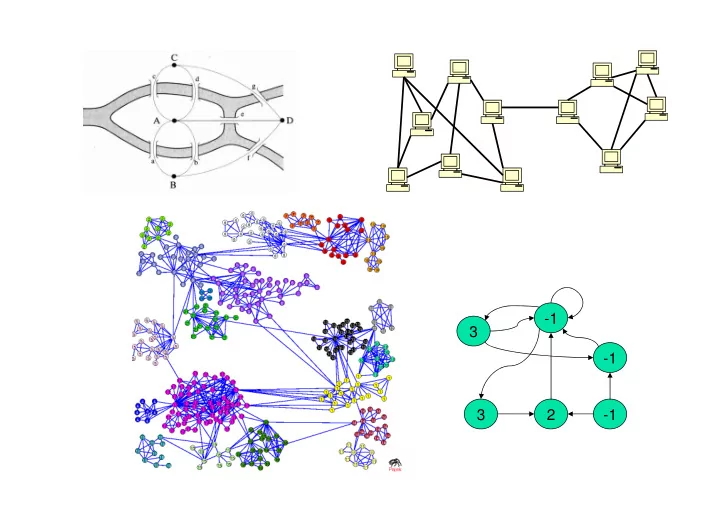
-1 3 -1 3 2 -1 - - PowerPoint PPT Presentation
-1 3 -1 3 2 -1
3
3 2
& '("($)$) ! *+ ,-*-
&
" 3
9
" : '
.
/3 0
< 4
' ' 3
<34 <34 < 4
/ 3 & > > "0
8 3 )0 > )
3 @ ' "33 0 # 9 0 3
A '
*??5" *??+A0 A" %
( B 3 0 & 0 3 C;0
=# *-3 > #
D 33 0C 0 <4 8 '
E "
=0 90B $
1
=# =#
D # C3 0 0 #C
(
3 *: 3 0
&
C C*λ,
=# C
4 ; 0 =# C & #Cλ, ($' *?+7% =#C >
=0 #@ =# =# #
)30$" $& *?++%
=# *?G?%
> 00 )H ; I% = !
=#3 0 3 &
0 $
D D0
(C 8' ' % & $30 0 ' :J=JC"3 0
C ' 0C "3 3 0 C 0 #*
,% 3
!$A ,--L% ' 0 <4 3 ' 0 <4
8
/ 30 .
(
3 #0
84 @ =3 )&$$M0
( 0 ( C;
3
3 2
3 2
time %
%' (
3 2
time time R(t) %
3
time 3 3 3 3
time R(t) %
A C0
C ;
8 3
1 1 1 1 1 1 1 1
&3 0 C 3 &3 0%C
/ # 3 0 ( 0 0 3
#
C C0 ( 0
!"$)$8 I$)3 $
:3
time stability Time 0: single-node communities are optimal Between 0 and 1: Potts model, cut size Time 1: modularity Large times: Fiedler partition is optimal
133 130 6 4 2 1
Time Number
379 21 17 15 5 3 2 24 9 10 16 10 17 4 25 42 22 9 20 29 7 10 16 61 8 20 10
3 0
31 clusters (time=1) 18 clusters (4 ≤ time ≤ 10) 6 clusters (25 ≤ time ≤ 60) 4 clusters (107 ≤ time ≤ 159) 2 clusters (time ≥ 852)
) $3 0$ !3$ E ;)9$M$