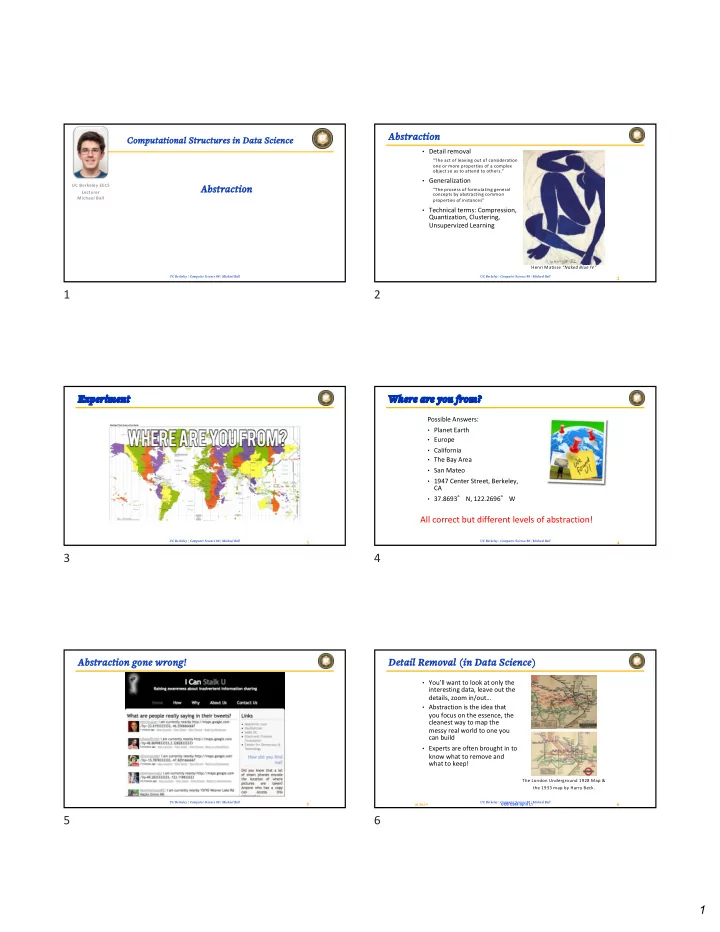
1 2 Ex Experiment Where ar Wh are you from? Possible Answers: - - PDF document

1 2
SMART_READER_LITE
LIVE PREVIEW

1 2 Ex Experiment Where ar Wh are you from? Possible Answers: - - PDF document

Ab Abstr stracti ction Co Computatio ional S Structures in in D Data S Scie ience Detail removal The act of leaving out of consideration one or more properties of a complex object so as to attend to others. Generalization


slide-1
SLIDE 1

1

Co Computatio ional S Structures in in D Data S Scie ience

UC Berkeley EECS Lecturer Michael Ball

UC Berkeley | Computer Science 88 | Michael Ball

Ab Abstr stracti ction

1

UC Berkeley | Computer Science 88 | Michael Ball
  • Detail removal

“The act of leaving out of consideration

  • ne or more properties of a complex
  • bject so as to attend to others.”
  • Generalization

“The process of formulating general concepts by abstracting common properties of instances”

  • Technical terms: Compression,

Quantization, Clustering, Unsupervized Learning

Ab Abstr stracti ction

Henri Matisse “Naked Blue IV” 2

2

UC Berkeley | Computer Science 88 | Michael Ball

Ex Experiment

3

3

UC Berkeley | Computer Science 88 | Michael Ball

Wh Where ar are you from?

Possible Answers:

  • Planet Earth
  • Europe
  • California
  • The Bay Area
  • San Mateo
  • 1947 Center Street, Berkeley,

CA

  • 37.8693° N, 122.2696° W

All correct but different levels of abstraction!

4

4

UC Berkeley | Computer Science 88 | Michael Ball

Ab Abstr stracti ction gone e wrong!

5

5

UC Berkeley | Computer Science 88 | Michael Ball
  • You’ll want to look at only the

interesting data, leave out the details, zoom in/out…

  • Abstraction is the idea that

you focus on the essence, the cleanest way to map the messy real world to one you can build

  • Experts are often brought in to

know what to remove and what to keep!

De Detail l Re Remo mova val l (in Da Data Science)

The London Underground 1928 Map & the 1933 map by Harry Beck. 6

01/28/19 UCB CS88 Sp19 L1

6

slide-2
SLIDE 2

2

UC Berkeley | Computer Science 88 | Michael Ball
  • Examples:

– Functions (e.g., sin x) – Hiring contractors – Application Programming Interfaces

(APIs)

– Technology (e.g., cars)

  • Amazing things are built when

these layer

– And the abstraction layers are

getting deeper by the day!

Th The P Power o

  • f A

Abs bstraction, Ev Everywhere!

Abstraction Barrier (Interface)

(the interface, or specification, or contract)

Below the abstraction line

This is where / how / when / by whom it is actually built, which is done according to the interface, specification, or contract. We only need to worry about the interface, or specification, or contract NOT how (or by whom) it’s built

Above the abstraction line

01/19/18 UCB CS88 Sp18 L1

7

7

UC Berkeley | Computer Science 88 | Michael Ball
  • Abstraction is not universal without loss of information

(mathematically provable). This means, in the end, the complexity can only be “moved around”

  • Abstraction makes us

forget how things actually work and can therefore hide bias. Example: AI and hiring decisions.

  • Abstraction makes things special and that creates dependencies.

Dependencies grow longer and longer over time and can become unmanageable.

Ab Abstr stracti ction: Pitfa tfalls

01/19/18 UCB CS88 Sp18 L1

8

8

UC Berkeley | Computer Science 88 | Michael Ball

Al Algorith thm

  • An algorithm (pronounced AL-go-rith-um) is a procedure or formula to

solve a problem.

  • An algorithm is a sequence of instructions to change the state of a
  • system. For example: A computer’s memory, your brain (math), or the

ingredients to prepare food (cooking recipe). Think Data 8: Change or retrieve the content of a table.

9

9

UC Berkeley | Computer Science 88 | Michael Ball

Al Algorith thm: Proper erti ties es

  • An algorithm is a description that can be expressed within a finite

amount of space and time.

  • Executing the algorithm may take infinite space and/or time, e.g.

``calculate all prime numbers”.

  • In CS and math, we prefer to use well-defined formal languages for

defining an algorithm.

10

10

UC Berkeley | Computer Science 88 | Michael Ball

Al Algorith thm: Wel ell-De Definition

11

11

UC Berkeley | Computer Science 88 | Michael Ball

Al Algorith thms s Early In Life fe (1st

st Gra

Grade)

12 7 8 + 5 1

  • perands
  • perator

least significant digit of result carry (MSD)

12

slide-3
SLIDE 3

3

UC Berkeley | Computer Science 88 | Michael Ball

Al Algorith thms s Early In Life fe (In Binary)

13 +

  • perands
  • perator

LSB result carry (MSD) 1 1 1 1 1 1 1 1 1 1 12 14 26 +

13

UC Berkeley | Computer Science 88 | Michael Ball

Mo More Termino nology (Int ntui uitive)

Code A sequence of symbols used for communication between systems (brains, computers, brain-to-computer) Data Observations Information Reduction of uncertainty in a model (measured in bits)

14

14

UC Berkeley | Computer Science 88 | Michael Ball

Da Data or r Co Code?

15

15

UC Berkeley | Computer Science 88 | Michael Ball

Da Data or r Co Code?

16

16

UC Berkeley | Computer Science 88 | Michael Ball

Da Data or r Co Code?

17

Here is some information!

17

UC Berkeley | Computer Science 88 | Michael Ball

Da Data or r Co Code? Abstra raction!

18

Compiler or Interpreter Here: Python Human-readable code (programming language) Machine-executable instructions (byte code)

18

slide-4
SLIDE 4

4

UC Berkeley | Computer Science 88 | Michael Ball

Co Code o

  • r G

r GUI: M More re A Abs bstra raction!

  • Big Idea: Layers of Abstraction

– The GUI look and feel is built out of files, directories, system code, etc. 19

19

UC Berkeley | Computer Science 88 | Michael Ball

Re Revi view: w:

  • Abstraction:

– Detail Removal or Generalizations

  • Code:

– Is an abstraction! – Can be instructions or information

Computer Science is the study of abstraction

20

20

UC Berkeley | Computer Science 88 | Michael Ball

21

21

Co Computatio ional S Structures in in D Data S Scie ience

UC Berkeley EECS Lecturer Michael Ball

UC Berkeley | Computer Science 88 | Michael Ball

Pyt Python: S Stateme ments a and F Functions

22

UC Berkeley | Computer Science 88 | Michael Ball

Le Learn rning O g Obj bjective ves

  • Evaluate Python Expressions
  • Call Functions in Python
  • Assign data to Variables

23

23

UC Berkeley | Computer Science 88 | Michael Ball

Le Let’s t talk Pyt Python

  • Expression

3.1 * 2.6

  • Call expression

max(0, x)

  • Variables

my_name

  • Assignment Statement

x = <expression>

  • Define Statement:
  • Control Statements: if …

for … while … list comprehension

24 def <function name> (<argument list>) :

24

slide-5
SLIDE 5

5

Co Computatio ional S Structures in in D Data S Scie ience

UC Berkeley EECS Lecturer Michael Ball

UC Berkeley | Computer Science 88 | Michael Ball

Pyt Python: De Definitions a and Co Contro rol

25

UC Berkeley | Computer Science 88 | Michael Ball

Le Learn rning O g Obj bjective ves

  • Create your own functions.
  • Use if and else to control the flow of code.

26

26

UC Berkeley | Computer Science 88 | Michael Ball

Co Conditional S Stateme ment

  • Do some statements, conditional on a predicate expression
  • Example:

27

if <predicate>: <true statements> else: <false statements> if (temperature>37.2): print(“fever!”) else: print(“no fever”)

27

UC Berkeley | Computer Science 88 | Michael Ball

De Defining g Functions

  • Abstracts an expression or set of statements to apply to lots of instances
  • f the problem
  • A function should do one thing well

28

expression

def <function name> (<argument list>) : return

28

UC Berkeley | Computer Science 88 | Michael Ball

Fu Function ions: : Exam ampl ple

29

29

UC Berkeley | Computer Science 88 | Michael Ball

Ho How w to Wri rite a Go Good Function

  • Give a descriptive name

– Function names should be lowercase. If necessary, separate words by underscores

to improve readability. Names are extremely suggestive!

  • Chose meaningful parameter names

– Again, names are extremely suggestive.

  • Write the docstring to explain what it does

– What does the function return? What are corner cases for parameters?

  • Write doctest to show what it should do

– Before you write the implementation.

30 Python Style Guide: https://www.python.org/dev/peps/pep-0008

30

slide-6
SLIDE 6

6

Co Computatio ional S Structures in in D Data S Scie ience

UC Berkeley EECS Lecturer Michael Ball

UC Berkeley | Computer Science 88 | Michael Ball

Fu Function ions an and d Envir iron

  • nments

31

UC Berkeley | Computer Science 88 | Michael Ball

Fu Function ions: : Cal allin ing an and d Returnin ing Results

32

Python Tutor def max(x, y): return x if x > y else y x = 3 y = 4 + max(17, x + 6) * 0.1 z = x / y

32

Co Computatio ional S Structures in in D Data S Scie ience

UC Berkeley EECS Lecturer Michael Ball

UC Berkeley | Computer Science 88 | Michael Ball

Ite Itera rati tion With th While le Loops

33

UC Berkeley | Computer Science 88 | Michael Ball

Le Learn rning O g Obj bjective ves

  • Write functions that call functions
  • Learn How to use while loops.

34

34

UC Berkeley | Computer Science 88 | Michael Ball

while Sta Statem tement ent – Ite Itera rati tion Contro trol

  • Repeat a block of statements until a predicate expression is satisfied

35

<initialization statements>

while <predicate expression>:

<body statements> <rest of the program>

35