1/11/2013 Master Planning Task Force Options Session January 10, - - PowerPoint PPT Presentation

1 11 2013
SMART_READER_LITE
LIVE PREVIEW

1/11/2013 Master Planning Task Force Options Session January 10, - - PowerPoint PPT Presentation

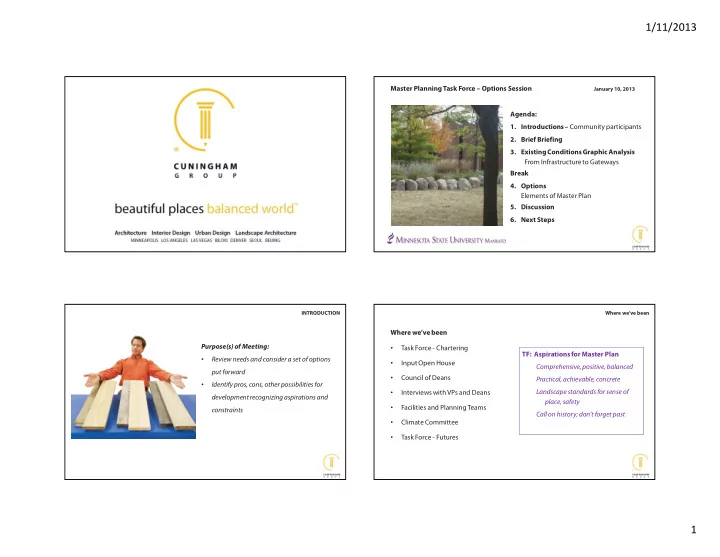
1/11/2013 Master Planning Task Force Options Session January 10, 2013 Agenda: 1. Introductions Community participants 2. Brief Briefing 3. Existing Conditions Graphic Analysis From Infrastructure to Gateways Break 4. Options


slide-1
SLIDE 1

1/11/2013 1

Agenda:

  • 1. Introductions – Community participants
  • 2. Brief Briefing
  • 3. Existing Conditions Graphic Analysis

From Infrastructure to Gateways Break

  • 4. Options

Elements of Master Plan

  • 5. Discussion
  • 6. Next Steps

Master Planning Task Force – Options Session

January 10, 2013

Purpose(s) of Meeting:

  • Review needs and consider a set of options

put forward

  • Identify pros, cons, other possibilities for

development recognizing aspirations and constraints

INTRODUCTION

Where we’ve been

  • Task Force - Chartering
  • Input Open House
  • Council of Deans
  • Interviews with VPs and Deans
  • Facilities and Planning Teams
  • Climate Committee
  • Task Force - Futures

Where we’ve been

TF: Aspirations for Master Plan Comprehensive, positive, balanced Practical, achievable, concrete Landscape standards for sense of place, safety Call on history; don’t forget past

slide-2
SLIDE 2

1/11/2013 2

Themes – from Input Sessions

  • Convenient Transportation /

Parking/Biking

  • Inviting: ease of access/winter

environment

  • Connections supported by

technology – to community, partners, other campuses, world

  • Telepresence for distance learning,

more off-campus opportunities

Where we’ve been

  • High utilization – need operational

and physical solutions for space

  • Support Grad students and teaching

assistants with work space

  • Spaces on campus to promote

connections and build community for on-line learners

  • Sustainable practices; energy

efficiency; lighting/daylighting

Institutional Profile – Brief Analysis – Existing Conditions Analysis - Infrastructure Needs

slide-3
SLIDE 3

1/11/2013 3

2013 HEAPR List (Millions) Proposed Scope Wiecking Center: $6.5 Roofs, Sprinklers, Windows Taylor Center: $5.8 Roofs, Wall panels Armstrong: $4.6 Roofs, Basement HVAC, VAVs, ADA Toilets Memorial Library: $3.2 Reroofing, Carpet, Sprinklers Morris Addition: $2.1 HVAC Upgradeay Nelson Hall $1.8 Envelope, Roof Highland Center, A $2.9 Roofs Utility Plant $1.1 Burner Upgrades Wissink Hall $1.1 Reroofing

Analysis - Infrastructure Needs

Renewal/repair needs for next 5 years add to future requests

Campus-wide Needs:

  • Flexible furniture, technology,

and connections in learning space

  • Interaction and collaboration

space for faculty, grad assistants, students

  • Labs - Applied Lrng / Rsrch
  • Larger Intercultural Center
  • GSI, Residence Life,

Clinical Sciences

Analysis – Program Needs Analysis – Scheduled Instructional Space

Classrooms + Class/Labs Armstrong: 49 / 9 Trafton complex: 14 / 22 Wissink: 7 / 7 Morris: 10 / 2 Performing Arts: 6 / 3 Wiecking: 5 / 3 Utilization typically high

Analysis – Casual Interaction Space

None observed in Armstrong, Morris, Nelson

slide-4
SLIDE 4

1/11/2013 4

Analysis – Circulation

Pedestrian core: priority to pedestrians Transition zone: priority to non- motorized and transit; limited veh. Vehicle access zone: vehicles permitted, but priority to routes for non-motorized connections

Observations/Issues

  • Major roadways circling campus

core are barrier and safety issue for pedestrians: Stadium Road, Warren, Maywood

  • Bike and pedestrian routes lack

amenities, need separation from roads

  • Pedestrian routes/destinations could

use improved wayfinding

  • No dedicated bike paths, no N-S bike

routes

  • Secure bike storage needed

Analysis – Circulation

  • Shuttles are popular; students and

commuters want more service

  • Limited amenities for parking to

shuttle at major lots

  • Opportunities to enhance

bus/shuttle experience through real- time arrival displays, etc.

Analysis – Gateways, Edges, Quads

slide-5
SLIDE 5

1/11/2013 5

Opportunities Opportunities – Additional Space

i parking deck j future building k transit support

a b c d i e f j g h k

New space to:

  • relieve pressure,
  • allow for learning-mode

improvements

  • Allow for remodeling

Not all simultaneous:

  • 3, 5, 7; major new buildings15-20+

years out Major challenge is cost: cannot take on large new projects Greek ‘Lodge’/Gathering – more thought

Opportunities – Additional Space

Global Solutions / Business School

Image by Perkins & Will

Also in the works: Clinical Sciences, New Dining Hall

Opportunities – Renewal/Remodeling

Furniture, technology can have high impact

slide-6
SLIDE 6

1/11/2013 6

Opportunities – Renewal - Armstrong Opportunities – Interaction Space

New and remodeled buildings should be designed to include interaction and collaboration space

Opportunities - Edges Opportunities - Edges

slide-7
SLIDE 7

1/11/2013 7

Opportunities - Edges Opportunities - Gateways Opportunities - Gateways Opportunities – Safety

slide-8
SLIDE 8

1/11/2013 8

Opportunities – Safety Opportunities - Bicycles Opportunities – Bicycles Opportunities – Mobility and Circulation Concept

Pedestrian Route Bicycle route (7. is N-S route) ‘Complete Street’ treatments Limited Access campus loop Transportation Hub (10.) features could include heated shelter, restrooms, furniture, real-time displays…

slide-9
SLIDE 9

1/11/2013 9

Facilities Master Planning - Next Steps:

  • January - Options development and

rough costing

  • Feb. 1+/- 50% Master Plan submittal
  • Feb. 7 - Options Open House(s)
  • Feb. 7 - Task Force – Implementation
  • Discuss potential sequence, costs,

priorities

  • March 21 – Task Force - Draft Master

Plan

Next Steps